Is Threads Worth It? Performance Marketing Guide 2026
Jump to a section
- Beyond the Hype The Question Performance Marketers Should Ask
- Threads in 2026 Platform Reality and Audience Fit
- Evaluating the Paid Advertising and Monetization Engine
- A Framework for High-Velocity Creative Testing
- Your Performance KPI Checklist for Threads
- The Final Decision Rubric Weighing the Opportunity Cost
- Conclusion The Verdict for Your Growth Team
Most advice about Threads is built for social teams that can afford loose experimentation. Media teams usually cannot. Every new channel competes with budget, creative bandwidth, analyst time, and the cost of delaying tests that already have a clearer path to revenue.
That is the core question: Is Threads worth it? A useful answer starts with opportunity cost. If a team adds Threads, what work gets deprioritized, how will success be measured, and what proof would justify keeping it in the mix after the trial period?
Threads has enough momentum to earn a serious review. Scale alone still does not make it a good buy. Performance marketers need a stricter standard than audience curiosity or executive pressure to show up early on every Meta product.
For teams already buying across Meta, the better lens is channel fit inside a broader Meta media buying strategy. Can Threads create incremental reach, support faster creative testing, or surface signals that improve spend allocation elsewhere? If the answer is no, the platform may still be interesting, but it does not deserve a standing role in the plan.
That standard cuts through hype fast.
Beyond the Hype The Question Performance Marketers Should Ask
Threads does not need another top-of-funnel debate. Performance teams need a budget decision.
The useful question is not whether the platform feels relevant or whether leadership wants a presence. The useful question is whether Threads can earn a place in the media plan by producing incremental reach, usable creative learnings, or conversion support that justifies the time spent testing it.
That standard is stricter than the one social teams often use, and it should be. A channel can have obvious momentum and still be a poor use of acquisition resources. Early scale matters. It does not remove the burden of proof.
For growth teams, "worth it" usually comes down to four operating questions:
- Does Threads create reach you are not already buying through other Meta surfaces?
- Can your team build text-led, conversational creative without slowing down higher-priority campaigns?
- Can you measure signal clearly enough to separate curiosity traffic from traffic that assists pipeline or revenue?
- Does the test teach you something you can use across a broader Meta paid social strategy, even if Threads itself stays small?
Those questions force a better decision. They turn Threads from a trend story into a testable media input.
I have seen new placements fail for two opposite reasons. Some teams reject them too early because attribution is noisy at launch. Others approve them on platform momentum alone and then discover the hidden cost sits in copy production, creative review, analyst time, and reporting cleanup. Both mistakes hurt efficiency.
A practical rule helps here. Large audience interest is a screening factor, not an approval factor.
So the first pass is simple. If Threads cannot plausibly add incrementality, shorten creative feedback loops, or generate insights you can apply elsewhere in Meta, it does not need a permanent role. It may still deserve a controlled test. That is a different decision, and a much better one for performance marketers.
Threads in 2026 Platform Reality and Audience Fit
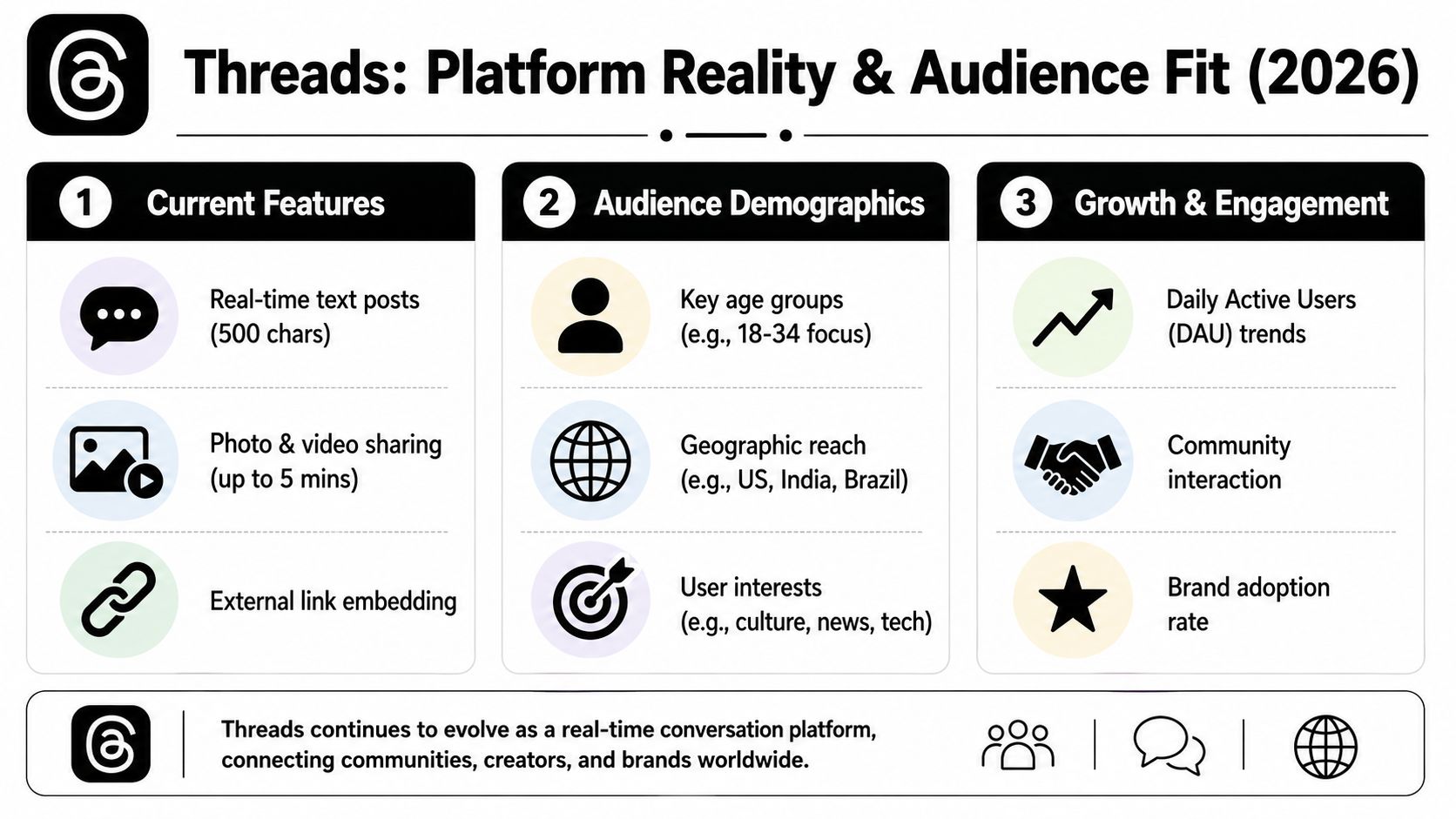
Threads is easiest to misunderstand if you treat it like a smaller Instagram feed. It isn't. The product behaves more like a conversational layer attached to Meta's ecosystem, with text doing more of the work and visuals supporting the message rather than carrying it alone.
That matters because creative that wins on image-led platforms often feels overproduced or misplaced in a feed built around quick reactions, short commentary, links, and public back-and-forth. Teams that publish polished brand posts without adapting tone usually look like they imported the wrong asset into the wrong room.
Why Threads scaled so fast
Threads had an advantage most startups never get. It launched on 5 July 2023 in more than 100 countries, reportedly reached 10 million users within seven hours, and had around 30 million users by the end of its first day. A major reason was its access to Instagram's roughly 2 billion active users, which gave Meta an enormous built-in distribution funnel, according to Investing.com's Threads facts and statistics summary.
That launch advantage still shapes how marketers should think about audience fit. Threads didn't have to build awareness from zero. It could pull from an existing habit base, existing identity graph, and existing creator-follow relationships.
For marketers, that means two things:
- Audience overlap is real. If you already perform well on Instagram, Threads is more likely to be adjacent to an audience you understand.
- Behavior overlap is not guaranteed. Users may enter through Instagram, but they don't necessarily behave the same way once they're inside Threads.
What fit actually looks like
You won't get a clean demographic shortcut from the available evidence in this brief. The safer way to assess fit is behavioral.
Threads tends to reward brands that can do at least one of these well:
| Brand capability | Why it matters on Threads |
|---|---|
| Strong point of view | Text-first environments expose weak positioning fast |
| Fast reaction cycles | Conversation decays quickly if approvals drag |
| Clear voice | Generic social copy gets ignored |
| Useful links or ideas | Threads gives you room to bridge discussion and action |
A quick diagnostic helps. Review your current Instagram comments, creator briefs, community replies, landing page hooks, and top-performing ad copy. Then ask whether the same brand can sound natural in a looser public conversation.
If your team only knows how to publish finished campaigns, Threads will feel awkward. If your team can publish thinking in public, it's a better fit.
This is also where competitive research helps. Looking through the Instagram Ads Library workflow won't show Threads behavior directly, but it will show whether your category already relies on messaging angles that can be reworked into shorter, more conversational formats.
Evaluating the Paid Advertising and Monetization Engine
For a performance marketer, the organic question is secondary. The paid question is harder and more useful: can Threads function as a media placement, not just a profile you maintain?
The answer is increasingly yes, but with caveats that matter.

As of 2025, Meta has been rolling out Threads placements inside Ads Manager, and many advertisers must pair Threads inventory with Instagram feed ads rather than buying it as a fully separate placement, according to Darkroom's analysis of Threads for brands in 2025. That sounds like a small implementation detail. It isn't.
What that setup means in practice
Bundled placement changes how you interpret results.
If Threads inventory is paired with Instagram feed, you can't assume a strong campaign result came from Threads itself. It may have benefited from the wider delivery system, stronger adjacent inventory, or creative that happened to fit Instagram better. On the other hand, weak results don't prove Threads is poor inventory either. They may reflect creative built for visual feed behavior, not text-led engagement.
That leaves performance teams with a familiar problem. Placement inclusion is easy. Placement learning is harder.
Here's the practical read:
- Targeting benefits from Meta's broader system. You're not starting from a cold ad stack.
- Isolation is imperfect. Placement-level clarity may lag behind what buyers want.
- Creative adaptation matters more than usual. Threads isn't just another box to check inside the same export package.
How to approach Threads ads without fooling yourself
Treat Threads as a test environment inside Meta, not as a fully mature standalone buying surface. That changes your campaign design.
A disciplined approach looks like this:
Use controlled creative sets
Keep message families tight. Don't compare one Threads-ready copy-led ad against a polished video built for Reels and call it a placement test.Hold offer and audience steady
If audience, objective, and offer all change at once, you won't learn anything useful about Threads.Track downstream quality, not just delivery
Cheap reach can hide weak session quality. Watch for on-site behavior, assisted actions, and whether leads or purchases look comparable to your baseline Meta traffic.Review publishing logistics early
If your team needs operational clarity on asset setup and workflow, the Meta publishing documentation is the kind of reference worth checking before you scale tests.
The medium is still evolving, but that doesn't make it irrelevant. It makes it sensitive to setup.
A short explainer on ad workflow helps frame where it fits in Meta's stack:
Threads is most useful when you treat it as an additional surface for message testing, not as a miracle new acquisition channel.
If you expect mature direct-response efficiency on day one, you'll likely overread noise. If you use it to extend testing, learn faster, and find message angles that travel across placements, it becomes much more interesting.
A Framework for High-Velocity Creative Testing
Threads punishes recycled social content faster than many teams expect. Not because the platform is hostile to ads or brands, but because weak adaptation shows immediately. The feed is conversational. Users read. They react to phrasing, posture, timing, and relevance. A mediocre hook can sink an otherwise solid offer.
That's why the right creative model for Threads is modular testing, not occasional posting.
Build creative in parts, not finished masterpieces
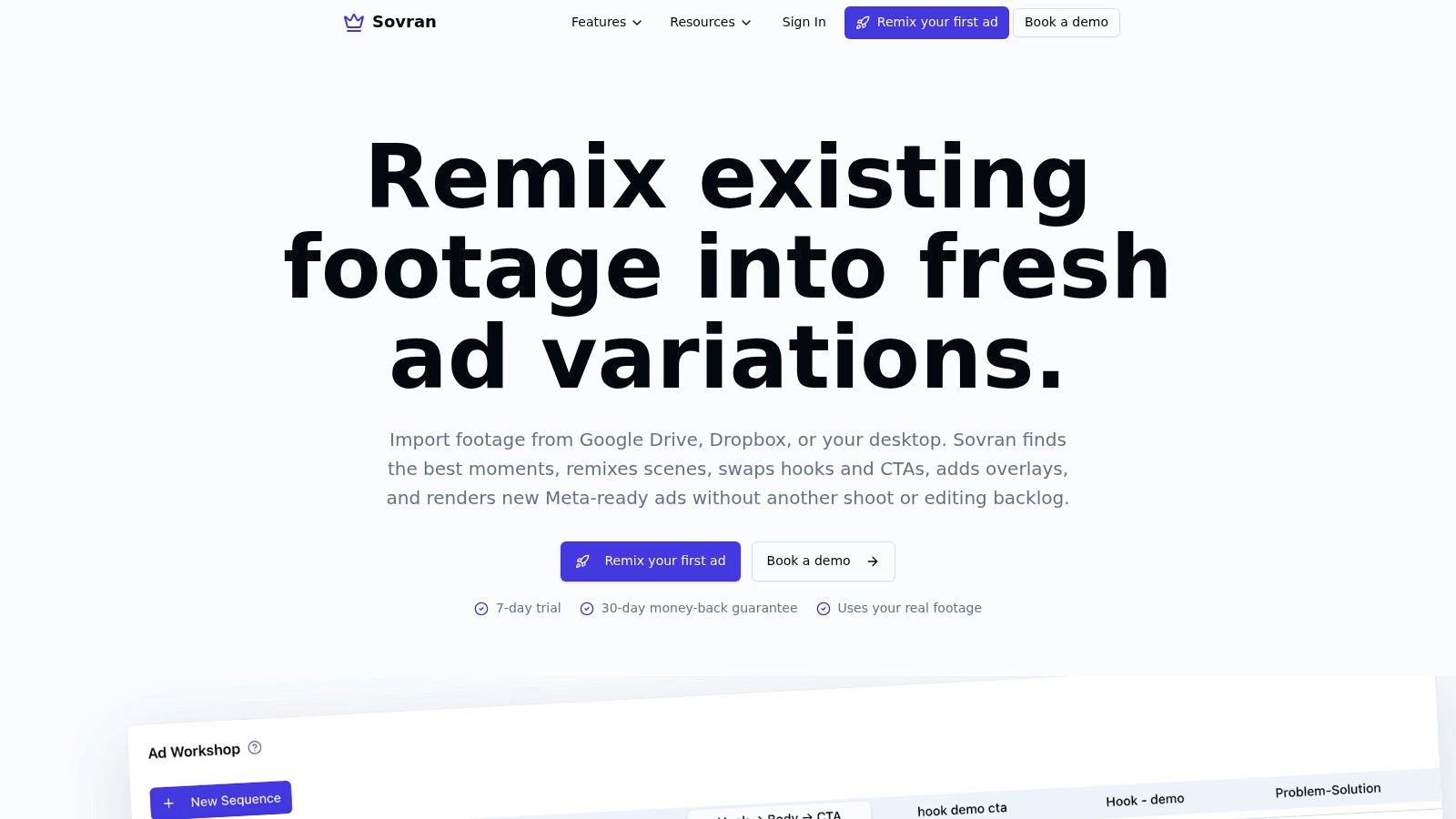
The most reliable way to test Threads is to separate the ad into components you can swap quickly:
Hook
The opening line or visual frame. On Threads, this often carries more weight than on image-heavy placements because the audience is primed to read first.Body
The explanation, proof point, tension, or product framing. Keep this sharper than you would on a broad awareness asset.CTA
The ask. Click, learn more, compare, browse, sign up. A soft CTA may fit some brand campaigns, but a test still needs a measurable next step.
This isn't theoretical. It changes production speed. If you build one monolithic ad and it misses, you restart. If you build a system of interchangeable hooks, bodies, and CTAs, you can learn from each component without rebuilding everything.
What tends to work and what tends to fail
A few patterns show up repeatedly when teams adapt well to conversational placements.
| Usually works | Usually fails |
|---|---|
| Strong opinions stated clearly | Corporate copy with no tension |
| Text overlays that sharpen the message | Decorative captions that add nothing |
| Ads that feel like native commentary with intent | Generic awareness creative pasted from another channel |
| Variants built around one hypothesis each | Assets changed in too many ways at once |
If your team needs better visual fundamentals for paid social assets, this guide on how to improve marketplace ad creative is useful because it forces attention onto legibility, hierarchy, and message framing rather than just aesthetic polish.
Creative note: Threads creative should feel authored, not exported.
A simple testing cadence for performance teams
A practical testing loop looks like this:
- Start with one offer and several hooks.
- Keep the body copy tightly related, not entirely different.
- Rotate CTA language only after the hook starts showing traction.
- Kill weak variants quickly.
- Promote the message pattern, not just the individual ad.
That last point matters most. If “comparison” framing outperforms “feature list” framing, that insight can travel into Instagram feed, Facebook feed, landing page headlines, email subject lines, and even sales scripts.
For a deeper operating model, this creative testing framework for Meta ads is a useful reference point because it matches how serious teams structure hypothesis-driven iteration instead of random content churn.
Threads is worth more when you use it as a fast message lab. It's worth less when you treat it like another place to dump assets.
Your Performance KPI Checklist for Threads
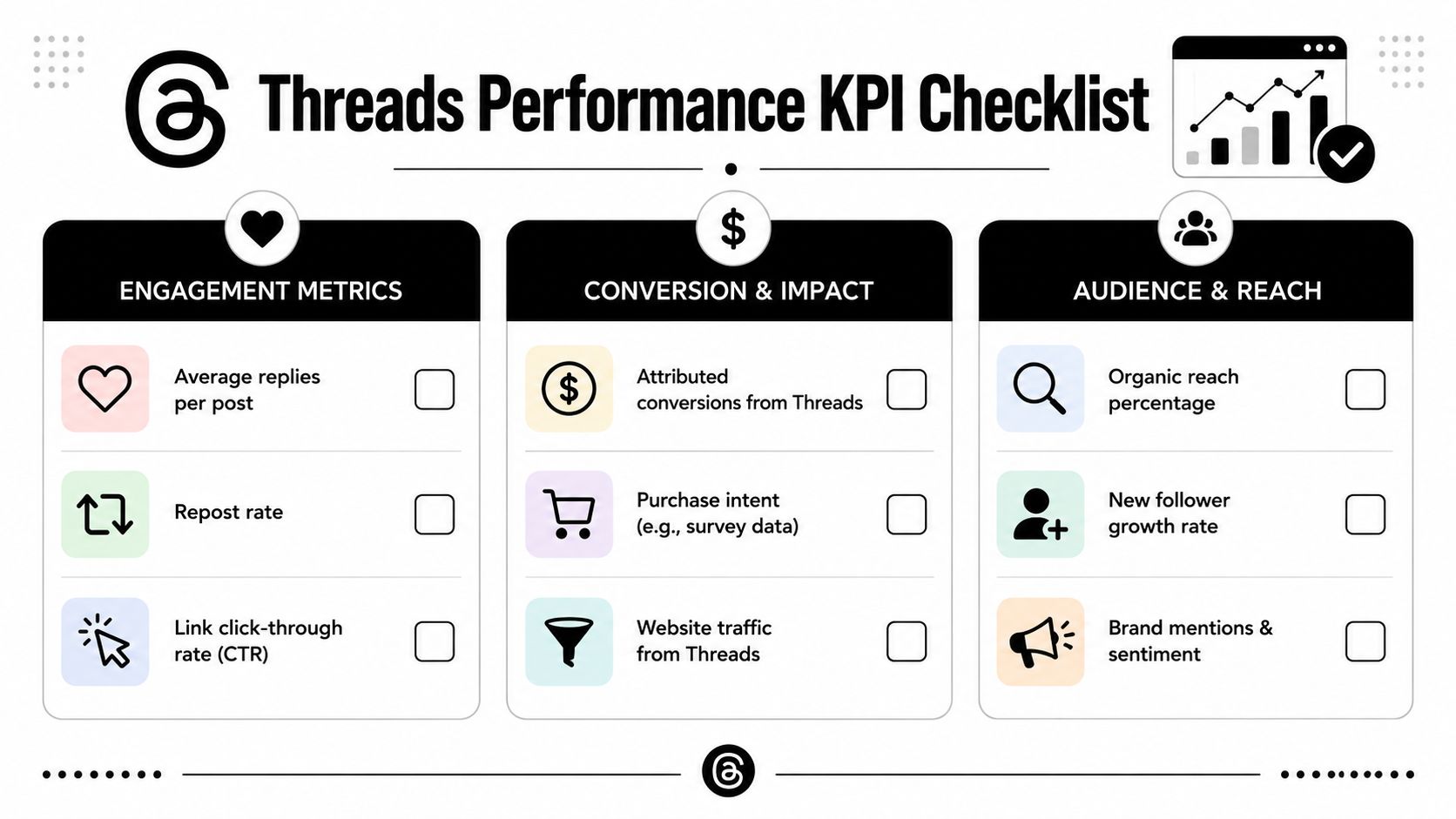
Vanity metrics make Threads look clearer than it is. Replies, likes, and follower growth can tell you whether content is landing socially, but they don't answer whether the channel deserves budget and team time.
A better KPI set starts with funnel stage and reporting discipline.
Top-of-funnel signals
These metrics tell you whether your message fits the environment.
Engagement rate per impression
Useful for checking whether the creative prompts reaction relative to delivery, not just in raw totals.Reply quality
Don't just count replies. Read them. Useful curiosity, objections, and product questions often matter more than volume.Profile visit rate
A strong signal that your ad or post created enough interest for the user to seek context.
Mid-funnel checks
At this point, social interest starts turning into measurable intent.
Outbound click-through rate
Not because CTR is everything, but because it tells you whether your CTA and landing promise align.Landing page engagement quality
Watch whether visitors from Threads behave like qualified traffic or like accidental clicks.Assisted touchpoints
Threads may influence a later conversion even when it doesn't close the session itself.
Good Threads traffic should look curious and coherent, not noisy.
Bottom-funnel accountability
This is the layer that decides whether the channel scales.
| KPI | What it tells you |
|---|---|
| Cost per acquisition | Whether Threads can compete with or support existing Meta efficiency |
| Return on ad spend | Whether the placement contributes enough revenue value to justify spend |
| Lead quality or purchase quality | Whether downstream outcomes match your normal standards |
| Incremental conversion contribution | Whether Threads adds something new instead of cannibalizing existing demand |
Use a consistent reporting window. Keep attribution logic stable during the test. If you change the way you read conversions midstream, you'll manufacture false confidence.
For budgeting conversations, a simple ROAS calculator helps teams align on break-even logic before they debate creative winners and losers.
What not to overvalue
A few metrics tend to mislead teams on Threads:
- Raw impressions because cheap delivery can hide weak commercial value
- Follower growth because followers don't automatically become customers
- Likes without clicks or quality replies because passive approval often has little buying intent
The right checklist is not universal. A B2B SaaS team, a DTC brand, and a mobile app advertiser will all rank these metrics differently. But every team needs one rule: Threads doesn't earn expansion because it looks active. It earns expansion because it produces useful business movement.
The Final Decision Rubric Weighing the Opportunity Cost
Most “is Threads worth it” content ignores the uncomfortable part. Every new channel steals time from somewhere else.
That trade-off is the actual decision. Not whether Threads can work in theory, but whether it deserves creative resources, media attention, and reporting bandwidth compared with the channels already producing results. As one creator-focused discussion put it, the unanswered issue for many marketers is whether Threads earns a place in an already crowded content mix, rather than becoming “yet another platform” to maintain, as discussed in this video on whether Threads is worth it.
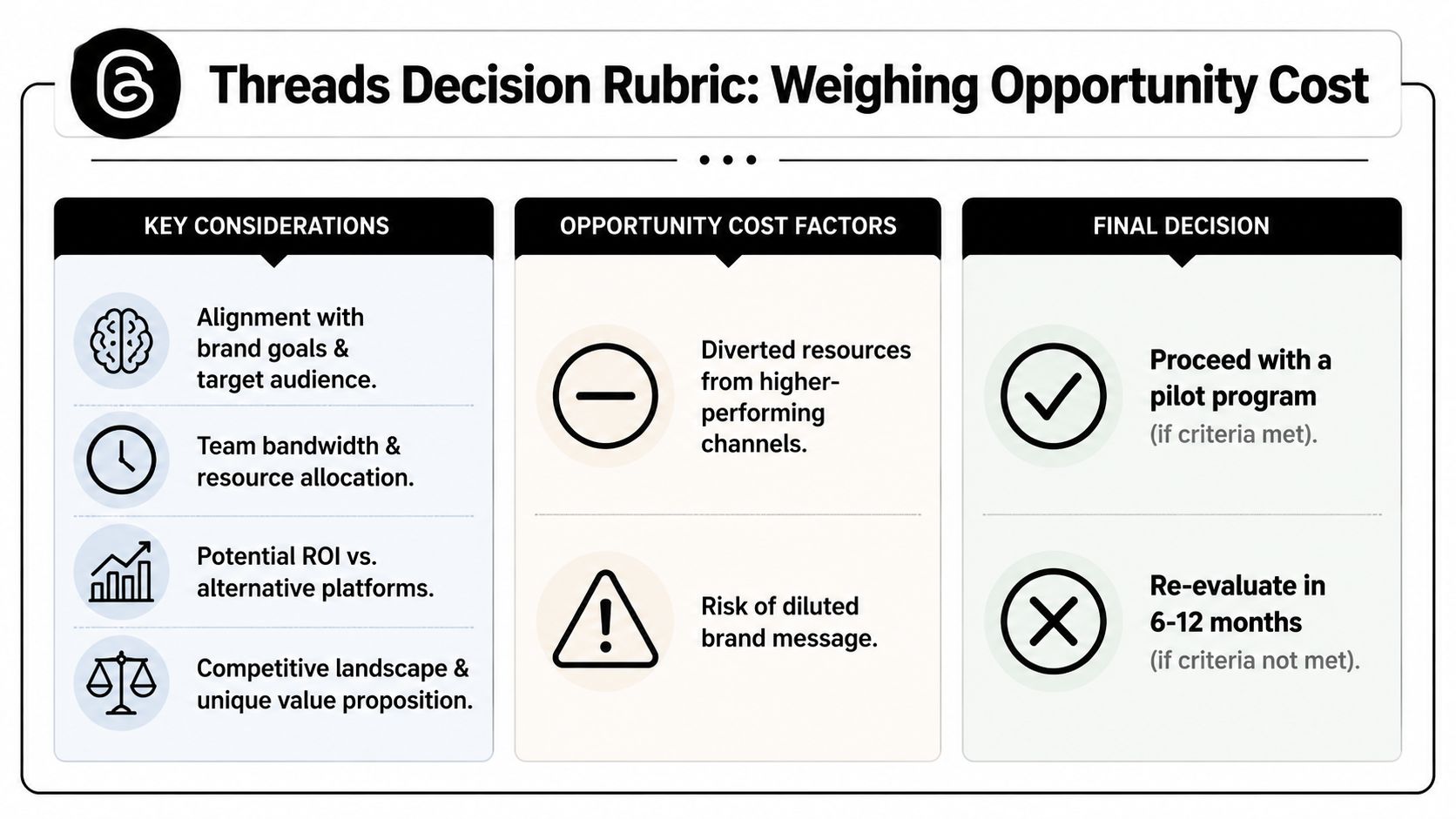
Score the channel before you commit
Use a simple internal rubric. You don't need fake precision. You do need a repeatable way to say yes, no, or not now.
| Criterion | Low score | High score |
|---|---|---|
| Audience fit | Your buyers rarely engage in text-led social environments | Your buyers already respond well to discussion-led content |
| Resource capacity | Team is already stretched and approvals are slow | Team can publish and iterate quickly |
| Paid media relevance | You need strict placement isolation immediately | You can run controlled tests inside Meta and learn over time |
| Creative adaptability | Existing assets don't translate well into text-forward ads | You already have strong hooks, copy, and modular creative |
| Measurement readiness | Reporting is fragmented | Team can track assisted and direct outcomes clearly |
Ask the questions that usually get skipped
A lot of poor channel decisions happen because teams don't ask operational questions early enough.
Consider these before you greenlight anything:
- What gets deprioritized if Threads becomes a recurring workstream?
- Who owns copy, publishing, moderation, and reporting?
- Can your legal or brand review process move at the pace the platform expects?
- Will you learn something transferable, even if Threads itself stays small in your mix?
Those answers matter more than broad statements about platform momentum.
If Threads requires net-new effort across strategy, copy, creative, and reporting, it has to earn that burden.
Three common outcomes
Teams generally land in one of three buckets.
Run a pilot now
Best for brands with strong Instagram adjacency, flexible copy talent, and a clear testing culture.Keep an organic foothold, delay paid emphasis
Best for teams that want signal gathering without committing spend or production complexity yet.Revisit later
Best for teams whose current bottleneck is not channel inventory but creative capacity or measurement discipline.
This rubric also prevents a common mistake: assuming a platform with obvious consumer scale must be an immediate fit for your growth model. Sometimes the right call is to wait until your team can test properly. Sometimes the right call is to run a contained pilot because the learning value alone is worth it.
Threads isn't automatically worth it. But avoiding it without scoring the opportunity cost is just as lazy as jumping in because everyone else is experimenting.
Conclusion The Verdict for Your Growth Team
The honest answer to Is Threads worth it is conditional. It can be worth it for growth teams that have audience overlap, enough creative flexibility to adapt to a conversational format, and the reporting discipline to separate signal from novelty.
It's usually not worth it if you're adding it out of fear, if your team is already overextended, or if you expect a clean standalone performance channel from the start. Threads looks more useful as a measured test inside a Meta program than as an automatic budget expansion.
The right move is small, controlled, and accountable. Set a hypothesis. Decide what success means before launch. Keep the creative variables clean. Measure both direct response and assist value. Then make a decision based on your own economics, not platform discourse.
That's the only serious way to answer the question.
If your team wants to run that kind of disciplined experiment, Sovran helps performance marketers generate and launch high volumes of modular video ad variations for Meta faster, so you can test hooks, bodies, and CTAs at the pace emerging placements demand.

Manson Chen
Founder, Sovran
Related Articles

Storyboard Development: Scale Video Ad Production in 2026

8 Pattern Interrupt Techniques for Video Ads