A Performance Marketer's Guide to the Instagram Ads Library
Unlock competitor strategies with our deep dive into the Instagram Ads Library. Learn how to find, analyze, and leverage ad creative to scale your campaigns.
Jump to a section
The Meta Ads Library is a completely free, public database of every single ad currently running on Instagram, Facebook, and the rest of Meta's platforms. But don't let its "transparency tool" label fool you. For performance marketers, this thing is a goldmine. It's your direct line of sight into your competitors' ad creatives, messaging, and entire funnel strategy—and it won't cost you a penny.
Why the Instagram Ads Library Is a Game-Changer
Forget thinking of the Ads Library as some PR move by Meta. For those of us in the trenches, it's a fundamental shift in how we do competitive analysis. You get an unfiltered, real-time look into the advertising playbooks of everyone in your space, from the scrappy startup down the street to the massive industry leader.
This isn't just about mindless scrolling. It's about systematic, data-driven research that helps you solve real problems.
With a direct feed into live campaigns, you can start tackling some of your biggest marketing challenges head-on:
Beat Creative Fatigue: Are your ads getting stale? By seeing what fresh concepts your competitors are running, you can pull in a constant stream of inspiration to keep your own creative from burning out.
Speed Up Your Testing: Instead of guessing what might work, you can see which ad formats, hooks, and messaging angles are already resonating in your market. This lets you build campaigns on proven concepts, leading to much faster and more informed testing cycles.
Find What's Actually Profitable: Look at the value propositions and pain points your competition hammers home again and again. If they've been running an ad with a specific angle for months, that’s a massive signal it’s making them money.
This approach flips "ad spying" from a murky tactic into a legitimate, strategic research methodology.
Uncovering Competitor Strategies in Real-Time
The real magic of the Ads Library is its immediacy. You’re not looking at case studies from six months ago—you’re seeing the ads that are live right now.
Launched as part of Meta's transparency push back in 2019, the library has completely changed how performance marketers keep tabs on the competition. By 2026, it's expected to archive over 3.54 billion active ads. That's a staggering amount of data for user acquisition managers and growth marketers to dig through. As detailed by sources like Post-Bridge, this tool gives us an unprecedented view into winning strategies.
The interface is simple, but don't let that fool you. This is the starting point for understanding how your competitors are positioning their products, what offers they're pushing, and which creative formats they’re banking on for Instagram.
Key Insights You Can Extract from the Instagram Ads Library
The table below breaks down the most valuable data points you'll find in the library and what they mean for your own strategy. It's all about connecting the dots between what you see and what you can do.
Data Point | What It Reveals | Actionable Insight for Performance Marketers |
|---|---|---|
Ad Start Date | Campaign longevity and creative fatigue. | Long-running ads (30+ days) are likely profitable. Analyze these "winners" for messaging and creative formats to test in your own account. |
Creative Formats | Where they are allocating creative resources (video, image, carousel). | If top competitors are heavily invested in video, it's a strong signal you should prioritize video production and testing. |
Number of Active Ads | The scale of their testing and campaign diversification. | A high ad count (50+) suggests a robust testing framework. Look for patterns across their ads to see what variables they're testing (hooks, offers, angles). |
Copy & Messaging Angles | Their primary value propositions, pain points, and offers. | Identify recurring themes (e.g., "fast shipping," "save money," "easy to use"). Test these same angles with your own product and brand voice. |
Call-to-Action (CTA) | The specific action they want users to take. | Note the CTAs used (e.g., "Shop Now," "Learn More," "Sign Up"). Test different CTAs to see what drives the highest intent for your audience. |
This isn't just about copying what others are doing. It's about understanding the underlying strategies that are working in your market right now.
Key Takeaway: The library’s value isn't just in seeing individual ads, but in recognizing patterns. Consistent messaging, recurring visual styles, and long-running campaigns are all clues that point to a successful, profitable strategy you can learn from.
Ultimately, mastering this tool is about moving from a reactive marketing mindset to a proactive one. You get to validate campaign ideas before you spend big, spot market trends as they emerge, and turn the library into your secret weapon for consistent campaign wins.
How to Find Winning Ads in the Library
Jumping into the Meta Ads Library can feel like trying to find a needle in a digital haystack. With millions of ads running at any given time, the real skill isn't just knowing how to search—it's about filtering with surgical precision. A generic search will just drown you in noise. A strategic one, on the other hand, can basically hand you your competitor's entire playbook.
You'll start with a simple choice: search by a specific advertiser or by a keyword. While looking up a direct competitor is always a good starting point, I’ve found that the real breakthroughs often come from digging into broader, value-proposition keywords.
For example, if you're doing user acquisition for a mobile game, don't just search for "Raid Shadow Legends." That's too narrow. Instead, try searching for terms like "mobile game," "RPG," or "strategy game." This wider net helps you spot emerging competitors and even brands in adjacent categories who are hitting your target audience with similar creative angles.
Mastering the Art of Filtering
Once you've got your initial search results, the filters are where the magic happens. This is how you separate the signal from the noise and zero in on what's working on Instagram.
Here’s a quick rundown of the filters you absolutely need to get comfortable with:
Advertiser: Perfect for pinpointing a direct competitor or an aspirational brand you want to learn from.
Country: This is non-negotiable for understanding geo-specific strategies. A DTC brand’s top ad in the US might be a total flop in the UK.
Platform: This is critical. Make sure you select Instagram to strip out all the Facebook and other placements. From there, you can get even more granular and look for ads made just for Reels and Stories.
Ad Status: Always, always filter for Active ads. This shows you what's currently live and spending money, not some old, paused campaign from six months ago.
By layering these filters, you can build some incredibly specific queries. Let's say you're a DTC strategist looking for user-generated content (UGC) ads in Europe. You could set your country to Germany, filter for Instagram, and then pop in a keyword like "customer review" to see what comes up.
The image below shows a filtered search for video ads related to "mobile app" in the United States, giving a clear view of the current creative landscape.
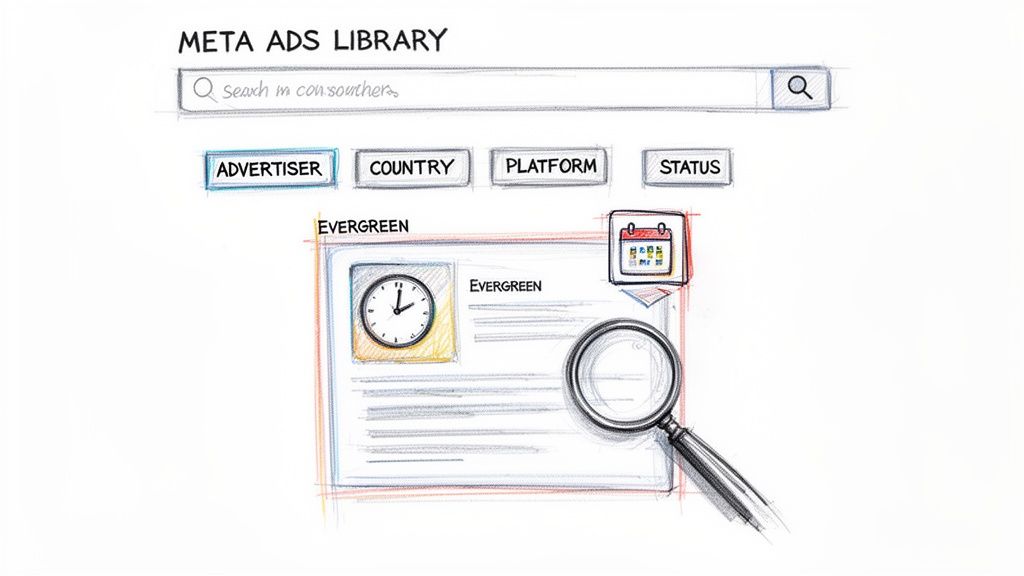
This kind of focused view immediately starts revealing patterns in hooks, pacing, and the calls-to-action that top mobile apps are using to drive installs right now.
The Secret to Identifying Profitable Ads
Okay, so the Ads Library doesn't give you the good stuff like CPA or ROAS. So how can you tell if an ad is actually a winner? The single most reliable indicator is longevity.
An ad that has been running for over three months is almost certainly profitable. No brand, regardless of size, will continue to pour money into a creative that isn’t delivering a positive return on investment.
These long-running campaigns are what we call "evergreen" ads. They represent a winning combination of creative, copy, and offer that has been validated in the market. When you find one of these, it’s a huge signal to stop and analyze every single component. Look for its start date—the older it is, the more likely it's a core piece of their profitable scaling strategy.
Real-World Search Scenarios
Let's make this practical. Here’s how you might apply these ideas in a couple of common situations.
Scenario 1: The Mobile Game UA Manager
Your mission is to find top-performing video ads for a new puzzle game you're launching in the US.
Country: Set to "United States."
Ad Category: Keep it at "All Ads."
Keyword: Start broad with "puzzle game."
Filters:
Platform: Instagram
Media Type: Video
Ad Status: Active
Now, the important part: scroll through the results and pay close attention to the "Started running on..." date. Any ad that’s been active for more than 30-60 days is worth a closer look. You'll quickly start to notice trends in the style of gameplay footage, the text overlays they use, and especially the types of hooks they use in the first three seconds.
Scenario 2: The DTC Creative Strategist
You're looking for inspiration for UGC-style ads for a new skincare product launching in Europe.
Country: Pick a key market like "United Kingdom" or "Germany."
Ad Category: "All Ads."
Advertiser: Search for 3-4 of the top competitors in the skincare world.
Filters:
Platform: Instagram
Ad Status: Active
As you dig through their active ads, keep an eye out for creatives featuring real people, unboxing clips, or testimonial-style videos. Those are your targets. Pay attention to the messaging angles. Are they focused on "glowing skin," "acne reduction," or "anti-aging"? This research gives you an incredible foundation for your own creative briefs, letting you build campaigns on proven concepts from day one.
Deconstructing Ad Creatives for Actionable Insights
Finding a high-performing ad in the Instagram Ads Library is like discovering a treasure map. But the real gold isn't the ad itself—it's understanding the formula that makes it work. To turn that inspiration into a repeatable strategy, you have to break down winning creatives into their core components.
This isn't just about watching ads; it's a systematic process that moves you from simply observing to truly understanding what makes an ad convert.
Every successful ad, especially on a fast-paced platform like Instagram, can be deconstructed into three fundamental parts: the Hook, the Body, and the Call-to-Action (CTA). By analyzing each element separately, you can spot patterns and build a library of proven concepts to fuel your own campaign ideas. This methodical approach ensures you're not just guessing what works; you're reverse-engineering it.
Pinpointing the All-Important Hook
The first three seconds of an Instagram ad determine whether a user keeps scrolling or stops to watch. This initial moment, the Hook, is arguably the most critical component of any video creative. Your analysis has to start here, focusing intently on what the advertiser does to immediately capture attention in a crowded feed.
When you find a promising ad in the library, get granular with your questions about its opening:
What's the first thing you see? Is it a close-up of someone's face showing a strong emotion, a dynamic product shot, or bold, flashing text?
What's the first thing you hear? Does it open with a question, a surprising sound effect, or a snippet of trending audio?
What's the format? Is it a raw, user-generated content (UGC) style clip, a polished studio shot, or a screen recording demonstrating a problem?
For example, a mobile game advertiser might open with a "fail" clip—a player making an obvious mistake—to create instant curiosity. A skincare brand might start with a macro shot of a common skin issue to make the ad immediately relatable. Cataloging these opening tactics is the first step to building your own high-impact hooks.
Analyzing the Body and Narrative Structure
Once the hook has done its job, the Body of the ad takes over. This is where the advertiser tells a story, presents a solution, and builds value. The narrative structure here is just as important as the visuals. Don't just watch the ad; identify the framework it's built on.
You'll find that successful ads often follow proven storytelling formulas. Your job is to spot them.
Problem-Agitate-Solution (PAS): Does the ad introduce a common pain point, amplify the frustration around it, and then present their product as the perfect fix? This is a direct-response classic.
Testimonial Mashup: Is the ad a rapid-fire sequence of different customers sharing positive experiences? This format builds social proof and trust incredibly fast.
Listicle or "Top 3" Format: Does the creative present information in a numbered list, like "3 Reasons Why..." or "5 Ways To..."? This structure promises easily digestible information and keeps viewers engaged.
By identifying these frameworks, you're not just getting ideas for a single ad; you're learning repeatable narrative structures you can adapt to any product or service. This is how you build a scalable creative strategy.
Deconstructing the Call-to-Action
The final piece of the puzzle is the Call-to-Action (CTA). This is where the advertiser explicitly tells the viewer what to do next. A weak or unclear CTA can make an otherwise brilliant ad fall flat. When analyzing competitor ads, pay close attention to how they guide the user toward the desired action.
Look beyond just the button text ("Shop Now" or "Learn More"). Analyze the entire closing sequence.
Is it a direct command? "Tap the link to get your free trial."
Is it a benefit-driven statement? "Start sleeping better tonight."
Does it ask a question? "Ready to transform your workflow?"
Notice how the final visual and audio elements support the CTA. A fashion brand might end on a visually stunning shot of their product with an overlay pointing to the "Shop Now" button. A SaaS company might end with a simple screen showing their logo and a compelling offer.
This final instruction is your last chance to drive a conversion, and seeing how top brands execute it provides invaluable lessons. This is especially true for video, which dominates user engagement. If you are looking for more real-world examples, you might be interested in our guide on successful video advertising campaigns.
The shift to vertical video formats has made this analysis even more crucial. Globally, Stories ads alone generated $15.95 billion in 2022, and with Reels now reaching over 700 million new users monthly, prioritizing these placements is essential. Video content consistently captures over half of all user interactions, meaning your ability to deconstruct and replicate winning video formulas is directly tied to your campaign performance.
Turning Your Research Into Winning Campaigns
Sifting through the Instagram Ads Library is more than just window shopping for cool ads. The real payoff comes when you turn that raw intel into a repeatable system for creating your next winning campaign. This is where observation becomes action—transforming your research into a high-velocity testing engine.
This whole process starts with a simple mindset shift: treat every insight not as a finished idea, but as a testable hypothesis. You've spotted the hooks, narratives, and CTAs that are killing it for the top brands in your niche. Now, let's build a workflow that injects those findings straight into your creative production. The goal here is to stop guessing and start building a data-informed system that finds winners, fast.
Start with a Creative Hypothesis Brief
Before you even think about opening a video editor or writing a single line of copy, boil down your research into a Creative Hypothesis Brief. This isn't some formal, ten-page document. Think of it as a one-pager that acts as the strategic North Star for your entire production sprint.
Your brief needs to state your core testing idea clearly. For example, after looking at competitor ads, your hypothesis might be: "For our audience, UGC-style hooks showing a product 'before and after' in the first 3 seconds, paired with a testimonial-driven body, will beat our current studio-shot ads."
Make sure your brief includes:
The Core Hypothesis: One clear sentence on what you think will work and why.
Key Hooks to Test: List 3-5 specific hook concepts you found (e.g., unboxing, a problem-focused shot, a reaction clip).
Narrative Angles: Outline the story structures you want to model (e.g., Problem-Agitate-Solution, feature list, customer journey).
CTA Variations: Jot down the calls-to-action that seemed most effective (e.g., a direct command vs. a benefit-focused question).
This simple brief gets everyone—from copywriters to editors—on the same page about the "why" behind the creative.
Pro Tip: Your hypothesis brief isn't set in stone. It’s a living document. Once performance data from your tests rolls in, circle back and update it. You want to create a feedback loop where library research informs your tests, and your test results sharpen your next round of research.
Assemble and Create Your Raw Assets
With your brief ready, it's time to gather your raw materials. The key here is to source assets that actually match your hypothesis. If your research pointed to raw, unpolished UGC as the winner, spending a ton on a slick studio shoot is a waste of time and money.
Instead, you could:
Mine Existing UGC: Dig through customer reviews, tagged posts, and testimonials for authentic gold.
Shoot New, Lo-Fi Content: Grab a smartphone and create assets that feel native to Instagram. Authenticity beats polish.
Generate AI B-Roll: For more abstract ideas, use AI tools to create supporting clips that fit your style without a full production lift.
This isn't just about collecting files; it's about strategically sourcing the right building blocks. You're thinking about ads in their core components—hook, body, and CTA—so you can mix and match them later.
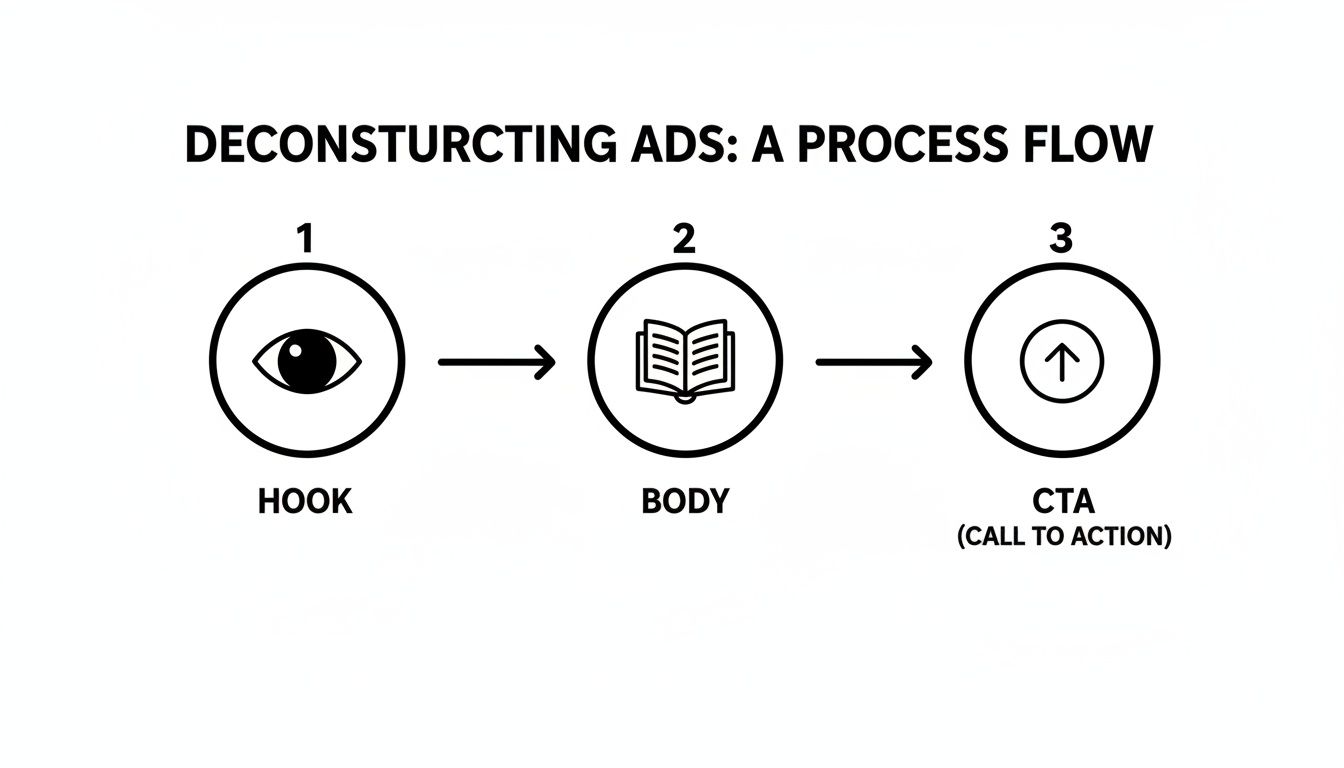
This diagram shows exactly how to think about it. Every ad is just a modular combo of these three parts, which is the secret to testing efficiently.
Build and Scale Your Ad Variations
Now for the fun part: assembling your ad concepts and spinning them out into dozens of testable variants. Using a platform like Sovran, this goes from a soul-crushing manual task to a quick, automated process. You're not just building one ad; you're building an entire testing matrix.
First, build a few "base" ads that follow the narrative structures from your brief (e.g., one Problem-Agitate-Solution ad, one testimonial mashup). These are your control concepts. Then, the real magic happens.
This is where you start mixing and matching your assets at scale. Take your top 3-5 hooks and combine each one with your different body structures. Then, layer on various CTA options. This modular approach lets you quickly generate 20, 30, or even 50+ unique ad creatives from a handful of core assets. This is how you can use research to create powerful AI-powered carousel ads and other formats that drive real results. For a deeper dive into video specifics, our guide to Instagram video advertising is a great next step.
Here’s a simple table illustrating how this workflow looks from start to finish.
From Library Insight to Live Ad
Phase | Action in Ads Library | Action in Production | Outcome |
|---|---|---|---|
1. Research | Identify top-performing hooks & narratives from 3-5 competitors. | - | A list of testable ad concepts and angles. |
2. Hypothesis | Analyze common CTAs and messaging patterns. | Draft a Creative Hypothesis Brief outlining the core test. | A clear strategic guide for the creative team. |
3. Asset Creation | Note visual styles (UGC vs. studio, etc.). | Source or create assets that match the winning style. | A library of hooks, body clips, and CTA assets. |
4. Assembly & Scaling | - | Use a platform like Sovran to build base ads and generate dozens of variations by mixing hooks, bodies, and CTAs. | A full ad set with 20-50+ unique creatives ready for testing. |
This process transforms your Ads Library research from a passive "inspiration" habit into a powerful, scalable system for high-velocity creative testing. You’re no longer just guessing what might work—you're systematically deconstructing what is working and rebuilding it to find your next breakthrough campaign.
Advanced Strategies and Ethical Ad Spying
The Meta Ads Library is a fantastic starting point for research, but its real power comes when you learn to read between the lines. It's crucial to know what it doesn't tell you to pull out truly valuable insights. You won't see direct performance metrics like cost per acquisition (CPA) or return on ad spend (ROAS), which can definitely feel like you're flying blind.
Still, you can piece together the success story from other clues. As we've covered, an ad's lifespan is a huge signal. Another advanced move is to watch for tiny, iterative changes. When you see a competitor drop several almost identical ads at once—maybe with a slightly different headline or a new first three seconds—you've just caught an A/B test live in the wild. This gives you a front-row seat to the exact variables they think are worth their time and money to test.
Reading Between the Lines
To get the most out of the library, you have to put on your detective hat. Look for subtle strategic shifts over time. Is a competitor suddenly ditching their polished studio creative for raw, user-generated content? That's a massive hint that their audience is responding better to authenticity.
Also, pay close attention to how top advertisers tweak their creative for different placements. You'll notice an ad built for Instagram Reels is often much faster-paced with bold text overlays, while the same campaign running in the Feed might be more cinematic. These observations are a masterclass in platform-specific creative, helping you shape your own assets way more effectively. For a deeper dive on structuring these experiments, check out our guide on building an effective ad creative experimentation tool workflow.
The Ethical Line Between Inspiration and Plagiarism
This is probably the most important part of using the Meta Ads Library. Your goal is inspiration, not imitation. Ripping off a competitor's script, visuals, or exact ad copy is not just bad form; it's a terrible strategy. It waters down your own brand voice and usually falls flat because you don't have their specific audience, offer, or brand equity.
The smart, ethical approach is to deconstruct the why behind a successful ad, not just the what.
Model the Framework: See a Problem-Agitate-Solution ad crushing it? Great. Adopt that narrative structure but use your own product's unique story and your audience's specific pain points.
Borrow the Angle: If competitors are winning with a "save time" messaging angle, brainstorm all the unique ways your product delivers that same benefit.
Analyze the Concept: Is a certain visual hook, like an unboxing video, trending in your niche? Figure out how you can create an authentic unboxing experience that feels true to your brand.
The objective is to use competitive insights for strategic direction. This way, you maintain your brand’s integrity while making smarter, data-informed creative decisions.
Beyond the Ads Library, pairing your findings with dedicated best Instagram competitor analysis tools can give you an even richer understanding of what your rivals are up to. This combo paints a much more complete picture of the market and can expose opportunities you might have missed. This approach transforms "ad spying" from a simple tactic into a cornerstone of a solid growth strategy.
Lingering Questions About the Instagram Ads Library
Even after you get the hang of navigating the Ads Library, a few common questions always seem to pop up. Performance marketers are a curious bunch, after all.
Getting these details straight is what separates casual browsing from a systematic competitive research workflow. Let's clear up some of the most frequent sticking points.
Can I See Performance Metrics Like Clicks or Conversions?
This is easily the #1 question, and the answer is a hard no.
The Ads Library is a transparency tool first and foremost, not a performance dashboard. Meta built it to show the public what ads are running, not how well they’re converting. You won’t find any juicy metrics like click-through rate (CTR), cost per acquisition (CPA), or return on ad spend (ROAS).
But that doesn't mean you're flying blind. You just have to learn to read the tea leaves.
Longevity is the biggest clue: If a brand has been pumping money into the same creative for weeks, or even months, it’s almost certainly profitable. Smart advertisers don't keep funding a loser.
Look for variations on a theme: See a brand running five slightly different versions of the same ad? That’s a massive tell. It means they’ve found a winning concept and are now just optimizing it for even better performance. That’s a goldmine for you.
How Often Should I Check the Ads Library for My Competitors?
There’s no magic number here—it all comes down to the rhythm of your industry. You need to match your research cadence to the market's pulse.
For fast-paced, cutthroat niches like DTC, e-commerce, or mobile apps, you’ll want to be in there 2-3 times per week. New campaigns and creative trends can pop up overnight. For industries with longer sales cycles or less frequent creative refreshes, a deep dive once a week or even every other week might be enough.
The key is consistency. Make it a non-negotiable part of your weekly routine.
What's the Difference Between Inspiration and Plagiarism?
This is a critical line to walk, and getting it wrong can torch your brand’s reputation and lead to flat, uninspired creative.
Inspiration is about reverse-engineering the why. You’re analyzing the strategic framework (like a Problem-Agitation-Solution narrative), the core messaging angle (like focusing on convenience over price), or the type of hook (like a raw, user-generated unboxing video).
Plagiarism is ripping off the what. It's lifting a script word-for-word, mimicking a visual style so closely it's a carbon copy, or straight-up using another brand’s footage.
Your goal is to understand the strategic principles that make a competitor's ad resonate. Then, you apply those principles through the lens of your own unique brand voice, assets, and value proposition.
Are All Ads Visible in the Instagram Ads Library?
Yep. According to Meta's own transparency policies, every active ad running across its platforms has to be in the library. That means you get a complete view of what's live on Instagram, Facebook, Messenger, and the Audience Network.
This is what makes the tool so powerful and reliable. You can be confident you’re seeing the full picture of a brand’s paid social strategy, from their Reels and Stories ads to their carousels and static image placements.
Ready to turn these insights into high-performing video ads without the manual grind? Sovran automates the entire creative process. Upload your assets, and our AI helps you generate, iterate, and launch hundreds of ad variations for Meta and TikTok up to 10x faster. Start your 7-day free trial today and see how quickly you can find your next winning campaign.

Manson Chen
Founder, Sovran
Related Articles
8 High-Converting Static Ads Examples for 2026
Discover 8 high-performing static ads examples from top apps. Learn to create text-overlays, testimonials, and lifestyle ads that convert.
How to Turn Link Into Video: Ads That Convert in 2026
Learn how to turn link into video for Meta & TikTok ads. Leverage AI to scale creation, boost ROI, and succeed in 2026.
Your Ultimate Guide to UGC Style Video Ads
Master UGC style video ads for Meta and TikTok. This guide reveals proven frameworks, scripts, and scaling tactics to boost your ROAS in 2026.