10 High-Converting Video Advertising Examples to Copy in 2026
Discover 10 powerful video advertising examples for Meta & TikTok. Steal our scripts, frameworks, and actionable tips to boost your ad performance today.
Jump to a section
- 1. Hook-Body-CTA Framework
- 2. Problem-Agitate-Solution (PAS) Copywriting in Video
- 3. User-Generated Content (UGC) Testimonial Mashups
- 4. Listicle Format Videos (Top 5/10 Lists)
- 5. Before-After Transformation Videos
- 6. Carousel/Swipe-Series Video Ads (Video Sequences)
- 7. Pattern Interrupt + Quick Cut Editing
- 8. Educational/Tutorial Video Ads (How-To Format)
- 9. Social proof & Statistics Video Ads
- 10. Animated Explainer & B-Roll Composite Videos
- 10 Video Advertising Examples Comparison
- Scaling Your Creative: From Examples to Engine
In the fast-paced scroll of Meta and TikTok, generic ads are invisible. The difference between a skipped video and a high-converting asset lies in a deliberate, strategic framework. This article moves beyond surface-level showcases to dissect 10 powerful video advertising examples that consistently deliver results for performance marketers.
We will break down the psychology and structure behind each high-performing format, from the foundational Hook-Body-CTA framework to authentic User-Generated Content (UGC) mashups. This is a tactical playbook, not just a gallery of ideas. You'll learn not just what works, but precisely why it works and how you can replicate that success at scale. To truly understand how effective video ads can convert viewers into customers, delve into the broader strategies of video marketing for lead generation.
Each example includes a concise breakdown of its objective, hook, creative devices, and performance signals. We also provide recommended variants and tests you can run immediately. The goal isn't just to inspire; it's to equip you with replicable strategies and templates to build your next profitable ad campaign and overcome creative fatigue before it tanks your performance.
1. Hook-Body-CTA Framework
The Hook-Body-CTA is the foundational structure for high-performing video ads, especially on fast-paced platforms like Meta and TikTok. This framework is designed to capture attention immediately, deliver a concise message, and drive a specific action, all within seconds. It’s a modular approach that prioritizes grabbing user interest in the critical first 3 seconds before they scroll away.
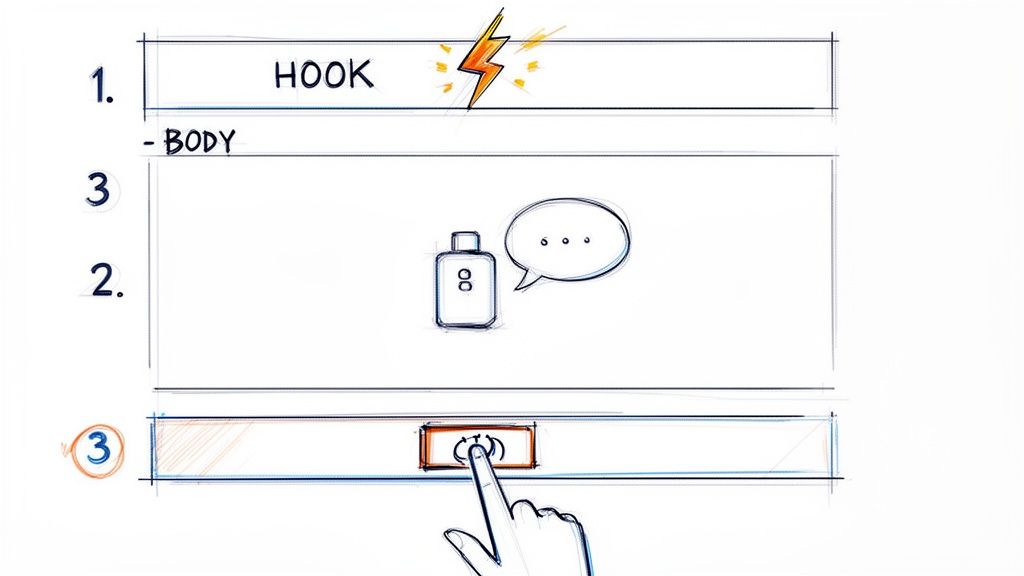
This method breaks a video into three distinct parts:
Hook: The first 1-3 seconds. Uses a pattern interrupt, a bold claim, or a relatable problem to stop the scroll. Think of Dollar Shave Club’s problem-solution openings or a mobile app ad showing a common user frustration.
Body: The next 5-15 seconds. This section quickly demonstrates the product or solution, explains the core value proposition, and builds interest.
CTA (Call-to-Action): The final 1-3 seconds. A clear, direct instruction telling the viewer what to do next, like "Install Now" or "Claim Your Offer."
Why It’s a Top Video Advertising Example
This framework is effective because it aligns perfectly with user behavior on social feeds. By front-loading the most compelling element (the hook), it earns the viewer's attention rather than assuming it. This structure is also incredibly versatile, allowing for endless testing. Advertisers can mix and match different hooks with various body segments and CTAs to identify winning combinations at scale. For a deeper dive into structuring these components, check out our guide on how to write an advertising script. This modularity makes it one of the most reliable video advertising examples for consistent performance.
2. Problem-Agitate-Solution (PAS) Copywriting in Video
The Problem-Agitate-Solution (PAS) framework is a classic copywriting formula translated into a powerful video narrative. It’s designed to create a strong emotional connection by first identifying a viewer's pain point, then amplifying the frustration associated with it, and finally presenting the product as the perfect resolution. This psychological arc is incredibly effective for driving conversions.
This narrative method breaks a video into three sequential parts:
Problem: The video opens by highlighting a common and relatable frustration. Think of a Duolingo ad showing the awkwardness of not being able to speak a local language while traveling.
Agitate: This part intensifies the problem. It dwells on the negative emotions or consequences, making the viewer feel the pain more acutely. For instance, a fitness app might show the ongoing struggle and lack of progress with generic workout plans.
Solution: The product is introduced as the clear and simple answer to the agitated problem, demonstrating its core benefit and providing a sense of relief and hope.
Why It’s a Top Video Advertising Example
The PAS framework is a top-tier strategy because it leverages fundamental human psychology. By first creating tension and then resolving it, the ad positions the product not just as a "nice-to-have" but as an essential solution to a real problem. This makes the call-to-action feel like a natural next step for the viewer. This structure excels in performance marketing, turning passive viewers into motivated leads. Due to its narrative strength, it stands out as one of the most persuasive video advertising examples for products that solve a clear customer pain point.
3. User-Generated Content (UGC) Testimonial Mashups
User-Generated Content (UGC) Testimonial Mashups are video ads created by stitching together authentic customer testimonials, unboxings, and organic reviews. This approach builds powerful social proof by letting real customers tell the brand’s story. It performs exceptionally well on platforms like TikTok and Meta because modern audiences trust peer recommendations far more than polished brand messaging.
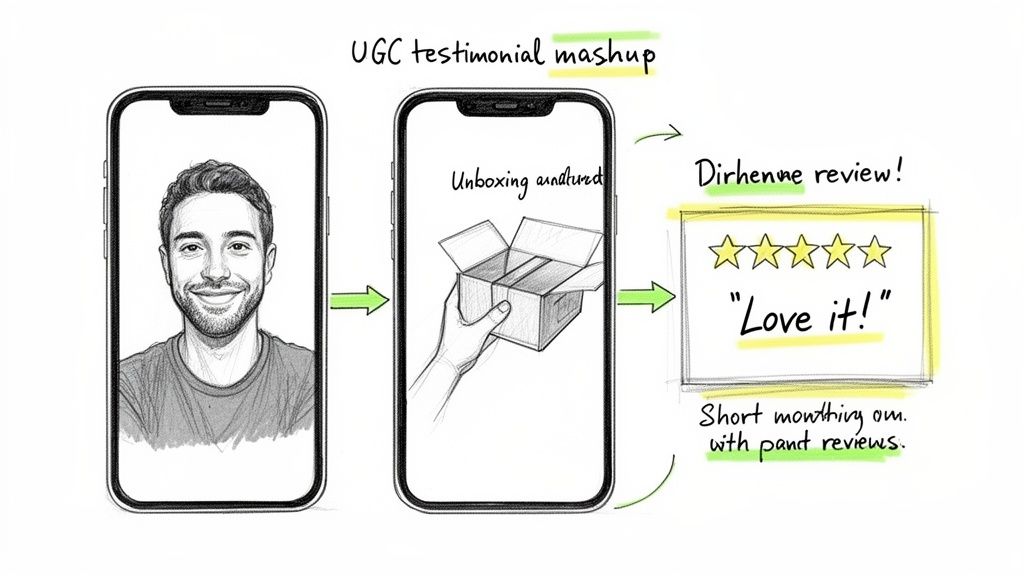
This method involves compiling various pieces of customer content:
Video Testimonials: Short clips of users sharing their positive experiences.
Unboxing Videos: Footage showing the excitement of receiving and opening a product.
Static Reviews: Screenshots of 5-star ratings or positive text comments from social media or review sites.
Why It’s a Top Video Advertising Example
This strategy is effective because it leverages authenticity to build immediate trust and credibility. Instead of a brand making claims, satisfied customers provide the validation. To truly harness the power of testimonials and mashups in your video ads, it's beneficial to first understand what user-generated content (UGC) is in detail. This approach is also highly scalable; a handful of strong testimonials can be remixed into dozens of ad variations by changing the order, music, or on-screen text. For more guidance on creating these types of ads, explore our resource on how to make UGC. Its ability to generate trust and volume makes it a cornerstone of modern video advertising examples.
4. Listicle Format Videos (Top 5/10 Lists)
Listicle videos organize information into a numbered or ranked list, such as "Top 5 Features" or "10 Ways to Use Our Product." This structure transforms a standard ad into a piece of value-driven content, satisfying user curiosity and aligning perfectly with the short-form, educational style popularized on platforms like TikTok and Instagram Reels. The format is designed for easy consumption, breaking down complex information into quick, digestible segments.
This method breaks a video into a scannable sequence:
Hook: The video opens by announcing the list format, like "Here are the top 3 reasons to..." This immediately sets expectations and creates a curiosity gap that encourages viewers to watch until the end.
Body: Each list item is presented as a short, distinct scene (3-5 seconds). Quick cuts, consistent on-screen text, and a logical progression from a lower-ranked item to the top-ranked item maintain viewer momentum.
CTA (Call-to-Action): The final scene transitions from the #1 list item directly into a compelling call-to-action, such as "Download now to unlock all these features."
Why It’s a Top Video Advertising Example
The listicle format is a powerful tool for engagement because it creates a "retention loop." Viewers are psychologically motivated to see the entire list, especially the number one item. This structure is highly modular, allowing advertisers to easily test different list items or reorder them to see which sequence performs best. For example, a productivity app could test whether "AI Scheduling" or "Focus Mode" is a more compelling #1 feature. This makes the listicle one of the most effective video advertising examples for communicating multiple value propositions in a single, high-retention creative.
5. Before-After Transformation Videos
The Before-After Transformation is a visually powerful and persuasive video format that instantly communicates value. This technique showcases a clear, tangible change resulting from a product or service, making it incredibly effective for categories where results are the primary selling point. It works by creating a stark contrast between a "problem" state and a "solution" state.
This method typically involves two key visuals:
Before: Establishes the initial problem or starting point. Think of a cluttered digital workspace, an unedited photo, or a pre-workout physique.
After: Reveals the dramatic, positive outcome achieved with the product. This could be a perfectly organized dashboard via a productivity app or a stunning transformation from a fitness program. The reveal is often enhanced with quick cuts, split screens, or dramatic sound effects.
Why It’s a Top Video Advertising Example
This format’s strength lies in its simplicity and universal appeal. It requires no complex explanation; the visual evidence speaks for itself, making the value proposition instantly understandable. This is especially potent for beauty, fitness, home improvement, and productivity apps where demonstrating efficacy is crucial for driving conversions. It's a classic direct-response technique adapted for short-form video, making it one of the most compelling video advertising examples for products that deliver visible results. The modular nature of this format also allows for rapid testing; advertisers can easily swap different before-after clips to find the most resonant transformations for their audience.
6. Carousel/Swipe-Series Video Ads (Video Sequences)
Carousel or swipe-series video ads mimic the native swiping behavior of Instagram and TikTok carousels within a single video format. This approach breaks a narrative into distinct, sequential scenes, encouraging viewers to mentally "swipe" through the content. Each scene acts as a self-contained story beat, feature highlight, or step in a customer journey. This format is perfect for telling a more detailed story without losing user engagement.
This method organizes a video into connected scenes:
Scene 1 (Intro): Presents a core problem or introduces a broad concept, like Notion’s "Meet your new workspace" ads that set up a productivity challenge.
Scene 2-4 (Progression): Each subsequent scene reveals a new feature, benefit, or step in the solution. For instance, a mobile banking app might show scenes for budgeting, then investing, then rewards.
Scene 5 (Conclusion/CTA): The final scene summarizes the value and presents a clear call-to-action, tying the entire sequence together.
Why It’s a Top Video Advertising Example
This format excels at educating viewers and communicating complex value propositions in a digestible way. By breaking information into modular scenes, it holds attention longer than a monolithic video might. The sequential nature builds a narrative momentum that keeps users watching to see what comes next.
It's also highly testable; advertisers can reorder scenes to test different narrative flows, like starting with the most compelling feature versus building up to it. This modularity makes it one of the most strategic video advertising examples for products with multiple features or a story to tell. For example, you can test if users respond better to a problem-solution-benefit sequence or a feature-by-feature walkthrough. The snappy, consistent transitions between scenes are key to maintaining the illusion of a user-controlled swipe experience.
7. Pattern Interrupt + Quick Cut Editing
This high-energy editing style is engineered to combat feed fatigue and capture attention on visually saturated platforms like TikTok and Instagram Reels. The technique uses a rapid succession of short clips, bold text overlays, and jarring visual or audio shifts to create a pattern interrupt. This jolt is designed to stop a user's scroll reflexively within the first second.
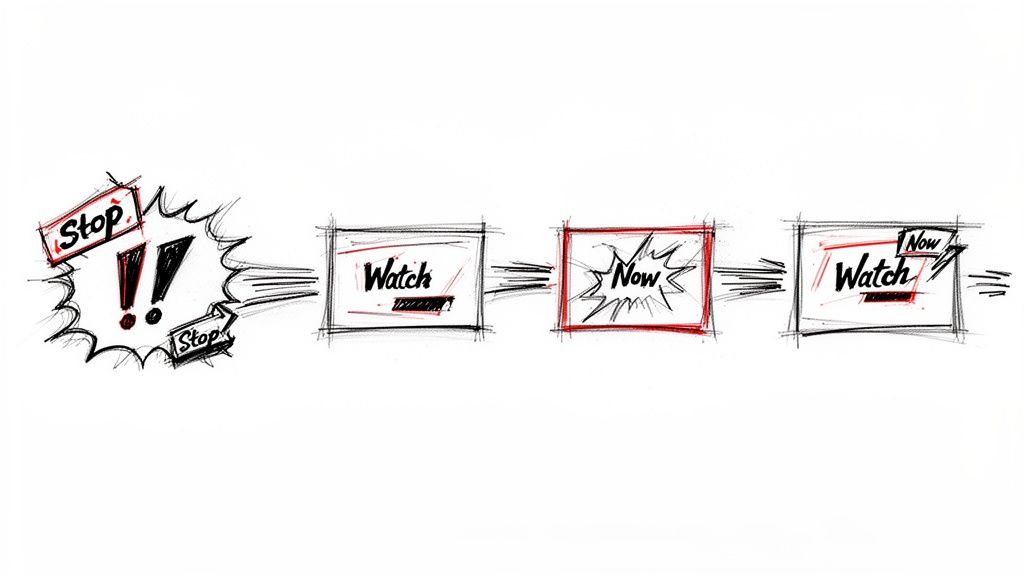
The core principle is to overload the viewer's senses just enough to make them curious. This is achieved through:
Rapid Cuts: Each clip lasts no more than 1-3 seconds, creating a fast-paced, dynamic viewing experience. Mobile game ads often showcase multiple quick gameplay failures or wins.
Bold Visuals: High-saturation colors, extreme close-ups, and text overlays on every scene maintain visual intensity and guide the narrative.
Sound Design: Sharp sound effects (SFX) are synchronized with cuts and transitions to enhance the jarring effect and add another layer of engagement.
Why It’s a Top Video Advertising Example
This technique is effective because it mirrors the native language of short-form video platforms, making ads feel less like interruptions and more like organic content. Brands from fast food to fashion leverage this style to feel current and energetic. The constant stimulation prevents viewer drop-off, making it ideal for direct-response goals like app installs or clicks. This aggressive editing style is one of the most powerful video advertising examples for hooking viewers who have developed a high tolerance for conventional marketing, ensuring the core message is seen before they have a chance to scroll away.
8. Educational/Tutorial Video Ads (How-To Format)
Educational or "how-to" video ads teach viewers a valuable skill or solve a specific problem, positioning the product as the essential tool for success. This format builds trust and provides immediate utility, which encourages longer watch times on platforms like Meta and TikTok. Instead of a hard sell, the ad offers a mini-lesson, demonstrating the product's value in a practical context.
This approach breaks down a complex task into simple, digestible steps:
Promise a clear outcome: The hook presents a desirable result, like "Here's how to master a new language in 5 minutes a day."
Show the "how": The body guides the user through 3-5 clear steps using the product, often with on-screen text and annotations for clarity. Examples include Duolingo showing a quick language lesson or a finance app demonstrating how to set a savings goal.
Reinforce the result: The CTA connects the lesson back to the product's core benefit, encouraging viewers to download and try it themselves.
Why It’s a Top Video Advertising Example
This format is powerful because it shifts the advertiser's role from seller to teacher. By providing genuine value upfront, it attracts high-intent users who are actively looking for solutions. This educational approach generates strong engagement and positions the brand as a credible authority. The step-by-step structure is also highly adaptable for A/B testing; marketers can easily test different teaching paces, on-screen text variations, or tutorial segments. This makes educational content one of the most effective video advertising examples for building both brand affinity and direct-response performance.
9. Social proof & Statistics Video Ads
This advertising approach leverages the psychological principle of social proof by foregrounding hard numbers, such as user counts, ratings, and key metrics. The core idea is to build instant credibility and reduce viewer skepticism by showcasing a product's widespread adoption and success. It's a direct and powerful way to communicate value, especially for apps and services where network effects are a key selling point.
This method breaks down into a simple, persuasive argument:
The Hook: A large, compelling statistic immediately grabs attention. Think of a dating app opening with "20 Million Matches Made" or a fintech app flashing "Join 5M+ Investors."
The Body: This section provides brief context or visuals supporting the statistic, such as app UI demonstrating the feature related to the number.
The CTA: The call-to-action reinforces the social proof, inviting the user to join the large, satisfied community with a CTA like "Join Millions" or "Download Now."
Why It’s a Top Video Advertising Example
Social proof is one of the most effective conversion drivers because it taps into a fundamental human tendency to follow the crowd. When potential users see that millions of others trust and use a service, it significantly lowers the perceived risk of trying it themselves. This format is exceptionally effective for mobile app install campaigns, as it directly answers the viewer's subconscious question: "Is this app popular and trustworthy?"
This strategy is highly scalable for testing. Advertisers can rapidly generate dozens of variations by swapping out different statistics (e.g., user count vs. star rating vs. usage metric) to see which number resonates most. This makes it a go-to among video advertising examples for performance-focused marketers who need to produce and test creatives at a high velocity.
10. Animated Explainer & B-Roll Composite Videos
This hybrid format combines clean, animated motion graphics with dynamic b-roll footage (stock, filmed, or AI-generated) to explain complex ideas or showcase lifestyle contexts. It's a powerful approach for SaaS, Fintech, and Health apps that need to visualize abstract concepts like data flows, security features, or internal processes in a way that is both clear and engaging. The animation simplifies the core message while the b-roll adds a relatable, human element.
This composite method breaks down barriers for products that are hard to demonstrate physically:
Animation: Clearly illustrates user interfaces, data points, or abstract benefits. Think of Stripe showing a payment flow or Notion explaining a "workspace."
B-Roll: Provides real-world context, showing the outcome or lifestyle enabled by the product. This could be a team collaborating or a user feeling relieved.
Why It’s a Top Video Advertising Example
This is one of the most scalable video advertising examples because it allows for infinite variation without expensive reshoots. By treating the animation as a static base layer, advertisers can use tools like Sovran to rapidly generate and composite dozens of AI b-roll clips, testing which lifestyle visuals resonate most. This modularity is perfect for explaining complex services in a visually compelling and cost-effective way. To see more ways to incorporate secondary footage, explore these high-impact b-roll examples for ads.
10 Video Advertising Examples Comparison
Format | Implementation complexity 🔄 | Resource requirements ⚡ | Expected outcomes ⭐ / 📊 | Ideal use cases 💡 | Key advantages 📊 |
|---|---|---|---|---|---|
Hook-Body-CTA Framework | 🔄🔄 Medium — modular assembly, strong hooks required | ⚡⚡ Medium — short hook/body/CTA clips, creative variants | ⭐⭐⭐⭐ — high engagement, clear conversion tracking | UA managers & growth marketers testing ad angles | Rapid testing, platform-optimized, clear ROI |
Problem-Agitate-Solution (PAS) | 🔄🔄🔄 Medium‑High — narrative crafting and pacing | ⚡⚡ Medium — emotion-driven footage, longer cuts (15–30s) | ⭐⭐⭐⭐ — strong emotional resonance, higher watch‑through | App marketers targeting pain‑aware audiences | Persuasive storytelling that naturally leads to CTA |
UGC Testimonial Mashups | 🔄🔄 Low‑Medium — curation and stitch editing | ⚡ Low — user clips, subtitles; lower production cost | ⭐⭐⭐⭐ — high trust & CTR (often 2–5x on TikTok) | Brands with community engagement; Gen Z UA | Authentic social proof, scalable, cost‑efficient |
Listicle Format Videos | 🔄 Low — templateable, predictable structure | ⚡⚡ Low‑Medium — visuals for each list item | ⭐⭐⭐ — high completion rates, scannable information | App feature highlights, quick educational ads | Scannable, easy to produce, strong for feature-heavy products |
Before‑After Transformation | 🔄🔄 Medium — needs consistent before/after assets | ⚡⚡ Medium — quality transformation footage required | ⭐⭐⭐⭐ — clear benefit signal; high CTR (3–7%) | Beauty, fitness, productivity apps with measurable results | Instantly communicates impact; highly shareable |
Carousel / Swipe‑Series Video Ads | 🔄🔄🔄 High — multi‑scene sequencing and flow design | ⚡⚡⚡ High — multiple high‑quality scene assets | ⭐⭐⭐⭐ — higher watch‑through; supports complex narratives | Complex product storytelling, multi-feature positioning | Multi‑beat storytelling, easy to test scene orderings |
Pattern Interrupt + Quick Cut Editing | 🔄🔄🔄 Medium‑High — strict editing rhythm required | ⚡⚡ Medium — rapid clips, SFX, bold overlays | ⭐⭐⭐⭐ — exceptional stop‑scroll rates (up to ~60% higher) | Gen Z targeting, viral‑focused mobile UA | Powerful attention capture; masks lower production value |
Educational / Tutorial (How‑To) | 🔄🔄 Medium — instructional design and clarity needed | ⚡⚡ Medium — demo footage or screen recordings | ⭐⭐⭐ — high engagement and shareability; awareness focus | Awareness campaigns, value‑demonstration strategies | Positions brand as authority; highly shareable utility content |
Social Proof & Statistics Ads | 🔄 Low — simple text/animation overlays | ⚡ Low — editable numbers/graphics | ⭐⭐⭐ — builds credibility; reduces adoption friction | Trust‑building, new market entry, finance/health verticals | Fast to update, complements other formats, credibility boost |
Animated Explainer & B‑Roll Composite | 🔄🔄🔄 High — animation and compositing expertise | ⚡⚡⚡ High — motion graphics, b‑roll, possible agency cost | ⭐⭐⭐⭐ — high production value; explains complex concepts | SaaS, fintech, premium/brand‑focused campaigns | Visualizes abstractions, scalable via templates/AI b‑roll |
Scaling Your Creative: From Examples to Engine
We've explored a powerful arsenal of ten high-performing video advertising examples, moving far beyond surface-level descriptions to dissect the strategic machinery that makes them effective. From the psychological pull of the Problem-Agitate-Solution framework to the authentic trust built by UGC testimonials, each example serves as a proven blueprint for capturing attention and driving action on platforms like Meta and TikTok.
The core lesson is clear: successful video advertising isn't about finding a single "magic bullet" creative. Instead, it's about systematically applying versatile frameworks that resonate with your audience's core motivations. These structures provide a reliable starting point, allowing you to focus your energy on testing the most critical variable: the first three seconds of your ad.
Key Takeaways and Your Path Forward
As you move from inspiration to implementation, remember these central principles that connect all the best video advertising examples:
Frameworks Over Formulas: The hook-body-CTA, PAS, and Before-After structures are not rigid rules but flexible templates. Master them, and you can adapt any product feature or user benefit into a compelling video narrative.
Velocity is a Competitive Advantage: The speed at which you can test new hooks, angles, and formats directly impacts your ability to find winning ads and scale your campaigns profitably. A slow creative workflow is a significant bottleneck to growth.
Modularity is the Key to Scale: Think of your ads as systems of interchangeable parts. A powerful hook from one ad can be tested with a different body or CTA. This modular approach, seen in UGC mashups and quick-cut edits, allows for exponential testing with minimal new asset creation.
From Manual Effort to an Automated Engine
The true challenge isn't understanding these frameworks; it's operationalizing them at scale. Manually creating dozens of variations in tools like CapCut to test a single hypothesis is time-consuming and unsustainable. This is where the strategic focus must shift from one-off ad creation to building a repeatable, scalable creative engine.
The goal is to build a system where you can feed in raw assets like user reviews, screen recordings, and b-roll footage, and rapidly generate hundreds of testable ad variations based on the proven frameworks we've analyzed. By embracing creative automation, you transform these video advertising examples from a static list of ideas into a dynamic playbook. This allows your team to move faster, learn quicker, and consistently uncover the creative combinations that unlock new levels of performance for your campaigns.
Ready to stop the manual grind and build your own creative engine? Sovran uses AI to turn your raw assets and winning frameworks into hundreds of ad variations in minutes. See how top performance marketers are scaling their creative testing by visiting Sovran.

Manson Chen
Founder, Sovran
Related Articles
8 High-Converting Static Ads Examples for 2026
Discover 8 high-performing static ads examples from top apps. Learn to create text-overlays, testimonials, and lifestyle ads that convert.
How to Turn Link Into Video: Ads That Convert in 2026
Learn how to turn link into video for Meta & TikTok ads. Leverage AI to scale creation, boost ROI, and succeed in 2026.

Your Ultimate Guide to UGC Style Video Ads
Master UGC style video ads for Meta and TikTok. This guide reveals proven frameworks, scripts, and scaling tactics to boost your ROAS in 2026.