Budget Allocation Methods Guide for UA and Media Buying
Jump to a section
You're halfway through a campaign month, and the budget doesn't look the way it did at launch. TikTok is burning through spend without the returns you wanted, Meta is holding steady, and everyone on the team wants a fast answer about where the next dollars should go. That's the pressure behind budget allocation methods, not theory, but the daily call of deciding what stays, what gets cut, and what deserves more room to prove itself.
Good allocation is rarely about finding one perfect formula. It's about matching the method to the job, then defending that choice with a cost driver that makes sense. If the driver is weak, the math may still be clean, but the result won't be believable.
Introduction to Budget Allocation Challenges
UA managers and media buyers know the pressure of making a budget call before the numbers fully settle. A campaign starts slowly, a creative variant spikes, and the team has to decide whether to keep spend in place or shift it before the flight is over. That choice feels straightforward only when the account is small.
As budgets grow, weak rules create noise. A team that moves spend too quickly can starve a promising campaign, while a team that never reallocates can keep funding poor performance. The point of budget allocation methods is to replace guesswork with a repeatable rule for deciding where money should go next.
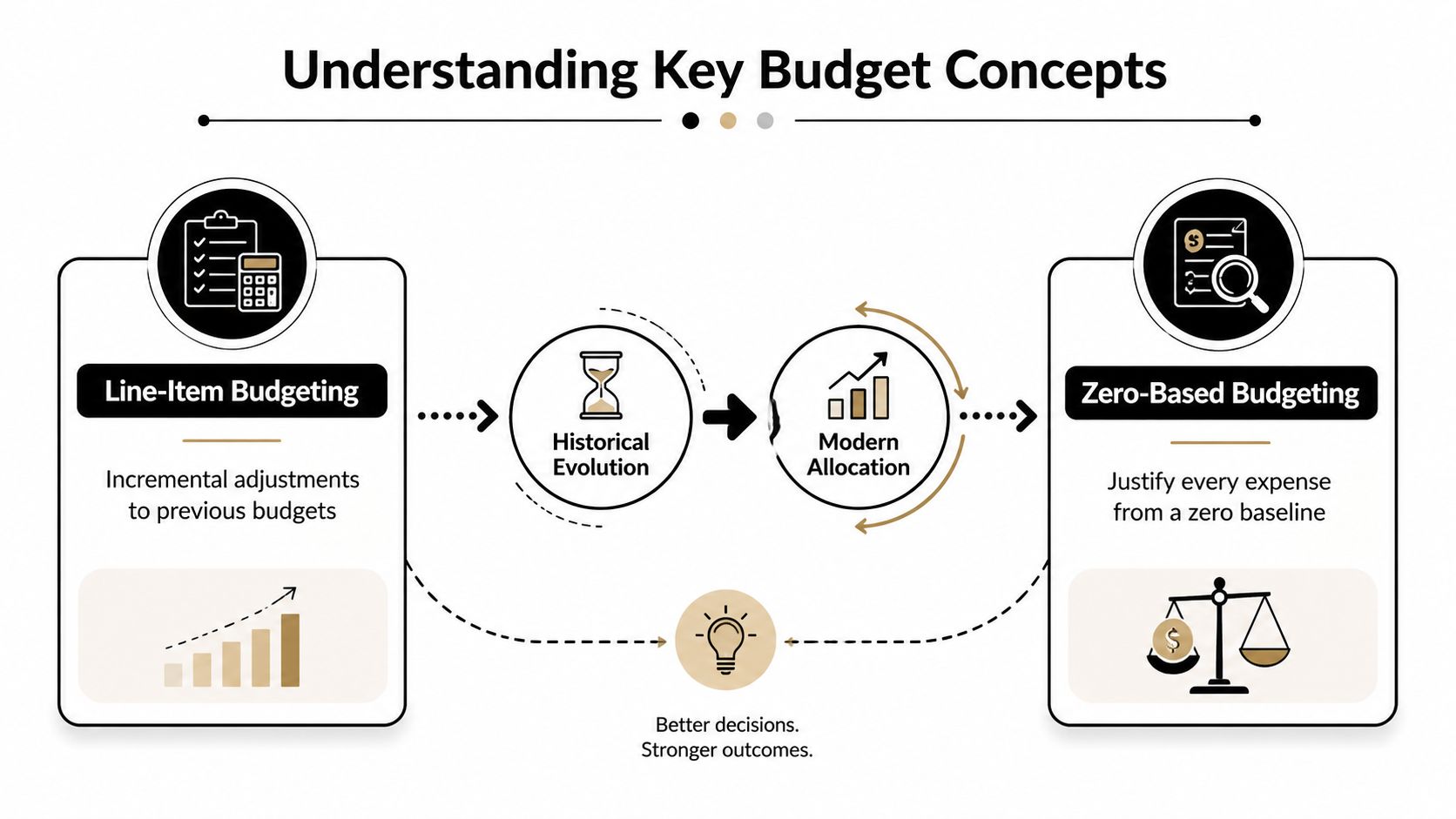
The historical pattern matters here too. Traditional line-item budgeting starts from prior-year spending, while zero-based budgeting asks every expense to justify itself again, from scratch, and the U.S. National Center for Education Statistics still lists both alongside other common models such as performance, program, site-based, and outcome-focused budgeting NCES budgeting models. In plain language, one method inherits the past and the other forces a fresh review.
That tension shows up in media buying every day. Some teams want continuity because it is easier to manage. Others want a harder reset because the channel mix changed, the creative changed, or the audience changed. The better question is not which method sounds smarter, but which one gives you the most defensible answer for the kind of cost you are managing.
Cost driver defensibility is the part many teams skip. If a channel can point to a clear driver, such as qualified traffic, booked calls, or another outcome that matches how the budget moves, the allocation has a stronger case. If the driver is vague, the method may still look neat on paper, but the spend decision will be harder to trust.
For teams scaling paid social, the practical pressure often starts with creative volume and performance drift. A useful companion guide on that problem is how to scale Facebook ads, because scaling spend without a matching allocation logic usually turns into noisy experimentation instead of controlled growth.
Understanding Key Budget Concepts
A budget split only makes sense when you can answer two questions clearly, what is the starting point, and what is the reason for moving money. The starting point is the baseline, the amount already in view. The reason is the driver, the signal that tells you why one channel, campaign, or line item should receive more or less.
That distinction is the part many teams skip. A baseline keeps planning grounded in something known, while a driver explains change. If a channel keeps receiving spend just because it received spend last month, the allocation may look tidy, but it does not tell you whether the money is following real demand, real activity, or just habit.
Baselines and drivers
A baseline is the amount you begin with. A driver is the factor that explains why money should move in one direction instead of another. Once you separate those two ideas, budget allocation becomes easier to evaluate because you are no longer treating every dollar as if it has the same job.
That matters because the strongest allocation method is the one that can defend its driver. A spend rule based on qualified leads, booked calls, or another measurable outcome is easier to justify than a rule based on convenience. In allocation systems, Infor allocation workflow describes the mechanics as taking a source value, applying a percentage, and posting the result to a target area. The math is simple. The harder question is whether the chosen percentage reflects real usage, or only gives the appearance of order.
Practical rule: if the driver does not match the resource it is supposed to explain, the allocation is weak even when the spreadsheet looks clean.
Cost driver defensibility becomes useful in this context. A defensible driver is one you can explain without hand-waving. If media spend is rising because a channel is producing more qualified traffic, the link is clearer than if the increase is based on last period's pattern alone. That difference matters for budget allocation methods, because the method is only as trustworthy as the logic behind the driver.
For teams checking whether a channel's return can support a new split, a ROAS calculator can help test the allocation before money is committed.
Overview of Common Methods
The most useful way to compare budget allocation methods is by asking what each one protects. Some methods protect stability. Others protect scrutiny. A few protect the link between spend and activity, or spend and outcomes. Once you know what a model is protecting, the trade-off becomes much easier to see.
Microsoft Dynamics 365 makes this distinction in system design by separating methods that keep budget lines within the same plan from methods that move lines across plans. It distinguishes three intra-plan methods, Allocate across periods, Allocate to dimensions, and Use ledger allocation rules, from three inter-plan methods, Aggregate, Distribute, and Copy from budget plan Microsoft Dynamics 365 allocation methods. That split is useful because it mirrors a practical finance question, are you phasing the same budget, or are you rebuilding the budget structure itself?
Side by side comparison
| Method | How it works | Pros | Cons |
|---|---|---|---|
| Incremental budgeting | Starts from the prior budget and adjusts up or down | Fast, easy to explain, keeps continuity | Can carry weak assumptions forward |
| Zero-based budgeting | Every line must be justified from zero | Forces scrutiny and prioritization | Takes more time and review effort |
| Activity-based budgeting | Funds follow the activity or process that consumes resources | Ties money to operational drivers | Can be hard when activities are indirect |
| Performance-based budgeting | Funds are linked to outcomes or defined standards | Focuses attention on results | Can miss useful work that is hard to measure |
Incremental budgeting is the closest thing to “keep what worked unless there's a reason not to.” It's useful when the operating environment is stable and the team needs speed. Zero-based budgeting is the opposite. It's a reset button, and that's why it can reveal waste, but it can also create administrative drag if the whole account has to be rebuilt too often.
Activity-based budgeting asks a different question: what activity consumes the resource? Performance-based budgeting asks whether the resource produced the outcome you wanted. Those aren't interchangeable. A channel may be active without being efficient, and a program may be valuable even when its output takes longer to show up.
A useful reminder for media teams is that testing discipline matters as much as allocation discipline. If your creative or channel changes are too small to read clearly, your budget split won't teach you much. A guide to how many ad variations to test can help frame that testing logic alongside your allocation process.
Identifying KPIs and Data Requirements
A budget allocation method only works when the measurements beneath it are defensible. If a team tracks spend by itself, it may mistake a costly channel for an inefficient one, even when that channel is carrying harder-to-reach demand. The cleaner question is whether the KPI matches the cost driver, because the wrong metric can make a reasonable allocation look weak.
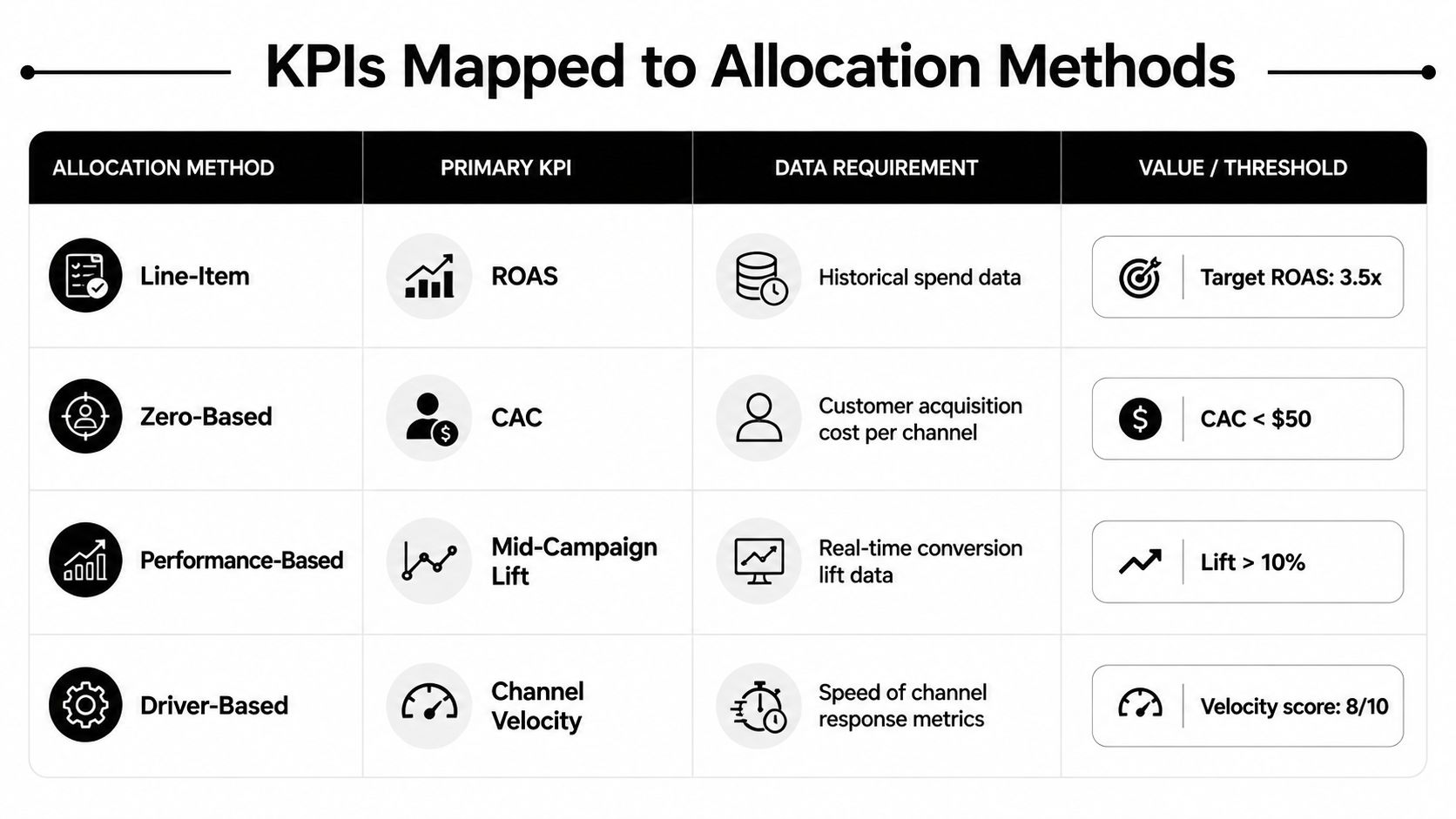
For marketing teams, the key metrics usually include ROAS, CAC, performance changes during a campaign, and how quickly a channel responds to new spend. Industry reporting on Gartner's 2026 CMO Spend Survey says marketing budgets sit at 7.7% of company revenue, down from a 2021 peak of 11%, and that paid media accounts for 30.6% of total marketing spend 2026 marketing budget planning summary. The same summaries say top performers reserve 18% of budgets for mid-year reallocation and many teams move 10–15% of spend between channels each quarter based on recent performance. That pattern points to a practical shift, allocation now depends more on proving which cost driver deserves the next dollar.
What each method needs
- Incremental budgeting: historical spend, past pacing, and a clean view of what changed last period.
- Zero-based budgeting: line-level cost detail, a reason for each expense, and enough context to challenge old assumptions.
- Performance-based budgeting: outcome data, conversion tracking, and a defined link between spend and result.
- Driver-based budgeting: a believable driver such as volume, time, or usage, plus a way to verify that the driver tracks real consumption.
The hardest part is not collecting data. It is checking whether the data really supports the allocation base you chose. Teams often have plenty of numbers, yet the numbers still fail to explain why a cost moved. A channel can look expensive because its activity is broad, delayed, or poorly tracked, not because the method is wrong. That is why the measurement plan has to match the logic of the budget method, especially when the cost driver is indirect or shared across teams.
If channel performance is changing quickly, attribution has to be part of the measurement setup, not an afterthought. For that broader context, master attribution for 2026 helps frame how credit should be assigned before you shift money based on recent results.
Spend data tells you where money went. It does not always tell you whether the money belonged there.
For sampling and test design, a sample size calculator is useful when you need to judge whether an observed lift is large enough to trust before you move budget aggressively.
Implementing Allocation Methods in Practice
A budget allocation method only works after the team agrees on the logic behind it. Software can record the steps, a spreadsheet can calculate the split, and a BI dashboard can display the result, but none of them can fix a weak cost driver. Start with the rule, then build the workflow around that rule.
The practical challenge is usually less about arithmetic and more about ownership. The media buyer should own the channel data, the analyst should check whether the driver reflects real usage, and finance should confirm that the allocation lines still tie back to the wider budget structure. That division keeps the process from slipping at handoff points, which is where many allocation mistakes start.
A workable rollout sequence
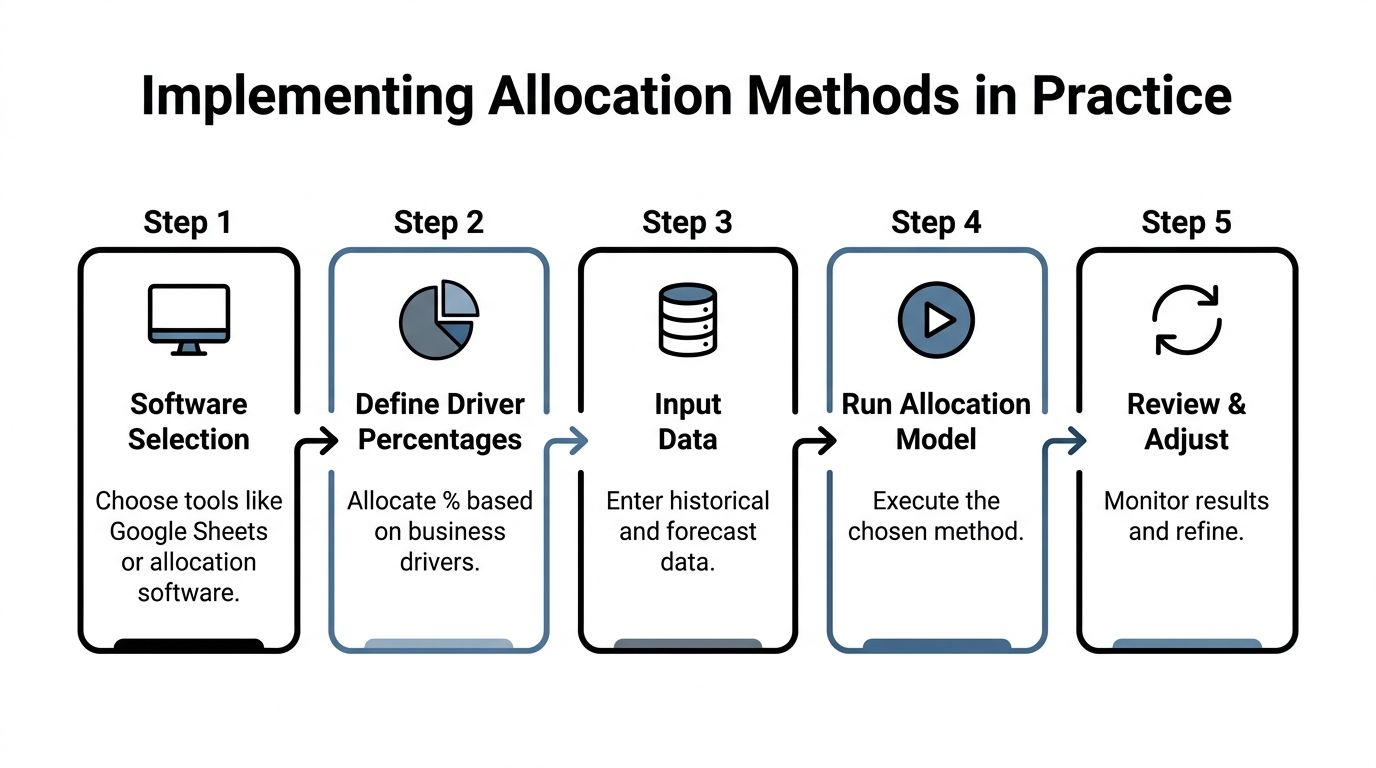
- Choose the tool. A shared spreadsheet can work for small accounts, while larger teams usually need stricter controls and clearer audit trails.
- Define the driver. Time, volume, spend share, or outcome share can all work, but only if the cost behaves in a way that makes the driver believable.
- Load the data. Pull in historical spend, current pacing, and the fields that show where the resource is flowing.
- Run the allocation. Apply the rule to distribute the values, then inspect the output for anything that looks structurally off.
- Review and adjust. Check the allocation on a cadence that fits how quickly the channel changes.
The most useful test is whether the chosen base can be defended. A driver is not just a field in a sheet, it is the explanation for why one bucket absorbs more cost than another. If shared creative time is being split by channel, for example, the question is whether time tracks consumption, or whether a cleaner base would be closer to the work being done. For paid media teams, a Facebook ad budget calculator can help pressure-test planned spend against the channel setup before any reallocation goes live.
The workflow itself should feel mechanical once the logic is settled. Source values are identified, a percentage or driver rule is applied, and the result is posted to the target area. That is why the difficult part sits before the calculation, not inside it, because a neat formula still produces the wrong answer if the underlying base does not match how the cost behaves.
Choosing the Best Method for Your Team
The strongest choice is usually the one that matches the cost behavior most accurately. That's why the same budget method can work well in one account and fail badly in another. A method is not “best” in the abstract, it's best only when the driver is defensible.
The most overlooked question in allocation is whether the cost is direct, indirect, or jointly produced. Guidance for nonprofit and public-sector accounting makes this point clearly, because common allocation bases include FTE or staff time, square footage, number of clients, units of service, and percentage of total direct costs, yet the right choice depends on matching the method to the cost behavior allocation base guidance. That's the same issue media teams face when they spread shared creative, analytics, or operational costs across channels.
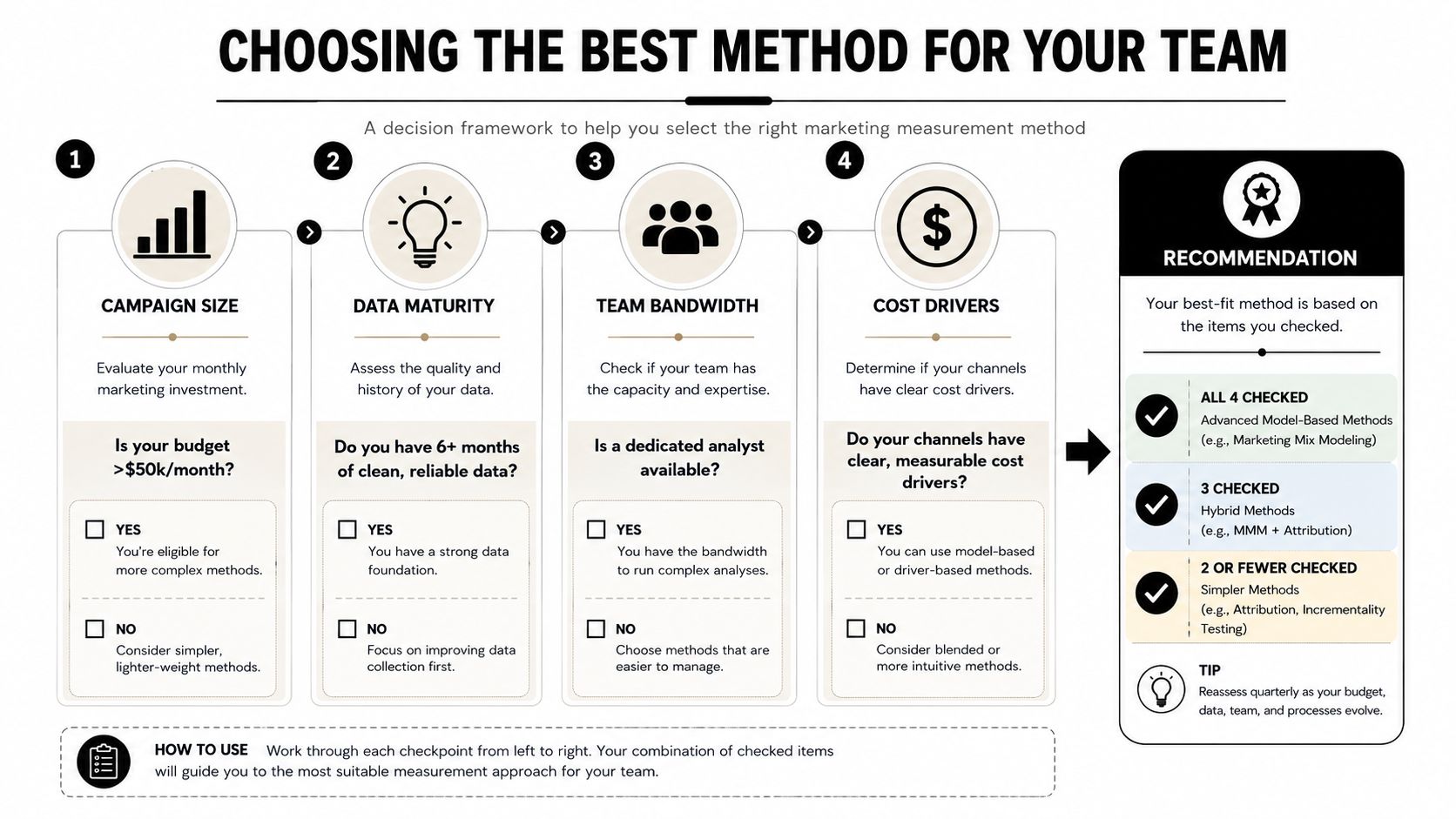
A decision frame that holds up
- If the budget is stable and the account is mature, incremental budgeting can be a practical starting point.
- If every line needs a fresh defense, zero-based budgeting gives you the strictest reset.
- If resource usage tracks a clear operational driver, activity-based budgeting is usually more defensible.
- If the business cares most about outcomes, performance-based budgeting gives the cleanest conversation with leadership.
For a UA manager running mid-funnel paid media, the strongest default is usually the method that ties spend back to a believable driver of volume or conversion, then layers in performance review. Mid-funnel campaigns can look noisy if you judge them only on immediate return, so a rigid performance-only approach can hide the role they play.
For a creative-focused media buyer testing many video variants, the better method is often the one that treats creative production and testing as a governed input, not a vague overhead bucket. The wrong allocation base here is usually the one that's easiest to apply, because ease doesn't equal causality.
If a cost behaves like occupancy, don't allocate it like labor. If it behaves like labor, don't allocate it like media spend.
That's the practical takeaway. The best teams don't ask, “Which method is modern?” They ask, “Which method lets us explain the resource pattern without forcing the data to lie?” That one question cuts through most budget debates fast.
Next Steps and Conclusion
The cleanest path forward is to pick one allocation rule, pilot it on a limited budget segment, and review the result against the driver you chose. If the driver makes sense and the outputs are stable, you can scale the method with more confidence. If the result feels tidy but doesn't match reality, the problem is probably the allocation base, not the spreadsheet.
The bigger lesson is that budget allocation methods work best when they match both the business model and the cost behavior. Continuity is useful, but defensibility matters more. A team that can explain why money moved has a much stronger budgeting process than a team that merely moved it quickly.
Sovran helps performance teams turn creative testing into a repeatable system, so your allocation choices can follow real campaign evidence instead of gut feel. If you want a clearer way to feed new variations into your media plan and keep budget decisions tied to performance, visit Sovran and see how it fits into your workflow.

Manson Chen
Founder, Sovran
Related Articles

Storyboard Development: Scale Video Ad Production in 2026

8 Pattern Interrupt Techniques for Video Ads