8 Pattern Interrupt Techniques for Video Ads
Jump to a section
- 1. The Hook Pattern Interrupt
- 2. The Contrast Principle Pattern Interrupt
- 3. The Question-Based Pattern Interrupt
- 4. The Sensory Disruption Pattern Interrupt
- 5. The Scarcity and Urgency Pattern Interrupt
- 6. The Social Proof and Authority Pattern Interrupt
- 7. The Narrative Structure Break Pattern Interrupt
- 8. The Emotional Valence Shift Pattern Interrupt
- 8-Point Comparison of Pattern Interrupt Techniques
- Turn Interrupts Into a Repeatable Testing System

A pattern interrupt can make a persuasive message more thoroughly processed, not merely noticed. A 2015 Journal of Consumer Research study found across five studies that momentary interruptions improved message elaboration in different experimental contexts and content domains. That finding matters for video advertising because an interruption isn't automatically a gimmick. It can briefly break automatic processing and give the viewer a reason to reassess the message.
The same evidence also sets a boundary. Interruptions can reduce commercial outcomes when they feel too intrusive, and later research connected online-ad interruptions with measurable changes in frontal and prefrontal brain activity during a single exposure window (research summary). The practical question isn't whether a creative should be disruptive. It's whether the disruption earns attention, clarifies a relevant promise, and leads naturally to proof, product, and action.
This guide treats pattern interrupt techniques as testable creative components. You'll find practical approaches for hooks, contrast, questions, sensory changes, urgency, proof, narrative structure, and emotional shifts. Each one can become a modular opening, a controlled experiment, and a reusable production asset across social and video campaigns. For teams building short-form ads, this shorts generator guide offers additional context on producing fast-moving creative.
1. The Hook Pattern Interrupt
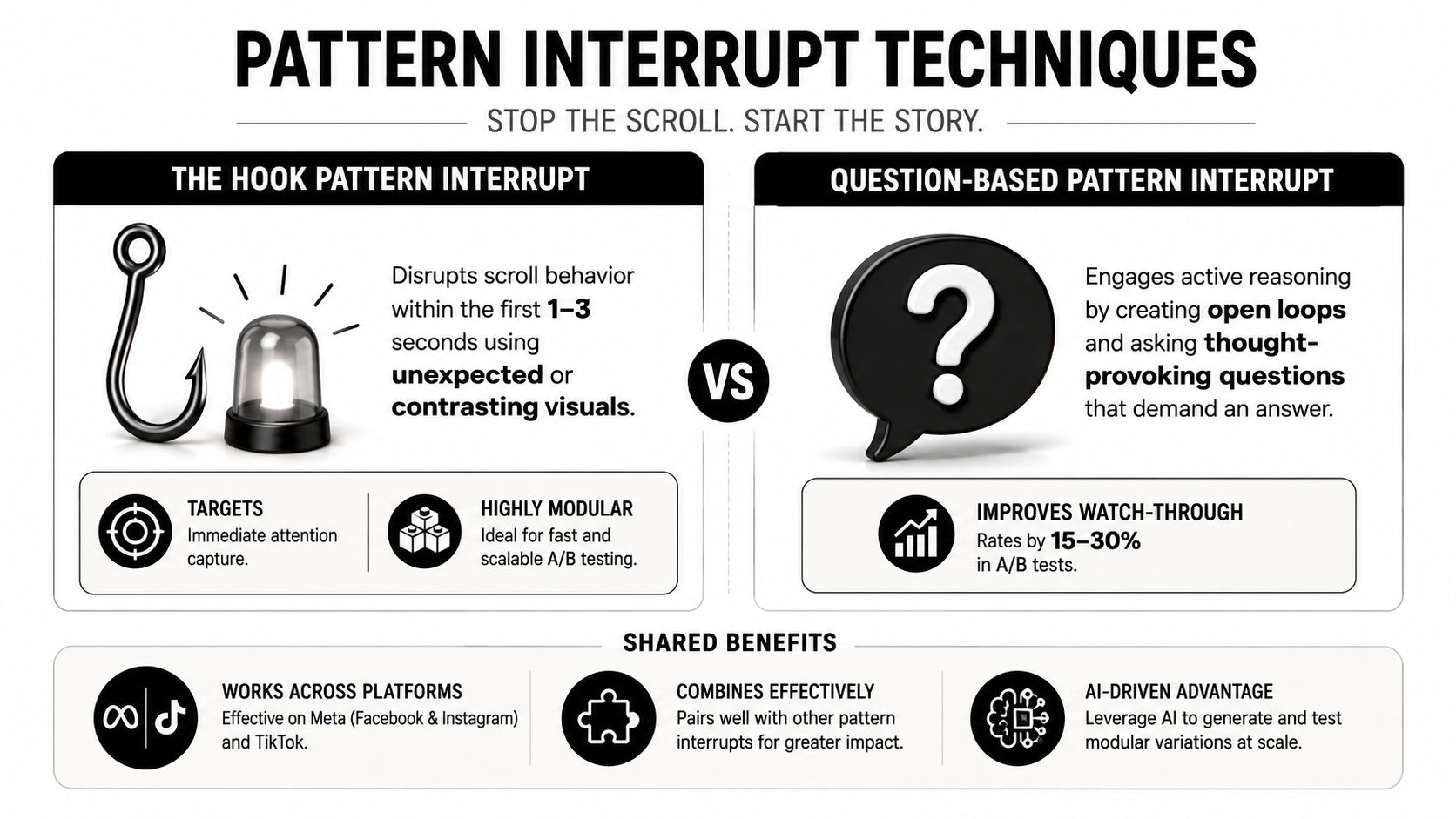
The first frame doesn't need to explain the entire product. It needs to create a clear reason to keep watching. A hook pattern interrupt breaks the expected feed rhythm with an unexpected visual, statement, movement, or product moment, then hands attention to the next piece of the message.
A useful opening might show a product producing an unfamiliar result, begin with a direct contradiction, or place large text over an unusual scene. A DTC tool brand could open with a close-up transformation and the line, “This small tool does that?” A gaming app might lead with the most surprising gameplay moment rather than a logo or menu screen. A mobile app can use a counterintuitive problem statement, provided the body immediately explains it.
The hook should be treated as a removable module. Keep the body and CTA stable while changing the opening, then label each version by hook type, visual treatment, first line, and promise. Sovran's video hook generator can support that kind of rapid variation, while its Asset Bank can help teams tag and retrieve clips by visual category.
Build the payoff into the opening
A strong hook creates a question, but the next scene must begin resolving it. If the opening shows a dramatic product transformation, follow with the mechanism or use case. If it makes a challenging claim, explain the underlying problem before presenting the product.
Practical rule: Don't optimize the opener in isolation. A hook that attracts attention but creates confusion can damage the rest of the ad.
Review watch-time heatmaps for the point where viewers stay, dip, or re-engage. Test abrupt cuts, text-first openings, direct address, and product demonstrations as separate variables. Rotate the winning structure before audiences become familiar with it. Paid-social operators often use a 20% CTR decline from a post-learning baseline as a fatigue threshold, with weekly frequency between 2.0 and 2.8 commonly treated as a point where decay becomes measurable (creative fatigue reference). Those figures are operational signals, not universal laws, so compare them with your own baseline and downstream conversion data.
2. The Contrast Principle Pattern Interrupt
Contrast works because viewers have to reconcile two adjacent elements that don't normally belong together. The mismatch can be visual, emotional, or narrative. A productivity ad might cut from a cluttered desk to a clean dashboard. A gaming ad could move from an ordinary commute to an intense in-game sequence. A finance product might contrast financial anxiety with a concrete planning interface.
The important distinction is between productive contrast and random dissonance. The first scene should establish a recognizable problem, environment, or expectation. The second should reveal why the difference matters. Without that connection, the viewer may notice the edit but fail to understand the product.
A simple structure keeps the device controlled:
- Visual contrast: Pair a messy physical space with an organized digital workflow.
- Tonal contrast: Move from a flat, mundane delivery to energetic gameplay or product use.
- Narrative contrast: Show the painful assumption first, then introduce the more useful explanation.
- Caption contrast: Change typography, color, or placement at the same moment as the visual shift.
Control the intensity
Use two or three clips at most in the opening sequence when the message needs to remain easy to follow. Then test the transition itself. A hard cut, a fast zoom, and a slower reveal can all communicate the same contrast while producing different viewing behavior.
Sovran's scene detection can help identify and tag contrasting footage, and bulk text overlays let teams align captions with the visual change. That makes contrast easier to test as a component rather than requiring a new edit from scratch.

The trade-off is cognitive load. An abrupt shift can reset attention, but a shift without a clear product relationship can make the ad feel assembled rather than intentional. Test contrast intensity by audience and placement, and judge success using more than the initial view signal. The right contrast increases curiosity while preserving comprehension.
3. The Question-Based Pattern Interrupt
A question turns passive exposure into a small mental task. Instead of receiving a claim, the viewer has to consider a problem, possibility, or personal gap. “Why does this workflow still take so long?” can work for a productivity app because it points toward a familiar frustration. “What would change if the hardest level started here?” fits a gaming concept when the ad can answer through gameplay.
Questions are more useful when they're specific to the audience's situation. An aspirational audience may respond to a “what if” prompt. A practical buyer may prefer a “why” question that challenges an existing assumption. The wording should also match the product's real capability. A question that promises a result the ad can't demonstrate creates curiosity at the cost of trust.
Pair the question with visible evidence
Put the question in spoken audio and on-screen text when possible, because captions carry the message in sound-off environments. The visual shouldn't just show a talking head. It can show the product interface, an incomplete task, a striking before state, or an action that makes the question concrete.
The best question-based openings have three parts:
- A relevant tension: Name the problem or desired outcome.
- A visual interruption: Use motion, an unusual crop, or a direct look into the camera.
- A prompt answer: Begin resolving the question before the viewer has to wait for the CTA.
A question can also function as a modular voiceover layer. Keep the footage constant and generate alternative openings with different emotional deliveries, then compare how each version carries into the same body. Sovran's guidance on attention-grabbing ad openings is relevant to this workflow.
Don't use questions as decorative copy. If the ad asks whether the viewer knows a particular detail, show how the product helps them find or improve it. The interruption should open a loop, but the product should close it. Recent work on short-form commercial content supports this broader sequence, an unexpected early hook followed by emotionally grounded problem framing and a product-integrated resolution (open-access research).
4. The Sensory Disruption Pattern Interrupt
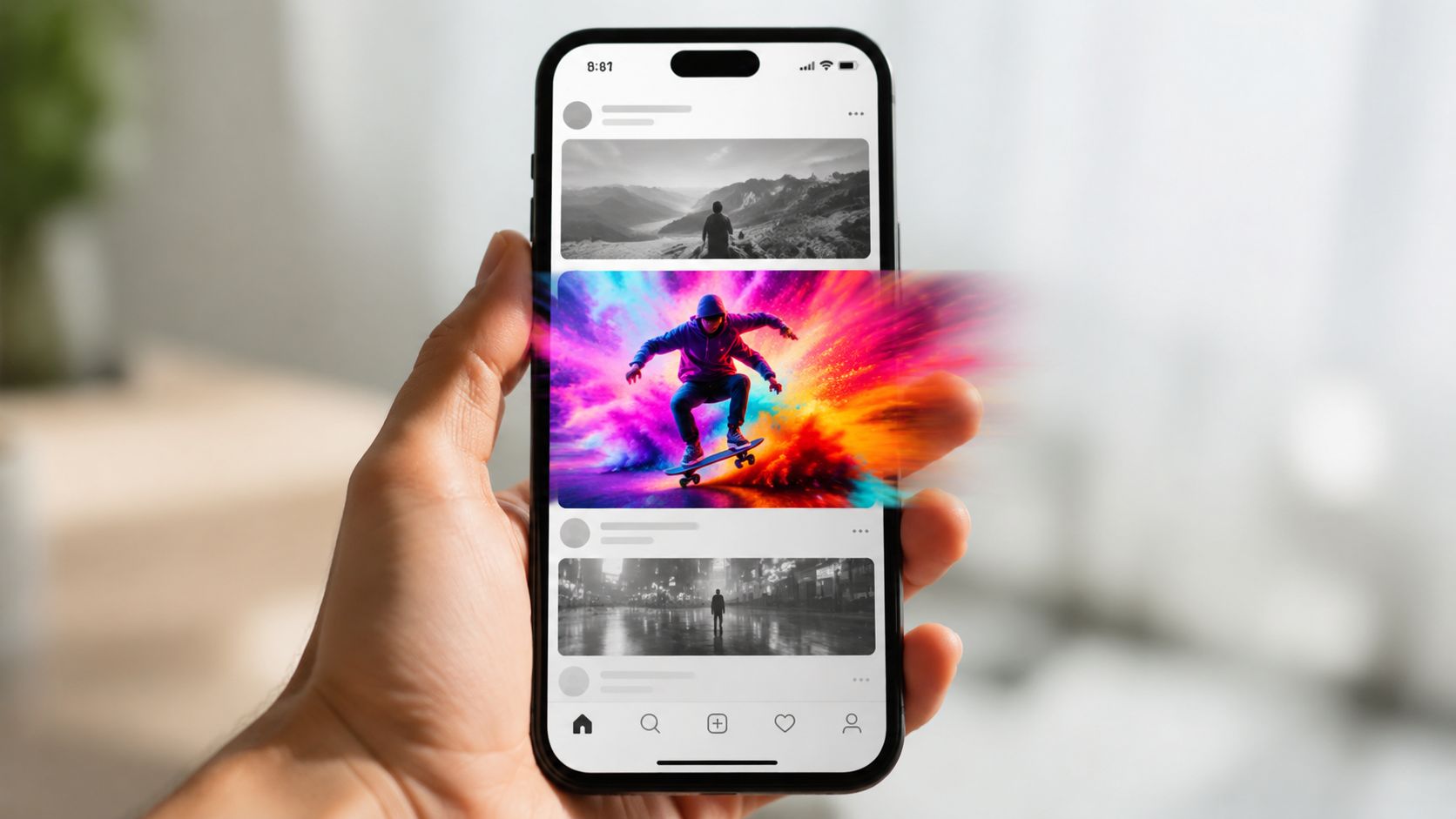
Sensory disruption changes what the viewer sees or hears at a moment when the feed has established a different rhythm. A sudden sound, color shift, crop, zoom, animation, or silence can reset attention. The device is especially useful when the opening footage would otherwise resemble ordinary creator content or polished brand ads.
Use the sensory element to signal meaning. A notification sound can introduce an app problem. A sharp visual change can reveal the product result. A sudden silence can make a direct statement feel deliberate. The interruption shouldn't compete with the message, and it shouldn't rely on audio alone because many viewers encounter social ads with sound disabled.
Design for two attention conditions
Create a sound-on version and a sound-off version with equivalent information. The silent edit needs visible captions, readable text hierarchy, and a visual change that doesn't depend on a sound spike. The sound-on edit can use voice texture, music, or a product-specific effect, but keep the transition tied to the promise.
Sovran's AI B-roll workflow can help teams add supporting footage when the sensory change needs a stronger visual bridge. Use heatmaps to identify whether the interruption creates genuine re-engagement or merely a brief glance.
A sensory break should reset attention, then disappear into the message.
The risk is irritation. A loud or visually aggressive opening may stop a scroll while making the brand feel careless. A neuroscience experiment on online-ad interruptions observed reduced activity in frontal and prefrontal cortical areas across all frequency bands, alongside significant changes in the frontal/prefrontal asymmetry index (PubMed record). That evidence doesn't tell you which sound effect to use, but it reinforces the need to treat intensity and timing as test variables.
A related mobile field experiment found that extra stimuli can improve attentional engagement and ad effectiveness for pop-up ads interrupting a task, showing why environment matters (field experiment discussion). A sensory device that works in a busy task-based setting may not work in a relaxed feed. Test by placement, sound condition, and task context.
5. The Scarcity and Urgency Pattern Interrupt
Urgency changes the decision frame. Without a deadline, a viewer can postpone evaluation. With a legitimate deadline or capacity limit, the viewer has to decide whether waiting carries a real cost. That makes urgency useful late in the attention sequence, but it can also work near the opening when the offer itself is the most relevant reason to stop.
The creative should distinguish real urgency from manufactured pressure. A genuine enrollment window, inventory constraint, promotional end date, or trial deadline gives the message a defensible reason to act now. A countdown that resets for every visitor teaches people to distrust future claims.
Use visual language that matches the business logic:
- Soft urgency: “The offer ends soon” for viewers still evaluating.
- Specific urgency: State the actual closing condition when one exists.
- Capacity urgency: Explain what is limited, such as places, access, or availability.
- Progress urgency: Use a bar or status indicator only when it reflects a real process.
Match pressure to intent
High-intent viewers may need a clear deadline. Low-intent viewers often need relevance and proof before pressure becomes useful. Test mild and strong versions while keeping the product explanation and CTA consistent. The comparison should reveal whether urgency improves clicks, qualified sessions, and conversions, not only immediate interaction.
Sovran's guidance on effective CTAs for video ads can inform the final action language, while dynamic text overlays can help teams update legitimate offer details across variations.
Urgency also needs a payoff. A viewer who stops because of a deadline should quickly learn what they receive, why it matters, and what action preserves access. If the ad opens with pressure and delays the offer explanation, the interruption becomes friction. Truthful urgency supports action. Unsupported urgency damages credibility and can make the entire ad feel like a trap.
6. The Social Proof and Authority Pattern Interrupt
Credibility can interrupt skepticism before the product explanation begins. A customer on camera, a credible review, a supported user figure, a certification, or a recognizable customer logo changes the opening from “the brand says this works” to “people use or endorse it.”
Treat every proof element as a testable creative component. Use a real customer experience, an authentic testimonial, or an authority relationship the brand can substantiate. Impressive-looking numbers, logos, and endorsements create a stronger first frame only when they are accurate and relevant. Unsupported proof can attract attention while creating legal, reputational, and conversion risk.
Build a proof library before producing variations. Store testimonial audio, speaker footage, product demonstrations, endorsement text, and brand identifiers as separate assets. Recombine them with different hooks and bodies to compare speaker credibility, proof format, and message relevance without rebuilding the entire ad.
Place proof beside the promise
An app ad might open with a user demonstrating the result, then explain the workflow. A B2B ad could begin with a customer describing the operational problem before showing the platform. A fitness product can use a real user's specific experience rather than a generic declaration.
Choose the proof type based on the next objection:
- Customer proof: Keep the language concrete and tied to a product use case.
- Authority proof: Show why the person or organization is qualified to comment.
- Visual proof: Demonstrate the interface, product, or process instead of relying on praise alone.
- Freshness: Review older testimonials and remove claims that no longer reflect the offer.
Sovran's testimonial ad examples can help teams evaluate early proof placement and flexible testimonial assembly. Scene detection can surface high-energy clips, while caption tools can make the central claim legible without sound.
Credibility isn't a visual decoration. It has to answer the viewer's next objection.
Sequence affects interpretation. Proof-first may stop a skeptical viewer, while problem-first can establish relevance before the endorsement appears. Demonstration-first can make the claim easier to judge. Test these openings against the same body, offer, and CTA so the opening sequence remains the isolated variable.
Measure more than the first interaction. Compare retention through the proof, qualified sessions, CTA progression, and conversion quality. When one speaker, claim, or demonstration wins, preserve that component and pair it with new hooks or bodies. The result is a reusable combination for video and social ads, not a one-off testimonial.
7. The Narrative Structure Break Pattern Interrupt
A narrative break earns attention by making the viewer reconstruct the sequence. Instead of moving from problem to product, benefit, and CTA, open with the outcome, begin during the action, or alternate between the failed process and the improved one. The interruption needs a payoff: each unusual cut should reveal context, prove the benefit, or sharpen the reason to act.
Outcome-first storytelling suits results that are easy to see. A productivity app can open on a completed dashboard, then reveal the fragmented workflow it replaced. A gaming ad can start at the decisive moment and follow with the choices that created it. Curiosity starts the sequence; context and product evidence must resolve it.
Build the footage as reusable components:
- Establishing footage: The environment and audience context.
- Problem footage: The frustration, delay, or failed workaround.
- Solution footage: The product in use.
- Result footage: The visible or emotional outcome.
- CTA footage: The action and final brand frame.
From those components, produce separate timelines. Test a result-first cut against a problem-first cut, then try an alternating version. Sovran's timeline editor supports rapid reassembly, allowing narrative order to remain an isolated creative variable in video and social ad testing.
Protect comprehension with consistent cues. Captions, music changes, visual contrast, and voiceover transitions can mark a time shift without explaining every edit. If viewers cannot tell what changed, the interruption becomes friction rather than meaning.
Research on interruption effects indicates that the interruption's features matter, not only its presence (Journal of Consumer Research article). Apply that principle in the edit: test the opening order while holding footage, offer, and CTA constant. Measure early retention, completion, product engagement, and conversion quality. When one sequence wins, keep its order and test new hooks or result shots around it. This turns a narrative break into a modular component that can scale across ads.
8. The Emotional Valence Shift Pattern Interrupt
A pattern interrupt built on emotional valence changes the feeling attached to an ad. Frustration can turn into relief, self-doubt into confidence, and surprise into delight. The turn earns attention when the opening reflects a credible audience problem and the product visibly causes the change.
Start by defining three variables before filming: the opening emotion, the product action that changes the situation, and the feeling demonstrated at the end. A financial wellness ad might move from uncertainty to control through a clearer planning process. A fitness app can shift hesitation toward capability when the viewer sees an actual product interaction, not a generic montage.
Build the shift as a testable component
Coordinate the signals that carry the emotional change. Music, color, pacing, voiceover, and performance can all shift, but each should reinforce the product story. Desaturated footage may move into fuller color. Hesitant delivery may become direct. A static frame may give way to active product use.
Test one signal at a time when the goal is learning. Use AI voiceover generation to compare urgent, calm, conversational, and authoritative deliveries while keeping the footage constant. Separate narration, visual sequence, music, and color treatment in the edit. That structure helps identify whether wording, performance, or timing produced the response.
A practical emotional map can guide the cut:
- Starting state: Name the uncomfortable experience without exaggeration.
- Turning point: Show the product action that changes the situation.
- Ending state: Demonstrate relief, confidence, or satisfaction through behavior.
- CTA moment: Place the action after the resolution, once the viewer understands what changes.
Produce alternate timelines from the same components. Test a fast emotional turn against a slower build, then vary the payoff shot while holding the opening and CTA constant. Measure early retention, completion, product engagement, comments, and conversion quality. When a combination wins, preserve its emotional order and test new voiceovers, music beds, or result shots around it for video and social ads.
The trade-off is manipulation. An extreme negative opening may attract attention while weakening trust and making the brand feel exploitative. Keep the problem credible, let the product create the turn, and judge emotional intensity by solution relevance, not engagement alone.
8-Point Comparison of Pattern Interrupt Techniques
| Pattern Interrupt | 🔄 Implementation Complexity | ⚡ Resource & Production Requirements | 📊 Expected Outcomes | ⭐ Key Advantages | 💡 Tips |
|---|---|---|---|---|---|
| The Hook Pattern Interrupt | Medium, quick edits/rapid iteration | Low–Medium, many short variations from single shoot | High immediate CTR & watch-time uplift | Modular, highly testable, platform-agnostic | Rotate monthly; test 15–20 variations; combine with body variants |
| The Contrast Principle Pattern Interrupt | Medium–High, needs careful pacing/editing | Medium, multiple contrasting clips, color/tonal work | Increased retention, memorability, shareability | Leverages cognitive dissonance; strong for before/after stories | Use 2–3 clips max; test transition timing; pair with contrasting VO/captions |
| The Question-Based Pattern Interrupt | Low, swap voiceover/captions easily | Low, voiceover/caption variations, minimal reshoot | Improves watch-through (≈15–30%) and recall | Drives active reasoning; cost-effective to test | Use open-ended questions; ensure payoff; test 8–12 Q variations |
| The Sensory Disruption Pattern Interrupt | Medium, intensity must be calibrated | Medium–High, sound design, quick visual effects/animation | Strong scroll-stopping; measurable watch-time spikes | Targets RAS attention filter; effective across languages | Keep sensory bursts 0.5–2s; test intensity; provide immediate payoff |
| The Scarcity/Urgency Pattern Interrupt | Low, overlays/timers are simple to add | Low, dynamic overlays, countdowns, claims verification | Direct conversion lift (typ. 15–40% in e‑commerce) | Drives immediate action; easy A/B testing | Back claims with real limits; test mild vs. severe urgency; segment by intent |
| The Social Proof/Authority Pattern Interrupt | Low–Medium, sourcing authentic assets takes time | Medium, testimonials, logos, permissioned assets | Boosts trust and conversion; improves new-brand performance | Reduces friction via credibility; reusable testimonial assets | Place strongest proof in first 5s; refresh quarterly; test proof types |
| The Narrative Structure Break Pattern Interrupt | High, requires advanced editing and planning | Medium–High, multiple scripted scenes and reassembly | Novelty-driven recall uplift; reduces creative fatigue | Structural innovation yields engagement without new footage | Map emotional beats; test 3–4 orders; use visual/audio cues for transitions |
| The Emotional Valence Shift Pattern Interrupt | High, precise timing of VO, music, grading | High, music, voice talent, color grading, nuanced edit | Strong memory encoding, shareability, brand affinity | Powerful emotional arcs that increase resonance | Plan emotional journey; pair VO/music/grading; time CTA at emotional peak |
Turn Interrupts Into a Repeatable Testing System
A pattern interrupt becomes valuable when your team can explain what changed, why it changed, and what happened after the change. Start with one audience problem and one product promise. Create several versions of a single interrupt while keeping the body, offer, landing-page relationship, and CTA as controlled as possible. If you change the hook, music, proof, and CTA at the same time, you won't know which component earned the result.
Label every asset at the component level. A useful naming system can include audience, problem, hook type, visual treatment, voiceover style, body angle, proof type, CTA, placement, and version. Store raw footage separately from finished ads. That lets the team recombine a strong hook with a different body, replace a tired testimonial, or adapt a winning structure to a new product angle without restarting production.
Measure the full sequence of signals:
- Attention: Review early-view behavior and retention around the interruption.
- Engagement: Check whether viewers continue, interact, or abandon after the opening.
- Click quality: Compare CTR with landing-page engagement, not clicks alone.
- Conversion: Track the action that matters to the business.
- Fatigue: Watch for deterioration from your established baseline and refresh before the decline becomes steep.
The evidence supports a balanced operating model. Momentary interruption can improve message elaboration, but excessively intrusive advertising can lower willingness to pay for the associated brand (interruptive advertising research). The strongest creative therefore connects novelty to relevance quickly. An unexpected hook should lead into emotionally grounded problem framing and a product-integrated resolution, not remain a disconnected spectacle.
Truthful urgency and authentic proof deserve the same discipline. A real deadline can help a decision. A supported customer statement can reduce uncertainty. Neither should be manufactured for a stronger thumbnail or opening frame. When an interrupt increases early attention but weakens downstream conversion, treat that as a diagnostic result, not a failure. The creative may need a softer opening, a faster payoff, clearer captions, or a more relevant audience segment.
Sovran can support this workflow by organizing footage into an Asset Bank, detecting scenes and transcripts, generating supporting B-roll, voiceovers, and captions, adding bulk overlays, adapting formats, and assembling sequences in a timeline editor. Teams can recombine hooks, bodies, and CTAs into multivariate creative variations and move selected ads into Ads Manager. You can also browse the test results for an additional view of structured creative experimentation.
Don't build one permanent winner and wait for fatigue to expose it. Preserve the proven structure, then refresh the hook, contrast, proof, narration, or emotional turn before audiences see the same execution too often. A repeatable interrupt system gives performance marketers more than new ideas. It gives them a controlled way to learn which combinations earn attention and convert it into action.
Sovran helps performance teams organize footage, generate modular hooks and supporting creative, and recombine video ad components for structured pattern interrupt testing. Visit Sovran to build a faster workflow for testing hooks, bodies, proof, and CTAs before creative fatigue takes over.

Manson Chen
Founder, Sovran
Related Articles

Customer Journey Mapping for Performance Marketing

Production Schedule Optimization for Scalable Ad Testing