Master Your First 3 Seconds Video Ad Hooks
Jump to a section
On mobile, people give you 1.7 seconds on average before they move on, according to Facebook data cited by Cometly. That single fact should change how many teams build ads.
A first 3 seconds video ad is not a creative detail. It is the decision point. If the opening does not stop the thumb, the rest of the script, your offer, your testimonial, and your CTA never get a fair chance.
Many pieces of advice on hooks is too soft. “Be engaging” does not help a media buyer who needs more winning variants this week. The job is operational. You need a repeatable system for ideation, scripting, testing, and rapid iteration, especially on Meta and TikTok where fatigue shows up fast and static production workflows break under volume.
Why the First 3 Seconds Dictate Your Ad's Success
Teams that buy media at scale see the same pattern fast. If the opening misses, the platform spends against weak attention, the audience drops before the offer appears, and the creative gives you poor feedback on what failed.
That is why the first 3 seconds are a measurement problem as much as a creative one.
In account audits, I usually see weak hooks distort the read on everything downstream. A soft opener can make a strong offer look average. It can make a clear CTA look irrelevant. It can also hide a targeting issue, because too few people stay long enough for you to separate a hook problem from an audience problem.
What performance teams usually get wrong
Many performance marketing teams still treat the hook as setup instead of the first conversion event. They open with logo animation, wide lifestyle footage, slow scene-setting, or creator intros that delay the point. That style can work in brand film. It usually underperforms in feed where the ad has to prove relevance immediately.
The same viewing behavior shows up across short-form video ads on TikTok Reels. Fast context, clear payoff, and visible specificity tend to beat openings that ask the viewer to wait for the message.
There is a trade-off here. Clean branding in frame one may help recall, but if that branding comes at the expense of tension, curiosity, or relevance, watch time drops and the algorithm gets weaker engagement signals. For performance creative, the better choice is usually to embed the brand inside the hook rather than pause the hook for branding.
What the opening should do instead
The job of the opening is simple. Give the viewer a reason to stay for one more beat.
In practice, the first frames should accomplish at least one of these:
- Break feed pattern: Use motion, framing, pacing, or an unexpected visual to separate the ad from surrounding content.
- Call out the right viewer: State the problem, use case, or outcome so the intended audience can self-identify fast.
- Show proof early: Lead with the product in action, the result, or the before-and-after tension instead of delaying the payoff.
- Lock the structure: If your team needs a clearer build for intros, body, proof, and CTA, this video ad components breakdown gives a practical framework.
Teams that win with video do not rely on one clever opening. They build hook angles in batches, test them fast, and keep the body of the ad stable long enough to learn what the first seconds are doing. That operating speed matters more than any single creative trick.
The Core Principles of Unskippable Video Hooks
The best hooks are not random flashes of creativity. They rely on a small set of principles that repeatedly work because they match how viewers make snap decisions in-feed.
The retention case for this is strong. Facebook data cited by Puresive Films shows the first 3 seconds establish 65% retention to 10 seconds and 45% to 30 seconds. The same source notes that the first five seconds can influence up to 74% of brand preference, based on Advertising Research Foundation findings.
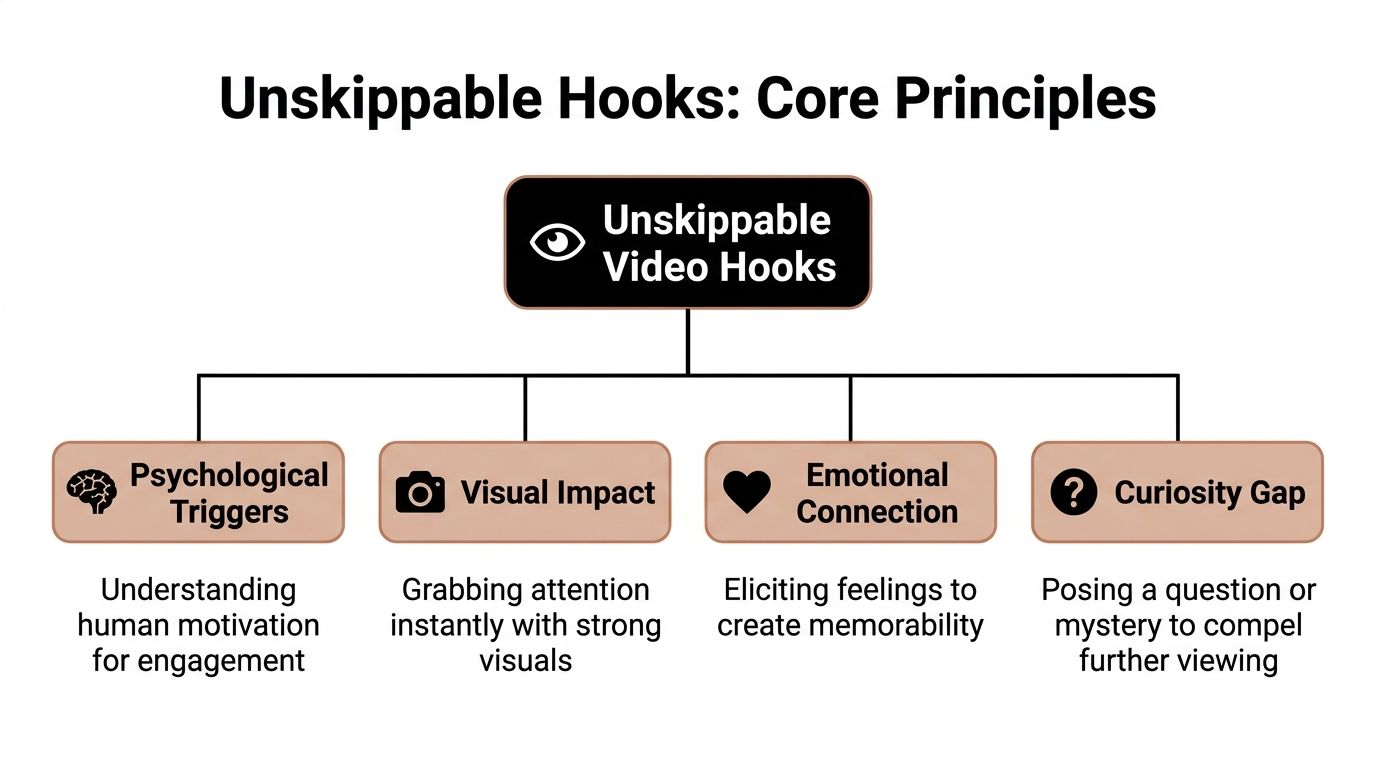
Pattern interrupt
Feeds train people to ignore familiar shapes. Pattern interrupt works by breaking that autopilot.
That can be an extreme close-up, an odd camera angle, a frozen action frame, a surprising prop, abrupt motion, or a visual contradiction. The exact device matters less than the effect. The viewer has to feel that this unit is different from the content around it.
This principle is especially useful when your category is crowded. Supplements, mobile apps, beauty, and DTC gadgets all suffer from repetitive ad grammar. If every competitor opens with the same smiling creator and product hold, the brand that breaks the visual rhythm gets the extra second.
Immediate relevance
Some hooks do not need surprise. They need precision.
When you call out a pain point clearly, the right person recognizes themselves fast. “Your app installs are expensive because the ad starts too late” is stronger than a generic “Struggling with performance?” because it sounds like it was made for a specific buyer.
Immediate relevance works best when the audience is already problem-aware. It is often more effective than broad curiosity because it filters in the right viewer rather than trying to entertain everyone.
Credibility spark
People assess trust quickly. A hook that flashes proof early can lower skepticism before the body of the ad begins.
Credibility sparks include a founder face, a product UI doing something concrete, a customer reaction, a category-specific result statement, or a recognizable use case. This is not the same as dumping a long testimonial into the opening. It is a fast cue that says, “this is real.”
Curiosity with payoff discipline
Curiosity still matters, but sloppy curiosity loses. If the opening hints at a reveal and the next seconds meander, viewers leave.
Good curiosity creates tension and resolves it fast. It gives just enough information to keep the viewer moving into the body. If your team builds around modular creative, this Hook-Body-CTA breakdown is worth keeping close: https://sovran.ai/blog/hook-body-cta-video-ad-structure
A hook earns attention by being different, relevant, credible, or unresolved. The strongest ones combine two of those in the same opening beat.
A simple decision table
| Situation | Hook principle to prioritize | Why |
|---|---|---|
| Crowded visual category | Pattern interrupt | You need to break feed sameness first |
| Pain-aware audience | Immediate relevance | Precision filters in qualified viewers |
| Skeptical buyer | Credibility spark | Proof lowers resistance quickly |
| Product needs demonstration | Curiosity with payoff | Tease the result, then show it fast |
Your Playbook for Crafting and Scripting Hooks
A winning hook rarely comes from a single clever line. It comes from volume, selection, and discipline. The process matters more than inspiration.
Meta and TikTok buyers should pay attention to one data point here. NextDrop Design reports that internal TikTok metrics from 2025 showed hooks using pattern interrupts, such as extreme close-ups or surreal visuals, achieved a 28% higher 3-second view rate than static intros in performance campaigns. The same source says recent Meta audits found problem-agitation hooks outperformed simple role-callouts by 15% in click-through rate for mobile app install campaigns.
Start with hook families, not single ideas
Do not brief “one good hook.” Brief a set of hook families.
For many performance teams, these are the most useful families:
Problem agitation
Open on the cost of the problem. This works well for app installs, utilities, finance tools, and products solving a clear friction point.
Visual disruption
Use a shot that earns attention before any spoken line lands. This is useful when the product itself is visually boring and the ad needs motion to win the stop.
Fast proof
Start with the output, result, interface, or before-and-after moment. Good for software, creators, and tools with a visible payoff.
UGC confession
Use a creator-style opener that sounds like a real admission, not an ad voiceover. Best when authenticity matters more than polish.
Question with tension
Ask something the target viewer would answer internally. This only works when the next line moves immediately toward payoff.
Script the first beat at frame level
Many teams write hooks like copywriters. Better teams build them like editors.
Think in three layers:
- Visual: What appears first?
- Text: What can be read instantly with no audio?
- Audio: What line or sound tightens the stop?
A few practical formulas:
- Problem first: “Still paying for clicks that never convert?”
- Proof first: “This is the exact screen that fixed our onboarding drop-off.”
- Disruption first: Start with a zoomed-in texture, odd movement, or impossible-looking frame, then label it.
- UGC first: “I thought this app was overhyped until I tried this one feature.”
If your team also cares about broader organic mechanics, not just paid response, this guide on how to make a video go viral can help with idea shaping. The paid version still needs stronger message discipline than most viral-first advice suggests.
Build around what the viewer can understand without sound
Many ads still assume sound will carry the opening. That is a mistake.
The first frames should communicate the category, tension, or benefit without relying on voiceover. Strong subtitle timing, readable text, product visibility, and obvious motion do more work than clever scripting alone. If you need examples of scroll-stopping opening mechanics, this reference is useful: https://sovran.ai/blog/scroll-stopping-hooks
Use this pre-launch QA check
Before a first 3 seconds video ad goes live, check the hook against this list:
- Is the value obvious fast: Can a cold viewer tell what problem or outcome is being teased?
- Does the opening move: Static frames usually underperform when the feed around them is full of motion.
- Can it work muted: Text, product visuals, and framing should still carry the message.
- Is the first cut clean: Muddy edits weaken the stop even when the concept is right.
- Is the brand present early: Product, interface, packaging, or brand world should appear fast enough to matter.
- Does the body fulfill the promise: The opening cannot overpromise and then drift.
- Did you write alternates: One hook is an opinion. Multiple hooks are a testing plan.
Hook writing gets better when teams stop protecting ideas and start producing options.
A Framework for Testing and Measuring Hook Performance
Creative instinct matters. It just should not make final decisions on its own. A hook is a hypothesis until it survives a controlled test.
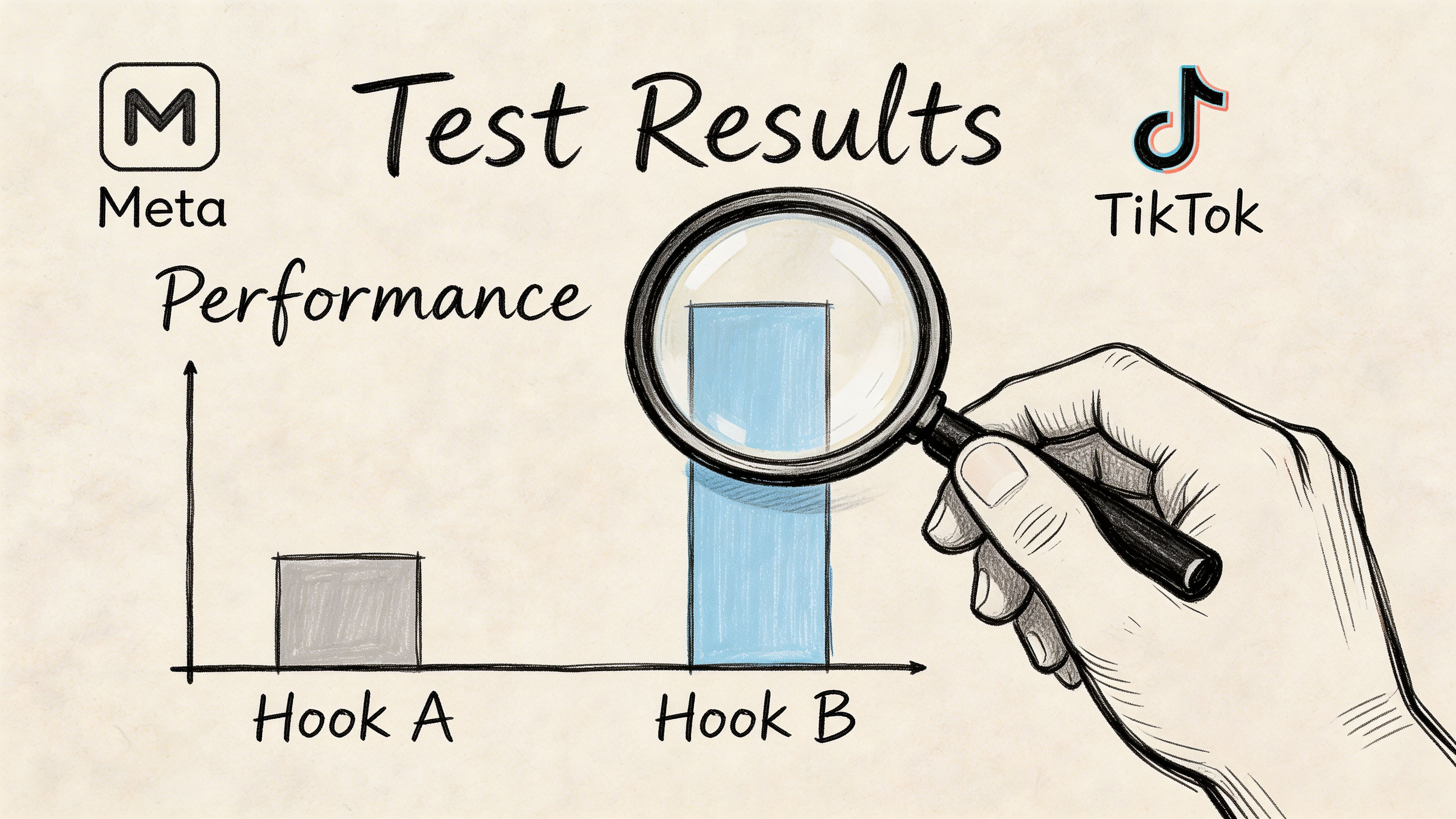
The cleanest way to test a first 3 seconds video ad is to isolate the opening while keeping the body, offer, CTA, audience, and spend conditions as consistent as possible. If you change multiple variables at once, you lose the ability to learn what caused the lift or drop.
Predictive Marketing gives useful benchmarks here. For video ads, top targets put Thumb-Stop Rate above 30%. Hooks hitting that level are shown to boost CTR by 20-35%. The same source says strong hooks should correlate with 25-50% average watch time, and that 47% of viewers make a retention decision in this initial phase. It also notes that without systematic A/B testing, an estimated 80% of untested hooks fail to perform optimally.
What to hold constant
When testing hooks, keep these fixed:
- The same body copy
- The same CTA
- The same offer
- The same edit length after the hook
- The same audience structure
- The same platform placement mix when possible
Change only the opening seconds. That gives you a clean read on the hook itself.
What to measure first
Do not jump straight to CPA and call the test too early. Use leading indicators first, then connect them to downstream outcomes.
Key reads:
- Thumb-Stop Rate: Did the opening pause the scroll?
- 3-second view rate or hook hold: Did the interruption sustain attention long enough to count?
- Average watch time: Did the opening pull people into the body, or did it create empty curiosity?
- CTR: Did attention turn into action?
A practical testing workflow is easier when the process is standardized. This guide on how to test video ad hooks scientifically lays that out well: https://sovran.ai/blog/how-to-test-video-ad-hooks-scientifically
How to interpret mixed signals
A hook can win one metric and fail the campaign. That is normal.
Here is a quick read table:
| Signal pattern | Likely issue | Next move |
|---|---|---|
| High thumb-stop, weak 3-second hold | Opening is flashy but unclear | Tighten message clarity after the first visual beat |
| Strong hold, weak CTR | Hook is relevant but offer or body is soft | Rewrite body and CTA before killing the concept |
| Low thumb-stop, decent downstream metrics | Good ad trapped behind weak opening | Replace only the first beat |
| High early metrics, poor conversion | Hook attracts curiosity, not buyer intent | Make the opening more qualifying |
A short walkthrough can help teams align on this logic before launching bigger tests:
The goal is not to find a hook that “looks good.” It is to find one that improves the whole funnel without polluting the audience with the wrong kind of attention.
How to Scale Hook Production and Find Winners Faster
Manual editing is the hidden tax on hook testing. The strategy can be right and the team can still lose because production speed is too slow.
That bottleneck matters more now because winning openings burn out. Audiences on Meta and TikTok see patterns quickly. If your workflow depends on someone manually rebuilding every variant in CapCut or Premiere, the account often runs out of creative momentum before the team finds enough winners.
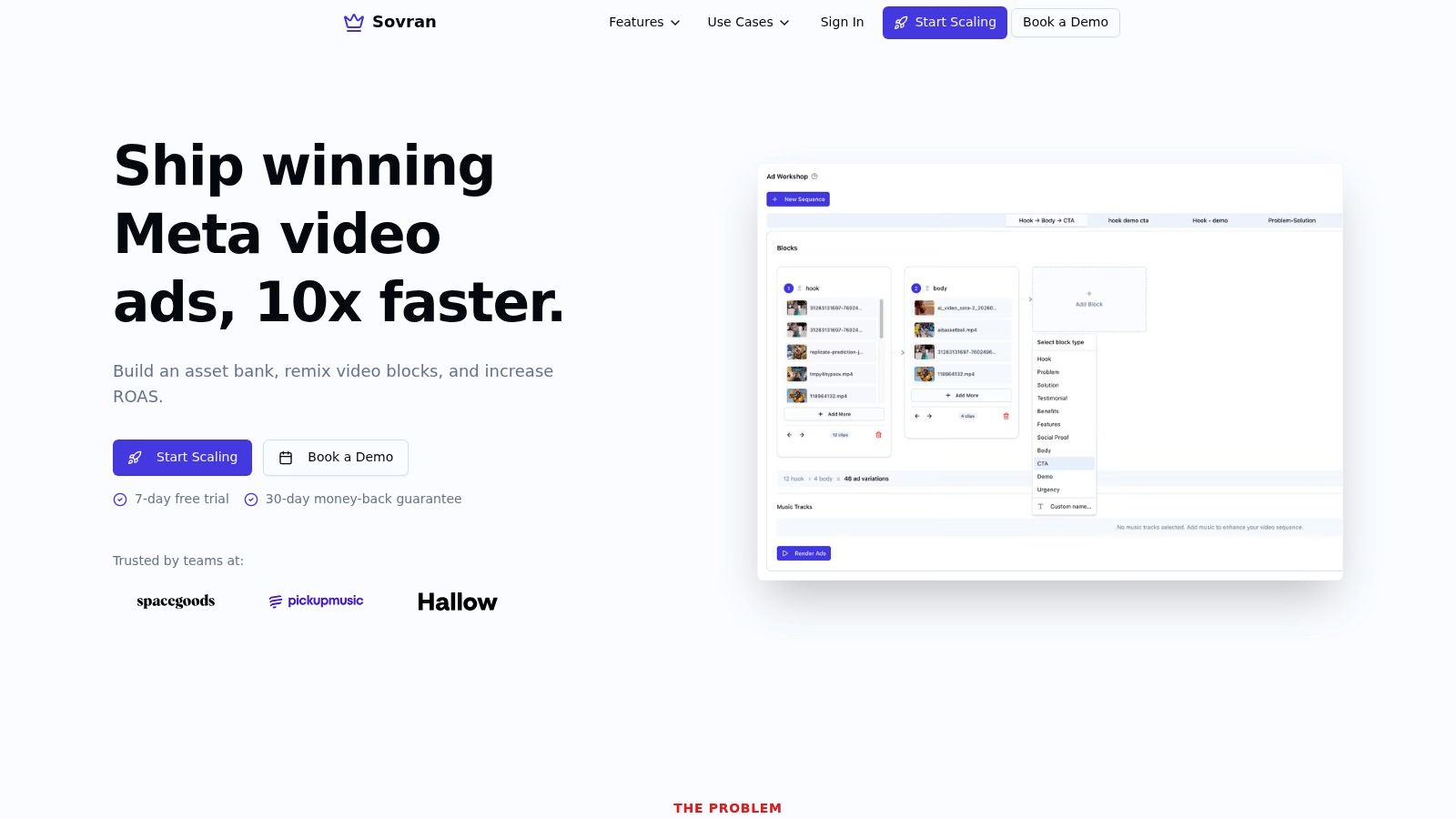
The operational case for AI is straightforward. A YouTube source summarizing recent 2025 TikTok developer reports says AI-remixed hooks generated from existing UGC clips retained 40% more viewers in the first 3 seconds compared with manually edited versions, and allowed teams to find winning ads up to 3x faster in high-velocity campaigns (YouTube).
Why manual workflows break
The old model has three recurring problems:
- Selection takes too long: Teams waste hours scrubbing footage to find one viable opener.
- Versioning is expensive: Small timing changes require too much hands-on editing.
- Learning loops stay slow: By the time results come back, the team has too few fresh variants ready.
That is why modular production beats one-off craftsmanship for paid social. You need reusable clips, reusable overlays, reusable structures, and a way to swap the hook without rebuilding the entire ad. This modular video ad framework is the right operating model for that: https://sovran.ai/blog/modular-video-ad-framework
What scalable production looks like
A scalable setup usually includes:
- Tagged asset libraries: So editors and buyers can find “reaction shot,” “extreme close-up,” “UI demo,” or “founder credibility clip” fast.
- Reusable ad structures: Hook, body, proof, CTA assembled as components, not fixed edits.
- Batch rendering: So multiple openers can be exported at once with text and subtitle variations.
- Brand context stored centrally: So generated variants stay aligned with product language and claims.
A platform like Sovran integrates these capabilities. It tags uploaded clips into reusable building blocks, supports Hook-Body-CTA assembly, stores brand guidance in a Context Vault, and batch-renders variants for Meta and TikTok without rebuilding each ad manually.
The fundamental trade-off
Some teams hesitate because AI-generated variation can feel less handcrafted. That concern is fair. But in paid social, handcrafted does not automatically mean effective.
The more effective trade-off is controlled automation. Keep the strategic inputs human. Let systems handle tagging, swapping, subtitle versions, and bulk output. The creative director still decides what should be tested. The machine removes the production drag that keeps those tests from happening.
Answering Your Top Questions About Video Ad Hooks
Should hooks be different on Meta and TikTok
Yes, but not in the way many teams think.
The core job stays the same. Stop the scroll, signal relevance, and move into the body fast. The difference is usually in creative texture. TikTok often tolerates rougher, creator-led framing. Meta often rewards cleaner clarity earlier. The hook concept can stay the same while the packaging changes.
How many hook variants should I test at once
Test as many as your team can support without muddying the read.
A smaller set of distinct concepts usually beats a pile of tiny cosmetic edits. You want meaningful variation. Problem agitation versus proof-first versus visual disruption is useful. Five near-identical text changes often are not.
Should I use text overlays in the first three seconds
Usually yes, especially when the opening needs to work without sound.
Keep text short. Make it readable on a phone. Let the text support the visual rather than compete with it. If the footage is already doing the heavy lifting, the overlay should label the value, not explain the entire ad.
When should I use a simple opener instead of an elaborate sequence
Use simple openers when the product payoff is easy to understand in one glance.
If the result is obvious, extra visual complexity can slow comprehension. A clean product screen, a direct line, and one movement beat can outperform a stylish sequence that takes too long to decode.
What does a bad hook usually look like
Bad hooks tend to fail in one of three ways.
They are slow. They are vague. Or they attract the wrong attention. The first category gets scrolled past. The second confuses people. The third generates curiosity that never converts.
How do I know whether to kill or iterate a weak opener
Look at where it breaks.
If it does not stop the thumb, replace it. If it stops the thumb but loses people immediately after, keep the concept and fix the transition into the body. If it holds attention but clicks stay weak, the hook may be fine and the offer may be the underlying problem.
Should the brand appear in the first three seconds
Usually yes, but it should appear through product, interface, packaging, or use case rather than a slow logo reveal.
People need to know what world they just entered. Early branding works when it is embedded in the action.
If your team needs more hook volume without turning every test cycle into a manual editing project, Sovran is built for that workflow. You can upload clips once, tag them into reusable parts, generate Hook-Body-CTA variants, and move from idea to test much faster while keeping outputs aligned with brand context.

Manson Chen
Founder, Sovran
Related Articles

8 Pattern Interrupt Techniques for Video Ads

Customer Journey Mapping for Performance Marketing