Video Ad Components Breakdown to Scale Your Campaigns
Jump to a section
- The Building Blocks of High-Converting Video Ads
- Mastering the First Three Seconds with a Perfect Hook
- Building the Ad Body to Deliver on Your Promise
- Driving Action with an Irresistible CTA and Social Proof
- How to Assemble Components into Winning Ad Formulas
- Scaling Creative Production with a Modular System
- Frequently Asked Questions
Ever wonder how top performance marketers crank out winning video ads like it's second nature? It’s not about luck or some mystical creative genius. It's about a process.
They've learned to stop seeing a video ad as one big, monolithic thing and start seeing it for what it is: a collection of individual parts. We're talking about the hook, the body, and the call to action, all working together. By breaking ads down into these building blocks, you can test, swap, and optimize each piece on its own, which is the real secret to scaling up your campaigns.
The Building Blocks of High-Converting Video Ads
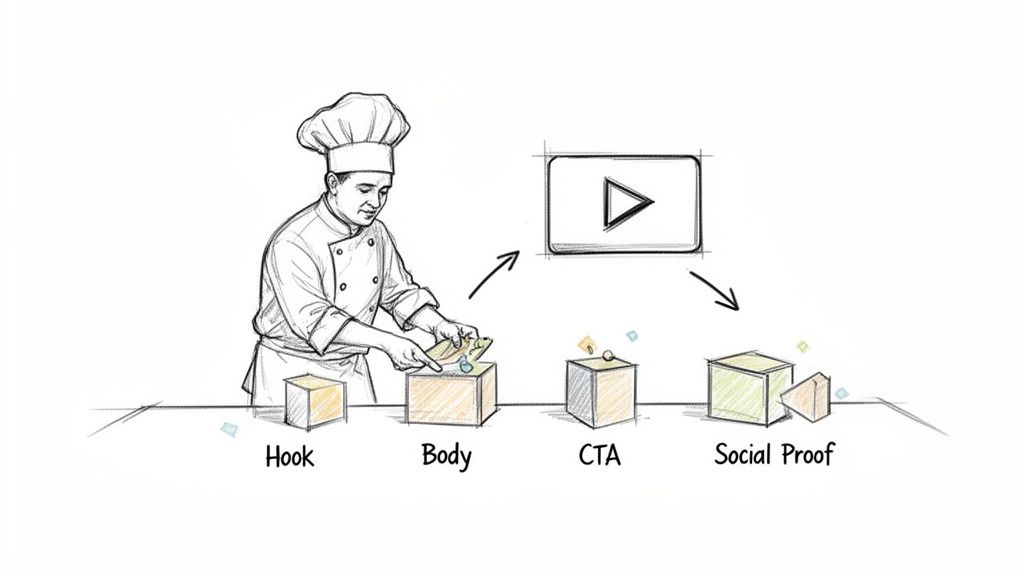
The best-performing video ads aren't born from a single flash of inspiration. They’re assembled, piece by piece, with scientific precision. Top marketers don’t just throw ideas at the wall and hope something sticks; they use a systematic, component-based approach.
Think about it like a master chef building a signature dish. They don’t just randomly throw things in a bowl. They understand exactly what each ingredient does—the sharp acidity of a fresh lemon, the salty punch of capers, the rich base of olive oil. Each element has a job.
A savvy marketer treats their video ad components the same way. This mindset shift is what separates the pros from the amateurs and unlocks the kind of rapid growth you've been looking for.
Why This Component-Based Approach Matters
Adopting this methodical approach has never been more important. The world of video advertising is absolutely exploding. In 2024, global spending on digital video ads rocketed past $191.3 billion, and it's on track to blow past $456 billion by 2025. This isn't just a fleeting trend—it's a seismic shift in marketing, and it demands a smarter, more analytical way of thinking about creative.
When you break down your video ad, you turn the creative process from a guessing game into a predictable science. You stop asking, "Did the ad work?" and start asking, "Which part of the ad worked, and how can we do more of that?"
This approach forces you out of the "good video/bad video" mindset. It pushes you toward a granular analysis that gives you real, actionable insights you can build on. Getting a handle on each part is the first step toward truly applying video marketing best practices across your campaigns.
Core Video Ad Components and Their Purpose
Before we get into the nitty-gritty, let's make sure we're all speaking the same language. Here’s a quick-reference table that breaks down the essential video ad components and the specific job each one has.
| Component | Primary Role |
|---|---|
| Hook | Stop the scroll and grab attention in the first 1-3 seconds. |
| Body / Value Prop | Deliver on the hook's promise and demonstrate the product's value. |
| Social Proof | Build trust and credibility with testimonials, reviews, or UGC. |
| Call to Action (CTA) | Tell the viewer exactly what to do next. |
This table is your cheat sheet. These are the core ingredients we'll be dissecting throughout this guide.
By mastering how each of these individual elements works, you'll be able to mix and match them into endless ad variations, test them without wasting time or money, and consistently find the winning combinations that deliver real results.
Mastering the First Three Seconds with a Perfect Hook
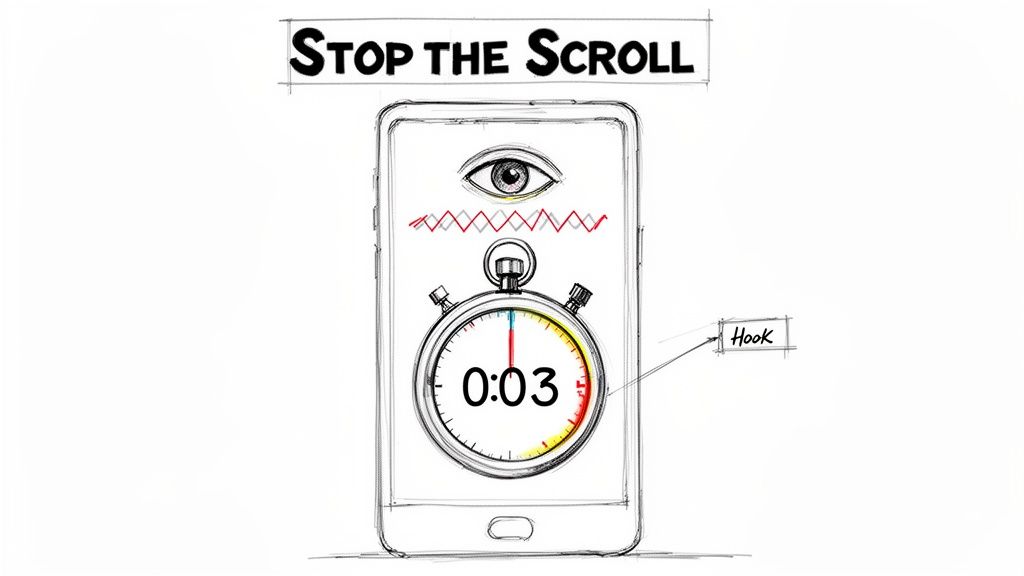
Let's get straight to it. In the fast-moving world of social feeds, your ad isn't just up against other brands. You’re fighting for attention against your viewer’s best friend, breaking news, and an endless stream of memes. This is exactly why the hook is the first, and most critical, component of any video ad.
Its only job? To slam the brakes on the user's thumb. You have about three seconds to give them a reason to stop scrolling. If the hook fails, everything that follows—no matter how creative or persuasive—is completely wasted.
And the competition is fierce. With an estimated 34 million videos hitting TikTok every single day, a weak opening just gets lost in the noise. A great hook isn't a bonus; it's a basic requirement for your ad to even have a chance.
Battle-Tested Hook Strategies
A hook that works isn't just about getting lucky. It’s applied psychology. You need to break a pattern, spark some curiosity, or connect with a real emotion. Here are three powerful approaches that we see win time and time again.
The Problem-First Hook: This is the most direct method. You lead with the viewer’s pain point, showing them you get their struggle right from the start. It makes them think, "Okay, you understand me," and they lean in to hear your solution.
- Example (Fintech App): A quick shot of someone looking completely overwhelmed by a spreadsheet, with a text overlay: "Does budgeting feel impossible?"
- Example (Skincare Brand): A user-generated clip showing someone’s real-life acne, with the caption: "Tired of breakouts ruining your plans?"
The Pattern Interrupt: This strategy uses a jarring visual, an unexpected sound, or a bizarre statement to jolt someone out of their scrolling hypnosis. The goal is to make them pause and think, "Wait, what did I just see?"
- Example (Mobile Game): The ad kicks off with the sound of shattering glass as a character smashes through the screen.
- Example (D2C Product): An opening shot of a product being used in a totally weird way, like someone using a fancy new blender to mix paint.
The Provocative Question: Asking a direct question forces the viewer's brain to engage and start looking for an answer. This creates an "open loop" they feel a natural urge to close, turning them from a passive viewer into an active participant.
- Example (Language App): "What if you could be fluent in Spanish in just 10 minutes a day?"
- Example (Productivity Tool): "Are you actually getting the most out of your workday?"
A/B Testing Hooks for Peak Performance
Because the hook is the gateway to your entire ad, it's the single most important element to test. I've seen a single hook variation double or even triple an ad's click-through rate.
Your best-performing ad isn't created—it's discovered. Systematic A/B testing is the only way to find the hook that truly connects with your audience and drives down your acquisition costs.
To start, create three to five different hooks for the same ad body. Run them with a small, controlled budget and watch one metric above all others: 3-second view rate, or what we call hook rate. This tells you what percentage of people bothered to watch past that crucial three-second mark.
The hook with the highest rate is your winner. From there, you can pair that winning hook with different ad bodies to keep optimizing. To really dial in your process, check out our guide on how to test video ad hooks scientifically. It's the systematic approach that separates the pros from the amateurs.
Building the Ad Body to Deliver on Your Promise
So you’ve stopped the scroll with a killer hook. Great. Now the real work begins. The ad's body is where you have to deliver on the promise you just made, transitioning from grabbing their attention to creating a genuine need for your product.
Think of it this way: your hook is the incredible aroma wafting out of a bakery that pulls someone in off the street. The body is the actual taste of that warm, delicious pastry. It absolutely has to be satisfying and live up to the hype, proving they made the right choice to stop and pay attention.
A weak body is an instant momentum killer. You'll see a huge drop-off rate as viewers, intrigued by the hook, quickly realize there's nothing of substance for them and scroll on.
Structuring the Body for Maximum Impact
There's no single "right" way to build your ad's body. The best structure really depends on what you’re selling and what your hook promised. That said, most of the successful ads we see fall into one of three formats, each designed to hold interest in a different way.
The Product Showcase: This is your direct, feature-first approach. You get right into showing the product in action, focusing on the key functions that solve the viewer's problem. It’s less about telling a story and more about showing tangible, undeniable proof. A fintech app might use a clean screen recording of its one-click budgeting tool, while a mobile game would cut straight to the most exciting gameplay.
The Micro-Story: This format creates an emotional connection through a simple narrative. It often follows the classic "problem-agitate-solution" arc. You show a relatable person struggling with a common problem, amplify that frustration, and then position your product as the hero that saves the day.
The Listicle: Borrowing a page from high-performing blog content, the listicle breaks down information into an easy-to-scan numbered or bulleted list. This works incredibly well for highlighting multiple benefits or features without overwhelming the viewer. An ad for a vitamin supplement, for instance, might use bold text overlays to list "3 Ways to Reclaim Your Energy" over energetic lifestyle shots.
Essential Elements for a Compelling Body
Beyond the overall structure, a few key elements need to work together to keep the viewer glued to the screen. Pacing, visuals, and audio are everything here.
You absolutely need fast, dynamic cuts and engaging B-roll to maintain energy. You can get some great ideas from our guide on b-roll examples for high-impact ads.
The goal of the ad body is to build an undeniable case for your product before you ever ask for the sale. Every second should be packed with value, whether it's educational, entertaining, or emotional.
Text overlays are another non-negotiable tool. They’re critical for reinforcing your message, especially since 85% of social media videos are watched with the sound off. Use them to call out benefits, pop key features on screen, or just guide the viewer's eye where you want it to go.
Finally, never underestimate the power of audio. The right soundtrack can make or break your conversion rate. This means taking the time to find effective music for Facebook ads that actually matches the mood and energy of your visuals. A mismatched track instantly kills the vibe and makes people scroll away, no matter how good your visuals are. When you get all these components right, you create a rich experience that holds attention and hammers your message home.
Driving Action with an Irresistible CTA and Social Proof
Getting someone to watch your ad is half the battle. Getting them to actually do something? That's where the money is.
The final few seconds of your ad are your moment to close the deal. This is where two key players come in: the Call to Action (CTA) and Social Proof. They work together as a one-two punch to turn a passive viewer into a paying customer.
The CTA is your direct instruction. After you've spent the ad building desire, the CTA needs to tell the viewer exactly what to do next, with no room for confusion. A fuzzy or non-existent CTA is like telling a great joke without the punchline—it just leaves people hanging and kills the momentum.
But even a strong CTA can run into last-second doubt. That’s where social proof swoops in. It’s the voice of everyone who’s already bought from you, telling the new person, "It's cool, we did it and it was great." It lowers the risk and makes clicking that button feel like a much safer bet.
Crafting a Compelling Call to Action
Let's get one thing straight: "Learn More" is not a CTA. It's a suggestion. Your CTA needs to be specific, packed with value, and feel just a little bit urgent. You want to make the action feel both simple and too good to pass up.
Create Urgency: Frame your offer like it won't be around forever. "Shop the Sale Before It Ends" works way better than just "Shop Now." You're tapping into a little FOMO (fear of missing out) to get them to act immediately.
Highlight the Benefit: Connect the click to the reward. Instead of a dry "Download," go with "Get Your Free Meal Plan." You're selling the destination, not the plane ticket.
Be Direct and Clear: This isn't the time for clever wordplay. Simple, action-focused phrases are your best friend. "Start Your Free Trial," "Book Your Demo," and "Claim Your Discount" are crystal clear.
Your CTA is the single most important instruction you will give your viewer. Make it impossible to misunderstand and too good to ignore.
A weak CTA throws away all the hard work your hook and body just did. It's the final, crucial puzzle piece.
Weaving in Social Proof to Build Trust
Social proof is basically a psychological shortcut. When people are unsure what to do, they look at what others are doing. Seeing that people just like them had a great experience with your product builds instant credibility. It’s the perfect way to squash skepticism right before you ask for the click.
Here are a few ways to bake social proof into the end of your video ads:
User Testimonials: A short clip of a genuinely happy customer is pure gold. Seeing and hearing a real person vouch for you is incredibly persuasive. If you need some inspiration, our post on testimonial ad examples breaks down why this works so well.
Star Ratings and Reviews: Nothing says "quality" faster than a visual of a 5-star rating. An overlay that pops up with "4.9/5 stars from 10,000+ reviews" is a powerful, instant signal of trust.
Press Mentions or Awards: Have you been featured somewhere cool? Flaunt it. Showing logos from publications like TechCrunch or Forbes ("As seen on...") is a form of third-party validation that money can't buy.
User-Generated Content (UGC): A rapid-fire montage of real customers using and loving your product feels authentic and raw. It’s unpolished proof that real people are getting real value.
When you combine a clear command (the CTA) with this kind of peer validation (social proof), you make the decision to convert easy. The data doesn't lie; this stuff works. For instance, a whopping 87% of video marketers say video has directly boosted their sales. To see more stats on how video impacts the bottom line, check out these video marketing statistics.
How to Assemble Components into Winning Ad Formulas
Alright, you know the individual building blocks. Now it's time for the fun part: putting them together into ad formulas that actually work. This is where theory gets real and where understanding ad components turns into a strategy that can make you money.
Think of it like being a chef. Knowing what salt, fat, and acid do is one thing. But the real magic happens when you know the classic recipes—how to combine those elements to create something incredible. Top-tier marketers don't just randomly mix hooks, bodies, and CTAs. They follow proven narrative sequences designed to get people to act.
Once you master these core formulas, you can start mixing and matching them to develop your own winning combinations for high-impact marketing campaigns. This is exactly where a modular system like Sovran gives you a serious edge, letting you build, test, and find the perfect narrative structure for your audience in a fraction of the time.
We see a handful of video ad frameworks consistently outperform the rest. Understanding what they are and when to use them is the first step to building a repeatable creative strategy.
Video Ad Framework Comparison
| Framework | Best For | Component Sequence |
|---|---|---|
| Hook-Body-CTA | Direct response, retargeting, and simple value props. | 1. Grab attention. 2. Deliver value. 3. Ask for the sale. |
| Problem-Agitate-Solution | Top-of-funnel, building demand, and emotional connection. | 1. Show a relatable problem. 2. Amplify the pain. 3. Introduce your product as the hero. |
| UGC Mashup | Building trust, social proof-heavy ads, and skeptical audiences. | 1. Authentic UGC hook. 2. Montage of testimonials. 3. Benefit-driven CTA. |
Let's break down exactly how to execute each of these powerhouse formulas.
The Classic Hook-Body-CTA Formula
This is the bread and butter of direct response. It's simple, it's effective, and it gets right to the point. You'll see this workhorse formula everywhere on Meta and TikTok because, well, it works.
The sequence is exactly what it sounds like. You grab their attention, show them why they should care, and then tell them what to do next. It's a no-fluff approach that's perfect for audiences who are already problem-aware or are ready for a direct offer.
- Hook (1-3 seconds): Hit them with your strongest scroll-stopper. It could be a sharp question, a wild visual, or a statement they can't ignore.
- Body (5-15 seconds): Immediately pay off the hook's promise. Show the product doing its thing, demonstrate the biggest benefit, or give a super-quick demo.
- CTA (3-5 seconds): End with a crystal-clear call to action. We often see the best results when this is reinforced with a splash of social proof or a hint of urgency.
This is your go-to framework for retargeting campaigns or for any product with a value prop so clear you can show it in just a few seconds.
The Problem-Agitate-Solution Formula
The Problem-Agitate-Solution (PAS) model is a copywriting classic that translates beautifully to video. It's engineered to forge a strong emotional connection by tapping directly into your viewer’s frustrations before you ever introduce your product.
PAS is so effective because it follows a natural psychological path. First, you make the viewer feel seen by validating their struggle. Then you intensify that feeling just a bit, which makes the final solution feel like a massive relief.
The PAS formula doesn’t just show a solution; it makes the viewer feel the need for it. By agitating the problem, you increase the perceived value of your product when it's finally revealed.
Here's how that sequence plays out:
- Problem (3-5 seconds): Open by showing a struggle your audience knows all too well. A quick UGC clip of someone looking frustrated is perfect for this.
- Agitate (3-5 seconds): Don't solve it yet! Pour a little salt in the wound. Use text overlays or fast cuts to highlight the negative consequences or annoying results of that problem.
- Solution (5-10 seconds): Now, bring in your product as the hero. Show how it solves that exact problem with ease, creating a satisfying sense of relief for the viewer.
This framework is an absolute killer for top-of-funnel campaigns where you need to build awareness from scratch and create demand.
The UGC-Testimonial Mashup
This formula puts authenticity on a pedestal. It works by combining the two most powerful types of social proof we have: User-Generated Content (UGC) and direct testimonials. The result is an ad that feels less like a corporate pitch and more like a genuine tip from a trusted friend.
It’s an incredibly smart approach for winning over skeptical audiences. Instead of you telling them your product is great, you’re letting a chorus of happy customers do the selling for you. This hierarchy of trust is what makes a CTA truly irresistible.
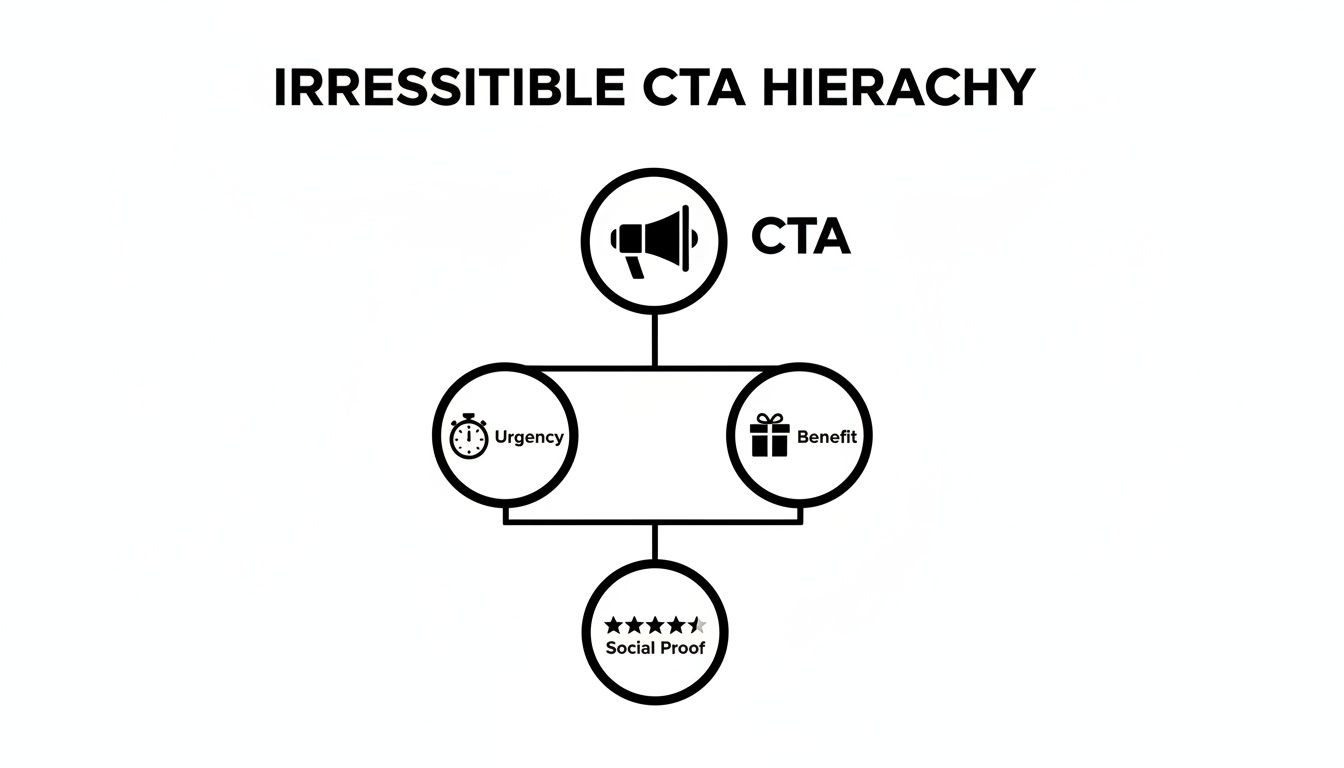
As you can see, while urgency and benefits are crucial, it’s that foundation of social proof that makes the entire offer feel solid, believable, and compelling.
The structure is usually fast-paced and feels native to the feed:
- Quick Hook: Kick things off with a relatable UGC clip or a powerful quote pulled from a rave review.
- Rapid-Fire Proof: Cut together a quick montage of different users showing the product, using it, or talking about their results.
- Benefit-Driven CTA: Close out with an offer that directly connects to all the positive outcomes they just saw.
Scaling Creative Production with a Modular System
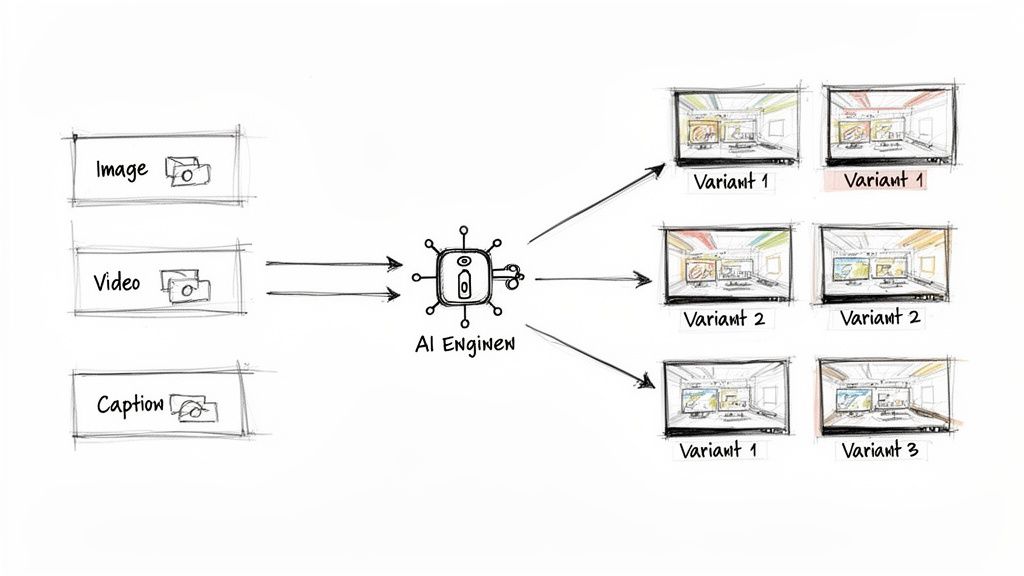
Alright, so you know how to build a winning ad formula. That’s one thing. But actually producing enough variations to keep your campaigns fresh and profitable? That's a completely different beast.
This is where most growth teams slam into a wall. They get trapped in the slow, manual grind of traditional video editing, and it kills their momentum.
Relying on tools like CapCut or Premiere Pro for every single ad variant is a recipe for falling behind. It just doesn't support the high-velocity testing you need to find top performers and fight off ad fatigue. You waste hours duplicating projects, swapping out one clip, and re-rendering everything—time you simply don't have.
To break free, you need to shift your mindset. You're not just a creative strategist anymore; you're a producer operating at scale. And for that, you need a creative engine, not just an editing tool.
From Manual Labor to a Creative Engine
Think about it like this: you could try to build a hundred Lego cars by hand, snapping together every single brick one by one. It would take forever.
Now, what if you had a machine that could instantly assemble hundreds of different car models using your pre-approved bricks? That’s the leap from manual editing to a modular, AI-powered system.
A modular system lets you stop thinking about individual videos and start thinking in components. You upload your assets—all your hooks, body clips, CTAs, and testimonials—just once. The system then tags and organizes them into a reusable library. These are your "Lego bricks."
By treating every part of your ad as a modular component, you empower yourself to generate hundreds of ad variations in minutes, not days. This fundamentally changes your team's capacity for testing and learning.
This approach takes the video ad components breakdown we've been talking about and puts it into action. It turns a strategic concept into a production reality, letting your team execute complex testing plans with ease. You can dive deeper into how this all connects in our guide to the modular video ad framework.
The Power of AI in Modular Production
This is where AI becomes a true game-changer. An intelligent system can take your tagged assets and automatically assemble them based on the winning formulas we've already covered.
You can set simple rules like: "Combine these five hooks with these three product demos and these two CTAs." The AI then gets to work, generating every possible combination, complete with on-brand text overlays and perfectly formatted captions.
Just imagine what this unlocks:
- Rapid Iteration: Generate 50+ ad variants from a single concept before you’ve even finished your morning coffee.
- Formula-Based Assembly: Automatically build ads based on proven structures like Problem-Agitate-Solution or UGC mashups.
- Systematic Testing: Launch ads with structured naming conventions that make it dead simple to track which hook, body, and CTA combinations are actually winning.
This systematic approach liberates your team from the mind-numbing work of manual editing. It allows them to focus on what really moves the needle: analyzing performance data and shaping high-level creative strategy. You'll find profitable winners faster, keep campaigns from going stale, and finally get ahead of creative fatigue for good.
Frequently Asked Questions
Alright, we've covered the building blocks of a killer video ad. But theory is one thing, and putting it into practice is another. When you're in the trenches, real questions pop up.
Here are the answers to the most common ones we get from performance marketers every day.
How Long Should My Video Ad Be?
There’s no magic number here—it all comes down to the platform and what you’re trying to achieve. As a rule of thumb, for platforms like TikTok and Meta, you should aim for 15-30 seconds. That's the sweet spot for grabbing attention while still having enough time to run through a full Hook-Body-CTA sequence.
That said, don't write off longer ads completely. If you have a more complex product or you're retargeting a warm audience that already knows you, testing a 60+ second video can work wonders.
What’s More Important: The Hook Or The CTA?
The hook. Every single time.
A brilliant CTA is crucial for getting the click, but it's totally useless if nobody sticks around long enough to see it. A great hook earns you the viewer's attention; the CTA is how you cash in on it.
When you're starting a new round of testing, put your budget and energy into finding a winning hook first. It has the single biggest impact on your ad's view-through rate and overall performance.
A great hook can make a mediocre ad watchable. A great CTA can’t save an unwatchable ad. Prioritize stopping the scroll first, then focus on driving the click.
How Much Should I Budget for Ads on Different Platforms?
Ad costs are all over the map, but here are some rough benchmarks. On average, you might see a $1.00 cost per click (CPC) on TikTok, while Instagram can range from $0.20 - $2.00 per click. Facebook's average CPC hovers around $0.44, but it can get incredibly competitive.
A few things to keep in mind:
- Platform Minimums: TikTok, for example, requires a minimum daily budget of $50 at the campaign level.
- Audience Competition: Reaching a broad, general audience is usually cheaper than targeting a hyper-specific, high-value one.
- Time of Year: Brace yourself for costs to climb during big shopping holidays like Black Friday.
The golden rule is to always start with a small, controlled test budget. Find your winning creative, and then scale up.
Ready to stop wasting hours in editing software and start pumping out winning ads? Sovran uses AI to turn your raw footage into hundreds of testable ad variations in minutes.
Start your free 7-day trial and find your next winner faster.

Manson Chen
Founder, Sovran
Related Articles
Demographic Targeting: A Performance Marketer's Guide 2026

Create Video Ads with AI That Perform in 2026