AI Is Which Generation? a Clear Guide for Marketers
Jump to a section
- Why the Question Is Trickier Than It Sounds
- The Technical Answer From Rule-Based to Deep Learning
- A Newer Four-Generation View of AI
- How AI Generations Show Up in the Timeline
- When “Generation” Actually Means People, Not Tech
- What Each AI Generation Means for Ad Creative
- Practical Recommendations for UA Managers
A colleague asks, “What generation of AI are we on?” Do they want a history answer, a model label, or a forecast of who uses AI most at work? A UA manager can give three different answers and have every one sound reasonable.
That's the problem with “AI is which generation?” In a planning meeting, “generation” might describe the age of the technology, the type of model inside a vendor's product, or a human cohort such as Gen Z and Millennials. Those meanings lead to different decisions about creative production, audience strategy, measurement, and platform adoption.
For performance marketers, the useful answer isn't a single ordinal number. It's a working map. The map below separates the technical generations, the newer agentic taxonomy, the historical timeline, and the human-generation question, then connects each one to the ad workflows you manage. For adjacent context, AI for advertisers is useful when translating broad AI concepts into paid-media work.
Why the Question Is Trickier Than It Sounds
A UA manager is reviewing a creative testing plan. Someone asks whether the team should prepare for the “next generation of AI.” One person hears a question about generative tools. Another hears a question about autonomous campaign management. A third assumes the conversation is about Gen Z adoption.
All three interpretations can appear in the same report. “Gen AI” usually means generative AI, not an AI generation number. “The next model generation” may mean a new model family. “Younger generations use AI more” refers to people. If the brief doesn't define the noun, the team can choose the wrong benchmark or expect the wrong capability.
Three questions hiding inside one phrase
The first meaning is research-era generation. In this sense, AI began as a formal field around the 1956 Dartmouth Summer Research Project on Artificial Intelligence, after Alan Turing's 1950 paper on machine intelligence. That history includes ELIZA in the 1960s, expert systems in the 1980s, Deep Blue's chess victory in 1997, and the deep-learning breakthrough era beginning around 2012. The historical AI timeline supports the important correction: AI overall isn't a new technology that started with chatbots.
The second meaning is consumer-facing generation. Generative AI became broadly visible after 2022, when tools began producing text, images, code, audio, and video through simple interfaces. McKinsey described 2023 as the year the world discovered generative AI and 2024 as the year organizations began using it and deriving business value. McKinsey's State of AI report gives that shift useful business context.
The third meaning is model-family generation. A platform update might refer to a newer foundation model, a multimodal model, or an agent designed to use tools. That label matters because the workflow changes, but it doesn't rewrite AI history.
Practical rule: Before acting on “next-generation AI,” ask whether the speaker means a historical era, a model capability, or a human audience cohort.
The thermostat-to-self-driving-car analogy helps here. A thermostat follows a narrow rule, a smarter thermostat learns patterns, and a self-driving system interprets a complex environment and chooses actions. The analogy is only useful if you first identify which kind of “generation” the conversation needs.
The Technical Answer From Rule-Based to Deep Learning
The most practical technical taxonomy places AI into three broad generations: rule-based systems, classical machine learning, and deep learning. This model is less about product launch dates than about how a system makes decisions and what kind of data it requires. The AI versus machine learning explainer from Drumloop AI offers helpful background on the distinction between broad AI systems and machine-learning methods.
Generation one follows instructions
Rule-based AI uses explicit logic. A developer writes conditions such as “if this happens, do that.” A thermostat is the familiar analogy: if the temperature drops below a chosen point, turn the heating on.
In marketing, spam filters and early decision trees fit this pattern. A creative system might show one headline to users in one location and another headline elsewhere. The variation is real, but the marketer defines the conditions in advance. The system doesn't discover a hidden pattern or invent a new message.
Generation two learns a score
Classical machine learning replaces many hand-written rules with statistical inference. The system receives historical examples, identifies relationships in the data, and produces a prediction or score. Logistic regression and gradient-boosted trees are common examples of this family.
A marketer already encounters this logic in audience scoring, conversion prediction, and platform optimization. A lookalike system may use signals from existing users to find people with related characteristics. The marketer supplies goals and data, while the model estimates which users or impressions are more valuable.
Generation three learns representations
Deep learning uses multilayer neural networks to learn increasingly abstract representations from large datasets. The 2012 breakthrough associated with GPU-trained convolutional neural networks such as AlexNet marked a major inflection point for image classification and helped establish deep learning as the dominant approach for many vision, speech, and language workloads. This technical overview of AI generations explains why the shift from handcrafted rules to data-driven representation learning mattered.
Generative AI sits within this newer deep-learning era. Transformers support language and multimodal systems, while diffusion models support many image and video-generation workflows. ChatGPT and Midjourney are familiar marketer-facing examples. The system doesn't select from a fixed menu. It generates an output from learned patterns.
| Generation | Hallmark technique | Data it learns from | Example in the ad stack |
|---|---|---|---|
| Rule-based | If-then logic and decision trees | Human-authored rules | Spam filters and fixed creative rules |
| Classical machine learning | Logistic regression and boosted trees | Structured historical outcomes | Audience scoring and bid prediction |
| Deep learning and generative AI | Neural networks, transformers, and diffusion | Large labeled or self-supervised datasets | ChatGPT, Midjourney, and multimodal creative tools |
A quick self-test works for almost any vendor pitch. Ask whether the tool follows rules you configure, predicts an outcome from historical data, or creates a new output from a trained model. If it can plan and execute actions across systems, you're moving beyond this three-bucket model into an agentic discussion.
For creative teams, the deep-learning era also changes production itself. A resource such as AI-powered video creation is most relevant when the question is how models turn prompts, footage, and structured inputs into usable assets.
A Newer Four-Generation View of AI
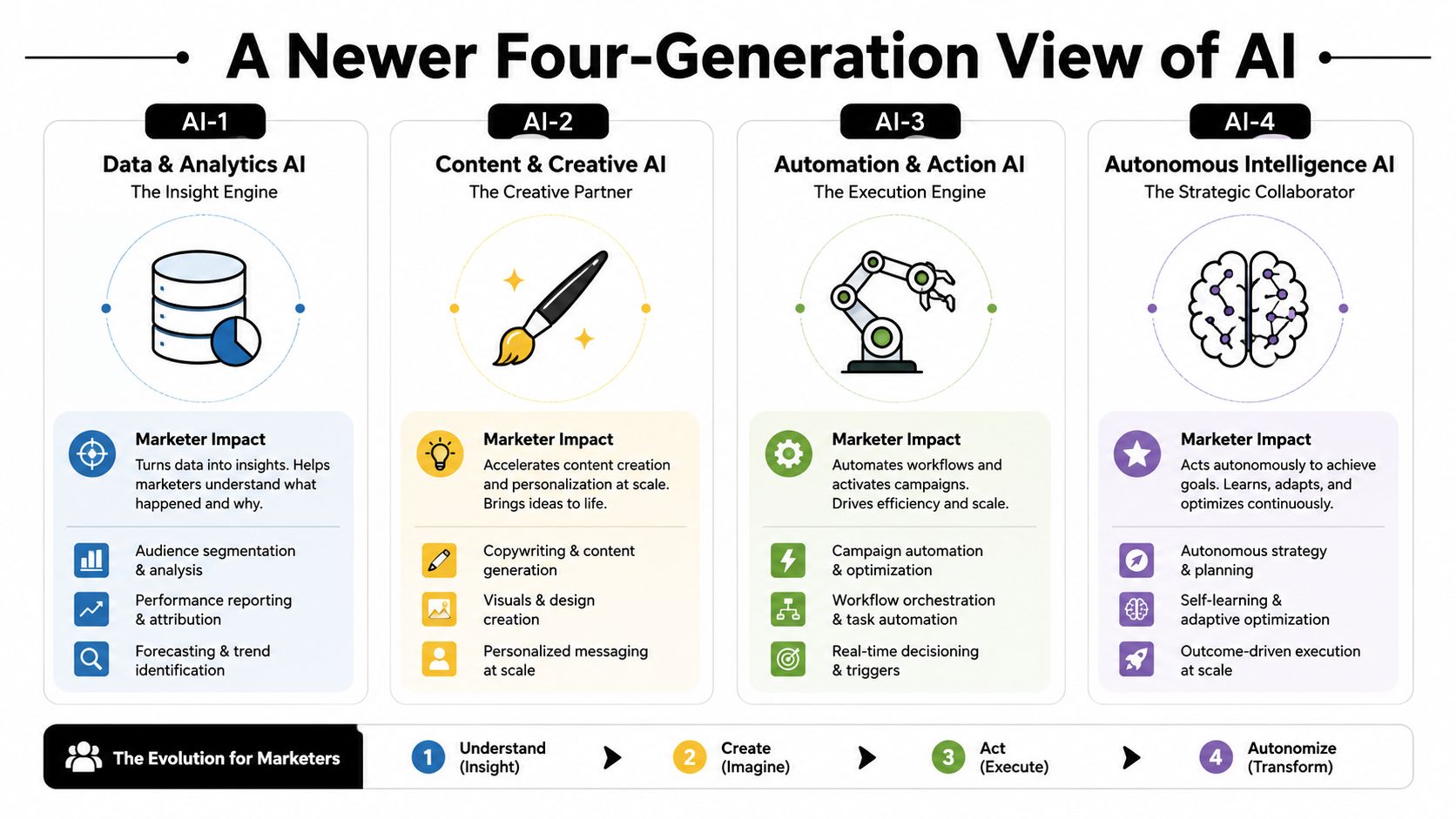
A newer taxonomy focuses less on model architecture and more on what the system does. One expert framing describes AI 1.0 as information AI, AI 2.0 as agentic AI, AI 3.0 as physical AI, and a speculative AI 4.0 as conscious AI. The expert framing published in this research article emphasizes the move from passive processing toward autonomous decisions and real-world action.
What each label means in marketing
AI 1.0, information AI, retrieves, organizes, and summarizes information. Think of a search box that answers a question or a reporting tool that surfaces a trend. It helps a media buyer find information faster, but it usually waits for a human request.
AI 2.0, agentic AI, adds planning and action. An agent can interpret a goal, choose steps, call tools, and complete a task with limited intervention. In a UA workflow, that could mean preparing campaign variations, checking results, or recommending a budget change. The critical feature is a closed loop, not just a generated paragraph.
AI 3.0, physical AI, extends perception and control into robots, vehicles, and other embodied systems. A robot that moves through a warehouse belongs here. A chatbot that writes a product description doesn't.
AI 4.0, conscious AI, remains speculative. A humanoid robot shown on a keynote stage may demonstrate impressive physical AI, but a performance marketer shouldn't treat a consciousness claim as a current media capability.
| Marketing reality | Roadmap language |
|---|---|
| Search, analysis, and content generation are active tools | Agentic systems are entering campaign automation |
| Agents can assist with multi-step workflows | Physical AI targets robotics and embodied control |
| Conscious AI has no established UA role | Vendors may use it as a speculative future label |
Almost every current creative tool in a UA manager's stack belongs to AI 1.0 or AI 2.0, depending on whether it only provides information or can take actions. For the rest of this guide, those are the two generations worth prioritizing. Physical and conscious AI may matter to technology strategy, but they shouldn't distract from measurable creative and campaign workflows.
How AI Generations Show Up in the Timeline
What changed at each AI milestone, and why should a UA manager care? The answer is practical: each stage changed what software could do in creative production, audience analysis, or campaign operations. The dates provide context, while the workflow impact gives them value.
The milestones a planning document needs
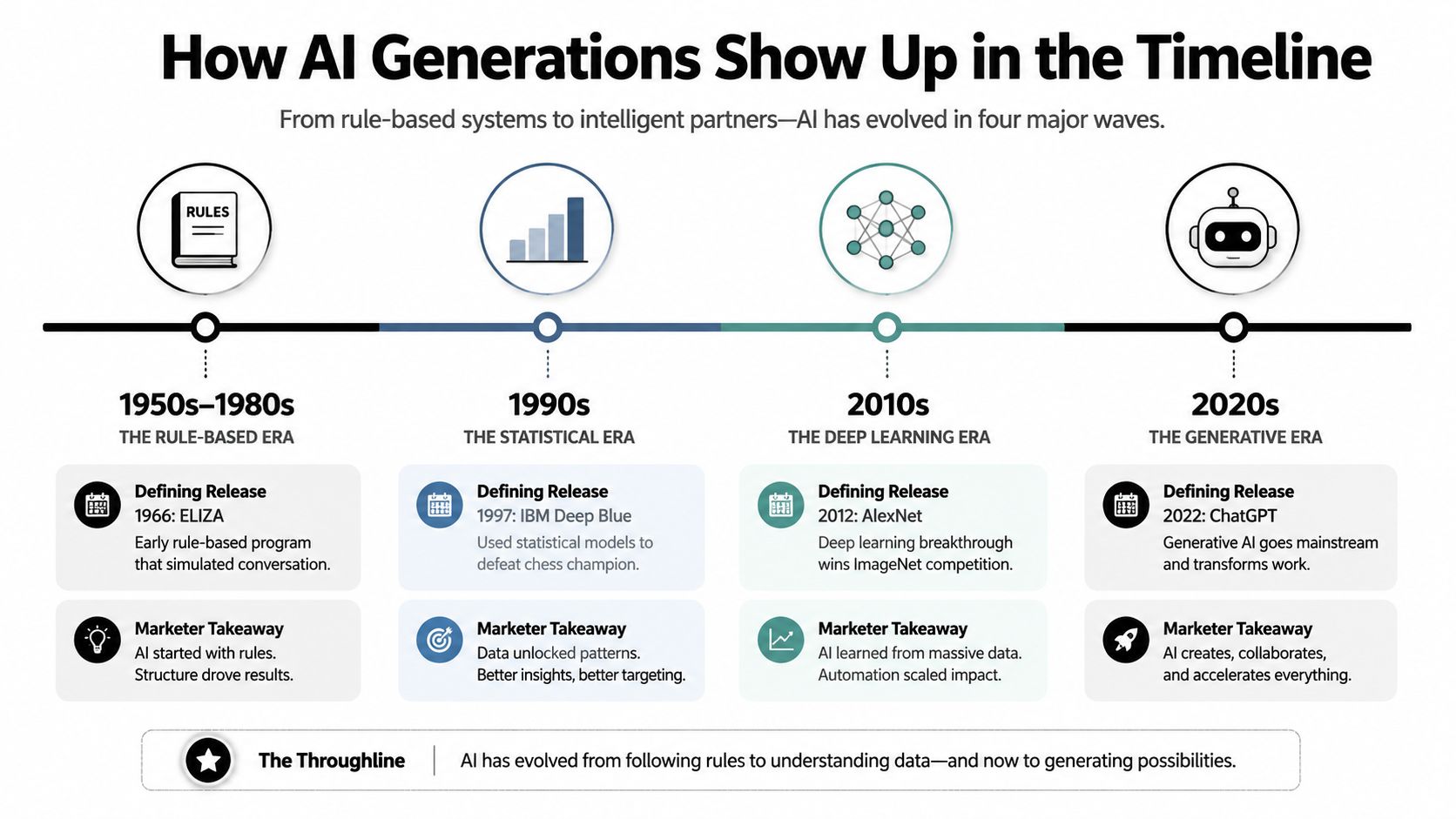
- 1950s to 1980s, rules and expert systems: Turing's 1950 paper and the 1956 Dartmouth project helped establish the field. Later expert systems encoded specialist knowledge. These systems could automate defined decisions, but people had to write the logic and update it when conditions changed.
- 1990s, statistical machine learning: Models began learning patterns from data instead of relying only on manually authored rules. This supports scoring, classification, forecasting, and optimization, the foundations behind many marketing prediction workflows.
- 2012, deep learning: AlexNet demonstrated the value of deep neural networks trained with substantial compute. Image understanding became more practical, creating a path toward visual classification and creative analysis.
- 2017, transformer architecture: Transformers handled relationships across sequences more effectively and became central to modern language and multimodal models. In marketing tools, that later appeared as stronger text generation and more flexible instruction following.
- 2020, GPT-3: Large language models moved closer to general-purpose writing and coding assistance. The workflow changed from choosing a label or prediction to producing a usable draft.
- After 2022, generative AI mainstreaming: ChatGPT, Midjourney, Stable Diffusion, and DALL-E 2 brought text and image generation into ordinary team workflows. McKinsey's framing of 2023 as discovery and 2024 as organizational use marks the shift from experimentation toward broader business adoption.
A UA manager does not need to memorize every release. Map each milestone to the job it changed: fixed decisions, predicted outcomes, learned perception, generated assets, or automated execution.
Platform updates require careful reading. A new model family can improve output quality without creating a new historical generation. Vendor labels also change quickly, so creative teams should track capability and workflow impact. Ask whether a release changes briefing, asset production, testing, reporting, or campaign control. That answer is more useful than assigning every model a new place in the taxonomy.
When “Generation” Actually Means People, Not Tech
A report says, “Gen Z uses AI more than older generations.” That sentence isn't describing an AI generation. It's describing a human cohort and its adoption behavior. Marketers often miss this distinction because “Gen AI” and “Gen Z” appear in the same trend reports, briefs, and conversations.
The word can also describe a product version. iPhone 15 versus iPhone 16 is a product-generation comparison. AI 1.0 versus AI 2.0 is a technology taxonomy. Gen Z versus Millennials is a demographic grouping. The noun beside “generation” tells you which measurement applies.
Read the noun before reading the chart
Recent reporting on workplace adoption illustrates why the distinction matters. A 2025 London School of Economics survey, cited in 2026 reporting, found that 83% of Gen Z workers and 73% of Millennials use AI at work, compared with 60% of Gen X and 52% of Baby Boomers. The workplace adoption report presents those figures as evidence that workplace use narrows the age gap without eliminating it.
That information can guide training, audience research, or internal enablement. It can't tell you whether a copywriting model is technically generative, whether an ad platform uses deep learning, or whether an automation is agentic.
| Sense | Example | What it actually measures |
|---|---|---|
| Human cohort | Gen Z, Millennials, Gen X | Adoption, trust, behavior, or demographic response |
| Product generation | iPhone 15 versus iPhone 16 | Version changes in a device or software product |
| Technology wave | Rule-based AI, deep learning, generative AI | Architecture, capability, and historical development |
Run a simple disambiguation test before acting on a “generation” data point:
- Human noun: Treat it as audience or workforce research.
- Model noun: Treat it as a capability and evaluation question.
- Technology noun: Treat it as a historical or technical classification.
Trust requires a separate question from usage. Younger users may adopt AI frequently while remaining skeptical of AI-assisted output, so a high-use segment isn't automatically a high-trust segment. That distinction affects messaging, review policies, and creator partnerships. If your team is exploring synthetic personalities or creator-led campaigns, how to create an AI influencer belongs in the product and audience conversation, not in the chronology of AI technology.
What Each AI Generation Means for Ad Creative
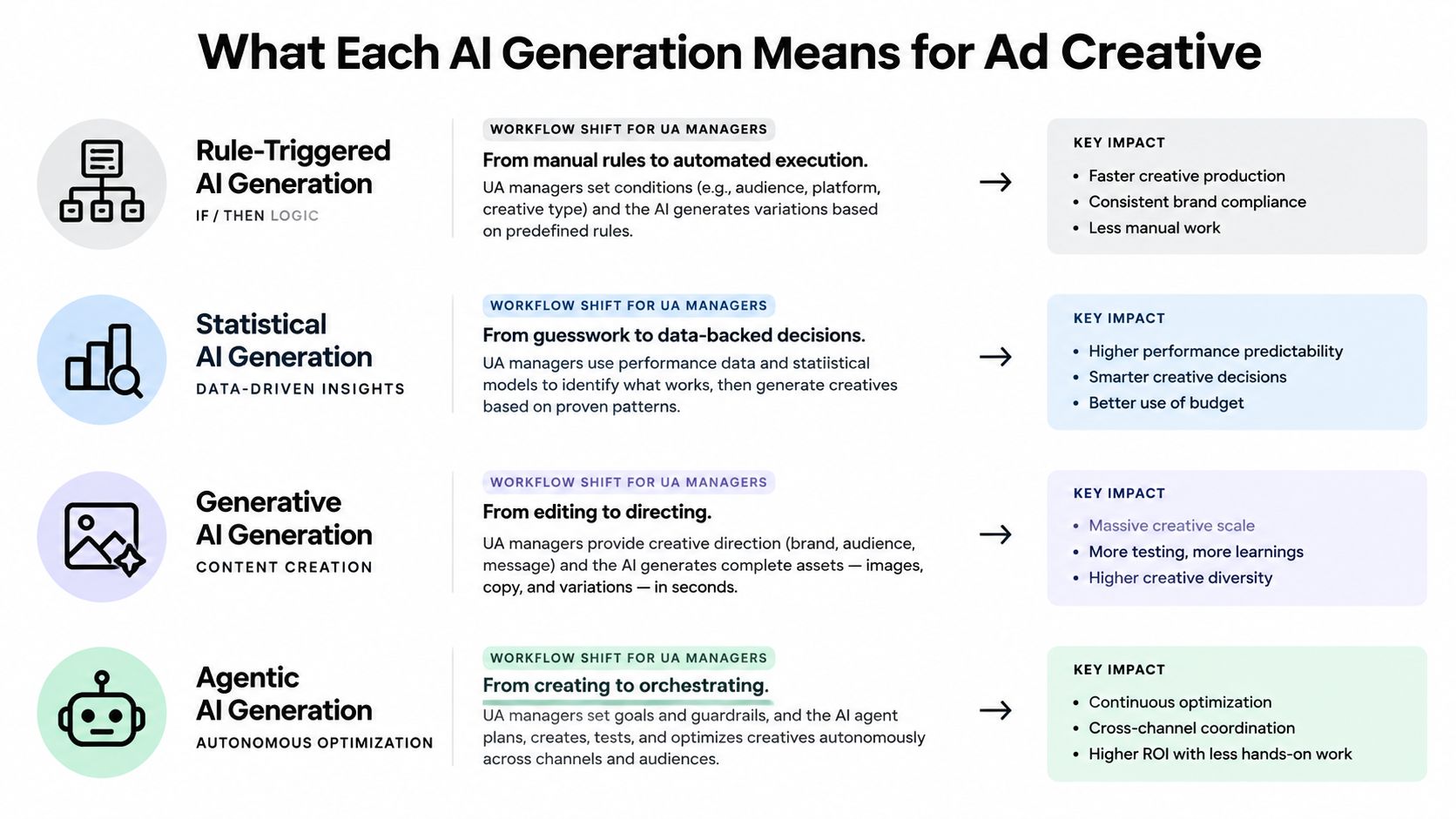
The clearest way to identify an AI generation is to look at the bottleneck it removes. Rules reduce repetitive decisions. Predictive models improve prioritization. Deep learning improves perception and recommendation. Generative systems reduce the time needed to create new assets. Agents reduce the delay between a decision and the action that follows.
Rule-based creative
The first workflow is conditional variation. A marketer writes the rules, defines the available fields, and lets the system assemble a limited set of combinations. Location, device type, audience label, or time of day might determine which headline or visual appears.
This approach improves consistency and reduces manual assembly. It doesn't discover a new hook, judge creative quality, or decide which concept deserves more budget. The main production metric is cycle time for repetitive assembly.
Statistical optimization
Classical machine learning shifts attention from “which rule applies?” to “which outcome is more likely?” Ad platforms can score audiences, predict conversions, and optimize bids using historical signals. Creative teams may also receive recommendations based on observed performance patterns.
The bottleneck becomes prioritization. You may have many possible audiences or placements, but the model helps rank them. The system still depends on the quality of the data, the objective you choose, and the feedback loop created by campaign measurement. For a wider overview of AI ad targeting and optimisation, the important distinction is between automated prediction and content generation.
Deep learning and visual understanding
Deep learning gives platforms stronger tools for interpreting images, video, speech, and text. A system can classify scenes, recognize structures, transcribe dialogue, or identify patterns across creative inputs. In practice, that supports lookalike expansion, image analysis, and recommendations inside ad platforms.
The operational metric is test throughput. Better analysis helps a team understand what appears in its library and connect creative attributes with outcomes. It doesn't necessarily create the next asset, but it makes the existing library more searchable and measurable.
Generative production
The post-2022 wave changes the supply side of creative. A marketer can ask a model for copy, images, voiceovers, captions, or video concepts, then refine the output through human review. The constraint moves from “can we make another asset?” to “can we evaluate and distribute enough useful variations?”
That doesn't justify claiming a fixed output increase for every team. Results depend on prompts, source footage, brand controls, approvals, and platform requirements. The reliable takeaway is qualitative: generative AI shortens the path from brief to draft and expands the range of concepts a team can explore. Tools such as creating video ads with AI fit this layer when they produce ad-ready material from structured inputs.
Agentic campaign workflows
Agentic AI adds execution. Instead of generating an asset and stopping, an agent may assemble a test, read performance data, recommend a change, and route the next action through connected tools. That creates a closed loop between production, measurement, and optimization.
The key metric is decision latency. An agent is valuable only when its permissions, guardrails, evaluation criteria, and escalation paths are clear. A tool that generates a report is information AI. A tool that can act on the account is moving into agentic territory.
Practical Recommendations for UA Managers
A useful answer to “which generation should we use?” starts with the workflow, not the vendor label. Choose the capability that removes your current constraint, then test it inside an existing campaign process.
Adopt agentic workflows carefully
Start with tasks that have clear inputs, outputs, and approval points. An agent can help organize creative variants, prepare test plans, summarize results, or route approved work. Keep budget changes and irreversible account actions behind human review until the system demonstrates reliable behavior in your environment.
This is AI 2.0 in operational form. The value isn't that the tool sounds autonomous. The value is that it reduces the gap between seeing a signal and taking the next approved action.
Test information and generative models
Use information AI for research, classification, reporting, and retrieval. Use generative models for copy drafts, CTA alternatives, captions, voiceovers, and visual concepts. Start with one campaign and one repeatable workflow, then compare the resulting creative quality and campaign metrics with your existing process.
Measure what your team can control. CTR and CPI can be useful campaign indicators, but they should sit beside review time, approval friction, asset usability, and testing throughput. Don't treat a model output as a winner until it survives brand review and real campaign delivery.
Skip speculative layers for now
Physical AI and conscious AI don't belong in a UA roadmap unless you have a specific embodied or research use case. A vendor's “next generation” language shouldn't pull attention away from basic needs such as clean asset organization, fast iteration, reliable naming, and disciplined testing.
A practical prioritization looks like this:
- Adopt: Generative workflows that create and adapt usable assets within your current production system.
- Test: Agentic assistance for analysis, experiment setup, and controlled routing of approved actions.
- Ignore for now: Physical and conscious AI claims without a direct connection to paid acquisition.
Sovran fits the generative creative layer by helping teams recombine hooks, bodies, and CTAs into modular video variations, generate supporting clips and voiceovers, add captions and overlays, and send approved work into Meta Ads Manager. The AI for ads overview provides a practical reference point for connecting those capabilities to a testing workflow.
If your team needs to turn one creative library into a structured stream of testable video variations, visit Sovran to see how its asset management, generation, modular assembly, and Meta workflow can fit into your existing UA process. Start with one campaign, define the approval rules, and use the resulting performance data to decide where automation should go next.

Manson Chen
Founder, Sovran
Related Articles
AI Talking Head Videos for Scaling Ad Creative
- ai talking head
- video ad production
- 3 more
Storyboard Development: Scale Video Ad Production in 2026
- storyboard development
- video ads
- 3 more
8 Pattern Interrupt Techniques for Video Ads
- pattern interrupt techniques
- video ad hooks
- 3 more