Choose Your App Advertising Agency Wisely: 2026 Guide
Jump to a section
You're probably in one of two situations right now.
Either your app has real demand but paid growth has stalled, or your team is spending too much time babysitting channels, chasing reporting, and trying to squeeze new life out of tired creatives. Installs flatten. CAC trends the wrong way. Everyone says the strategy is fine, but performance still slips.
That's usually when the agency question shows up.
Hiring an app advertising agency can help, but only if you hire for the way mobile acquisition operates now. The old checklist still matters. Platform expertise, references, communication, pricing. But those aren't the primary separator anymore. The most important question is whether an agency can operate a creative system fast enough to keep up with modern ad platforms.
The stakes are large. The global in-app advertising market was valued at $154.8 billion in 2025 and is projected to reach $562.3 billion by 2034, expanding at a 15.4% CAGR, according to Dataintelo's in-app advertising market report. More money in the system doesn't make buying easier. It makes the market more crowded, the testing pace faster, and weak agency operations more expensive.
If you're still tightening your internal growth motion before talking to agencies, this breakdown of a mobile app user acquisition strategy that works is a useful place to calibrate expectations.
Is It Time to Hire an App Advertising Agency
Organizations often don't hire an agency because things are going great. They hire because internal capacity has broken somewhere.
Sometimes media buying is the bottleneck. Sometimes attribution is messy. Sometimes the team has buyers but no creative system. And sometimes the company has enough budget to spend, but not enough operational discipline to spend it well. Those are very different problems, and they need different agency partners.
Signs you're ready
A good app advertising agency becomes valuable when your internal team can no longer manage the pace of testing, reporting, and creative iteration required to grow efficiently.
A few signals usually show up together:
- Paid growth is flat: You're still launching campaigns, but new spend no longer creates proportional gains.
- Your team is overextended: One person is handling strategy, channel ops, reporting, and creative feedback.
- Creative fatigue is visible: Ads work briefly, then performance drops before your team has replacements ready.
- Attribution trust is low: Product, finance, and growth don't agree on what's driving installs or downstream value.
- Channel expansion keeps getting delayed: Apple Search Ads, Meta, Google Ads, influencer programs, and retention loops all need attention, but no one owns the full motion.
Signs you're not ready
Some companies hire too early and then blame the agency for structural issues inside their own business.
You're probably not ready if you still haven't defined what kind of user you want, what post-install event matters most, or who on your team approves creative and budget changes. No agency can fix a company that wants scale without making strategic choices.
Practical rule: Hire an agency when you need execution leverage and specialist depth. Don't hire one to substitute for internal clarity.
What a strong agency relationship actually looks like
The best agency partnerships don't feel like outsourced ad buying. They feel like adding a focused growth pod with sharper process than most in-house teams can build quickly.
That means the agency should be able to do more than launch campaigns. It should be able to pressure-test your funnel, challenge your assumptions, move creatives quickly, and surface trade-offs in plain English. If the relationship starts and ends with weekly dashboards and vague “optimizations,” you're paying for motion, not progress.
Define Your North Star Goals and KPIs First
A common failure pattern looks like this. The agency launches fast, installs come in, the weekly report looks fine, and six weeks later finance is asking why payback slipped while product says the new users are low quality. Nothing broke in the ad account. The problem started earlier, when the company never defined what the agency was supposed to optimize for.
Write that down before you talk to vendors.
Start with the business outcome
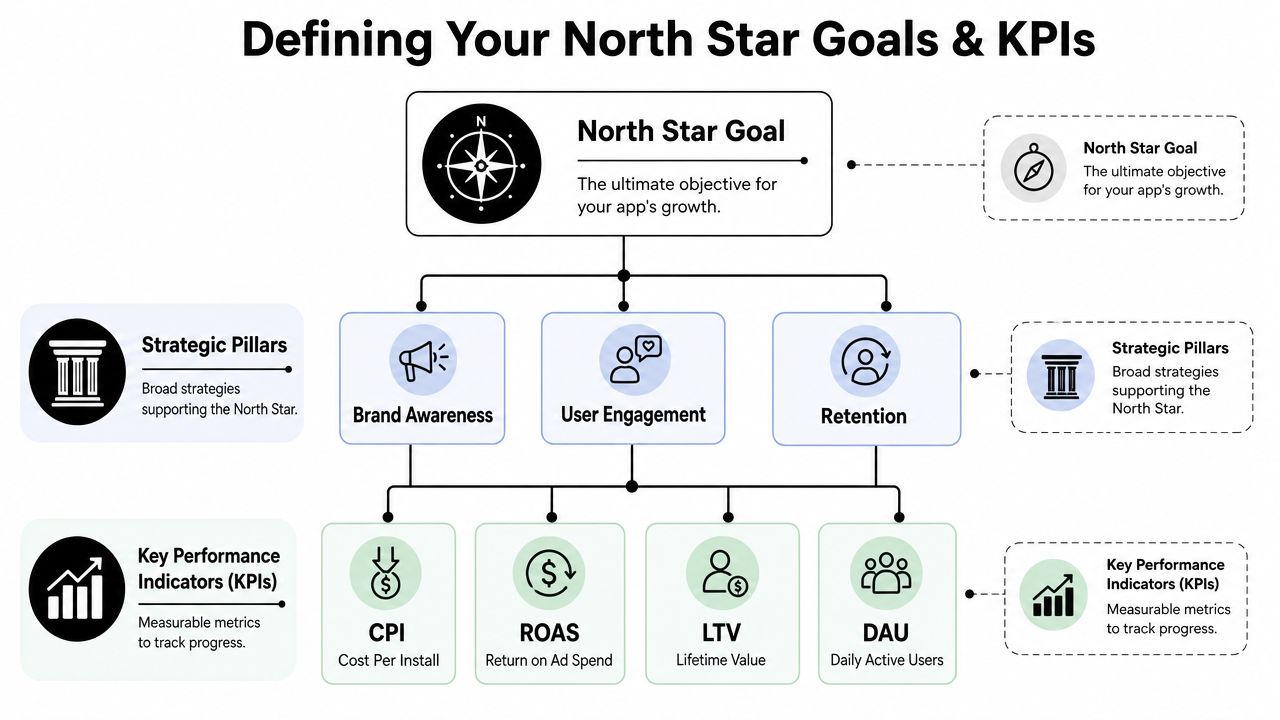
Your North Star goal should describe a business result the leadership team would approve in one sentence.
Examples are straightforward. Grow paid acquisition while holding payback within target. Enter a new geo without blowing up CAC. Increase subscriber volume from paid channels without lowering trial-to-paid conversion. Those goals give an agency something concrete to optimize toward, and they force internal alignment before spend starts.
Then turn that goal into operating KPIs:
- CAC target: the acquisition cost your model can support
- ROAS or payback window: the return threshold and time horizon you will judge against
- LTV benchmark: the value level that separates a good user from a cheap but low-quality one
- Retention markers: the post-install behaviors that predict long-term value
If your paid acquisition planning is still too channel-first, this guide to a paid social media strategy is a useful reset before agency conversations.
Build KPIs around the funnel, not the platform
A weak brief says, “Improve Meta performance.” A useful brief says, “Acquire trial starters at a CAC we can recover inside our payback window, and improve first-week retention from paid cohorts.” That difference matters because platform metrics can look healthy while the business result gets worse.
This is even more important in a post-Andromeda environment, where creative velocity often decides whether an account scales or stalls. If the agency cannot connect spend, creative themes, click quality, onboarding behavior, and downstream conversion, your KPI framework is too shallow. You are not hiring an app advertising agency just to buy traffic. You are hiring a team to run repeated experiments across targeting, bidding, and creative production without losing measurement discipline.
One practical framework is the 9-stage funnel infrastructure described by Sandyriev's mobile app marketing agency workflow, which starts with measurement and funnel setup before channel launch. The point is simple. KPI alignment has to happen before media buying, not after the first report.
The KPI questions to settle internally
I would not send an RFP until these answers are clear:
Which event defines success
Install is rarely enough. Decide whether success means registration, trial start, first order, subscription, or a product-qualified action.Which variables the agency can influence
Agencies can control media buying, creative testing, audience structure, pacing, and reporting. They usually cannot fix pricing, broken onboarding, review volume, or product bugs.Which decision window you will use
Daily optimization and monthly business evaluation can coexist, but only if everyone agrees on the rules. Otherwise the agency chases cheap signals while leadership judges on lagging revenue.How creative performance will be judged
Ask which creative metrics matter at each stage. Hook rate, CTR, install rate, trial start rate, and retention by concept can point in different directions. Good agencies know how to trade off short-term efficiency against learning speed.Who approves changes
Budget shifts, new concepts, UGC sourcing, landing page edits, event mapping fixes, and geo expansion all need named owners on your side.
If success is vague before launch, reporting will turn into explanation instead of decision-making.
What to hand the agency
A serious agency brief should include your event map, attribution setup, current channel mix, historical performance by cohort if you have it, creative winners and losers, audience hypotheses, compliance limits, and known funnel breaks.
Include creative operations too. Who writes briefs. Who approves concepts. How fast assets can be produced. Whether the agency is expected to source creators, edit iterations, localize, and refresh fatigue-driven ads every week. That operational detail is where many selections go wrong. A polished strategy deck means little if the team cannot sustain the volume of testing your growth target requires.
If you need a model for structuring those requirements, this resource on crafting a winning marketing RFP is a useful reference.
Craft an RFP That Attracts the Right Partners
Most RFPs are too generic to attract strong agencies and too vague to filter weak ones.
They ask for credentials, pricing, services, and timelines. Every agency knows how to answer that. You end up comparing polished decks that all sound competent, while key issues stay hidden. How they think. How they fail. How they work under pressure. How they source and test creative ideas. How much senior attention you'll receive after the sale.
The fastest way to improve agency quality is to stop using a template built for procurement and start writing one built for operators.
What a useful RFP should include
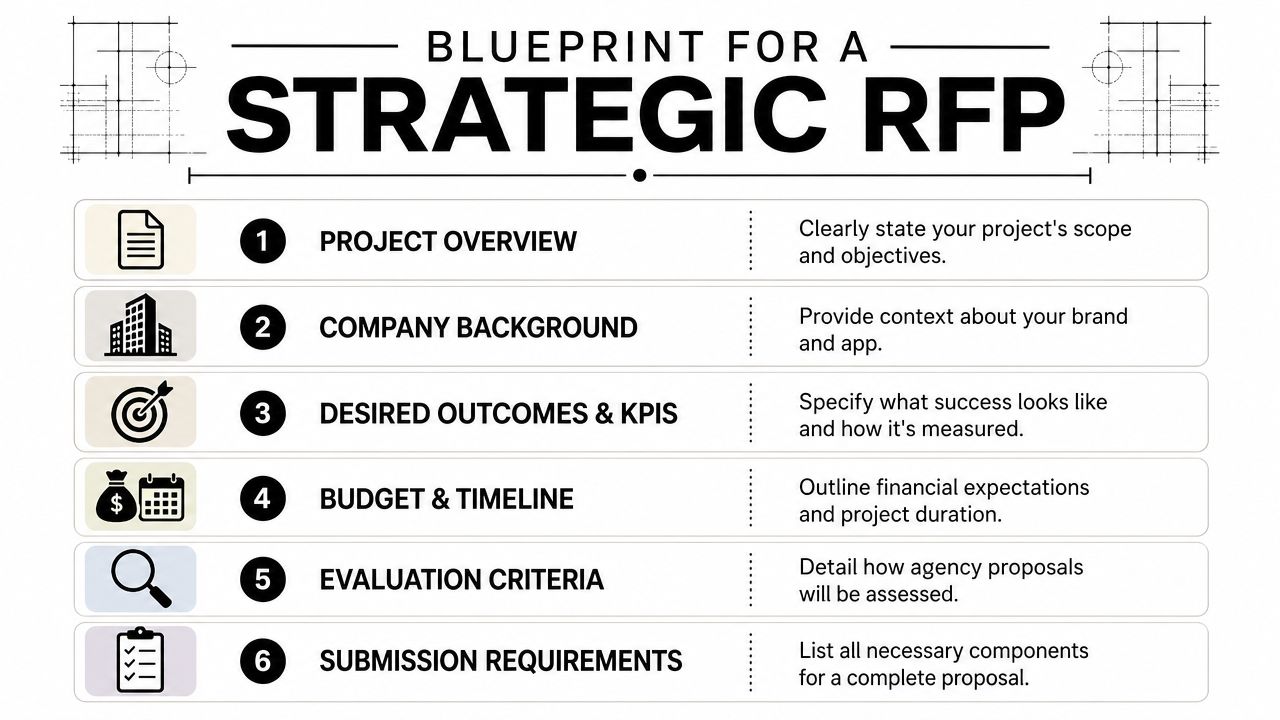
A strong RFP gives agencies enough context to think, not just enough information to quote.
Include these components:
- Business context: What your app does, who it serves, and where growth is currently constrained
- Current channel mix: Which platforms you're using now and where performance has been inconsistent
- Measurement stack: Your MMP, analytics tools, event map, and known reporting issues
- Creative reality: What assets exist today, who produces them, and where turnaround breaks down
- Decision criteria: How you'll evaluate proposals beyond price
- Access model: Whether the agency will work inside your accounts, use its own tooling, or both
A practical external resource on crafting a winning marketing RFP is useful if you want a broader framework before narrowing it to app growth.
The questions that actually reveal fit
Don't ask agencies to tell you their process in abstract terms. Ask for operational detail.
Here are better prompts than “What makes you different?”:
- Show your first 30 days: What exactly happens in week one, week two, and week three?
- Explain a failed test: Tell me about a creative angle or channel bet that didn't work and what changed next.
- Describe team structure: Who owns strategy, media buying, creative strategy, design, and reporting for an account our size?
- Show naming and taxonomy discipline: How do you structure campaigns and creative IDs so learning compounds instead of getting lost?
- Walk through escalation: If tracking breaks or CAC spikes, who notices first and what happens in the next 24 hours?
- Clarify asset workflow: How do raw clips become testable ad variants, and who decides what gets remixed or retired?
A proposal template can help if you need a starting point for formatting and scope control. This Facebook ads proposal template is relevant when Meta will be part of the account.
Later in the process, it helps to hear someone talk through agency brief mechanics from the other side:
What weak responses look like
Watch for agencies that answer every question with frameworks but no specifics.
If they can't explain how they brief creatives, how they prioritize test volume, how they reconcile platform reporting with business outcomes, or how their team handles backlog pressure, that isn't because the process is proprietary. It's usually because the process is thin.
Vet Creative Capabilities and Tech Stacks
Most app companies tend to under-interview agencies at this stage.
They spend hours on strategy, case studies, fee models, and platform badges. Then they spend ten minutes on the only capability that often determines whether performance improves or decays. The agency's ability to generate, organize, launch, and learn from creative at speed.
In mobile acquisition, a pretty portfolio means very little if the agency can't keep feeding the machine.
Portfolio quality is not enough
A portfolio shows taste. It doesn't show throughput.
That distinction matters because creative fatigue drives 60 percent of performance decline in mobile campaigns, and Meta's Andromeda environment demands hundreds of modular ad variations, according to Moburst's app marketing services discussion. Most agencies say they do creative production. Far fewer can show an operating system for modular recomposition of hooks, bodies, and CTAs at the velocity modern app growth requires.
Ask them to walk you through the full lifecycle of one concept:
| What to inspect | What a strong answer includes |
|---|---|
| Concept intake | Clear hypotheses tied to audience or funnel stage |
| Asset ingestion | A way to tag footage, identify scenes, and reuse components |
| Variant creation | Modular assembly instead of starting from scratch every time |
| Launch workflow | Fast export and deployment into live campaign structure |
| Learning loop | A method for connecting creative attributes to results |
Questions that expose the real creative engine
A serious agency should be comfortable answering questions like these in detail:
- How many concurrent creative tests can your team support without slowing media ops?
- How do you structure hooks, bodies, CTAs, text overlays, and aspect ratios for reuse?
- Who owns creative analysis after launch?
- What happens when a winning concept fatigues?
- How do you decide whether to iterate an angle or kill it?
- What tools do you use to manage modular assets and version control?
Good agencies don't just make ads. They run a repeatable system for producing learnings.
What to look for in the tech stack
You're not buying software directly, but the agency's tooling affects your speed, costs, and visibility.
At minimum, they should be using tools that support asset organization, fast editing workflows, clear naming conventions, and direct connection between creative variants and performance readouts. If they rely on scattered folders, manual handoffs, and one-off edits for every version, velocity will collapse as soon as testing volume increases.
Some teams use combinations of editors, DAM tools, and spreadsheets. Others use purpose-built systems. For example, Sovran's video production software comparison is useful if you want to understand the trade-offs between general editing tools and workflows built for high-volume ad iteration. One option in this category is Sovran, which is designed to recombine modular assets into many ad variants and push them into Meta workflows.
Red flags during creative due diligence
These usually show up before you sign:
- They talk only about “concepts” and avoid discussing production operations.
- They can't show versioning logic for how one winning ad becomes multiple follow-ups.
- They separate creative and media teams too sharply, so learnings move slowly.
- They over-index on polished hero assets instead of scalable test assets.
- They treat fatigue as a refresh problem instead of a pipeline problem.
An app advertising agency that can't explain creative throughput will eventually blame the market, the audience, or the product. Sometimes those are real issues. Often the issue is that the agency ran out of usable creative before the account ran out of budget.
Decode Contracts and Reporting Cadence
A contract tells you how the relationship will work when things get messy. That's why it matters.
Every agency looks organized when performance is stable. The test comes when tracking breaks, results are mixed, creative ownership gets fuzzy, or budget pressure changes priorities. If the contract is vague, those moments turn into long calls and defensive emails.
What to lock down before signing
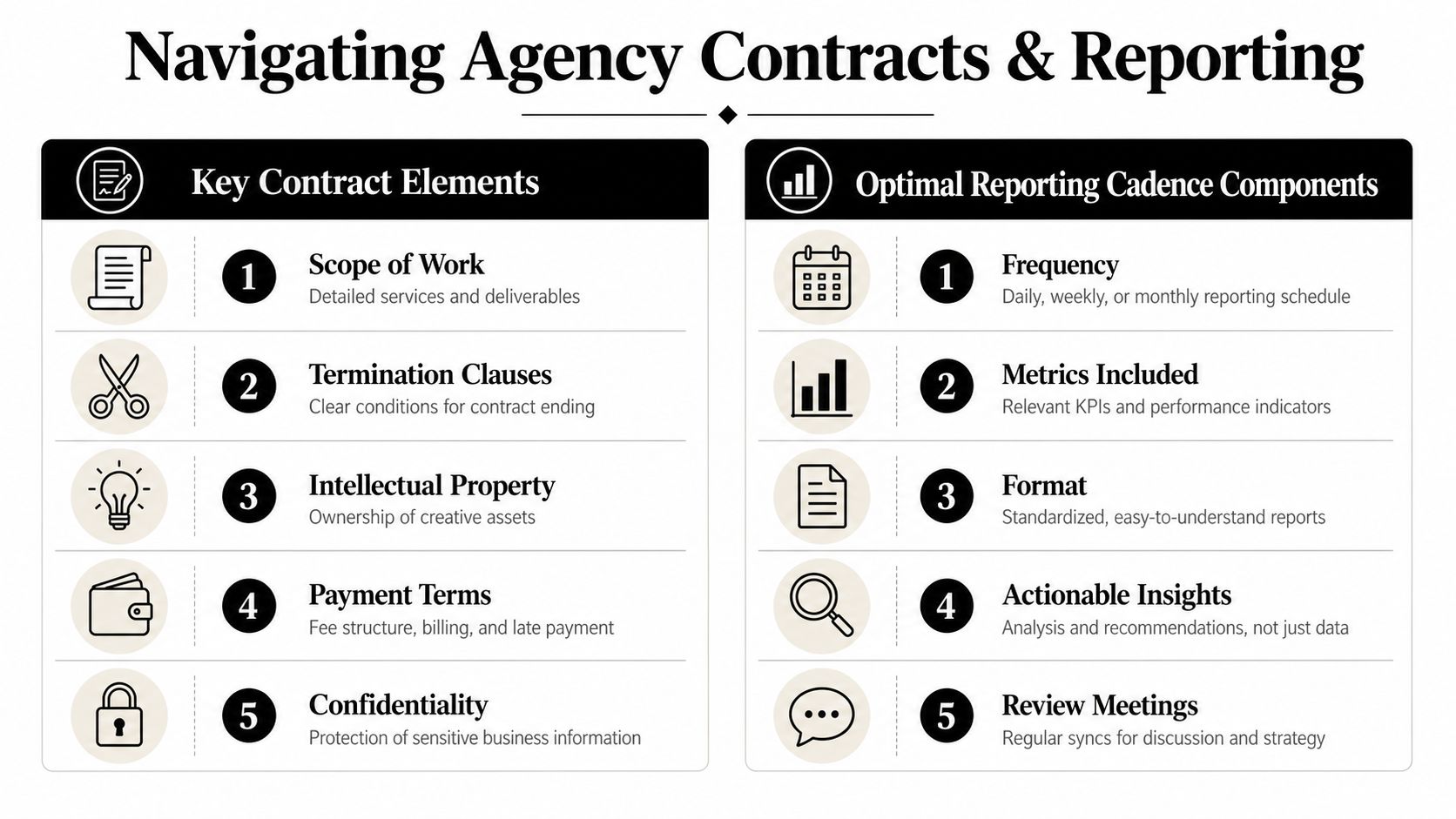
A usable contract needs operational clarity in plain language.
Focus on these areas:
- Scope of work: Which channels, deliverables, reporting tasks, creative responsibilities, and testing motions are included
- Creative ownership: Who owns raw files, edited variants, scripts, briefs, and account learnings
- Account access: Whether campaigns run in your ad accounts and whether you retain admin-level visibility
- Termination terms: Notice period, transition support, and handoff expectations if the relationship ends
- Approval mechanics: What requires your sign-off and what the agency can change independently
A short table helps when comparing compensation models:
| Model | Where it fits | Main risk |
|---|---|---|
| Retainer | Stable scope and consistent operating rhythm | Can drift into complacency if accountability is weak |
| Percent of spend | Larger budgets with active buying needs | Incentives can tilt toward spend growth over efficiency |
| Performance-based | Narrowly defined goals and clean measurement | Usually creates disputes if attribution is messy |
| Hybrid | Mixed channel, creative, and analytics support | Complexity can hide what you're actually paying for |
Reporting should explain decisions, not just show numbers
One of the hardest truths in app growth is that reporting can look precise while still hiding important uncertainty.
App marketers often ask, “how do you explain ROI logic behind every number?” Yet agency reporting rarely addresses the structural opacity created when publishers limit audience data, making bid coordination harder and leading to inflated CAC claims, as described in the University of Washington Foster School summary of Amin Sayedi's online advertising market research.
That doesn't mean reporting is pointless. It means you should demand explanation, not just presentation.
If an agency can't tell you what it knows, what it infers, and what it cannot see, the reporting isn't honest enough.
Use a reporting framework that separates confirmed outcomes from modeled interpretation. This guide on how to measure your creative tests in Facebook Ads reporting is useful for setting expectations around what creative reporting should help you decide.
A healthy reporting cadence
The best cadence is usually simple:
- Frequent operational updates: Quick visibility into spend, blockers, launch status, and anomalies
- Weekly decision meetings: Review what changed, what was learned, and what gets tested next
- Monthly business review: Tie channel performance back to product and revenue context
If the agency only reports platform metrics and never discusses trade-offs, test quality, or confidence levels, you're getting dashboard theater.
Master the First 90 Days Onboarding and Integration
The first 90 days usually determine whether the partnership gets traction or drifts into polite underperformance.
A strong onboarding period creates speed without chaos. A weak one creates confusion that looks small at first, then spreads into every part of the account. Missing access, unclear owners, delayed approvals, inconsistent briefs, and slow creative feedback all compound quickly in app growth.
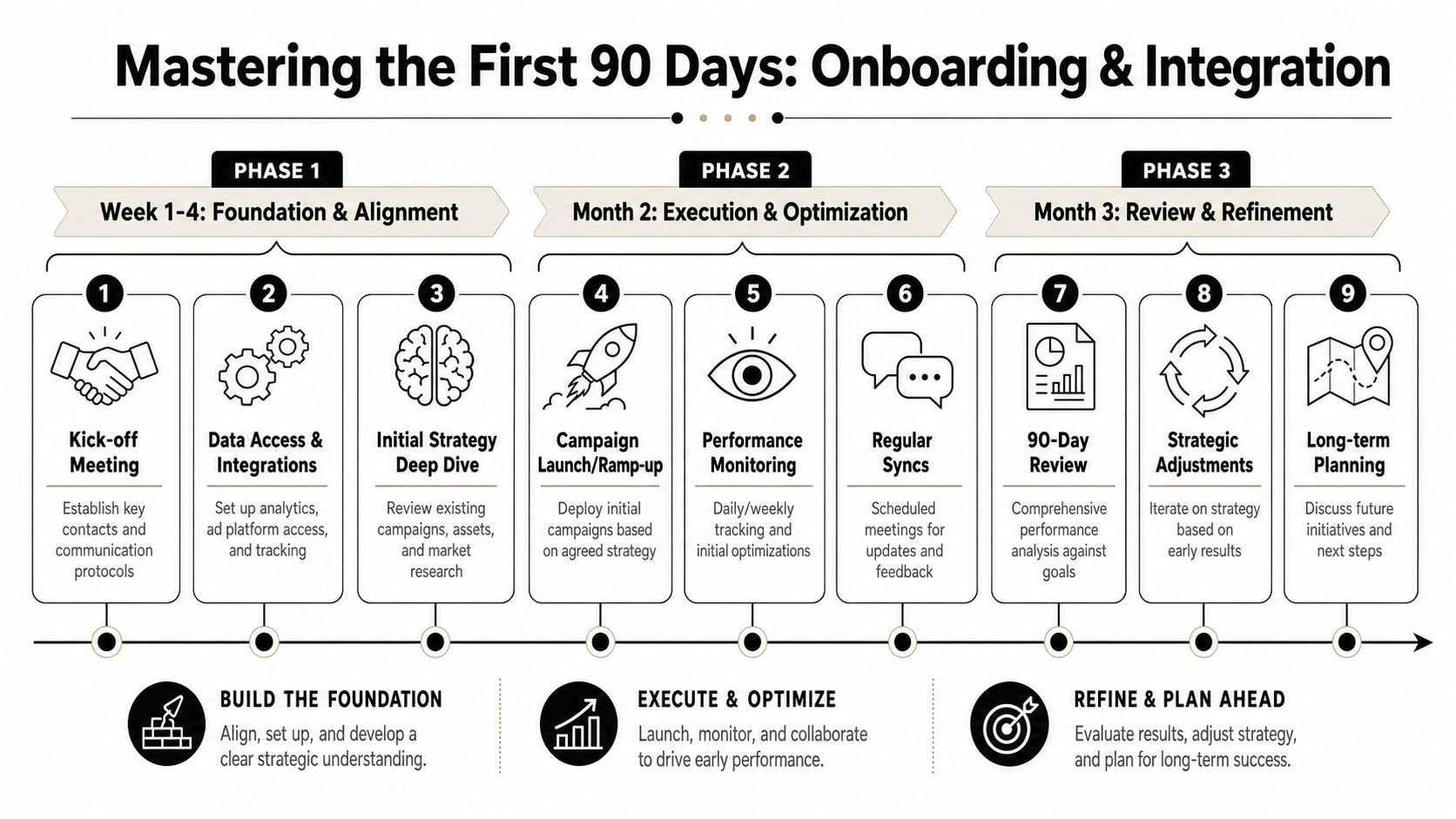
Days 1 through 30
The first month is about infrastructure and clarity.
Get every access dependency handled immediately. That includes your MMP, Firebase, GA4, App Store and Google Play event visibility, ad accounts, creative folders, historical reports, and any brand or legal constraints that affect production. If one of these stays unresolved for weeks, campaign learning slows before campaigns even mature.
The agency also needs direct contact with whoever owns product analytics, creative approval, and engineering support. If all questions route through a single marketing manager, you've built a bottleneck into the partnership.
Days 31 through 60
This is the execution window. The agency should already be testing.
At this stage, the biggest risk isn't failure. It's fake progress. Lots of meetings, lots of decks, lots of “insights,” and not enough shipped work. You want live tests, clear naming logic, active budget decisions, and a visible feedback loop between media buying and creative.
A practical operating rhythm looks like this:
- Shared communication channel: One place for launch requests, blockers, approvals, and daily context
- Weekly strategy call: Decisions, not status theater
- Creative review loop: Fast feedback on hooks, messaging, visual framing, and next variants
- Issue escalation path: A clear route for tracking problems, attribution conflicts, or account disruptions
The first 90 days should produce a working cadence, not just a collection of documents.
Days 61 through 90
By month three, you should be able to judge the relationship on operating behavior.
You may not have every answer yet, especially if your sales cycle or monetization model takes time to read. But you should already know whether the agency communicates clearly, learns quickly, documents tests well, and turns findings into action.
One overlooked area here is asset rights. If the agency is producing ads with music, voiceovers, or licensed elements, make sure your team understands what can be reused, edited, or repurposed after the engagement. For a clean overview of the issues, Drumloop AI's guide to music rights is a practical reference.
The simplest 90-day scorecard
Judge the partnership against a short list:
- Access complete: No recurring blockers from permissions or data gaps
- Testing live: New creatives and audience ideas are shipping
- Feedback tight: Approvals and revisions move quickly
- Learning visible: Wins and losses are documented clearly
- Trust improving: Internal stakeholders understand what the agency is doing and why
If you can't say yes to most of those by the end of the first quarter, the issue usually isn't patience. It's fit.
App Advertising Agency FAQs
How should an app advertising agency charge?
Pricing should match the work and the level of control the agency has over outcomes.
A retainer fits best when the agency is doing more than media buying. Strategy, forecasting, creative planning, reporting, experimentation design, and weekly cross-functional support are hard to price cleanly on spend alone. Percentage-of-spend models can work when channel mix, geo expansion, or account complexity makes buying heavier, but they need guardrails so the agency is not paid mainly to raise budget. Performance pricing sounds clean on paper, yet it gets messy fast when attribution is noisy, conversion windows are long, or product and lifecycle changes sit outside the agency's control.
Post-Andromeda, I look at one extra factor. Does the fee model support creative output, or does it implicitly treat creative as an add-on? If your growth depends on shipping fresh concepts, iterations, and cutdowns every week, the contract should reflect that operating reality.
Ask the simple question that tends to expose misalignment fast: does this pricing structure reward the agency for the outcome I want, or just for activity?
What are the biggest red flags when hiring an app advertising agency?
The red flags that matter most are operational, not cosmetic.
An agency can have a polished deck and still be weak where it counts. The pattern to watch is vagueness around how work gets done. If they cannot explain who writes briefs, how many concepts move into production each cycle, how quickly they replace fatigue, or how they decide a test deserves more spend, expect trouble later. In a post-Andromeda setup, that lack of detail usually turns into slow creative throughput and recycled learnings.
Another red flag is a split between the pitch team and the delivery team. Senior people win the business, then disappear. The people running your account may be smart, but if they lack support, your program slows down at the exact moment it should be getting sharper.
Watch for false confidence too. Any agency that sounds certain before seeing your tracking, event mapping, payback window, monetization model, and current asset library is guessing. Good operators ask inconvenient questions early because they know media performance and creative performance are tightly linked.
How much budget do we need before hiring?
There is no fixed minimum. A useful budget is one that can produce signal.
That usually means enough spend to test a few meaningful hypotheses, enough creative capacity to ship replacements when assets fade, and enough internal support to act on what the account reveals. If budget only covers tentative media spend with no room for new creative, the agency will spend most of its time managing constraints instead of generating learnings.
Teams often miss the key bottleneck. The issue is not only media budget. It is whether the system around that budget can support experimentation. A modest budget with fast creative production, clear KPIs, and disciplined review cycles can outperform a larger budget trapped in slow approvals and stale assets.
For smaller teams, narrower scope usually wins. Start with one or two channels, one primary conversion event, and a test plan the team can sustain for a full quarter.
If your team is evaluating agencies and the biggest concern is creative velocity, Sovran is built for that specific problem. It helps brands and agencies turn existing footage into modular video ad variants, organize assets for reuse, and launch high-volume creative tests without rebuilding every ad from scratch.

Manson Chen
Founder, Sovran
Related Articles

8 Pattern Interrupt Techniques for Video Ads
Customer Journey Mapping for Performance Marketing