Mobile App User Acquisition Strategy That Works
A solid mobile app user acquisition strategy isn't just a nice-to-have; it's your entire playbook for attracting new users. It's a calculated plan that blends...
Jump to a section
A solid mobile app user acquisition strategy isn't just a nice-to-have; it's your entire playbook for attracting new users. It's a calculated plan that blends paid ads, organic marketing, and in-app initiatives to do more than just drive installs. The real goal is to bring in high-value users who stick around. This means you have to know your audience inside and out, pick your channels wisely, and measure everything.
The Reality of Acquiring App Users Today
Look, having a killer app is only half the battle. If your plan is to just launch it and hope people find it, you're setting yourself up for a rough time. The app stores are unbelievably crowded. A clear-cut user acquisition strategy isn't just for growth anymore—it's for survival.
The game has changed. It's no longer about chasing the highest number of installs. The real challenge is getting noticed by the right people. A thousand downloads from users who churn after one session are worthless compared to a hundred downloads from people who become loyal, paying customers. This is where the real work begins.
To give you a better idea of what a modern UA strategy looks like, we can break it down into a few core pillars. Each piece plays a critical role, from understanding your audience to scaling your wins.
Core Pillars of a Modern User Acquisition Strategy
Pillar | Primary Objective | Key Channels |
|---|---|---|
Audience & Funnel | Identify and understand high-value user segments. | Market Research, Analytics, Surveys |
Channel Mix | Find the most profitable platforms to reach your audience. | Paid Social, Search, ASO, UA Networks |
Creative Strategy | Develop compelling ads that stop the scroll and drive action. | Meta, TikTok, Google App Campaigns |
Measurement & LTV | Accurately attribute installs and track long-term value. | MMPs, In-app Analytics, BI Tools |
Optimization & Scale | Systematically improve campaigns and grow your budget profitably. | A/B Testing, Data Analysis |
Ultimately, a winning strategy is a finely tuned machine where each of these pillars supports the others, driving you toward profitable and sustainable growth.
The Challenge of Market Saturation
The numbers don't lie—it's tough out there. In 2024 alone, the mobile app market saw a staggering 136 billion downloads across iOS and Google Play. But that growth comes with a huge catch: you're competing with over 5.5 million other apps for attention. To succeed in this environment, you need a smart plan that mixes organic efforts with highly targeted paid campaigns. You can dig deeper into this by checking out the latest findings on app market dynamics.
What this really means is that a great product just isn't enough to carry you anymore. Your strategy has to be proactive, built on data, and ready to adapt on the fly.
Key Takeaway: The goal of modern user acquisition is not just to acquire users, but to acquire them profitably. This means your Customer Acquisition Cost (CAC) must be lower than the Lifetime Value (LTV) each user brings.
Moving Beyond Vanity Metrics
If you want to build a strategy that actually grows your business, you have to stop obsessing over surface-level numbers. Sure, installs and impressions are easy to track, but they don't tell you what really matters. A truly effective plan zeroes in on what drives the bottom line:
User Quality: Are you attracting people who will actually use the app, stick around, and eventually pay you?
Profitability: Is the money you spend to get a user less than the revenue they generate over their lifetime?
Scalability: Can you repeat this process to grow your user base without your costs spiraling out of control?
To get this right, you need to stay on top of the top mobile app marketing strategies that tie all these elements together. This guide will walk you through building a plan that hits these goals, turning your UA efforts into a powerful engine for real, sustainable growth.
Finding Your Ideal Users and Mapping Their Journey
Before you spend a single dollar on ads, you need to answer two make-or-break questions: Who are you really trying to reach, and how will you turn them from a complete stranger into a loyal fan? Kicking off a mobile app user acquisition strategy without this clarity is like trying to navigate a new city without a map—you'll definitely be moving, but you won't get anywhere that matters.
Real success starts with a deep, almost obsessive, understanding of your audience and the path they take to find you.
This goes way beyond basic demographics. Knowing your audience is 25-34 and lives in a city is a start, but it doesn't tell you why they would ever choose your app over a dozen others. To get to the good stuff, you need to dig into psychographics—the attitudes, interests, and motivations that actually drive their decisions.
Uncovering Who Your Users Really Are
Psychographics help you get inside the head of the person on the other side of the screen. What gets them excited? Are they chasing productivity, pure entertainment, or a better version of themselves? What little frustrations pop up in their day-to-day life? Figuring this out is how you craft messaging and visuals that don't just get seen, but actually felt.
So, how do you pull back the curtain?
Talk to your current users: Don't just send a generic survey. Ask them what other apps they're obsessed with, what hobbies they have, and what specific problem your app magically solved for them.
Become a fly on the wall in competitor reviews: You'll find gold in the App Store reviews for other apps in your space. Look for patterns in the language people use. What features do they rave about? What pain points show up again and again?
Hang out where they hang out: Spend time lurking in the Reddit threads, Facebook groups, or Slack communities your ideal users frequent. Listen to their conversations. You'll learn more about their unfiltered needs and wants there than in any formal market research report.
The goal here is to stop targeting a generic "user" and start speaking directly to an individual's specific needs and dreams. This is the difference between an ad that gets scrolled past and one that feels like the perfect answer at the perfect time.
All this research should lead to creating a few detailed user personas. A persona is basically a fictional character profile of your ideal user, complete with a name, goals, and what keeps them up at night.
For example, a fitness app might be targeting "Productivity Paul," a 32-year-old project manager who lives for efficiency and data, and "Wellness Wendy," a 28-year-old yoga instructor who cares more about community and mindfulness. These two people need completely different ad copy, creative, and feature highlights.
This infographic breaks down how a smart, targeted strategy cuts through the noise of a crowded market to find those high-value users.
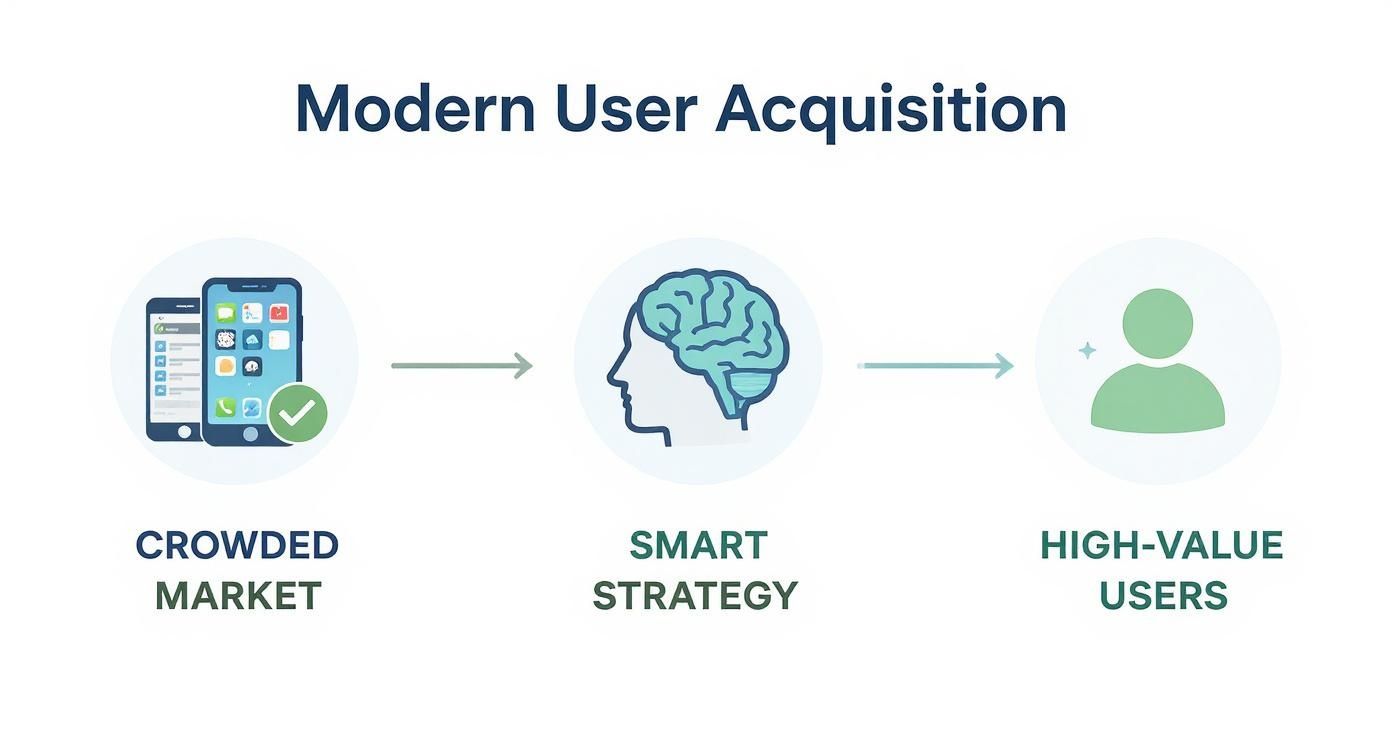
As you can see, a thoughtful strategy is the bridge connecting the saturated app landscape to your end goal: attracting engaged users who stick around.
Mapping the User Acquisition Funnel
Once you know who you're after, you need to map out how they'll get to you. The user acquisition funnel is just a simple framework for tracking the steps someone takes from the first time they hear about your app to the moment they can't live without it.
Each stage is a chance to connect with them and nudge them along to the next step.
A typical mobile app funnel looks something like this:
Awareness: This is the first glance. A potential user spots your app, probably in a TikTok ad, an article, or an App Store search. The only job here is to grab their attention and make them curious.
Consideration: They're intrigued, so they click over to your App Store page. Now they're judging the book by its cover—scanning your screenshots, reading your description, and scrolling through reviews to see if you're legit.
Conversion (Install): Success! They tapped "Get." But hold on, the journey's not over. A shocking number of installs become "install ghosts" that are never opened.
Activation: This is the magic moment. The user opens the app and completes a key action, like creating an account or finishing the tutorial. This is their "aha!" moment where they finally get why your app is awesome.
Retention: They keep coming back. Your app is now part of their routine. This is where the real value is created and is, frankly, the whole point of your acquisition efforts.
By mapping this out, you can spot the leaks in your bucket. Huge click-through rate on your ads but a pathetic install rate? Your App Store page is probably the problem. Lots of installs but no one activating? Your onboarding flow needs a serious tune-up. Nailing this down is the foundation of a user acquisition strategy that actually works.
Choosing and Mastering Your Acquisition Channels
Once you’ve nailed down your ideal user personas, the next big question is: where do you actually find these people? You can't be everywhere at once, especially when you're starting out. Picking the right mix of acquisition channels is absolutely critical to making your budget count and reaching the folks who will actually download and become fans of your app.
The most successful apps I've seen strike a smart balance between paid firepower and solid organic groundwork. They don't just throw money at ads; they build a sustainable growth engine.
Paid channels give you immediate speed and scale, putting your app in front of huge, targeted audiences almost overnight. On the flip side, organic channels like App Store Optimization (ASO) create a long-term foundation that keeps bringing in users without you having to constantly feed the ad machine.
Let's break down the heavy hitters.
Paid Social: The Modern Powerhouse
For most mobile apps today, paid social is the primary engine for user acquisition. It's just that simple. Platforms like Meta (Facebook and Instagram) and TikTok have become incredibly good at finding and converting high-quality users, all thanks to their ridiculously sophisticated algorithms and mountains of user data.
Forget thinking of these as just brand awareness platforms. They are direct-response machines engineered to drive installs. The trick is to understand the nuances of each and tailor your creative and strategy accordingly.
Meta (Facebook & Instagram): Still the undisputed giant, Meta is a beast for targeting based on detailed demographics, interests, and powerful lookalike audiences. It's a go-to choice for almost any app vertical you can think of, from gaming to fintech.
TikTok: The king of short-form video. If you're going after younger audiences with authentic, user-generated content (UGC) style creative, there's no better place. Its algorithm is almost magical at discovering new pockets of users for your app.
The market data backs this up. After a brief dip, user acquisition ad spend came roaring back in 2024, jumping 5% to $65 billion. The projections are even bigger, with mobile advertising expected to hit $433.7 billion of global ad spend by 2025. Gaming is still the top dog, but we're seeing explosive growth from AI apps. Keeping an eye on trends like this is key to building a smart channel strategy. You can discover more about these global UA data trends to really sharpen your approach.
Paid Acquisition Channel Comparison for Mobile Apps
Choosing where to spend your ad budget really comes down to your audience, your creative chops, and your financial runway. A gaming app targeting Gen Z is going to have a completely different channel mix than a B2B productivity app. It's all about finding the right fit.
To help you get started, here's a quick breakdown of the most popular channels I work with every day. This table should give you a solid starting point for deciding where to test your initial budget.
Channel | Best For | Targeting Capabilities | Avg. CPI | Key Consideration |
|---|---|---|---|---|
Meta Ads | Reaching broad audiences with specific interests and behaviors. Ideal for most app categories. | Extremely granular interest, demographic, and lookalike audience targeting. | $1.50 - $3.50 | Creative fatigue is high; requires a constant stream of new ad concepts. |
TikTok Ads | Apps targeting users under 35 with authentic, video-first creative. | Powerful interest and behavior targeting, driven by a discovery-based algorithm. | $0.50 - $2.00 | Ads must feel native to the platform. Polished corporate creative often tanks. |
Google App Campaigns | Maximizing reach across Google's entire network (Search, YouTube, Display, etc.). | Leverages Google's machine learning to find users based on signals across its properties. | $1.00 - $4.00 | Less granular creative control; you provide the assets, and the algorithm does the rest. |
Remember, the best strategies rarely stick to just one channel. They blend them. You might use TikTok for broad, top-of-funnel awareness and then switch to Meta for retargeting users who've shown some interest. The name of the game is to test, measure everything, and then pour gasoline on what's working for your specific app.
As you get deeper into testing, you'll find that efficient creative production becomes a huge bottleneck. Learning how to scale paid growth with modular video ads is a great next step, as it lets you test way more creative concepts across these platforms without burning out your team.
App Store Optimization: Your Organic Bedrock
While paid ads get all the glory, App Store Optimization (ASO) is the unsung hero of a truly durable mobile app user acquisition strategy.
Think of ASO as SEO, but for the App Store and Google Play. It’s the entire process of optimizing your app’s product page to rank higher in search results and, just as importantly, to convince more visitors to actually install your app.
Get this: a staggering 70% of mobile users use app store search to discover new apps. If you’re invisible when they type in keywords related to what your app does, you're leaving a massive stream of high-intent, free traffic on the table.
Your ASO efforts should zoom in on these key areas:
Keyword Optimization: This is foundational. You need to research and target the right keywords in your app's title, subtitle, and keyword list so you show up in relevant searches.
Creative Asset Conversion: It's not enough to get found; you have to seal the deal. This means designing a compelling icon, screenshots, and preview videos that make people need to hit that download button.
Ratings and Reviews: Social proof is everything. Actively managing your user feedback and encouraging positive reviews heavily influences both your search rankings and the trust of potential new users.
ASO is never a "set it and forget it" task. It's a continuous loop of testing, learning, and refining. A well-optimized app store page doesn't just drive free organic downloads—it also boosts the conversion rate of all your paid traffic, making every single ad dollar you spend work harder.
Developing a Creative Strategy That Converts

Alright, you've mapped out your audience and picked your channels. Now for the fun part—the part that genuinely separates a winning mobile app user acquisition strategy from a money pit: your creative.
In a world where everyone is fighting for a split second of attention, your creative is your only shot to stop the scroll. It's how you connect, build trust, and ultimately, drive that download.
Forget the old days of running one "hero" ad for months on end. Platforms like Meta and TikTok are hungry for freshness, and their algorithms are designed to reward advertisers who feed them a steady stream of new concepts. This means your creative development can't be an afterthought; it needs to be a systematic, data-driven engine.
Building Your Ad Concept Frameworks
Before you hit record or open up a design tool, you need a solid foundation of ad concepts. Don't stare at a blank canvas. The best mobile app ads almost always fit into a few proven categories that you can tailor to your app and your audience.
Here are some of the most reliable frameworks we see working right now:
User-Generated Content (UGC) Style: This is the undisputed king, especially on TikTok. These ads don't look like ads. They feel like authentic posts from a real person, which builds instant trust. Think selfie-style testimonials, screen recordings with a casual voiceover, or "day-in-the-life" clips that feature your app.
Problem-Agitate-Solution (PAS): A classic direct-response formula for a reason—it works. You start by calling out a specific pain point your user has, twist the knife a little by agitating that frustration, and then present your app as the perfect cure. This is killer for utility and productivity apps.
Feature-Benefit Showcase: Don't just list what your app does; show it in action. A quick demo connecting a specific feature (like one-click budgeting) to a tangible benefit (like saving 30 minutes a week) is incredibly effective.
Animated Explainer Videos: Got a more complex app? A polished animated video can break down your value prop in a way that's easy to digest and visually engaging. These are perfect for fintech or B2B apps where you need to communicate clarity and professionalism.
The best creative doesn't feel like an ad. It feels like a helpful piece of content that solves a problem or offers some entertainment. The goal is to blend into the native feed while your message stands out.
Structuring a Creative Testing Plan
Great creative isn't a stroke of genius; it’s a product of structured, scientific testing. The whole point is to isolate variables so you can learn exactly what resonates with your audience. A simple, repeatable testing workflow is the absolute backbone of any paid acquisition effort that's built to scale.
Your plan should revolve around a few core elements you can test iteratively. Start broad, get a signal, and then drill down.
The Creative Testing Hierarchy
Test Big Ideas First (Concepts): Your initial tests should pit completely different creative angles against one another. For example, run a raw, UGC-style testimonial against a slick, animated explainer. The goal is to find the core message and format that gets you the best initial traction.
Isolate the Hook (First 3 Seconds): Once a concept proves itself, zoom in on the most important part of your video: the first three seconds. Test different opening lines, visuals, or on-screen questions to see what truly stops the scroll and pulls people in.
Refine the Details (CTAs & Visuals): Finally, with a winning concept and a killer hook, you can start tweaking the smaller stuff. Test different calls-to-action ("Download Now" vs. "Get Started"), text overlays, or even background music to squeeze out those extra performance gains.
When it comes to crafting the actual words for your ads, leaning on effective ad copy frameworks can give you a massive head start on your video scripts and headlines.
Building a solid creative strategy is as much about the way you think as it is about what you make. To get a deeper understanding of this, check out these mental models to guide your creative strategy. This iterative process is how you keep campaigns fresh, optimized, and consistently driving results.
Measuring Performance for Profitable Growth
Let's be real: running campaigns without a solid measurement system is just flying blind. An effective mobile app user acquisition strategy isn't about guesswork; it's about knowing exactly what works, what doesn't, and most importantly, what’s actually making you money. This technical foundation is what separates guessing from growing.
The first step is to get out of the native ad platform dashboards. To get a clear, unbiased picture of performance across all your channels—from Meta to ASO—you absolutely need a Mobile Measurement Partner (MMP). Tools like AppsFlyer, Adjust, or Singular become your single source of truth for app growth.
An MMP’s main job is attribution. They connect an ad click or view to an install and all the in-app actions that follow. In a world of increasing privacy constraints, they provide the backbone for understanding which channels are driving real value, not just installs.
Mastering Your Core Growth Metrics
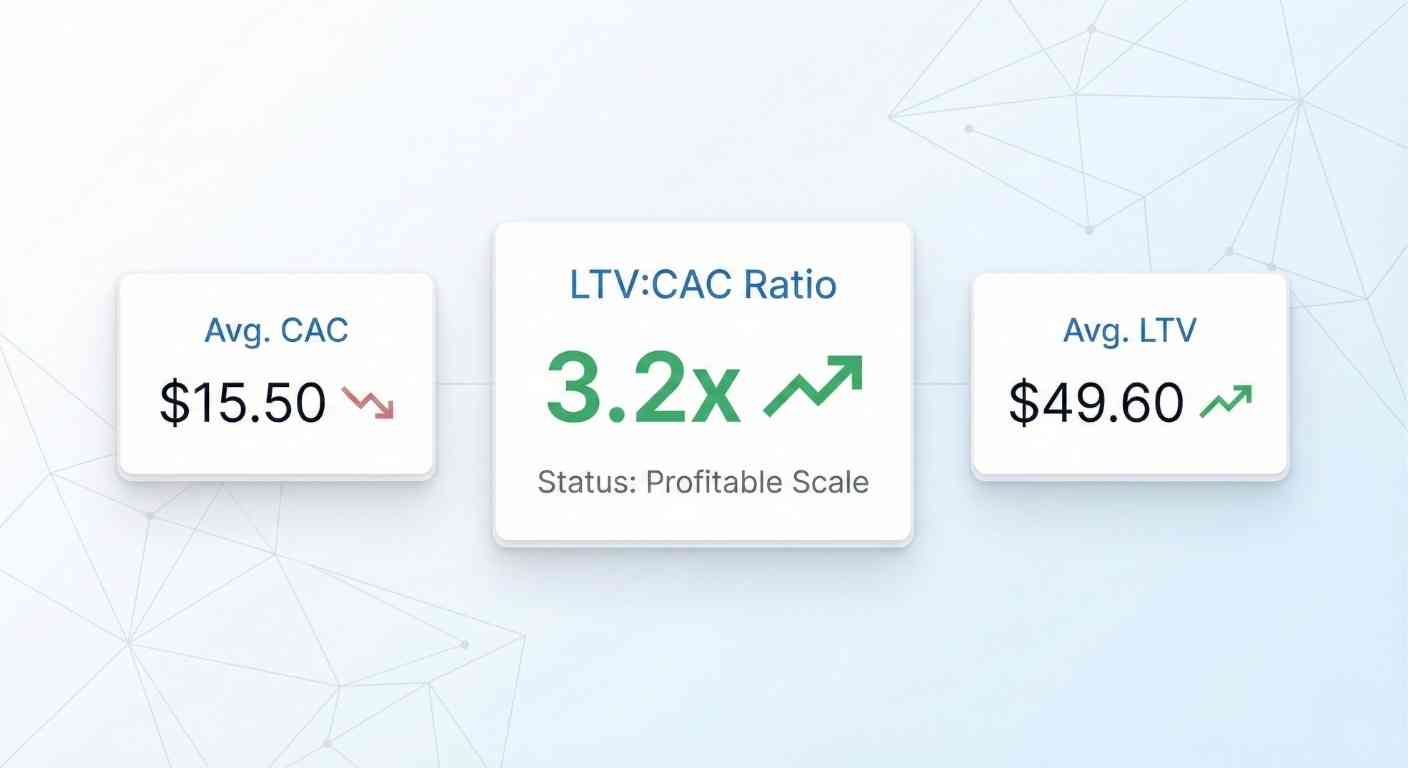
Once your measurement stack is locked in, you can stop obsessing over vanity metrics like impressions and clicks and focus on the numbers that actually dictate profitability. The two most critical metrics in your entire user acquisition world are Customer Acquisition Cost (CAC) and Lifetime Value (LTV).
Customer Acquisition Cost (CAC): This is your total cost to acquire a new, active user. You calculate it by dividing your total marketing spend by the number of new users you brought in over a set period. It’s a simple but powerful number that tells you the true price of growth.
Lifetime Value (LTV): This metric predicts the total revenue a single user will generate over their entire lifespan in your app. Calculating LTV can get complex, often involving historical data on user spending, subscription renewals, and ad revenue. But even a basic predictive model is a massive leap forward.
Getting a handle on these two metrics is non-negotiable. They are the core of your unit economics and the foundation for every scaling decision you'll ever make. For a deeper dive, our guide on how to measure your creative tests in Facebook Ads reporting offers more granular insights into tracking performance.
The LTV to CAC Ratio: The Golden Rule of Scaling
Knowing your LTV and CAC individually is one thing, but their relationship is what truly matters. The LTV-to-CAC ratio is your ultimate health check, telling you if your acquisition efforts are creating value or just burning cash.
Here's the simple breakdown:
LTV / CAC < 1: You're losing money on every new user. Hit the brakes on scaling immediately.
LTV / CAC = 1: You're breaking even. Your acquisition is funding itself but not generating profit.
LTV / CAC > 3: This is the magic number. A 3:1 ratio is widely considered the gold standard, signaling a profitable and scalable acquisition model.
This ratio becomes your primary decision-making tool. When a campaign consistently delivers a ratio of 3:1 or higher, you have a green light to confidently push more budget. If it dips below that, it’s a signal to pause, figure out what's wrong, and optimize before you even think about scaling further.
Key Insight: Profitability isn't about getting the cheapest installs. It's about maintaining a healthy LTV-to-CAC ratio as you scale. A higher CAC is perfectly fine if it brings in a user with an even higher LTV.
This financial discipline is especially vital when you realize that many apps can lose up to 80% of their users within the first three days after they install. That sobering statistic highlights why the focus has shifted from chasing volume to acquiring quality users who actually stick around. Every dollar spent on acquisition has to be justified by long-term user value, making the LTV-to-CAC ratio your most important compass.
Your Top User Acquisition Questions, Answered
Even with the best playbook, you're going to have questions. The world of mobile UA is full of tricky "what ifs" and "how much" scenarios. Let's cut through the noise and get straight to the practical answers for the most common hurdles you'll face.
How Much Should I Actually Budget for My First Campaign?
There's no single magic number here, but I can give you a solid starting point. For a platform like Meta, you want to budget enough to get at least 50-100 key conversions per ad set, per week. This is the volume their algorithm needs to get out of its learning phase and actually start working for you.
For a new app just getting its feet wet, a realistic test budget is usually somewhere in the $5,000 to $15,000 per month range. The most important thing is to start with a number you're comfortable learning with. Your first campaigns are all about gathering data, not hitting massive home runs.
Your first budget is an investment in learning. The goal isn't immediate profitability. It's about validating your core assumptions. Can you find the right audience? Does your creative resonate? Is your initial Cost Per Install (CPI) even in the right ballpark?
Once you see some positive signals—and you have a basic grasp of your unit economics (LTV > CAC)—then you can start scaling with confidence. Don't make the classic mistake of pouring money into a campaign before you've proven the fundamentals.
What Are the Most Important KPIs to Track?
Everyone obsesses over Cost Per Install (CPI), but honestly, it’s a vanity metric by itself. A low CPI means absolutely nothing if those users churn after day one. A smart UA strategy is guided by KPIs that tell you about user quality and long-term profitability.
Focus on this core set of metrics instead:
Retention Rate (D1/D7/D30): This is your #1 indicator of user quality, period. It answers the simple question: "Are people coming back after 1, 7, and 30 days?" High retention means you're finding the right users.
Cost Per Acquisition (CPA): This goes deeper than an install. It measures your cost for a user to complete a critical action—like finishing onboarding, starting a trial, or making that first purchase.
Lifetime Value (LTV): This is the total revenue you expect from a single user over their entire time with your app. It's the ultimate measure of the value you're bringing in.
LTV to CAC Ratio: This is your true north star. It pits the value a user brings against the cost to acquire them. A healthy target to aim for is 3:1—for every dollar you spend, you get three back.
Return on Ad Spend (ROAS): This is a direct measure of campaign efficiency, especially for apps with in-app purchases. It tracks the gross revenue you generate for every dollar you spend on ads.
Tracking these KPIs forces you to shift your mindset from buying cheap installs to investing in users who will actually grow your business.
How Long Does It Take to See Results?
Patience is a superpower in user acquisition. The timeline for results varies wildly by channel, and setting the right expectations is crucial to avoid killing a campaign that was just about to take off.
With organic channels like App Store Optimization (ASO), you're playing the long game. It might take 30 to 90 days of consistent work—tweaking keywords, updating screenshots, and getting reviews—before you see a real lift in organic downloads. Think of ASO as an investment, not a quick fix.
On paid ad platforms like Meta or TikTok, you'll see initial data like impressions, clicks, and CPI within the first 24 to 48 hours. But be careful—this early data is almost always volatile.
It usually takes a solid one to two weeks for the platform algorithms to really optimize and for you to have enough data to make smart calls on creative and targeting. Fight the urge to make big changes based on one bad day. True success, measured by things like LTV, requires looking at user cohorts over 30, 60, and even 90 days to see the real impact.
Ready to stop the manual grind and start scaling your creative output? Sovran uses AI to automate video ad production for Meta and TikTok, helping you test more, learn faster, and find winning ads up to 10x quicker. https://sovran.ai

Manson Chen
Founder, Sovran
Related Articles

10 High-Impact Marketing Video Examples for Your 2026 Strategy
In performance marketing, scrolling is the enemy. On platforms like Meta and TikTok, you have less than three seconds to stop a potential customer from swiping...
How to Scale Facebook Ads: A Guide to Profitable Growth
Trying to scale Facebook ads by just cranking up the budget is a classic rookie mistake. It's a surefire way to watch your ROAS tank. Real, sustainable scaling...
A Modern Playbook for AI for Advertisers
For advertisers, AI isn't some far-off, futuristic idea. It's a toolkit you can use right now to automate creative production, deliver personalization that...