Tool to Split Video Ads into Hooks and CTAs
Split your video ads into reusable hooks, bodies, and CTAs. Test each element independently and generate every combination automatically.
Jump to a section
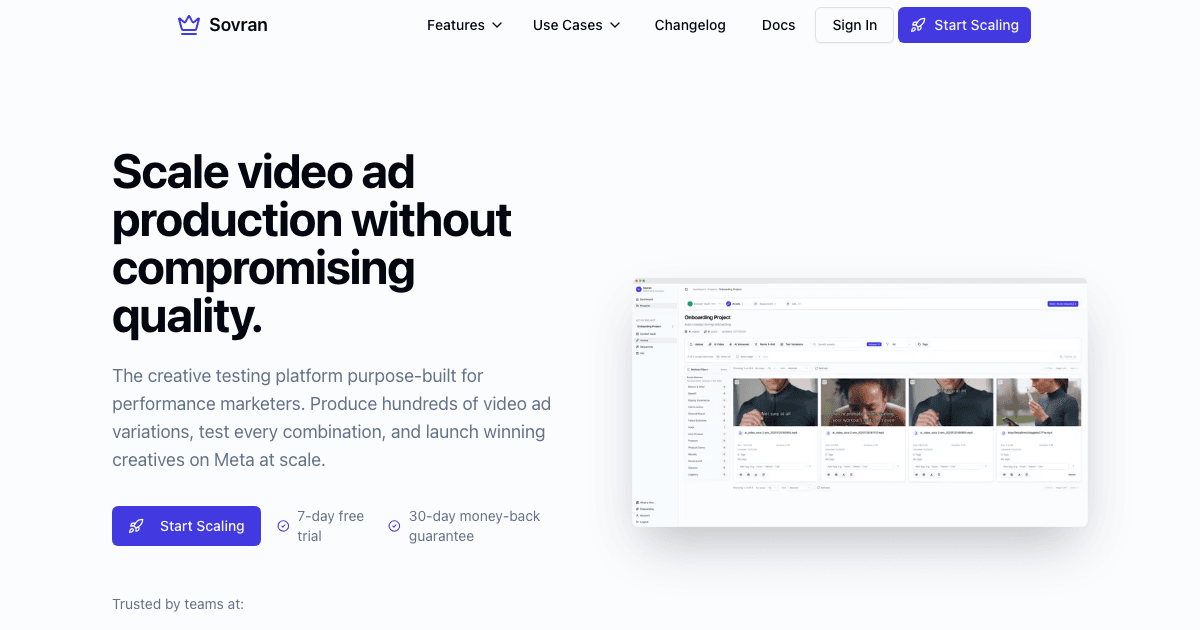
The hook is the highest-leverage element of any video ad. It determines whether someone watches or scrolls past. But most teams test hooks by creating entirely new ads — which means every hook test also changes the body and CTA, making it impossible to isolate what actually drove the performance change.
The solution is splitting your video ads into independent modules: hook, body, and CTA. Then test each one independently while holding the others constant.
Why Splitting Ads into Hooks and CTAs Matters
When you run a creative test with 10 ads, and ad #7 wins, what actually won? Was it the hook? The body? The CTA? The combination? Without modular testing, you cannot answer that question.
Splitting ads into components lets you:
- Isolate hook performance — test 5 hooks against the same body and CTA to find the best scroll-stopper
- A/B test CTAs — keep the same hook and body, change only the closing action
- Compound winners — take your best hook + best body + best CTA and combine them into a single high-performing ad
- Scale learnings — a winning hook can be paired with completely new bodies for the next testing cycle
How Sovran Splits Video Ads into Modules
Sovran treats every video ad as a sequence of swappable blocks:
- Upload your video — drop in an existing ad or raw footage
- Mark segment boundaries — define where the hook ends, where the body starts, and where the CTA begins
- Each segment becomes independent — the hook is now a standalone module that can be paired with any body and any CTA
- Add alternatives — drop in additional hooks, bodies, or CTAs into each slot
- Render all combinations — the system generates every permutation automatically
The original ad is preserved. You are creating a library of reusable components from it.
What You Can Do After Splitting
Once your ads are split into modules, the testing possibilities multiply:
- Hook testing: 5 hooks × 1 body × 1 CTA = 5 ads that isolate hook performance
- CTA testing: 1 hook × 1 body × 3 CTAs = 3 ads that isolate CTA performance
- Full matrix: 5 hooks × 2 bodies × 3 CTAs = 30 ads that test every combination
- Cross-pollination: Take winning hooks from one campaign and pair them with bodies from another
Example: 1 Ad Becomes 30 Variations
Start with a single 30-second video ad. Split it into:
- 1 original hook + 4 new hook options (filmed on your phone, 3 seconds each) = 5 hooks
- 1 original body + 1 alternate body (different demo angle) = 2 bodies
- 1 original CTA + 2 alternate CTAs (urgency vs. benefit vs. social proof) = 3 CTAs
5 hooks × 2 bodies × 3 CTAs = 30 unique video ad variations
Add a second aspect ratio (9:16 + 4:5) and you have 60 render-ready files. All from one original ad and a few minutes of additional filming.
Split Your First Ad
Take your best-performing ad and split it into modules. Then test 5 new hooks against the same body and CTA. You will learn more from that one test than from 5 completely new ads. Subscribe now and split your first ad in minutes.
Want to see the full math? Read our guide to making 50 video ad variations fast.

Manson Chen
Founder, Sovran
Related Articles

Storyboard Development: Scale Video Ad Production in 2026

8 Pattern Interrupt Techniques for Video Ads