Snapchat Ads for Business: The Ultimate 2026 Guide
Jump to a section
If you already run Meta and TikTok, treating Snapchat as a side channel is a mistake. The better frame is this: Snapchat is often where disciplined performance teams find extra reach, fresher inventory, and a different creative environment before fatigue catches up elsewhere.
That matters more now because Snapchat isn't a niche ad product anymore. Its advertising revenue is projected to reach US$7.26 billion by 2026 according to Snapchat advertising statistics. That kind of projection doesn't happen if advertisers only use it for soft awareness. It happens when enough businesses can justify budget with real outcomes.
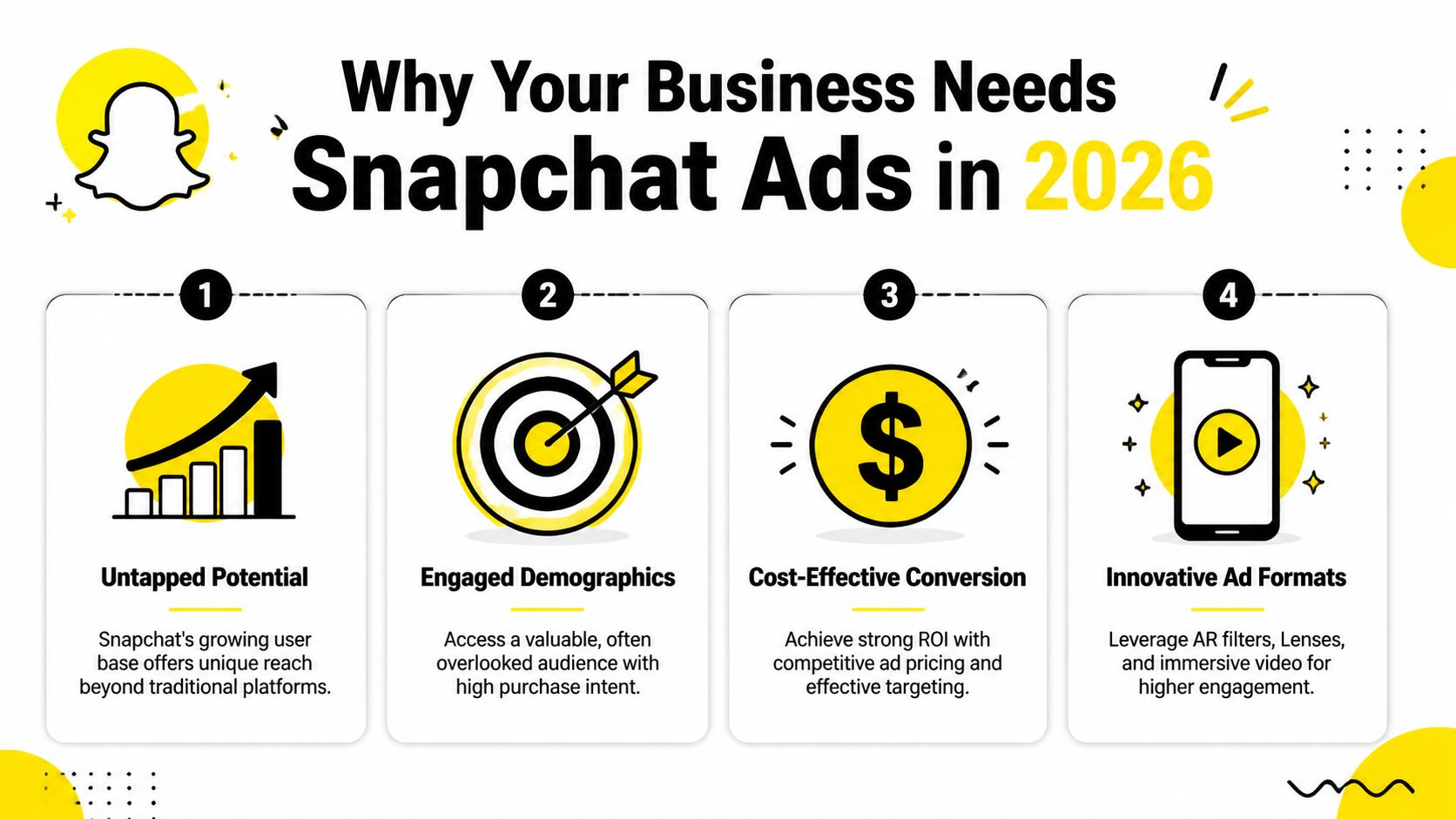
Why Your Business Needs Snapchat Ads in 2026
Snapchat reaches 75% of 13 to 34 year olds, and that audience represents $4.4 trillion in global purchasing power, according to this Snapchat advertising data roundup. For brands already spending on Meta and TikTok, that is not a side note. It is a real pool of incremental reach inside the same mobile-first buying behavior that drives paid social performance.
The strategic case is stronger than simple audience size. Snapchat works well inside a mature performance system because it gives media teams another place to test hooks, offers, creators, and cuts before fatigue drags down efficiency on bigger channels. That matters if your team already runs a high output creative process and needs more inventory to keep finding winners.
It is a real ad market with practical upside for operators
Three signals stand out.
- Revenue trajectory: The same report notes Snapchat ad revenue is projected at US$6.11 billion in 2024 and US$7.26 billion by 2026.
- SMB adoption: That report also says ads from small and medium-sized businesses grew 85% year over year in Q1 2024.
- Low barrier to test: The same source cites a US$5 daily campaign minimum, which makes Snapchat accessible for structured testing.
This SMB growth is the key signal for operators. Smaller advertisers do not expand into a channel at that rate unless they can get campaigns live, read results fast enough to make decisions, and find pockets of efficiency without enterprise-level budgets.
The opportunity is not replacing your existing spend mix. It is adding Snapchat where it can do a specific job inside the system.
Snapchat fills a gap Meta and TikTok do not cover the same way
Meta usually carries heavier retargeting volume and stable conversion demand once an account is seasoned. TikTok often produces strong creative discovery because the feed rewards fresh concepts quickly. Snapchat sits in a useful middle position for many brands. It offers a different auction, a different user behavior pattern, and a format environment where direct, native-looking vertical video can still break out without feeling recycled from another platform.
That difference matters when a concept starts to flatten on Meta or when TikTok CPMs rise on a broad test. Instead of forcing more spend into fatigued ads, strong teams use Snapchat to pressure-test the next batch of concepts with a similar audience profile but a different delivery environment. Sovran's Snapchat workflow overview is a good reference if you want to build Snapchat into an existing paid social testing system rather than run it as an isolated channel.
A common mistake is importing Meta campaign logic, resizing a few old videos, and judging Snapchat on weak creative. The better approach is to treat it as a distinct testing lane. Same offer. Same conversion goal. Different creative packaging, different audience response, and often a different signal on what deserves more budget across channels.
If your team is still tightening up the basics before adding another platform, a simple resource like 10 powerful marketing tips for small businesses is useful. Channel expansion works better when offer clarity, landing pages, and measurement discipline are already in place.
Setting Up Your Ad Account and Pixel Correctly
A lot of Snapchat performance problems start before the first impression. The account is live, ads are approved, traffic comes in, and reporting is already compromised. By the time the team notices, they've trained optimization on weak signals.

Build the account structure for clean data
Start with Business Manager, then verify the organization before you get deep into campaign creation. Verification isn't admin busywork. It affects access and scale, and it keeps the setup clean if you're managing multiple brands, regions, or client accounts.
A practical structure looks like this:
- One business entity per actual business
- Separate ad accounts by brand or materially different vertical
- One Pixel ID per ad account
- Shared access managed by role, not by login sharing
That last point matters for agencies and in-house teams alike. Clean permissions reduce mistakes, especially when creative, media, and analytics teams all touch the same setup.
Install the pixel like attribution depends on it, because it does
Snap Pixel should sit in the <head> of your site template with standard events mapped properly. At minimum, most ecommerce and lead gen setups should care about PAGE_VIEW, VIEW_CONTENT, ADD_TO_CART, and PURCHASE. If you're using Google Tag Manager, make sure the data layer passes dynamic values cleanly.
The most common failure isn't "pixel missing." It's variable mapping done badly.
- Product identifiers don't match the catalog
- Price or currency values don't pass consistently
- Duplicate firing creates noisy conversion data
- Client-side only tracking misses too much in privacy-heavy environments
According to Authencio's Snapchat ads strategy guide, a correctly configured Snap Pixel setup aligned with CAPI can improve attribution accuracy by 20-30%. The same guide says misconfigured pixels can cause 40% underreported conversions, and 65% of advertisers fail dynamic variable mapping, which can inflate CAC by 25%.
Bad pixel data doesn't just make reporting ugly. It teaches the platform to optimize against the wrong users.
What to check before you spend seriously
Before scaling budget, pressure test the implementation.
| Check | What good looks like | What failure usually means |
|---|---|---|
| Event firing | Key events trigger once per intended action | Duplicate tags or broken triggers |
| Dynamic variables | Item ID, price, and currency populate correctly | Weak catalog matching or poor revenue data |
| Purchase event timing | Fires only on confirmed completion | Inflated conversion counts |
| Browser plus server alignment | Events reconcile cleanly | Attribution gaps or double-counting |
If you use outside tools for routing, QA, or analytics, keep the handoff simple. A stack with too many disconnected layers creates attribution disputes fast. For teams stitching together event flows across platforms, Sovran's integration documentation is a practical example of how centralized connections should look.
Architecting Your Campaigns and Targeting
Good Snapchat account structure doesn't guarantee good campaign architecture. At this point, teams either build a system that learns or create a pile of ad sets that never exit the testing phase.
Snapchat has the scale to support a serious acquisition program. The platform has 474 million daily active users, and 48% of 18-25-year-old internet users are active there, according to ALM Corp's review of Snapchat platform activity. That same source notes a 25% year-over-year increase in user watch time, which matters because more watch time gives video advertisers more chances to get enough signal.
Match objectives to actual business goals
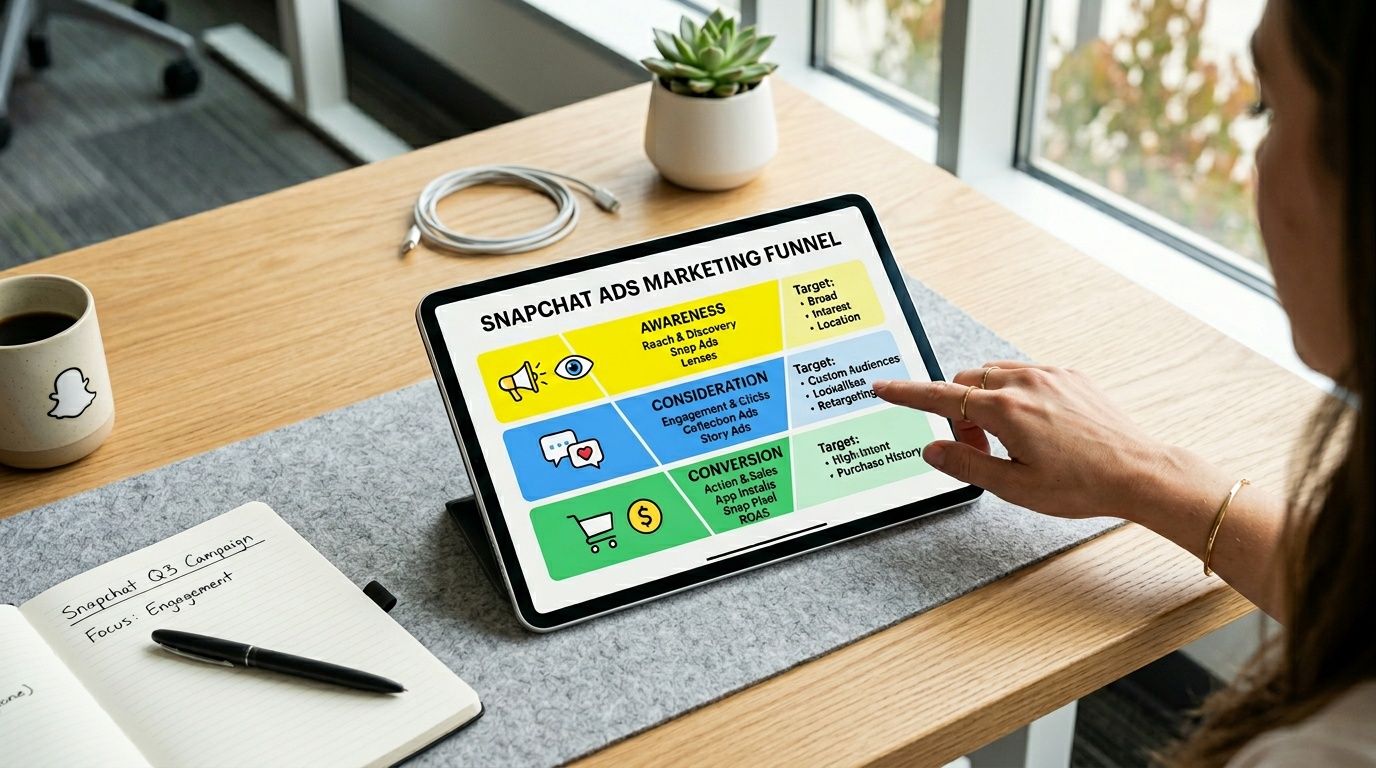
One common mistake is choosing an objective based on what feels safest rather than what the business needs. If the goal is purchases, don't hide inside traffic campaigns because the early numbers look cheaper. Lower click costs can mask weak buying intent.
A simple decision framework works better:
- Website conversions when you need purchases, leads, or other on-site actions
- App installs when user acquisition is the main KPI
- Reach or awareness when you're seeding a new market or supporting a larger launch
- Retargeting conversion campaigns when you already have site or app signal and need more efficient bottom-funnel follow-up
The objective affects delivery. That's why campaign naming and tracking discipline matter. If your campaign says "prospecting" but uses warm audiences and conversion-heavy creative, nobody on the team will trust the readout later.
Treat targeting like a toolkit, not a menu
Snapchat targeting works best when you use different audience types for different jobs.
For broad prospecting, start with core demographics and a small number of relevant interest clusters. Don't over-stack inputs on day one. In app campaigns, that might mean combining age range, geography, and a narrow layer of adjacent interests. In DTC, it might mean product-category relevance and purchase context without trying to pre-eliminate every low-propensity user.
For warmer traffic, move quickly into:
- Retargeting pools built from pixel events
- Customer lists through audience matching
- Lookalike audiences seeded from purchasers, high-value users, or qualified leads
Retargeting usually deserves its own campaigns. It behaves differently, spends differently, and responds to different creative. A cold audience often needs angle testing. A cart abandoner usually needs clarity, proof, or urgency.
Here's a quick visual if you want a baseline walkthrough of the platform mechanics before you refine your structure.
Two campaign patterns that hold up well
A gaming app and a DTC brand shouldn't share the same architecture.
| Business type | Prospecting approach | Mid-funnel approach | Bottom-funnel approach |
|---|---|---|---|
| Mobile app | App install campaigns with broad plus selective interest layers | Viewers and clickers grouped by engagement quality | Re-engagement focused on install completion or high-intent users |
| DTC ecommerce | Website conversion campaigns with category-relevant creative angles | Site visitors and product viewers segmented by behavior | Cart and checkout retargeting with offer, proof, or objection handling |
The best Snapchat structures are simple enough to read clearly and strict enough to compare against Meta and TikTok without guessing what each campaign was supposed to do.
Mastering Snapchat Ad Formats and Specs
Analysts at Strike Social found that format-compliant Snapchat campaigns can earn higher engagement and lower CPMs, while a large share of rejections come from basic spec mistakes, according to its Snapchat ad specs guide. That matters more than it sounds. In a fast creative testing system, every rejected asset slows learning, delays spend, and muddies comparisons with Meta and TikTok.
Snapchat rewards teams that treat specs as part of performance, not as post-production cleanup. A strong concept can still lose if captions sit under the UI, the crop cuts off the product, or the format does not match the user action you want.
The formats worth knowing
Many teams already spending seriously on paid social do not need every Snapchat unit. They need a small set of formats that map cleanly to creative intent and can fit into an existing testing workflow.
Commercials are the best fit when the first few seconds do the selling. The standard version is short. Extended Commercials can run longer, but the opening six seconds still carry the result because that portion is non-skippable, per the same reference. Use this format for hard hooks, direct product demos, launch moments, and offer-led creative you also want to compare against short-form Meta and TikTok variants.
Story Ads give more room for sequence and explanation. They work well when a single clip cannot handle the job, such as showing a product setup, before-and-after use case, or multi-angle proof. For ecommerce, they can bridge the gap between thumb-stop creative and product education without forcing everything into one crowded frame.
Single image or video ads usually do the heaviest lifting for acquisition. They are the easiest format to produce at volume, easiest to version quickly, and easiest to port from other channels with minor edits to safe zones and pacing.
Collection-style commerce units make sense for catalog-heavy brands with enough product depth to justify browsing behavior inside the ad experience. They can drive efficient traffic, but only if feed mapping, product titles, and landing page continuity are clean.
For teams managing assets across channels, a shared reference for social media video specs across placements cuts down avoidable rework.
Snapchat Ad Format Quick Reference 2026
| Ad Format | Dimensions (px) | Max Length | File Type | Best For |
|---|---|---|---|---|
| Commercials standard | 1080x1920 | 6s | .mp4, .mov | Tight product hooks, launches, broad reach |
| Commercials extended | 1080x1920 | 180s | .mp4, .mov | Explainers, demos, stronger narratives |
| Story Ads | 9:16 vertical | 180s | Video or image series | Multi-step storytelling, product education |
| Single image or video ads | 9:16 vertical | Varies by format | Image or video assets | Core acquisition and retargeting |
| Collection-style commerce units | 9:16 main asset plus catalog mapping | Varies by format | Mixed creative plus product feed | Ecommerce browsing and direct-response shopping |
What actually causes performance issues
The common failure points are operational.
- Safe zones ignored: headlines, offer copy, and CTAs get covered by Snapchat interface elements
- Wrong pacing for the format: a forced first view does not fix a slow or unclear opening
- Weak product visibility: creators talk, but the product or outcome shows up too late
- Broken catalog mapping: commerce units look fine in preview but send users to mismatched products
- Cross-platform reuse without adaptation: a Meta or TikTok winner often needs tighter framing and faster payoff on Snapchat
Creative operations matter. If your team already tests dozens of hooks a week on Meta or TikTok, Snapchat should not become a custom-production bottleneck. Build modular assets in 9:16 first, keep text away from interface-heavy zones, and export variants with Snapchat-safe framing before launch. Teams using a production system like the ShortGenius AI ad creative tool can move faster here because resizing, versioning, and hook swaps happen before the ad hits review.
Extended Commercials deserve one extra caution. More time does not mean more persuasion. In practice, longer units work only when the opening establishes the problem, product, or payoff immediately, then earns the next few seconds with proof. If that structure is weak, completion drops and delivery quality usually follows.
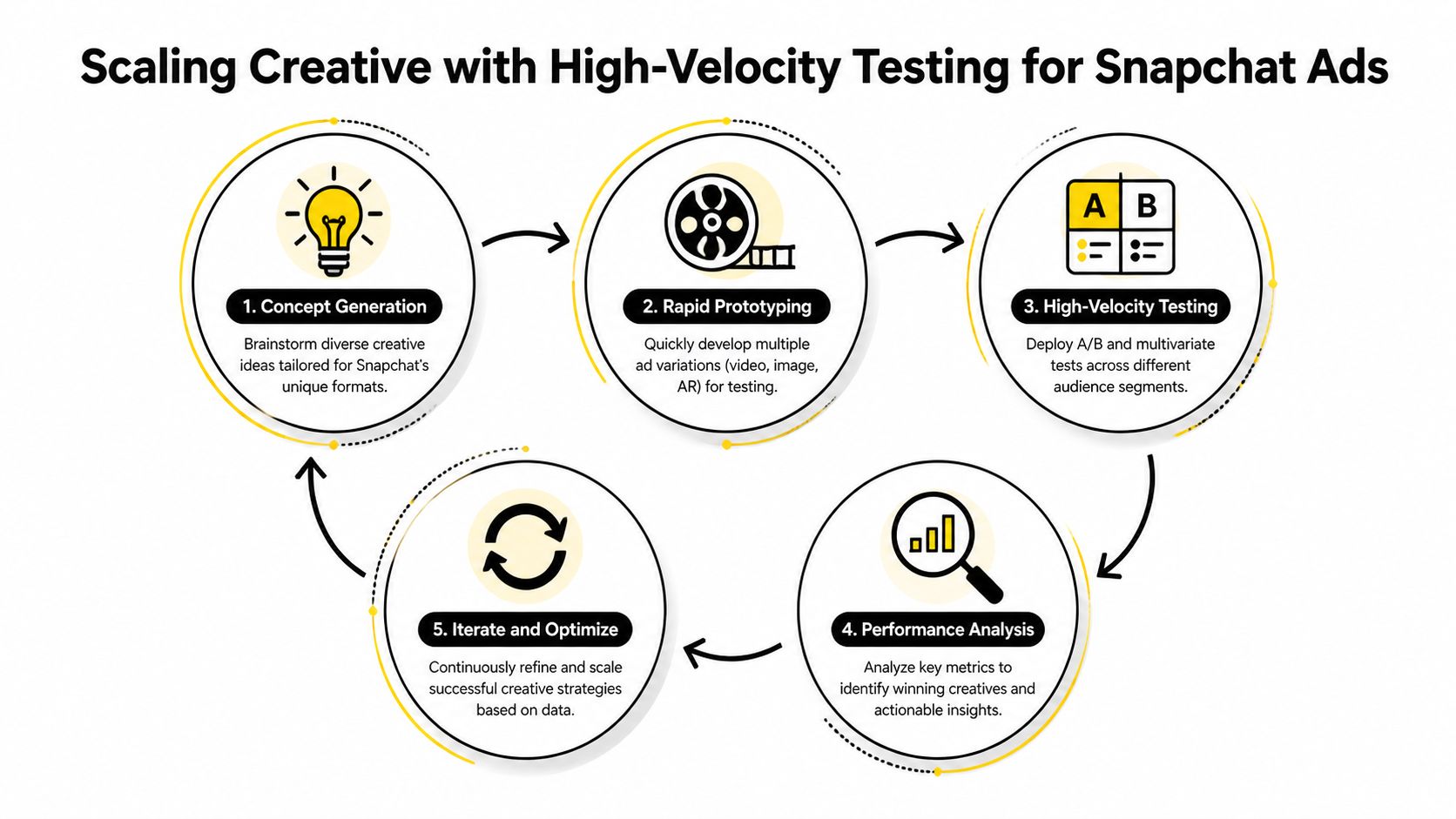
Scaling Creative with High-Velocity Testing
Most Snapchat guides spend too much time on ad formats and not enough time on output volume. That's the wrong emphasis for any team already buying seriously on Meta or TikTok.
The hard part isn't making one good ad. The hard part is producing enough structured variation to keep learning after the first winners fatigue. That's why snapchat ads for business should be treated as a creative systems problem, not just a media buying problem.
The modular workflow that fits Snapchat
Snapchat's own business materials leave a gap here. As noted in Snap's ad formats resource, most guidance focuses on formats and targeting, not on how teams produce hundreds of recombined hooks, bodies, and CTAs to fight fatigue.
That's the operating model if you're already running high-volume paid social.
A workable modular system looks like this:
- Hooks Short openings built around different angles. Problem-first, outcome-first, curiosity-first, creator-style, offer-led.
- Bodies The proof section. Product demo, use case, testimonial-style explanation, before-and-after framing, feature payoff.
- CTAs Direct purchase ask, install ask, limited-time framing, benefit-led action, social-proof close.
The point isn't to be clever. The point is to separate creative variables so you can tell what changed performance.
What to test first
Don't test everything at once. Start with the pieces that usually shift response fastest.
- Hook angle: Problem awareness versus payoff awareness
- Visual opening: Face to camera versus product-in-use
- Message density: Sparse text overlay versus more explicit explanation
- CTA framing: Direct action versus value-first action
If you already use tools for fast concept generation, a lightweight option like the ShortGenius AI ad creative tool can help teams turn rough ideas into testable creative directions before full production.
Teams lose time when they debate which ad is "best." They gain speed when they ask which variable deserves isolation next.
A practical testing rhythm
The Snapchat environment favors pace. Short-form vertical ads get judged quickly, and your team should react quickly too.
Use a workflow like this:
| Stage | What to do | What you're trying to learn |
|---|---|---|
| Asset intake | Pull raw footage, UGC, demos, testimonials, founder clips | What usable building blocks already exist |
| Tagging | Label scenes by product angle, persona, hook type, and CTA type | Which assets can be recombined without reshooting |
| Batch creation | Assemble many variants from the same source material | Which combinations deserve spend |
| Controlled launch | Group tests so one major variable changes at a time | Whether performance changes came from angle, edit, or audience |
| Iteration | Keep winners, replace weak modules, relaunch quickly | How to extend fatigue resistance |
A lot of teams struggle here because their editing workflow is still ad-by-ad. That's too slow. If you want a better mental model for this production style, this modular video ad framework explains the system clearly.
What works and what doesn't
What usually works on Snapchat:
- Native-feeling footage that doesn't look over-produced
- Fast first seconds with a clear reason to keep watching
- Message clarity over aesthetic perfection
- Large variation sets built from a small number of proven raw assets
What usually doesn't:
- Straight Meta carryover with no channel adaptation
- One hero video expected to carry a whole account
- Creative reviews driven by taste
- Testing too many variables in one batch
The best operators on Snapchat don't ask, "Did this ad win?" They ask, "Which component won, and how many more versions can we build from it?"
Bidding Budgets and Measuring True Impact
Buying Snapchat well means making two separate decisions. First, how aggressively you want the platform to spend. Second, how you'll decide whether that spend helped the broader paid social program.
The second part is where many businesses struggle.
Pick bidding based on campaign maturity
Different bid strategies fit different stages of account maturity.
Auto-bid is usually the right starting point when you're entering a new audience, testing new creative, or trying to gather enough signal for the platform to stabilize. It reduces friction early.
Target cost makes more sense when you've already identified a realistic efficiency range and want tighter control without choking delivery.
Max bid is the most manual option. It can help in narrow situations, but it also creates more ways to underdeliver if your inputs are wrong.
An easy way to visualize the process:
- Use auto-bid for exploration
- Use target cost when performance patterns are more stable
- Use max bid only when you have a strong reason to force tighter auction discipline
Don't let last-click decide the budget
Snapchat ads for business present a significant hurdle in this regard. Marketers can see platform-level metrics, but proving Snapchat's incremental contribution against Meta and TikTok is still difficult.
As explained in Stape's discussion of Snapchat ads for businesses, there's still little comparative data from unified dashboards that lets growth teams confidently allocate budget across those platforms. That's why a weak dashboard setup leads to bad budget calls. Snapchat can look worse than it is, or better than it is, depending on how attribution is configured.
A channel doesn't need to win every last-click report to deserve budget. It needs to improve the total system.
A better way to read performance
Use Snapchat's in-platform metrics for directional optimization, but evaluate budget decisions in a broader reporting layer.
That means checking:
- Creative-level trends to see which messages travel
- Audience-level differences between prospecting and retargeting
- Blended CAC or blended revenue movement across the wider paid social mix
- Incrementality-oriented tests where possible, especially when Snapchat supports bottom-funnel retargeting
If your team needs a practical framework for turning channel metrics into finance-relevant reporting, how to measure social media ROI is a good companion read. For creative-specific analysis, this guide to measuring creative tests in Facebook Ads reporting is useful even outside Meta because the discipline carries over.
The key is simple. Don't ask whether Snapchat's reported ROAS matches Meta's exactly. Ask whether adding Snapchat improves total acquisition efficiency, gives you more winning creative learnings, or reduces dependence on one crowded auction.
Optimization and Troubleshooting Checklist
When a Snapchat campaign stalls, the fix usually isn't mysterious. It's usually sitting in creative, tracking, audience quality, or format compliance. Use this as a quick triage sheet.
| If you see this | Then check this |
|---|---|
| High impressions, weak swipe behavior | Your hook probably isn't strong enough. Recut the opening so the first seconds show the product, payoff, or problem immediately. |
| Spend won't scale | Check bid strategy, audience size, and event quality. Restrictive settings or weak conversion signals often choke delivery. |
| Good click volume, poor on-site results | Review landing page match. If the ad promises one thing and the page delivers another, Snapchat traffic will expose it fast. |
| Reported conversions feel too low | Audit Pixel and server-side event alignment. Dynamic variables and duplicate suppression are common failure points. |
| Ads keep getting rejected | Review dimensions, safe zones, and format-specific requirements before blaming policy. A lot of "policy problems" are actually build problems. |
| Retargeting underperforms | Segment warmer audiences more tightly. Product viewers, cart users, and recent purchasers shouldn't all see the same message. |
| CPA rises after an early win | Fatigue is probably setting in. Keep the concept, replace the hook, body, or CTA module, and relaunch variations. |
| ROAS looks weaker than Meta | Compare contribution at the blended level, not just the platform dashboard. Snapchat may be assisting conversion paths you won't see in a narrow attribution lens. |
A few habits prevent most of these issues.
- Audit tracking before scaling: Fix signal quality first.
- Refresh creative on a schedule: Don't wait until performance collapses.
- Separate cold and warm logic: Prospecting and retargeting need different messages.
- Keep naming disciplined: If campaign names are messy, analysis gets messy too.
If your team wants to scale Snapchat the same way it scales Meta and TikTok, Sovran helps you build and test far more video variations from the footage you already have. It's built for performance marketers who need modular hooks, bodies, and CTAs, faster iteration, and a cleaner path from creative production to launch.

Manson Chen
Founder, Sovran
Related Articles

Storyboard Development: Scale Video Ad Production in 2026

8 Pattern Interrupt Techniques for Video Ads