TikTok Ads Conversion Rate: Quick Wins to Boost Campaigns
Boost your tiktok ads conversion rate with proven strategies for creative, targeting, and measurement. Get actionable tips now.
Jump to a section
- What a Good TikTok Ads Conversion Rate Looks Like
- The Four Pillars of High-Converting TikTok Ads
- Measuring What Truly Matters on TikTok
- Your Framework for Systematic Conversion Optimization
- Using AI to Overcome Creative Fatigue
- Common Mistakes That Destroy Conversion Rates
- Got Questions? We’ve Got Answers.
Across standard campaigns, the average TikTok ads conversion rate usually lands somewhere between 0.46% and 2.4%. But here's where it gets interesting: that number can absolutely explode, hitting over 10%, when you bring integrated features like TikTok Shop into the mix. This massive gap says a lot about the power of a smooth, in-app user experience.
What a Good TikTok Ads Conversion Rate Looks Like
Trying to pin down a single "good" conversion rate is a bit like asking for the perfect speed to drive a car. It completely depends on whether you're navigating city traffic or cruising down the highway. Your campaign goal and ad format are your city and highway—they change everything.
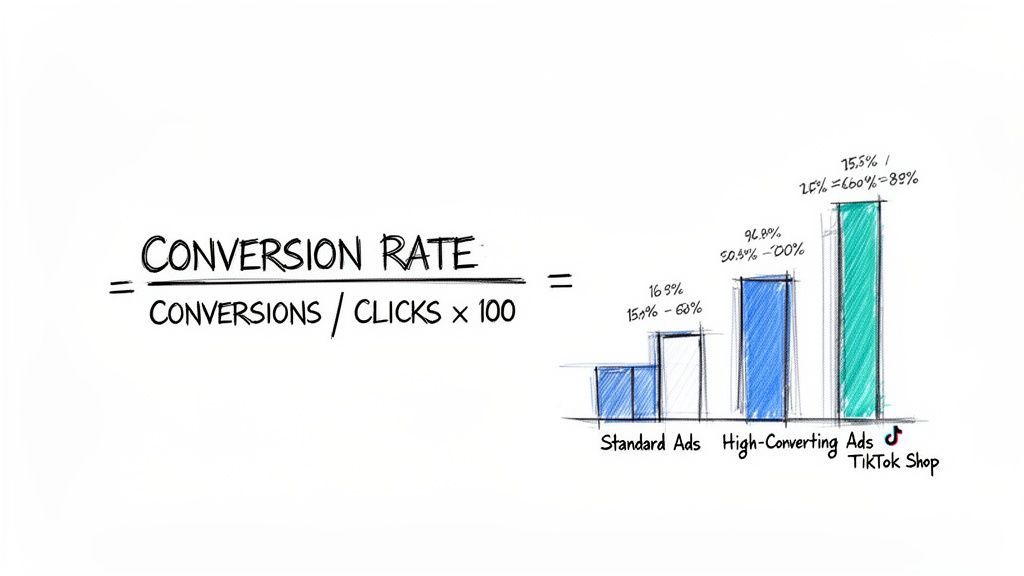
At its heart, the calculation is straightforward. It’s just the percentage of people who do what you want them to do after clicking your ad.
Conversion Rate Formula: (Total Conversions / Total Clicks) x 100 = Conversion Rate %
This little formula is your starting line. For instance, if 1,000 users clicked your ad and 15 ended up buying something, you're looking at a 1.5% conversion rate. It's the first vital sign you check to see if your campaign is healthy or needs a little help.
Standard Ads vs. TikTok Shop Performance
The biggest driver of your conversion rate? The user's journey. Standard TikTok ads have to work a lot harder because they send people off-platform to a website or landing page. This introduces friction—leaving the app, waiting for a page to load, figuring out a new layout.
Every extra step is a chance for a potential customer to drop off, which is why standard campaigns typically see those 0.46% to 2.4% conversion rates. It’s a respectable range, but it doesn't hold a candle to what’s possible with TikTok’s native commerce tools. To see what top-tier creative looks like, take a look at these inspiring video advertising examples.
TikTok Shop ads, on the other hand, pave a frictionless path to purchase right inside the app. The experience is seamless, which drastically cuts down on user drop-off. The data backs this up, with TikTok Shop integrations routinely pushing conversion rates past 10%.
This chart paints a pretty clear picture of the performance difference.
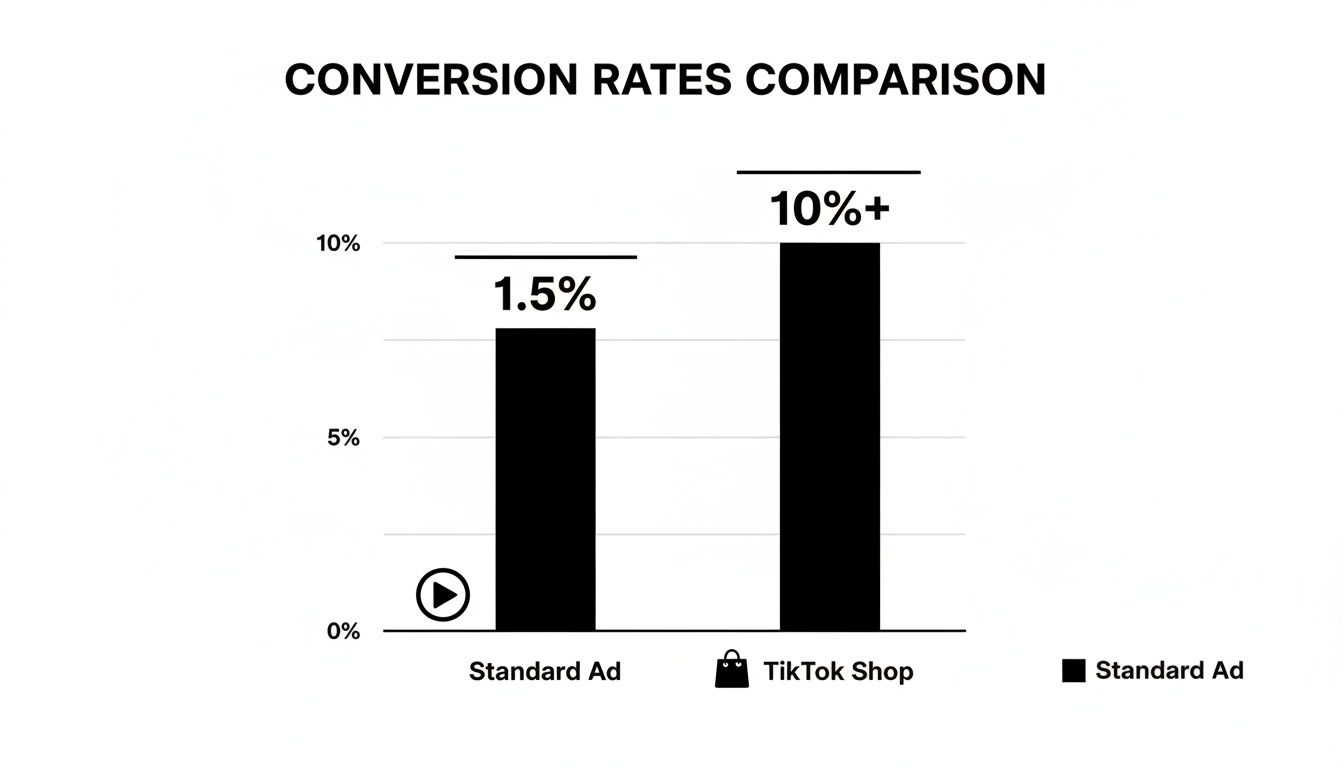
It’s a stark visual reminder of just how much an in-app checkout can do to turn casual viewers into paying customers.
Setting Realistic Benchmarks
Knowing these differences is crucial for setting goals that make sense. You can't expect a 10% conversion rate from an ad that sends users to a clunky, slow-loading external site. On the flip side, if you're settling for 1.5% on a TikTok Shop ad, you're leaving a lot of money on the table.
To help you set some realistic targets, here's a quick reference table breaking down typical conversion rates by campaign goal.
TikTok Ads Conversion Rate Benchmarks by Goal
Campaign Goal | Average Conversion Rate (Standard Ads) | High-Performing Rate (Standard Ads) | TikTok Shop Integration Rate |
|---|---|---|---|
Lead Generation | 2-3% | 4-5% | N/A |
E-commerce Purchase | 1-1.5% | 2-3% | 8-12%+ |
App Installs | 1-2% | 3-4% | N/A |
Keep these numbers in mind as a starting point. They'll help you gauge performance more accurately and focus your optimization efforts where they'll have the biggest impact. If your TikTok Shop ad is underperforming, it’s a strong signal to re-evaluate your offer, pricing, or creative.
The Four Pillars of High-Converting TikTok Ads
Nailing a high TikTok ads conversion rate isn't about some secret hack you can just switch on. It's about building a solid foundation.
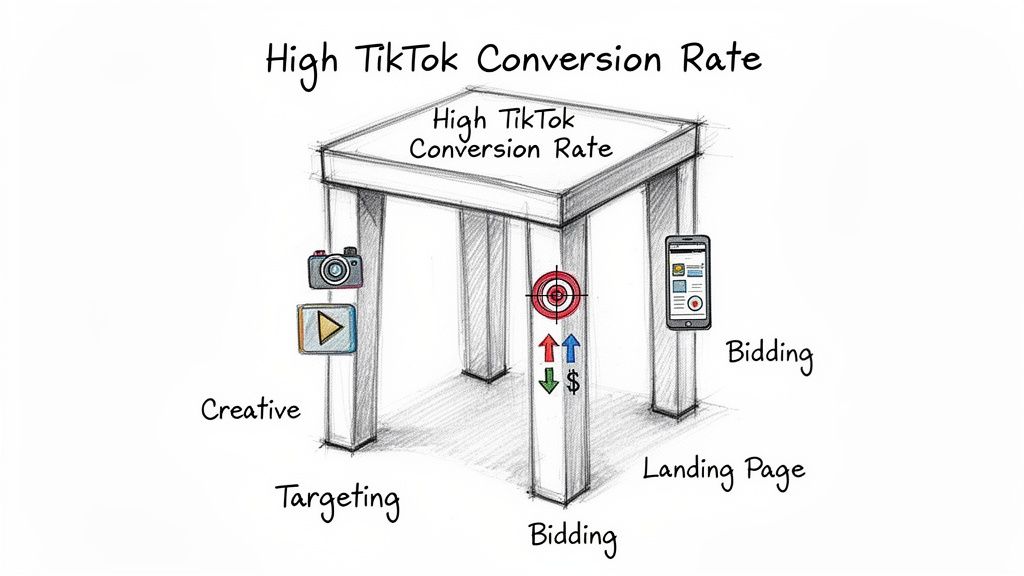
Think of your campaign as a four-legged stool. If one leg is wobbly, the whole thing is unstable and useless. For TikTok ads, those four legs are: Creative, Targeting, Bidding, and your Landing Page.
When all four pillars are working together, they create a smooth, powerful path that takes a user from their "For You Page" all the way to a finished conversion. Let's break down how each pillar contributes to a campaign that actually wins.
Pillar 1: The Creative That Stops the Scroll
On TikTok, your ad creative is everything. It's your first—and often only—chance to stop someone from swiping past.
This is where so many brands get it wrong. Highly polished, corporate-style videos feel like a traditional commercial interrupting the party. They stick out in the worst way and get ignored.
The content that consistently crushes it feels authentic, raw, and like it belongs on the platform. This is the domain of user-generated content (UGC) and creator-led ads. They blend right into the feed, grab attention without being jarring, and build instant trust. To really get into the weeds on this, check out our guide on TikTok creative best practices.
A killer creative really just needs a few things:
A Powerful Hook: The first 1-3 seconds have to be an absolute thumb-stopper. This could be a wild question, a shocking visual, or a direct callout to a user's biggest pain point.
A Clear Value Prop: The viewer needs to get what you're selling and why they should care, fast. No jargon, no fluff.
A Strong Call-to-Action (CTA): Tell them exactly what to do next. "Shop Now," "Learn More," "Download"—make it obvious.
Pillar 2: Precision Targeting That Finds Your People
Even the best creative in the world will flop if you show it to the wrong audience. Great targeting is about finding that sweet spot: broad enough for the algorithm to learn, but narrow enough to find users who will actually convert.
Start by layering different audience types. Go broad to let TikTok's algorithm explore and find pockets of users you might have missed. At the same time, build Lookalike Audiences from your best customers—like past purchasers or high LTV users—to find more people just like them.
One of the most common and expensive mistakes we see is continuing to serve ads to people who already converted. Always, always, always create a custom audience of your past purchasers and add them to your campaign's exclusion list. This one simple step focuses your budget on finding new customers instead of annoying your existing ones.
Pillar 3: Smart Bidding That Maximizes Your Budget
Your bidding strategy is you telling TikTok how to spend your money in the ad auction. Picking the right one is critical for controlling your costs and hitting your conversion goals. There are two main strategies you need to know.
Lowest Cost (or Highest Volume):
What it does: This tells TikTok to get you the most conversions possible within your budget, without a specific cost-per-conversion cap. The algorithm will bid dynamically to win as many auctions as it can.
When to use it: Perfect for new campaigns where you need to gather data quickly. It's also great when your main goal is just raw conversion volume, even if the CPA fluctuates a bit.
Cost Cap:
What it does: You set a maximum average cost you're willing to pay for each conversion. TikTok then tries to win only the auctions that meet this target.
When to use it: Use this when you have a specific target CPA you need to hit for profitability. It gives you way more control over your costs but can sometimes limit your campaign's reach if you set the cap too low.
Pillar 4: The Landing Page That Seals the Deal
The final pillar is your landing page—this is where the conversion actually happens. You can have the best creative, targeting, and bidding strategy on the planet, but a clunky landing page will tank your conversion rate.
The journey from your TikTok ad to your landing page has to feel seamless. The messaging, the visuals, the overall vibe—it all needs to match. If someone clicks an ad for a specific pair of shoes and lands on your generic homepage, they're going to get confused and bounce.
Your landing page must be built with a mobile-first mindset. Make sure it loads lightning-fast, because every second of delay kills conversions. It needs to be dead simple to navigate on a small screen, with a CTA button that’s impossible to miss. Any friction here—slow load times, confusing forms, too many clicks—will cause people to drop off, wasting all the ad spend that got them there in the first place.
Measuring What Truly Matters on TikTok
Relying only on last-click conversions for your TikTok campaigns is like watching the last minute of a movie and thinking you know the whole story. You see the ending, but you completely miss the plot that led up to it. TikTok’s real power is often more subtle; it plants a seed that might not sprout into a conversion for hours or even days. To get a real grip on your TikTok ads conversion rate, you have to look beyond that final click.
This is where view-through conversions (VTCs) come into play. A VTC is when someone sees your ad, doesn’t click, but is influenced enough to come back and convert later. Imagine them seeing an ad for your skincare product while scrolling, then remembering it that night and searching for your brand on their laptop.
Last-click attribution would give your TikTok ad zero credit for that sale. But the ad did its job perfectly—it built awareness and sparked intent. If you ignore these view-throughs, you're seriously undervaluing your campaign's true impact.
Choosing the Right Attribution Window
To capture this full story, TikTok lets you set an attribution window. This is simply the period of time after someone sees or clicks your ad where a conversion can be credited back to it. This isn't a one-size-fits-all setting; it needs to line up with how your customers actually buy.
You can tweak this window based on two key interactions:
Click-Through Attribution: This tracks users who click your ad and then convert. You'll typically see options for 1-day, 7-day, or 28-day click windows.
View-Through Attribution: This tracks users who only see your ad (no click) and convert later. Common settings are 1-day or 7-day view windows.
If you’re selling something with a short buying cycle, like a trendy t-shirt or a mobile game, a 1-day click and 1-day view window is probably spot-on. But for more considered purchases, like a mattress or an online course, stretching that to a 7-day click and 7-day view window gives you a much more accurate picture of your ad’s influence.
A strong benchmark for TikTok ad conversion rates often hovers around 1-3% for e-commerce and 3-5% for lead generation, but this tells only part of the story. View-through conversions can account for an additional 10-30% of total successes when measured with 1 to 7-day attribution windows. Discover more insights about TikTok conversion tracking on stape.io.
The Technical Backbone of Accurate Measurement
Of course, none of this sophisticated measurement means anything without a solid technical setup. Your entire campaign's reporting hinges on two critical tools working together: the TikTok Pixel and the Conversions API.
Think of the TikTok Pixel as a scout on your website. It's a small bit of code that watches what users do—viewing a product, adding to a cart, making a purchase—and sends that intel back to your TikTok Ads Manager. This is what lets you connect the dots between your ads and on-site actions.
But the Pixel lives in the browser, which means it can be tripped up by ad blockers and privacy updates that limit what it can see. That’s where the Conversions API (CAPI), also known as a server-side API, steps in.
CAPI is like a secure, direct line from your website’s server to TikTok’s server. It sends the same conversion data as the Pixel but from a much more reliable source, completely bypassing any browser-level roadblocks.
Running both the Pixel and CAPI together gives you a resilient, dual-layer tracking system. This tag-team approach ensures you’re capturing the most accurate data possible, giving you the confidence to make smart budget decisions and prove the real ROI of your spend. Without it, you're flying blind and leaving a huge chunk of your conversions on the table. For more on improving your campaign results, explore our guide on how to approach TikTok ad creative testing.
Your Framework for Systematic Conversion Optimization
Hoping for a sky-high TikTok ads conversion rate by just throwing a bunch of random creatives at the wall is like playing darts in a dark room. You might hit the board eventually, but it’s an expensive, exhausting, and totally unpredictable way to work. The best performance marketers I know don't play guessing games; they use a system to figure out what works, why it works, and how to do more of it.
This process isn't about luck. It's about turning chaotic testing into a repeatable science. Think of it as a simple, four-step loop: Analyze, Hypothesize, Test, and Scale. Following this method lets you build a library of proven insights about your audience, creating a predictable engine for growth.
Step 1: Analyze Your Funnel Data
Before you can fix a leak, you’ve got to find it. The first step is to get your hands dirty in your TikTok Ads Manager and website analytics to see exactly where people are bailing. Don't just glance at the final conversion rate—you need to dissect the entire user journey, piece by piece.
Look for the biggest drop-offs between these key stages:
Impressions to Clicks (CTR): A low Click-Through Rate is almost always a sign of a weak hook. Your ad simply isn't grabbing enough attention to stop the scroll and earn that initial tap.
Clicks to Landing Page Views: Seeing lots of clicks but very few people actually hitting your page? You probably have a technical problem. Your landing page might be loading at a snail's pace, especially on mobile.
Landing Page Views to Add to Carts: This is a classic sign of a message mismatch. Does your landing page deliver on the promise of your ad? Is the value crystal clear? Or are people getting sticker shock?
Add to Carts to Purchase: High cart abandonment usually points to friction at the finish line. We’re talking unexpected shipping costs, a checkout form that asks for their life story, or a lack of payment options they trust.
Once you find the biggest leak in your funnel, you know exactly where to focus your energy for the biggest win.
Step 2: Form a Clear Hypothesis
Okay, you've pinpointed the problem area. Now you need a hypothesis—an educated guess about what change will get you a better result. A good hypothesis isn't some vague idea; it's a specific, testable statement.
Hypothesis Framework: "Based on [this data observation], we believe that [making this specific change] for [this audience] will result in [this measurable outcome] because [this is our reasoning]."
This structure is gold because it forces you to connect a real data point to a specific action and a predicted result. It turns a lazy thought like "let's try a new hook" into something far more strategic.
Example Hypothesis:
"Based on our dismal CTR of 0.5%, we believe that swapping our product-focused hook for a problem-focused hook targeting our cold audience will increase our CTR and lower CPC. The reason is that it will hit on the viewer's pain points within the first three seconds, making it far more relatable."
Now that's a clean, measurable, and logical assumption you can actually go and test. And if you're looking for more ways to sharpen your campaigns, check out these powerful conversion optimization tips.
Step 3: Structure and Run a Clean Test
It's experiment time. To get data you can actually trust, you have to run a clean A/B test. The golden rule here is simple: change only one variable at a time. If you test a new hook, a new CTA, and a new offer all at once, you'll have zero clue which element actually moved the needle.
Set up your test using TikTok's Campaign Budget Optimization (CBO) to make sure the spend is distributed evenly between your ad groups.
Control Group: This is your original ad, the current reigning champion.
Variable Group: This is the new ad, identical to the control except for the one element you’re testing (like that new problem-focused hook).
You'll want to let the test run long enough to get statistically significant results. A good rule of thumb is at least 3-5 days or until each ad set hits around 50 conversions. This gives the algorithm enough time to learn and ensures your results aren't just a random blip.
To map this out visually, here’s a simple roadmap you could follow over a month.
Sample TikTok Creative Testing Roadmap
A structured plan like this helps you systematically test different creative elements over a four-week period to find what truly improves conversion rates.
Week | Test Focus | Hypothesis Example | Key Metric to Watch |
|---|---|---|---|
Week 1 | The Hook (First 3 Secs) | "A hook showing the product in action will outperform a static image hook." | CTR / Hook Rate |
Week 2 | The Offer/Value Prop | "Highlighting 'Free Shipping' will drive more Add to Carts than '50% Off'." | Add to Cart Rate |
Week 3 | The Call-to-Action (CTA) | "A direct 'Shop Now' CTA will convert better than a softer 'Learn More'." | Purchase CVR |
Week 4 | The Body (Visuals/Pacing) | "Faster-paced edits with quick cuts will hold attention longer than slow pans." | Video Completion Rate |
This methodical approach prevents you from testing randomly and instead builds on what you learn each week.
Step 4: Analyze Results and Scale the Winner
Once your test is done, it's time to check the scoreboard. Look at your main metric (in our example, it was CTR), but don't forget to check on secondary metrics like Cost Per Conversion and ROAS. Did your change produce the result you hypothesized?
If your new ad (the variable) crushed the control, you've found a winner. The next move is simple: kill the losing ad and push its budget over to the new champion.
But you're not done. Your new winner now becomes the control for your next test. This iterative loop—Analyze, Hypothesize, Test, Scale—is the real engine of growth. It allows you to continuously improve your TikTok ads conversion rate by stacking your wins instead of starting from scratch every single time.
Using AI to Overcome Creative Fatigue
On TikTok, even your best-performing ad has an expiration date. That viral creative driving an amazing TikTok ads conversion rate today will inevitably see its performance tank as users see it one too many times.
This phenomenon is called creative fatigue, and it's the single biggest threat to maintaining stable, profitable campaigns on a platform that craves novelty. The algorithm rewards freshness, and audiences get bored fast.
To keep conversion rates high, you need a constant stream of new ad variations. For most teams, this creates a brutal production bottleneck. Manually editing dozens of video concepts, testing different hooks, and swapping out calls-to-action is a slow, resource-intensive grind.
You're essentially fighting a losing battle. By the time you’ve edited and launched a new batch of creatives, the first ones are already starting to burn out. You're always playing catch-up, never truly getting ahead to scale your winners.
The Manual Bottleneck to Scaling Conversions
The traditional creative process is fundamentally broken for the speed of TikTok. It’s a slow, linear sequence of briefing, storyboarding, shooting, editing, and reviewing. A single video can take days or even weeks to produce, making the kind of rapid, iterative testing you need totally impossible.
Imagine you strike gold with a winning ad concept. To max out its potential, you need to test it with a bunch of variations:
Different Hooks: Can a question-based hook beat a problem-focused one?
Varying CTAs: Does "Shop Now" convert better than "Get 50% Off Today"?
New Music or Text Overlays: Will a different trending sound hit harder with your audience?
Manually creating each of these versions is a tedious chore. A creative team might spend an entire day in an editing tool just to produce a handful of variants, severely limiting the scope and speed of your testing. This slow pace means your campaigns often go stale before you’ve even gathered enough data to make smart decisions.
How AI Accelerates Creative Iteration
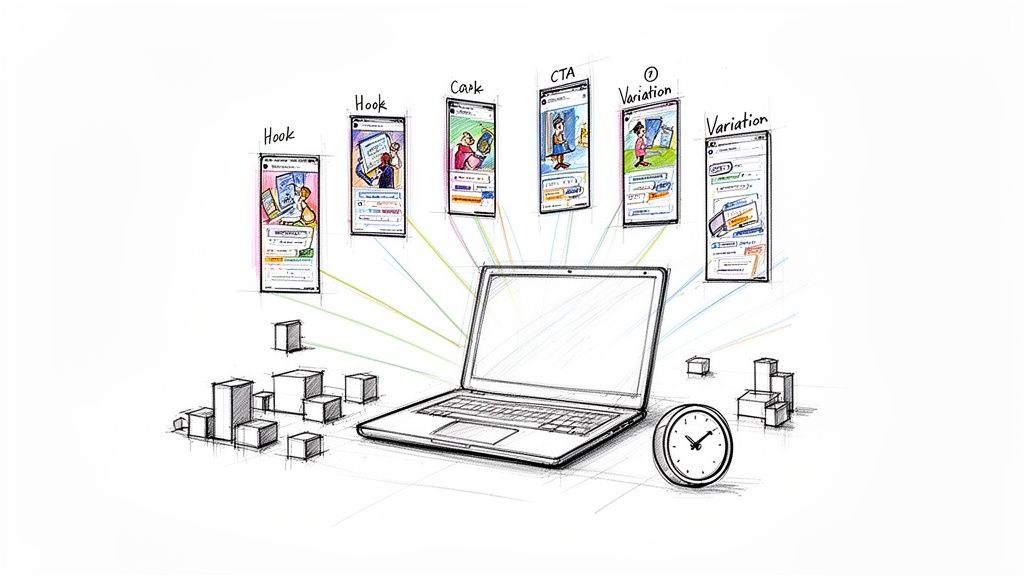
This is where AI-powered platforms like Sovran give you a serious competitive edge. Instead of treating each video as a single, monolithic project, AI tools take a modular approach. You can upload your existing assets—clips, logos, product shots—and the AI helps you assemble them into countless variations almost instantly.
Think of it like building with LEGO bricks instead of carving a statue from stone. You have a collection of pre-approved, on-brand "bricks" (hooks, body segments, CTAs) that can be reconfigured in seconds to create entirely new ads.
This AI-driven workflow allows you to move from idea to live test at a scale that is simply out of reach with manual editing. It transforms the creative process from a bottleneck into an engine for growth.
Sovran's AI-driven creative workflows let performance marketers generate hundreds of on-brand video ad variations in minutes, not weeks. This accelerates testing cycles by up to 10x, allowing teams to fight creative fatigue and find profitable ad concepts faster than ever.
Putting AI Into Practice
So how does this work in the real world? An AI platform like Sovran provides specific features designed to streamline this process and directly boost your TikTok ads conversion rate.
1. Modular Frameworks: You can define templates for proven ad structures like "Problem-Agitate-Solution" or UGC testimonials. The AI then automatically populates these frameworks with your assets, generating dozens of coherent video ads that follow a conversion-focused narrative.
2. Bulk Rendering: This is the ultimate weapon against fatigue. Select a winning hook, a few different body clips, and several CTAs. The platform can then mix and match these elements to render hundreds of unique video combinations in the background. What once took a week of manual labor now takes a few minutes.
3. Data-Driven Ideation: By storing brand guidelines, customer reviews, and top-performing scripts in a central repository, the AI can generate new concepts that are already aligned with your brand voice and what has worked in the past. It removes the guesswork and ensures every creative is built on a foundation of data.
By embracing this AI-powered approach, you can finally match the pace of TikTok. You can test more hypotheses, learn faster, and keep your campaigns supplied with a continuous flow of fresh creative, ensuring your conversion rates stay high and stable over the long haul.
Common Mistakes That Destroy Conversion Rates
Even the sharpest marketers can stumble into common traps that quietly sabotage their TikTok ads conversion rate. Knowing these pitfalls is the first step to avoiding them. Think of this as your pre-flight checklist—it's what separates campaigns that take off from those that stall on the runway.
Here's where things often go wrong.
Using Ads That Don’t Look Like TikToks
So many brands make this fatal error: they take their polished, high-production commercials from other platforms and drop them straight onto TikTok. That stuff sticks out like a sore thumb on the For You Page. It screams "I'm an ad!" and users swipe away instantly.
The fix is to create content that feels native. Use trending sounds, embrace user-generated content (UGC) styles, and speak the audience's language. Your ad needs to feel like another entertaining TikTok, not a commercial break.
The Ad-to-Landing-Page Disconnect
Another classic mistake is the jarring transition between your ad and your landing page. Imagine a user clicks a vibrant, fast-paced video for a specific product, only to land on a slow, generic, corporate-looking homepage. That disconnect shatters trust and kills their interest on the spot.
Ensure message and visual continuity. Your landing page should look and feel like a natural extension of the ad that brought the user there. Use the same headlines, imagery, and offers to create a seamless and reassuring user experience that guides them toward conversion.
Getting this consistency right is absolutely non-negotiable for turning clicks into customers.
Overly Broad Targeting
Yes, TikTok's algorithm is powerful, but giving it an audience that’s too broad is like trying to find a needle in a continent-sized haystack. You'll just burn through your budget showing your ad to millions of people who have zero interest in your product. The result? Rock-bottom click-through rates and an even lower conversion rate.
Instead, start with more defined audiences to give the algorithm a much stronger signal:
Lookalike Audiences: Build these from your best customers—think past purchasers or high-value email subscribers.
Interest Stacking: Combine relevant interests and behaviors to zero in on users who are most likely to engage.
And to keep your campaigns fresh and performing, you need to understand what's resonating. Using a tool like an Ad Creative Analyzer can give you the data-driven insights needed to overcome creative fatigue and continuously improve performance.
Got Questions? We’ve Got Answers.
As you start dialing in your TikTok ad strategy, a few common questions always seem to surface. We've been in the trenches with this stuff for a while, so here are some quick answers to the things that performance marketers ask us most.
How Long Do I Wait Before Killing an Ad Based on Conversion Rate?
Patience is a virtue, especially with TikTok's algorithm. You'll want to let a brand-new campaign run for at least 3-5 days before you even think about making a call.
Even more critical than the time frame is the conversion count. The magic number is around 50 conversions. This gives the algorithm enough data to climb out of its "learning phase" and gives you a stable baseline. Acting too soon means you might just be reacting to a normal Tuesday slump instead of a real performance trend.
Can My Ad Have a High Conversion Rate but a Low Click-Through Rate?
Absolutely. It's not the most common scenario, but we see it. It usually means your ad is a masterclass in pre-qualification. The creative and copy are so specific that only the people who are really serious about buying ever bother to click.
While this means you're getting super high-intent traffic, a rock-bottom CTR can throttle your ad's reach in the long run. It's a sign that you might want to test some broader hooks to pull more people in, without losing that powerful, targeted message that's clearly working on the back end.
The Bottom Line: A low CTR with a high CVR is incredibly efficient, but it often struggles to scale. The sweet spot is finding a balance between mass appeal and a message that speaks directly to your ideal customer.
Why Does My Landing Page Convert So Much Lower Than My TikTok Shop?
One word: friction. It all comes down to the user experience.
A TikTok Shop purchase is a beautiful, seamless experience. A user sees your product, taps a button, and buys—all without ever leaving the app. It's smooth, fast, and exactly what a mobile user wants.
Your landing page, on the other hand, asks them to leave the party. They have to click out, wait for a whole new page to load (which feels like an eternity on mobile), and then manually type in all their info. Every single one of those steps is an opportunity for them to get distracted and bail. To even begin closing that gap, your landing page has to be lightning-fast, flawless on mobile, and look and feel like a natural extension of the ad they just saw.
Tired of the endless grind of coming up with fresh TikTok ad creative? Sovran uses AI to spin up hundreds of on-brand video variations in minutes. It's how top teams fight off creative fatigue and scale their winning ads faster than ever. See how Sovran can amp up your ad performance.

Manson Chen
Founder, Sovran
Related Articles
How to Turn Link Into Video: Ads That Convert in 2026
Learn how to turn link into video for Meta & TikTok ads. Leverage AI to scale creation, boost ROI, and succeed in 2026.
- ai-video-generation
- link-to-video-ads
- 6 more

Your Ultimate Guide to UGC Style Video Ads
Master UGC style video ads for Meta and TikTok. This guide reveals proven frameworks, scripts, and scaling tactics to boost your ROAS in 2026.
- ugc-video-ads
- social-media-advertising
- 4 more
8 High-Converting Static Ads Examples for 2026
Discover 8 high-performing static ads examples from top apps. Learn to create text-overlays, testimonials, and lifestyle ads that convert.
- static-ads
- performance-marketing
- 5 more