RunwayML Video Editor vs Ad Platforms: Which is Best?
Jump to a section
- The Modern Marketers Creative Dilemma
- What is the RunwayML Video Editor Today
- What Are Ad-Focused AI Production Platforms
- Feature and Workflow Comparison for Ad Production
- Analyzing Pricing and True Return on Investment
- When to Use RunwayML vs When to Use an Ad Platform
- Making the Final Choice for Your Ad Production Workflow

You already have footage. You already have a concept that can work. What you don't have is enough time to turn one decent ad into the volume of variations Meta and TikTok now demand.
That's where the confusion starts. A tool like the runwayml video editor can generate striking clips, stylize footage, and create shots that would be expensive or impossible to film. But a performance team usually isn't trying to make one impressive video. It's trying to build a repeatable testing machine that can launch many variations, learn fast, and refresh before fatigue hits.
Most comparisons miss that operational gap. They compare visual quality, prompt controls, or editing features, then stop. For paid social teams, the harder question is workflow. Can this tool help you move from one generated asset to a system that reliably produces testable ads at scale?
The Modern Marketers Creative Dilemma
A common situation looks like this. You find a winning angle, maybe a strong hook, a creator style that finally converts, or a product demo that starts to pull. Then the platform asks for more. More variants, more cuts, more intros, more formats, more localized versions.

The problem isn't coming up with one idea. The problem is turning one idea into a production workflow that can keep feeding the ad account.
One clip is not a system
Runway gets attention because it can create novel visuals fast. That matters. For concept development, AI B-roll, and impossible camera moves, that kind of capability is useful. But Runway's Aleph research page also points to the gap many groups run into in practice. Public guidance tends to focus on how to generate videos, not how to turn those outputs into a scalable ad testing system.
That's the split in the market. One category helps you create assets. The other helps you operate creative testing.
If your team is dealing with naming chaos, fragmented folders, repeated manual exports, and endless requests for “five more versions with a different opening,” then the issue isn't whether AI can make a cool clip. The issue is whether the tool fits a production process built around speed and iteration. Teams working on scaling ad creative production usually discover that those are separate problems.
Performance marketing punishes slow creative workflows long before it punishes mediocre prompt writing.
Two tools, two jobs
Buyers often get tripped up:
- Generative AI platforms are strongest when the job is inventing or transforming footage.
- Ad production platforms are strongest when the job is assembling, versioning, and launching many testable ads from existing assets.
- Creative teams often need both, but they shouldn't expect one tool to cover the other tool's core job.
If you treat a generative platform like a testing pipeline, you'll end up doing a lot of manual coordination. If you treat an ad production platform like a cinematic generation lab, you'll feel boxed in. The right choice depends on where your bottleneck sits.
What is the RunwayML Video Editor Today
Many still picture runwayml video editor as a browser-based editor with AI features layered on top. That's outdated. Runway is now better understood as a generative video platform with editing and transformation capabilities around its models.
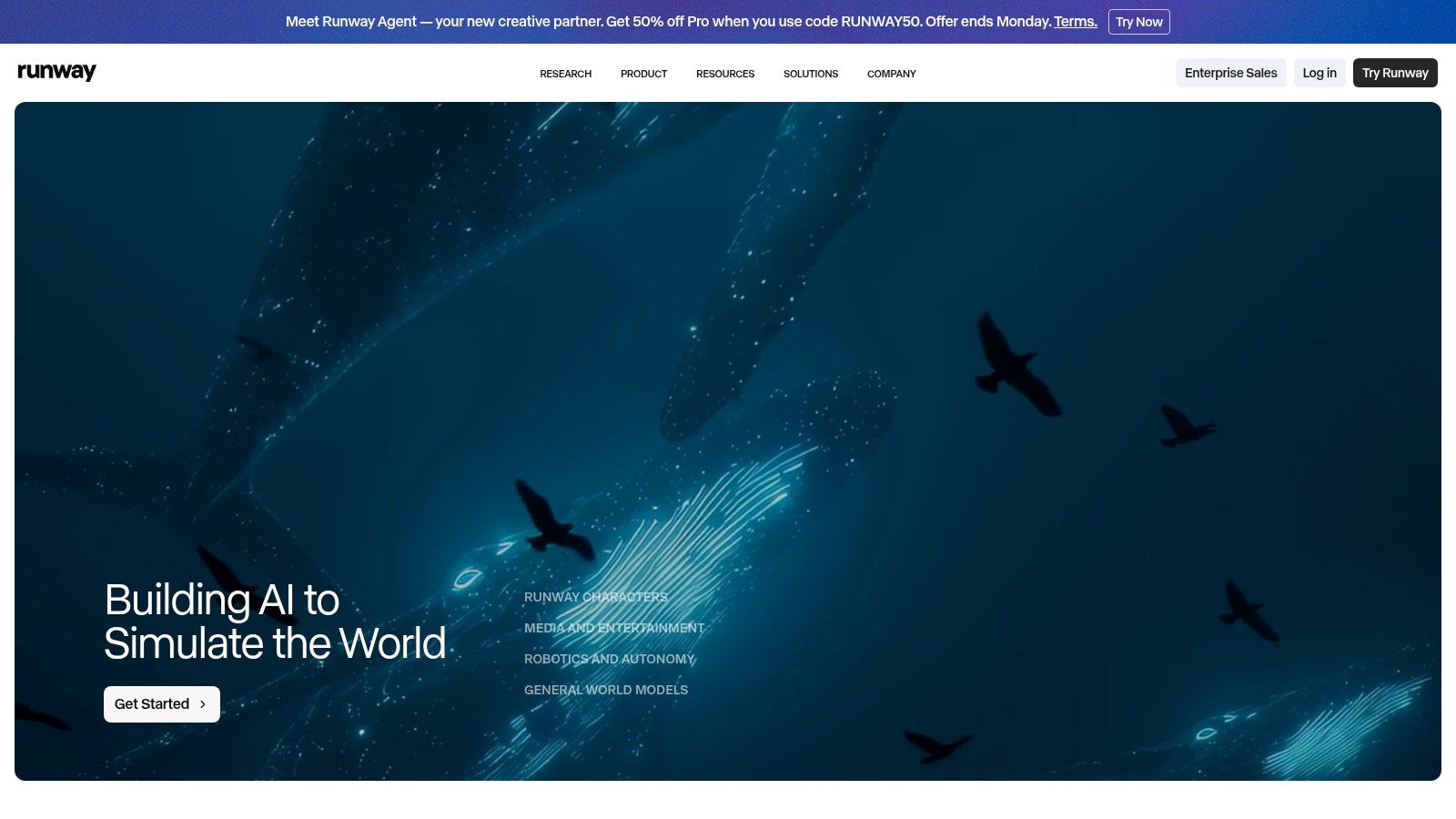
Runway's official site presents Gen-4.5 as its flagship model and describes it as “the world's top-rated video model,” with emphasis on cinematic realism and fine-grained creative control on the Runway homepage. That positioning matters. It tells you the company is optimizing around model-driven creation, not traditional timeline-first editing.
Why the old editor framing is misleading
The cleanest signal is in Runway's own product direction. Its help center says the classic timeline editor is “no longer being actively maintained” because the team is prioritizing generative workflows and core product features. That's a direct product shift away from the idea of Runway as a standard editor.
For marketers, this changes how you should evaluate it.
- Use Runway for generation first. Think text-to-video, image-to-video, style transfer, scene transformation, and synthetic shot creation.
- Don't buy it for manual editing depth. If your day-to-day work is trimming many ad variants, swapping text overlays, changing CTAs, or building repeatable outputs from one source clip, that isn't where Runway is most focused.
- Expect an AI-native workflow. You prompt, reference, transform, regenerate, and export.
That distinction makes comparisons cleaner. You're not comparing Premiere with an AI plugin. You're comparing a generative system with tools built for ad assembly and deployment.
What Runway is good at in practice
The strongest use cases usually look like this:
- Concepting new visuals when you need footage that doesn't exist yet.
- Generating stylized or cinematic inserts for a hero ad.
- Transforming source footage into alternate looks or scenes.
- Creating controlled AI shots from text, image, video, or audio inputs.
A quick product overview helps show what the platform has become:
If you want a broader breakdown of how the platform fits into modern creative stacks, this Runway comparison page is useful as a category view.
Practical rule: Evaluate Runway like a generation engine with editing attached, not like an editor that happens to use AI.
That one framing change prevents a lot of bad tool decisions.
What Are Ad-Focused AI Production Platforms
Ad-focused AI production platforms solve a different problem. They aren't built around the question, “How do we generate a brand new cinematic clip?” They're built around, “How do we take the footage we already have and turn it into many testable ads without rebuilding the process every time?”
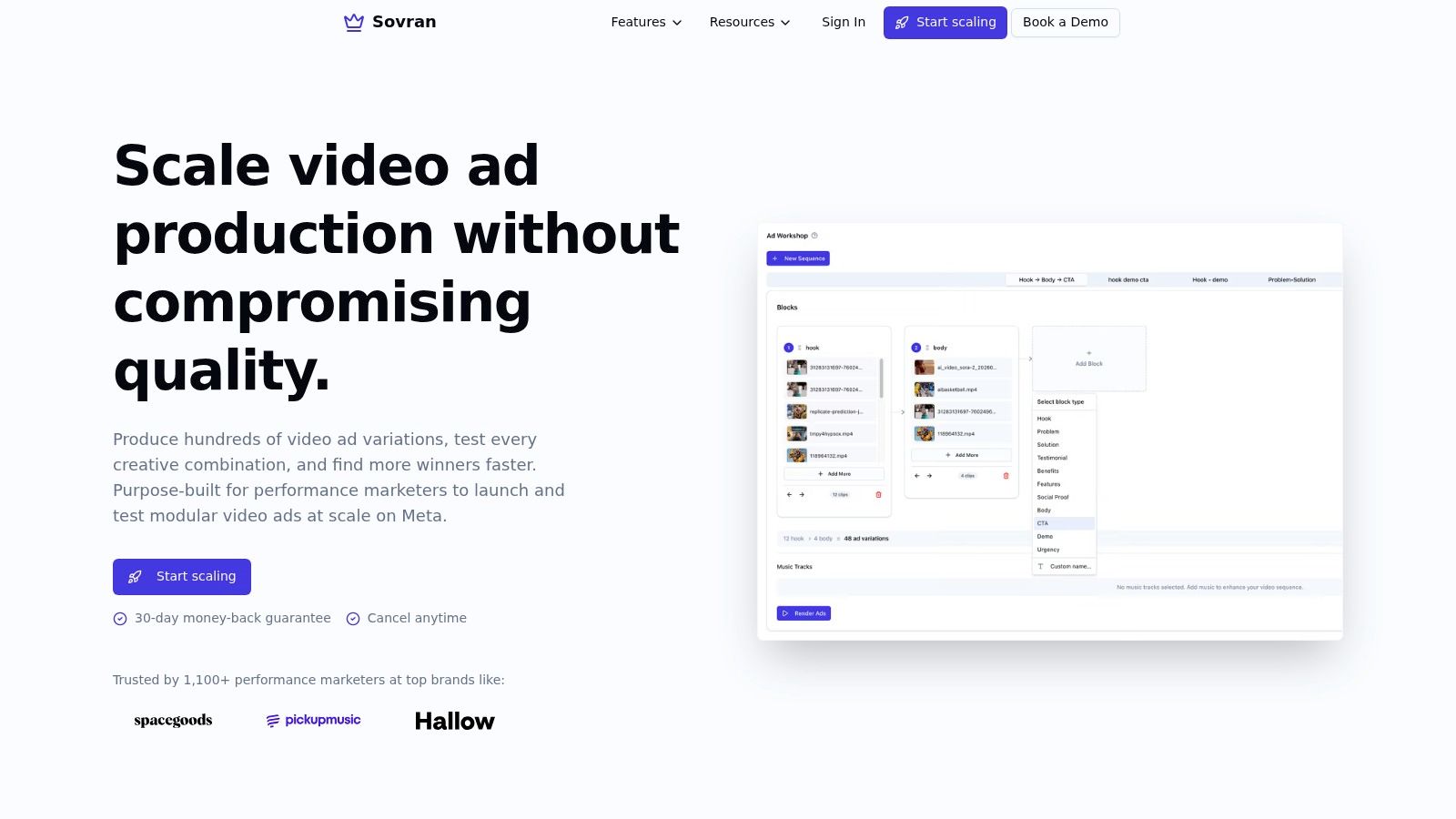
That difference matters more than feature checklists. A performance marketer usually needs modularity, reuse, and output speed. The winning raw material often already exists in UGC clips, founder videos, testimonials, demos, and prior top performers.
The modular ad production model
These platforms typically organize creative work around components instead of one linear edit.
A team might break an ad into:
- Hooks for the first seconds
- Bodies that explain the offer or show the product
- Proof such as testimonials, reviews, or outcomes
- CTAs adapted for audience, offer, or placement
Once the assets are structured that way, the workflow changes. Instead of opening one timeline and editing one ad at a time, the team recombines approved parts into many outputs.
This is also why adjacent creative categories are starting to converge. If you're interested in how producers are using AI in nearby fields, Drumloop AI's guide to Best AI software for producers is a useful example of how tool choice shifts when the job becomes repeatable production rather than one-off creation.
What these platforms are built to operationalize
The strongest ad-focused tools usually do some mix of the following:
- Ingest existing footage and structure it for reuse
- Tag scenes and transcripts so teams can find clips fast
- Support bulk overlays and formatting for different placements
- Assemble variations quickly from reusable modules
- Keep teams aligned on approved assets and outputs
One example in this category is AI creative automation platform workflows, where the emphasis is on turning creative production into an operational system rather than a one-off editing session.
The core point is simple. These tools solve a throughput problem. They help media buyers, strategists, and production teams move faster once they already know what kinds of messages, formats, and structures they want to test.
Feature and Workflow Comparison for Ad Production
The cleanest comparison is not “which tool has more features.” It's “which workflow removes the most friction for paid social production.”
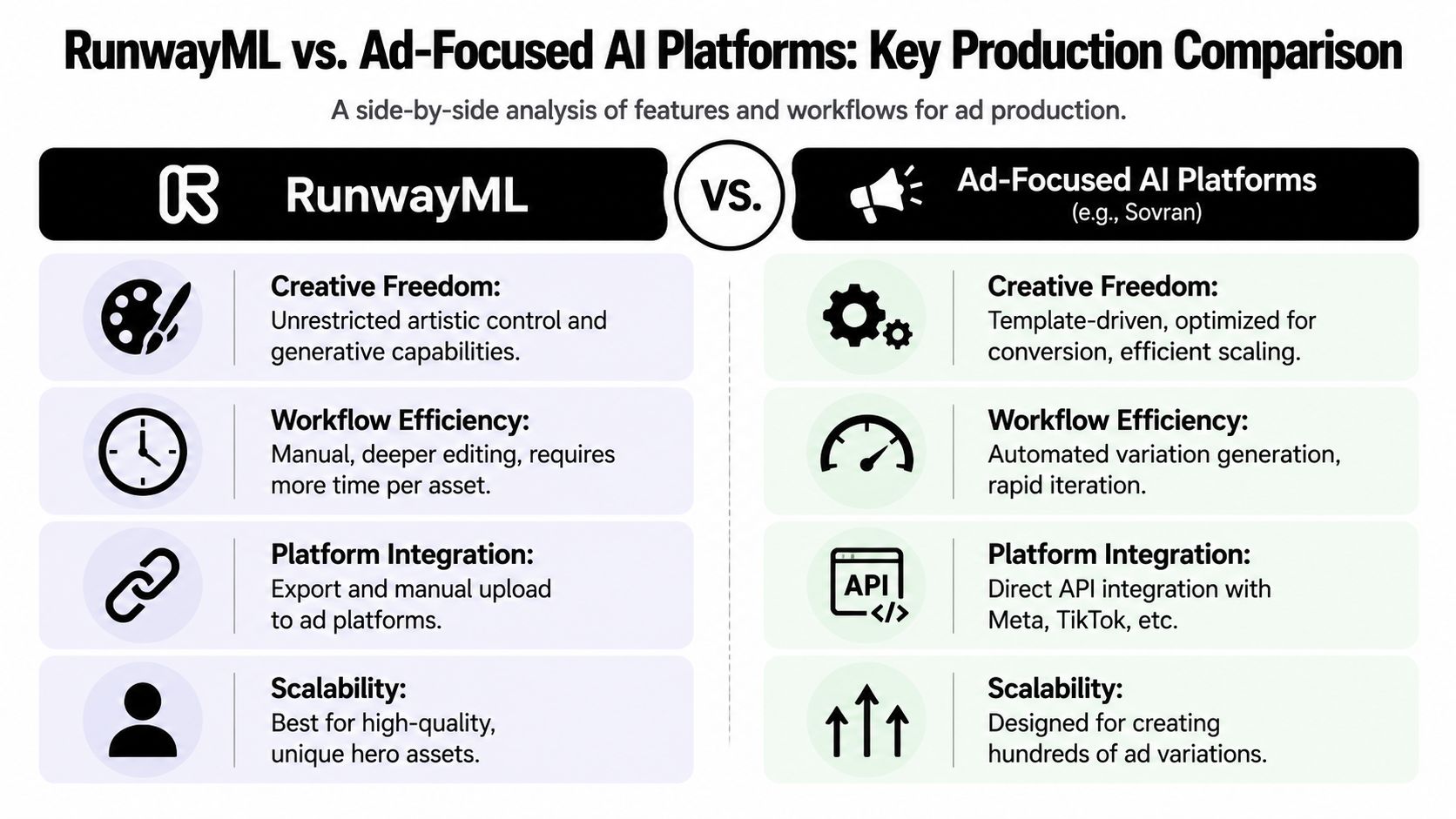
| Capability | RunwayML | Ad-Focused Platforms (e.g., Sovran) |
|---|---|---|
| Core job | Generate or transform video assets | Assemble and version ads for testing |
| Workflow model | Linear, clip-by-clip creation | Modular recombination of reusable assets |
| Best input type | Prompts, reference images, source clips | Existing ad footage, UGC, testimonials, product demos |
| Editing strength | AI-native generation and transformation | Fast production of many ad variants |
| Asset management | Useful for creation workflows | Built around retrieval, organization, and reuse |
| Output pattern | Fewer, more bespoke assets | Higher-volume test variations |
| Team fit | Creative R&D, brand, concepting | Performance marketing, media buying, iterative testing |
| Main trade-off | More manual production steps after generation | Less open-ended visual invention |
Creative freedom versus production throughput
Runway gives the creative team more room to invent. That can be a real advantage when you need footage that doesn't exist, or when a campaign needs a visual idea that can't be shot quickly. It's strong when originality matters more than repetition.
Ad-focused platforms trade some of that open-ended generation for speed and consistency. That's usually the right trade for paid social. Most winning ad accounts don't need infinite visual possibility. They need a steady stream of controlled variants built from proven ingredients.
Runway is excellent at making a clip. Ad production platforms are built to make a campaign workflow.
Where performance teams feel the difference
In day-to-day execution, the gap shows up in five places.
Editing logic
Runway tends to center the work around a single asset at a time. You generate, refine, export, then move on. That's good for crafted outputs.
Ad platforms center the work around variation logic. One body can support many hooks. One testimonial can feed many CTAs. The system is designed around recombination.
Asset reuse
With Runway, reuse often depends on your own file discipline. Teams can absolutely build organized systems around exports, but the platform itself isn't primarily optimized for modular ad libraries.
Ad-focused systems are designed to make reuse obvious. Teams can pull approved parts, swap intros, change text treatments, and keep moving without restarting from scratch.
Bulk production
This is usually the decisive category for performance marketers. If your team needs many variants from a common structure, generative tools often create hidden labor. Someone still has to name files, track what changed, preserve approved claims, match formatting, and route exports into launch workflows.
If you want a broader category view of those workflow trade-offs, this video production software comparison is a good reference point.
Consistency and governance
Runway's strengths and limits matter at the same time. Runway's Gen-4 research says the model can maintain consistent characters across changing lighting conditions, locations, and treatments from a single reference image on the Gen-4 research page. That's useful for creative continuity.
But public guidance is still thin on the failure modes marketers care about most. Runway's own realism resources leave open important operational questions around asset consistency across iterations, product accuracy, and deciding whether an AI edit is dependable enough for Meta or TikTok delivery on the realistic AI video tips page. In paid social, subtle drift matters. A product shape shifts. A label looks slightly wrong. A repeated character isn't quite the same. Small inconsistencies can create review, brand, or trust problems.
Workflow fit for business outcomes
For most performance teams, the business question isn't “Can the tool produce beautiful video?” Both categories can contribute there. The better question is:
- Are you missing assets that must be invented?
- Or are you failing to test enough variations from assets you already have?
If it's the first, Runway earns its place. If it's the second, an ad-focused platform usually removes more operational drag.
Analyzing Pricing and True Return on Investment
Runway's pricing makes more sense when you stop comparing it to a normal editor subscription and start comparing it to a high-end generation engine.
On Runway's pricing page, the Free plan is $0 per editor per month, includes 125 credits one time, and is meant for individuals exploring the tools. Paid plans start at $12 per month per editor for Standard, and the Unlimited plan is billed annually at $336 and supports up to 10 users per workspace.
The more important number is output cost. The same pricing page shows that 2,250 credits correspond to 90 seconds of Gen-4.5 video, 187 seconds of Gen-4, or 450 seconds of Gen-4 Turbo. That tells you something practical. High-quality generation is computationally expensive, and the best models aren't designed for careless, high-volume trial and error.
What that means for marketers
If you're using Runway to create a hero visual, a product world, or a set of premium inserts, that cost structure can still be rational. You're paying for something difficult to produce another way.
If you're trying to brute-force large ad testing matrices with generated footage alone, costs stack up quickly and the manual workflow burden grows with them. The free plan also includes a visible watermark, which makes it a poor fit for professional outputs.
Cost per tool matters less than cost per usable variation.
That's why ROI looks different in ad-focused platforms. Their value usually comes from lowering the operational cost of turning existing footage into many launch-ready ads. If you're trying to model that trade-off internally, a video production cost calculator can help frame the labor side, not just the software fee.
The practical ROI split
Think about it this way:
- Runway ROI comes from creating assets you otherwise couldn't produce quickly.
- Ad platform ROI comes from reducing the time and friction required to test many variants.
- The wrong fit wastes budget in hidden ways, usually through manual rework rather than line-item software cost.
That's why sticker price rarely answers the core question.
When to Use RunwayML vs When to Use an Ad Platform
Teams often don't need a philosophical answer here. They need a decision rule.
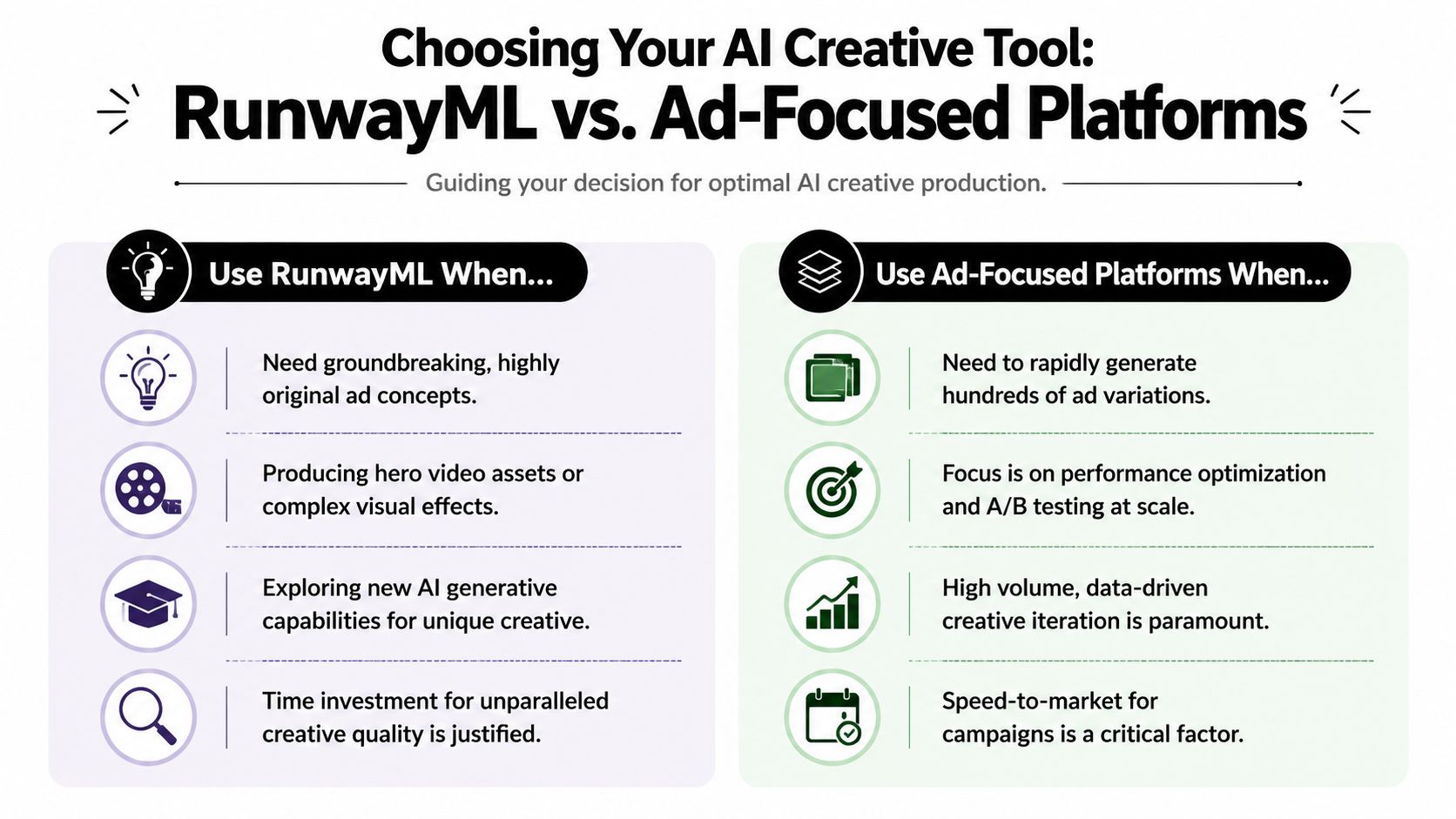
Use RunwayML when creative invention is the bottleneck
Runway is the right tool when the missing piece is the asset itself.
Use it when you need:
- Hero visuals that would be expensive or slow to film
- Concept exploration before a larger production decision
- AI-generated B-roll to support a campaign angle
- Scene transformation or stylized remixes of source footage
- Reference-based character or product visuals for a small number of controlled outputs
These are creation problems. They reward a model-first tool.
A good example is a launch campaign that needs a striking opener, a surreal product environment, or a cinematic transition sequence. Another is a creative strategist trying to storyboard multiple visual directions before a live shoot.
Use an ad platform when throughput is the bottleneck
A dedicated ad production workflow is usually better when the underlying footage already exists and the team needs more combinations, not more invention.
That looks like:
- Testing many hooks against one proven body
- Refreshing winners with new intros, captions, or CTA endings
- Localizing ads while preserving approved structure
- Reformatting for placements without rebuilding each version manually
- Managing reusable libraries across brands, agencies, or accounts
One option in that category is Sovran, which is designed for modular video ad production, asset organization, and high-volume variation workflows for paid social teams.
If your editors keep rebuilding the same ad with minor changes, you don't have an editing problem. You have a workflow design problem.
A simple decision filter
Ask these questions in order:
Do we need footage that doesn't exist yet?
If yes, start with Runway.Do we already have footage but can't turn it into enough testable variants?
Use an ad-focused production system.Is quality drift a bigger risk than lack of originality?
Lean toward structured production.Is this a brand centerpiece or a testing asset?
Brand centerpiece favors Runway. Testing asset favors modular workflows.
The mistake is forcing one tool to own the entire pipeline. Many teams get better results by using generative tools selectively, then moving into a system designed for variation, review, and launch.
Making the Final Choice for Your Ad Production Workflow
The easiest way to decide is to identify your primary bottleneck.
If your team keeps saying, “We need a visual we don't have,” then a generative platform like Runway makes sense. It helps create the raw material. That includes concept frames, synthetic B-roll, transformed scenes, and polished hero assets.
If your team keeps saying, “We have enough footage, but we can't produce variants fast enough,” then the better investment is a workflow built for modular testing. That's where ad production platforms usually outperform creative generation tools.
The diagnostic question that matters
Ask one question in your next creative review:
Are we blocked by asset creation or asset variation?
That question cuts through a lot of noise. It also prevents overbuying. Teams often adopt a generative tool hoping it will solve production throughput, then discover they've only improved the top of the funnel for creative ideas.
If you're using the wrong tool today
A practical migration path is simple:
- Keep Runway for ideation and special assets
- Move repeatable ad assembly into a structured production workflow
- Standardize hooks, bodies, proof segments, and CTAs
- Reduce manual exports and naming chaos
- Review outputs based on launch-readiness, not novelty
Tool choice should follow workflow reality. The best stack isn't the one with the most AI. It's the one that helps your team make better ads, test more combinations, and keep shipping without burning production time.
If your bottleneck is turning existing footage into more launch-ready ad variations, Sovran is built for that workflow. It helps performance teams organize assets, assemble modular video ads, and produce variations for paid social without treating every new test like a full custom edit.

Manson Chen
Founder, Sovran
Related Articles
Quality Assurance in Production: The 2026 Guide

AI Talking Head Videos for Scaling Ad Creative