Repurposing Video Content A Playbook for Performance Marketers
Stop the content grind. Learn how repurposing video content can fuel your Meta & TikTok ads. Turn old assets into high-performing campaigns today.

Jump to a section
This might sound obvious, but before you rush off to produce your next big ad creative, take a breath and look at what you already have. Your archives are an absolute goldmine. I'm talking about everything from old product demos and webinar recordings to user-generated content and even ad concepts that didn't quite make the cut the first time around.
This is where the real magic happens. By repurposing existing video, you can create dozens of high-performing ads for channels like Meta and TikTok from a single source video. It's a game-changer for saving time, crushing creative fatigue, and enabling the kind of high-volume testing that actually moves the needle.
What is Content Atomization?
The core idea here is something we call 'content atomization.' Think of it like taking apart a single long-form video—say, a 20-minute webinar—and breaking it down into its most essential, powerful building blocks.
It's not just about randomly slicing up a video. This is a strategic process. You're deconstructing a comprehensive asset into dozens of smaller, modular, and—most importantly—testable ad variants. This lets you isolate and remix the best moments for platforms like Meta and TikTok, where you have seconds, not minutes, to make an impression.
This flowchart breaks down exactly how it works: you start with your library, deconstruct it into modular pieces, and then reassemble those pieces into a ton of platform-specific ad variants.
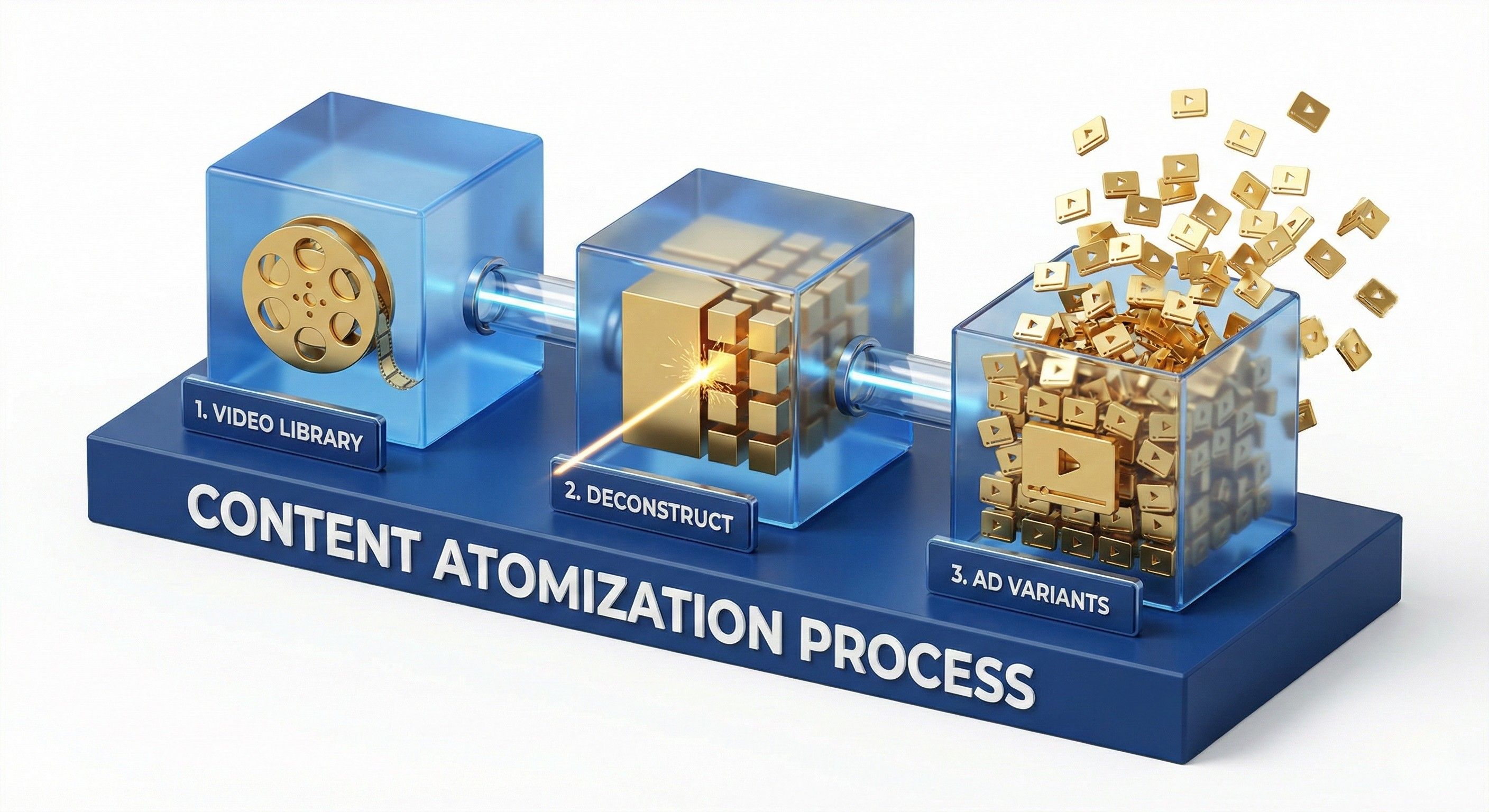
The key takeaway? A single piece of content can easily fuel an entire month's worth of ad testing. This is how you dramatically increase creative output without constantly needing new video shoots.
Before we dive deeper, it's worth taking a moment to understand just why this approach has become so critical for performance marketers today.
Why Repurpose Video Now? Key Drivers for Performance Marketers
Driver | Impact on Campaigns | Strategic Advantage |
|---|---|---|
Creative Fatigue | Audiences on platforms like Meta and TikTok burn through creative faster than ever. What worked last week might be dead today. | A repurposing system provides a constant stream of fresh ad variants, keeping performance stable and avoiding audience burnout. |
Rising Production Costs | High-quality video production is expensive and time-consuming. Relying solely on new shoots is unsustainable for most brands. | Maximizes the ROI of every production dollar by extending the lifespan and reach of each video asset you create. |
Platform-Specific Needs | A 16:9 YouTube video won't work on 9:16 TikTok Stories. Each platform demands unique formats, lengths, and styles. | Atomization allows you to easily reformat a single core asset for every channel, ensuring native performance. |
High-Volume Testing | Winning on paid social requires testing dozens, if not hundreds, of creative variations to find what truly resonates. | Repurposing is the only scalable way to generate the volume of creative needed for robust testing frameworks. |
Scarcity of Attention | You have 1-3 seconds to capture attention. Repurposing lets you isolate and test only the most potent moments from your content. | Instead of gambling on one long video, you can test 10 different hooks from that same video to find a winner. |
Simply put, repurposing is no longer a "nice-to-have" tactic; it's a foundational part of modern, scalable media buying.
The Hook-Body-CTA Framework: Your Blueprint for Repurposing
To make this system work, you need a simple, repeatable structure. The Hook-Body-CTA framework is the blueprint for this entire playbook. It’s essential for creating and testing ads in a systematic way.
Here’s the breakdown:
Hook: The first 1-3 seconds. Its only job is to stop the scroll.
Body: The middle part. This is where you deliver the core message or show the value proposition.
CTA (Call to Action): The final instruction. Tell the viewer exactly what to do next.
When you treat each of these parts as a swappable component, you unlock endless testing possibilities. You could take a powerful customer testimonial (your Hook), pair it with a quick product demo (your Body), and finish with a "Shop Now" end card (your CTA). A solid grasp of broader strategies for video marketing will help you identify the best clips to use for each component.
Repurposing is your best defense against creative fatigue. The constant demand for fresh content on paid social channels burns out even the best teams. By mining your archives, you create a sustainable system for high-volume testing and stay competitive.
Ultimately, a well-organized library becomes a massive strategic advantage. When you have a robust video asset management system, you can find, tag, and assemble these components almost instantly. This playbook will show you exactly how to build that system from the ground up.
Build Your Modular Ad Factory from Audit to Assembly
Let's be real. Turning that messy folder of video clips into a high-powered ad machine isn't going to happen by accident. You need a system. This is about moving past the frantic search for "that one good clip" and building an assembly line with pre-approved, perfectly tagged components. It's how you go from one-off creative ideas to a scalable production process for repurposing video content.
The whole system starts with a solid asset audit. But I'm not talking about a simple spreadsheet with filenames. I mean building a searchable, intelligent library where every single clip is a potential building block for your next winning ad.
You have to get way more granular than basic labels like "Product Demo." Think about tagging assets with meaningful, searchable data that tells you exactly what a clip does and what it contains.
Start with Smart Asset Tagging
Look, effective tagging is what turns a chaotic video folder into a strategic arsenal. Each tag is a filter, helping you find the exact component you need in seconds. No more scrubbing through hours of footage. You can instantly pull every clip that fits what you're trying to build right now.
Here are the tag categories I see working best:
Ad Component: Is this clip a Hook, Body, or CTA? This is non-negotiable and the most critical tag for this whole modular system to work.
Creative Angle: Does it tell a Problem-Agitate-Solution story? Is it a UGC Testimonial? A Benefit Lede? An Unboxing?
Visual Type: What are we looking at? A Product Shot, a Screengrab, a Founder Talking Head, or some Lifestyle B-roll?
Emotional Cue: What feeling does the clip give off? Tag it. Urgency, Surprise, Relatability, Trust.
Key Message: What's the one thing this clip communicates? Think: "Easy to use," "Saves time," or "30-day guarantee."
This level of detail lets you assemble powerful ad narratives on the fly. For instance, you could search for: "Hook" + "UGC Testimonial" + "Urgency" and immediately find the perfect scroll-stopping opener for a flash sale campaign.
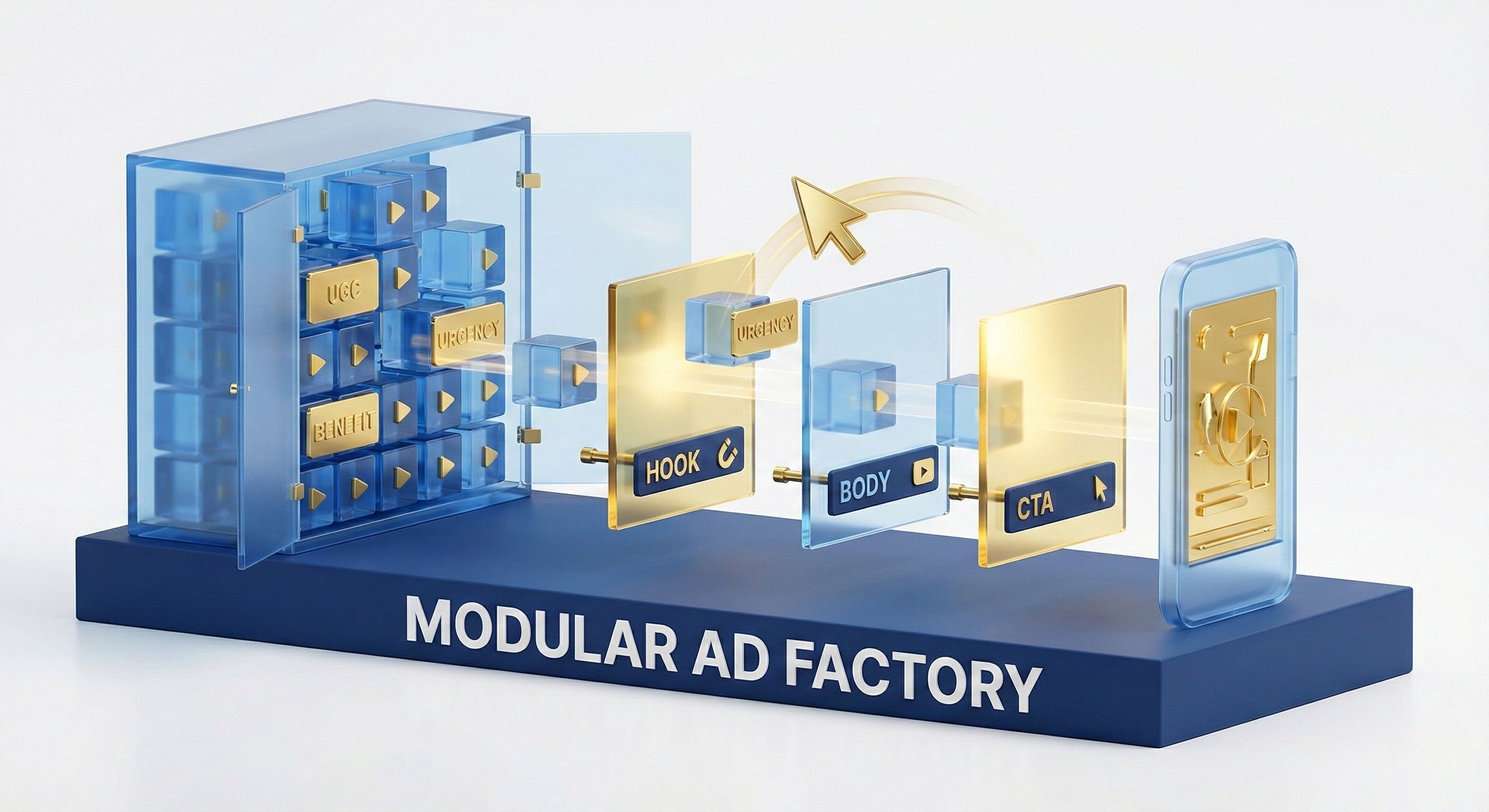
This is basically the blueprint. You're taking raw assets, sorting them into modular ad components, and getting them ready to mix and match for any platform. This systematic approach is the engine that drives scalable creative testing.
The Power of Modular Assembly
Once everything is tagged, the assembly process becomes ridiculously fast. You can operate like a factory, combining different components to create ads tailored to specific audiences and goals. This is where you can finally test a ton of ad frameworks without having to shoot new creative every single time.
Building a modular system isn't just about speed; it's about intelligence. When you test a hook and it fails, you swap only the hook, not the entire creative. This isolates variables and generates clean data, helping you learn what works up to 10x faster.
Imagine you're launching a new feature. With a modular library, your workflow is transformed:
Pick a Proven Body: You search your library for a tagged, 15-second clip that clearly demonstrates the new feature.
Test Multiple Hooks: You pair that body with three different hooks: one is a customer testimonial, another shows a surprising outcome, and the last one asks a provocative question.
Use a Standard CTA: You cap each variant with your best-performing "Download Now" end card.
In just a few minutes, you've got three distinct ad variants ready to test. This method lets you separate the performance of your opener from your core message. For more ideas on what to test, check out our deep dive on crafting the perfect video ad template.
Leverage AI for Speed and Scale
Manually tagging thousands of clips just isn't going to work. This is where modern AI tools become your best friend. The global AI video generator market is projected to explode from $534.4 million to $2,562.9 million by 2032—that's a massive shift toward automated production. And it’s not just hype; 63% of video marketers are already using AI to streamline their editing and repurposing workflows. You can see more on this trend in the latest Wix video marketing statistics.
AI-powered platforms can scan your entire library and automatically apply the kinds of descriptive tags we just talked about. They can spot potential hooks, transcribe speech, detect emotional cues, and even recognize when your product is on screen. This kind of automation turns a multi-week manual slog into an afternoon task, instantly unlocking the value hidden in your content archive.
The result is a system that lets you create ads rapidly and on-demand, freeing your team to focus on high-level strategy instead of getting buried in tedious edits.
Fine-Tuning Your Ads for Meta vs. TikTok
You can have the most brilliant ad concept in the world, but if it doesn't feel like it belongs on the platform where people are seeing it, it's dead on arrival. Once you've got your modular ad factory running, this is the last, crucial step: tweaking your ads to feel completely native on Meta and TikTok.
And let’s be clear, this is about more than just cropping your video to 9:16. It’s about diving deep into the technical quirks and creative expectations that define the user experience on each platform.
The first thing to nail down is the screen layout itself. Yes, both platforms are dominated by the 9:16 vertical format, but the user interface elements are placed differently. You absolutely have to respect the safe zones—those areas where usernames, captions, and like/comment buttons live. If you don't, your killer headline or that perfect product shot will get covered up, and your ad becomes useless before anyone even watches it.

Different Platforms, Different Rhythms
Beyond the technical layout, the biggest difference is the rhythm. The pacing and cadence of your ad has to match the vibe of the platform. An ad that performs well on Instagram Stories can feel painfully slow and awkward on TikTok.
TikTok Demands Speed: You have almost no time to waste. Your ad needs to deliver its hook within the first 1-2 seconds. This means lightning-fast cuts, front-loaded value, and an energetic pace that feels just like the organic content on the For You Page. Think rapid transitions and dynamic text that pops.
Meta Allows for More Story: While the first few seconds are still king, platforms like Instagram and Facebook give you a bit more breathing room. Users there are more accustomed to a slightly more polished, story-driven feel. You can build a little more context before the big reveal, but you still need to be concise.
The biggest mistake people make is thinking one edit fits all. Your TikTok ad should feel like it was made for TikTok—raw, fast, maybe a little chaotic. The same core clips, re-edited for Meta, can be more polished, cinematic, and brand-forward.
This difference in rhythm directly changes how you assemble your modular Hook-Body-CTA pieces. For TikTok, you might slam together three UGC clips in three seconds. For Meta, you could let a single, well-shot testimonial build an emotional connection over six seconds.
Nailing the Creative Details for a Native Feel
Making an ad feel native goes way beyond editing speed. It's about the little creative layers you add on top. These are the signals that tell a user, "this content belongs here," lowering their natural defenses against advertising. For a much deeper dive on this, check out our guide on TikTok creative best practices.
Subtitles and Text Overlays
This is non-negotiable. A huge chunk of users on both platforms watch with the sound off, so on-screen text is your lifeline.
TikTok Style: Use bold, native-looking fonts that grab attention. The text should be part of the action, appearing and disappearing to emphasize what's being said. It's as much entertainment as it is information.
Meta Style: Captions here can be a bit more professional and clean. Burned-in subtitles are the standard. Text overlays are typically used to state a clear benefit or highlight an offer.
Tapping Into Trending Audio
This is your secret weapon, especially on TikTok. Hopping on a trending sound can make your ad feel instantly relevant and organic. While Meta has its own trends, TikTok's audio culture is the heart of the entire experience.
When you're prepping an ad for TikTok, always take a minute to scroll through the trending sounds library. If you find one that fits your message, you've just found an easy way to stop the scroll and boost your ad’s relevance.
Scale Production and Testing Without Creative Burnout
Unlocking the real power of video repurposing happens at scale. But let's be honest, manually cranking out hundreds of ad variants is a one-way ticket to creative burnout. To actually win this game, you need a system—a production engine—that lets you pump out massive creative volume and test at lightning speed without overwhelming your team.
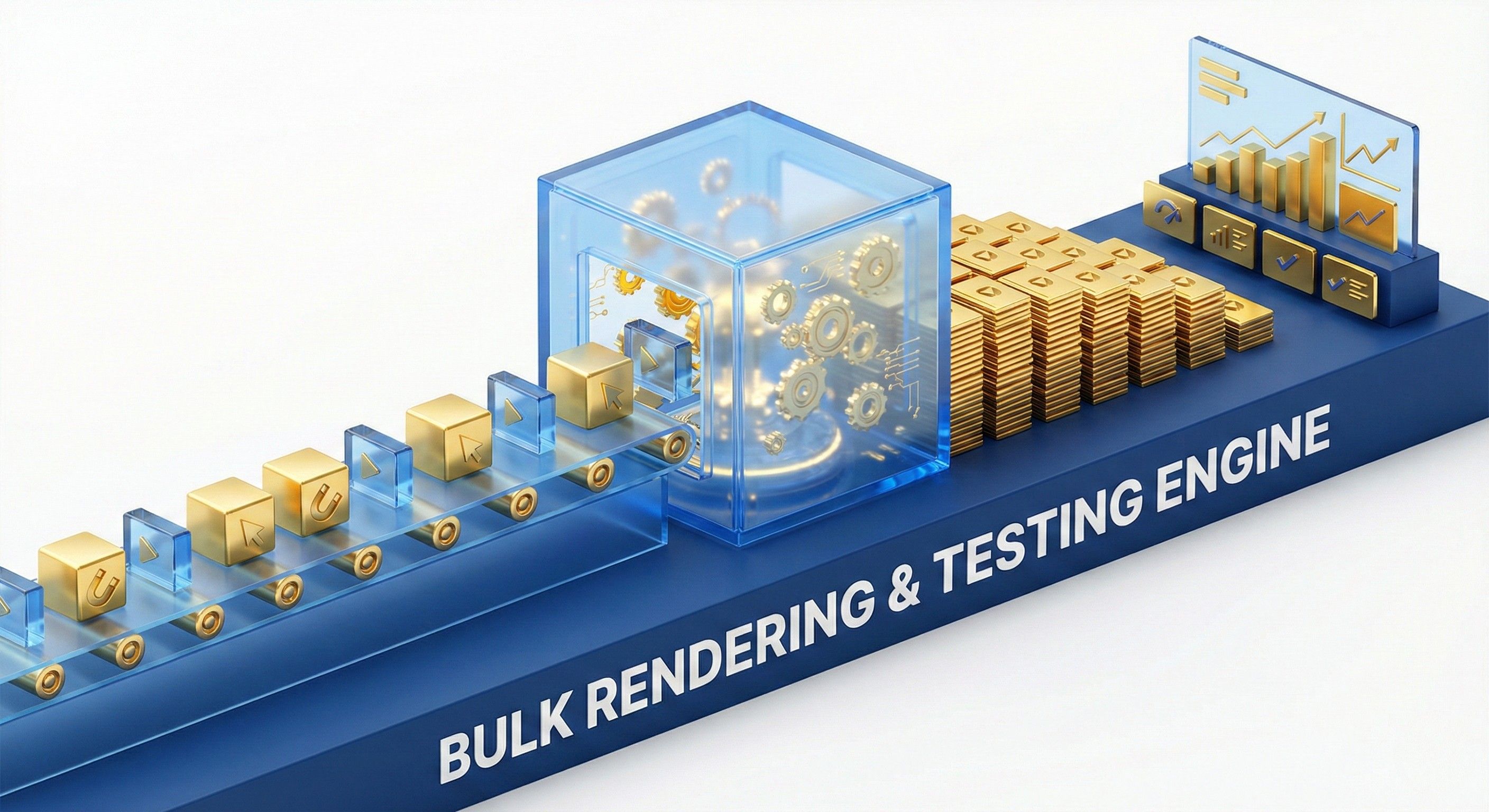
This is where you move beyond one-off edits in CapCut. Modern platforms are built specifically for this. They use bulk video rendering to take all those modular assets you’ve so carefully tagged—your hooks, bodies, and CTAs—and remix them into hundreds of unique combinations in minutes. This kind of automation kills the tedious, repetitive work that grinds even the best creative teams to a halt.
Think about it. Instead of spending a week to produce five ads, you can spend an hour generating fifty. This completely frees up your team to focus on what actually matters: strategy, analysis, and figuring out the next big idea, not just clicking "export" again and again.
A Structured Framework for A/B Testing
Generating hundreds of variants is just noise if you don’t have a solid plan to test them. The secret is isolating variables. If you test a dozen ads where everything is different, you learn nothing. But a structured, scientific test? That gives you clean data and real insights.
Start with a clear hypothesis. For instance: "Does a UGC hook outperform a studio-shot hook when we pair it with our main product demo?"
Here’s how you’d set up a simple A/B test for that:
Ad A (Control): [Studio Hook] + [Product Demo Body] + [Standard CTA]
Ad B (Variable): [UGC Hook] + [Product Demo Body] + [Standard CTA]
See what we did there? By keeping the body and CTA exactly the same, any difference in performance is directly because of the hook. You’re not just throwing spaghetti at the wall; you’re being methodical. This is the fastest way to learn what actually resonates with your audience.
Using Automation to Push Creative Boundaries
Beyond just remixing, automation can help you fight creative fatigue on a deeper level. When you feel like you’ve squeezed every last drop out of your existing footage, AI can step in and generate entirely new components for you to test.
This is where generative AI tools become a game-changer. You can use them to:
Create Synthetic B-Roll: Need a quick lifestyle shot to break up the creative? AI can generate custom b-roll that fits your brand aesthetic without you having to schedule a whole new shoot.
Generate New Hooks: Take your winning ad scripts and feed them into an AI model. You'll get back a dozen new angles, opening lines, and ideas you probably hadn't even considered.
The point of automation isn’t to replace your creative team; it’s to give them superpowers. By taking over the grunt work and sparking new ideas, you free up human creativity for what it does best: strategic thinking.
This isn't just a theory—the numbers back it up. In one recent analysis, simply repurposing 10 YouTube videos for Instagram Reels and TikTok generated an extra 1,761,995 views. That’s a 62% lift over YouTube alone. One video in particular went absolutely nuclear, hitting 842,000 views on TikTok compared to just 43,654 on YouTube. It’s proof that platform-specific edits can deliver explosive results.
Ultimately, scaling your creative output is about building a sustainable system. To get even better at this, check out some marketing automation workflow examples to see how the pros structure their processes. When you combine a modular asset library with bulk rendering and a disciplined testing framework, you create a powerful feedback loop. You're always learning, always iterating, and never running out of fresh creative to test.
Measure Success and Iterate for Peak Performance
Launching your new batch of repurposed video ads isn't the finish line—it's the starting pistol. The real race begins now, in the feedback loop. This is where you stop guessing and start learning what actually works, using hard data to build your next, even better, set of creatives.
Lots of marketers get distracted by vanity metrics like views or likes. While those numbers feel good, they don't pay the bills. Performance marketing demands a much sharper focus. To know if all this repurposing effort is actually driving business results, you have to zero in on the numbers that hit your bottom line.
Moving Beyond Vanity Metrics
The whole point of this system is to find profitable winners, and that means looking at the right data. Your core dashboard should tell a clear story about how your ads are performing from the first click all the way to the final conversion.
Here are the only KPIs that really matter for this process:
Click-Through Rate (CTR): This tells you how good your hook is at stopping the scroll and earning that initial tap. A chronically low CTR is a screaming signal that your hooks are falling flat.
Cost Per Purchase (CPP) or Cost Per Action (CPA): This is your efficiency metric. It tells you, in plain dollars and cents, how much you're spending to get a customer or a lead. No ambiguity here.
Return on Ad Spend (ROAS): The big one. For every dollar you put in, how many are you getting back? This gives you a clear, immediate picture of profitability.
Tracking these numbers is how you graduate from "I think this ad is good" to "I know this ad works." It's the only way to build a creative strategy that can actually scale.
Don't call a winner too early. Statistical significance is your best friend here. An ad variant needs enough data—both impressions and conversions—before you can make a definitive call. A few lucky early conversions might trick you into scaling a loser or killing a potential winner just before it takes off.
A Simple Framework for Analysis
Once the data starts flowing in, you need a way to turn those numbers into actual insights. This is where our modular approach to creative—separating the Hook, Body, and CTA—becomes incredibly powerful. Because you isolated the variables during testing, you can pinpoint exactly which part of your ad is doing the heavy lifting.
As you dig into the results, ask yourself these questions:
Which hooks are pulling the highest CTR? This shows you which opening shots and lines are most effective at grabbing attention right out of the gate.
Which body concepts keep people engaged and actually drive conversions? Look at metrics like ThruPlay or video completion rates, but always weigh them against the ultimate CPA.
Which CTAs are getting the most clicks and conversions? A killer hook and body mean nothing if your final ask is weak or confusing.
This isn't a one-and-done analysis. It's a continuous cycle of improvement where the lessons from one campaign directly fuel the creative decisions for the next. The value here is massive, especially when you consider that recent data shows 93% of marketers see strong returns from their video marketing. If you want to discover more about these video marketing stats, it becomes obvious that wringing every last drop of performance out of your assets through iteration is a proven path to success.
Performance Metrics for Repurposed Video Ads
To keep your analysis sharp and focused, it's helpful to organize your metrics based on what they're telling you about your creative's performance. The table below breaks down the essential KPIs for testing your repurposed video ads on platforms like Meta and TikTok.
Metric | What It Tells You | Optimization Goal |
|---|---|---|
Hook Rate (3s Views / Imp.) | Is the first 3 seconds stopping the scroll effectively? | Maximize this to ensure your ad's core message gets a chance to be seen. |
Click-Through Rate (CTR) | How compelling is the ad's initial promise and visual? | Increase to lower traffic costs and signal strong creative/audience match. |
Cost Per Purchase (CPP/CPA) | How efficiently is the ad converting viewers into customers? | Decrease this to improve overall campaign profitability. |
Return on Ad Spend (ROAS) | Is the ad generating more revenue than it costs? | Maximize this to ensure your campaigns are profitable and scalable. |
Video Completion Rate | Is the body of the ad holding viewer attention? | Improve this for longer narratives or to qualify viewers before the click. |
By tracking these KPIs, you can move beyond simple A/B testing and start understanding the why behind your results. A low CTR points to a hook problem, while a high CTR but low CPA might signal a disconnect between your ad's promise and your landing page experience. Each metric is a piece of the puzzle.
Common Questions from the Trenches
Even with a great playbook, you’ll always have questions when you start putting a new strategy into practice. Here are some of the most common ones I hear from performance marketers trying to get their video repurposing engine humming, along with my field-tested answers.
How Do I Know Which Videos Are Worth Repurposing?
Don't guess—use data. Your first stop should always be your existing analytics. Pull up your organic social accounts and find the videos with unusually high engagement. Then, dive into your ad account and spot the old winners—ads with a killer Click-Through Rate (CTR) or a super low Cost Per Action (CPA). These concepts have already proven they can stop the scroll and get a reaction.
After that, it's time to audit your long-form content like webinars, podcasts, or deep-dive product demos. You're looking for "golden nuggets"—those short, punchy moments that can be snipped out and stand on their own.
A good rule of thumb is to hunt for clips that do one of three things:
Clearly and quickly frame a user's problem.
Visually show your product delivering the solution.
Capture a raw, authentic emotional reaction (like a customer testimonial).
This process can be a real slog, which is where AI tagging tools have become so valuable. A solid platform can scan your entire archive and flag these high-potential segments for you, turning what used to be a week-long manual review into a task you can knock out in an afternoon.
What's the Biggest Mistake People Make When Repurposing Video?
The most common—and most expensive—mistake is what I call the "lazy repost." This is when you take a horizontal, 16:9 YouTube video, awkwardly crop it into a vertical 9:16 frame, and just toss it up on TikTok or Instagram Reels with no other changes. It's a surefire way to burn through your ad budget.
This approach fails because it completely disrespects the native user experience of vertical-scroll platforms. The pacing feels glacial, the crop cuts off critical information, and it just screams "I don't belong here." Users spot a lazy repost a mile away and swipe past it without a second thought.
Effective repurposing is always about re-editing, not just reformatting. You have to break the original video down to its core components and then rebuild it for the new environment. That means re-optimizing the first 1-3 seconds for a new hook, adding native-style text overlays, and adjusting the cut speed to match the platform’s rhythm.
How Many Ad Variants Should I Create from a Single Video?
There’s no magic number here. The real goal is to create just enough variants to scientifically test your main ideas without drowning your ad account in noise.
A fantastic starting point is to find 3 to 5 distinct potential hooks from one source video.
From there, you can use the modular approach we've talked about. Maybe you pair each of those hooks with two different body segments and two different Calls to Action (CTAs). That simple setup can instantly generate 12 to 30 unique ad combinations from a single original asset.
Don't feel pressured to test all 30 at once. Start smaller with a focused test. For example, your first campaign might just test your top three hooks against a single control body and CTA. Once you find a winning hook, you can expand your testing to find the best body to go with it.
Can AI Really Replace a Human Video Editor?
Think augmentation, not replacement. The strategic creativity of a skilled human editor or creative strategist is irreplaceable. AI can't replicate that nuanced understanding of your brand, audience psychology, and the art of storytelling. Not yet, anyway.
Where AI becomes a total game-changer is as a force multiplier. It excels at all the repetitive, time-sucking tasks that lead to creative burnout. Think of AI as the ultimate production assistant, handling the grunt work so your human talent can stay focused on high-level strategy.
Here’s where AI shines in this workflow:
Transcription and Subtitling: Blazing through hundreds of videos in minutes.
Automated Tagging: Analyzing thousands of clips to find hooks, products, and emotional moments.
Bulk Rendering: Assembling and exporting hundreds of ad combinations based on the rules you set.
This frees up your team to do what they do best: analyze performance data, dream up new creative angles, and refine the ad strategy that actually drives growth.
Ready to stop the manual grind and start scaling your creative output? Sovran is the AI-powered platform built for performance marketers. Automate your asset tagging, bulk-render hundreds of ad variants in minutes, and find your next winning ad up to 10x faster.

Manson Chen
Founder, Sovran
Related Articles
8 High-Converting Static Ads Examples for 2026
Discover 8 high-performing static ads examples from top apps. Learn to create text-overlays, testimonials, and lifestyle ads that convert.
- static-ads
- performance-marketing
- 5 more
A Performance Marketer's Guide to Video to Flipbook Conversion
Learn to convert video to flipbook formats that boost engagement. This guide covers actionable methods for ads, content, and scaling creative with AI in 2026.
- video-repurposing
- performance-marketing
- 4 more
How to Turn Link Into Video: Ads That Convert in 2026
Learn how to turn link into video for Meta & TikTok ads. Leverage AI to scale creation, boost ROI, and succeed in 2026.
- ai-video-generation
- link-to-video-ads
- 6 more