Mastering Instagram Ad Creation for Peak ROI
Level up your Instagram ad creation. Learn to build a solid strategy, design scroll-stopping creatives, and automate your workflow for measurable results.
Jump to a section
Before you even think about visuals or copy, your Instagram ad creation process needs to start with a solid plan. A winning campaign is built on a strategic foundation, and that foundation is your campaign objective.
Getting this wrong is like building a house without a blueprint. You might end up with something that looks okay, but it won't be functional and will likely fall apart. Let’s make sure that doesn’t happen.
Building Your Strategic Foundation for Instagram Ads
Your campaign objective is the single most important choice you'll make in Meta Ads Manager. It tells Meta’s algorithm exactly what you want to achieve, which directly impacts who sees your ads and how your budget is spent.
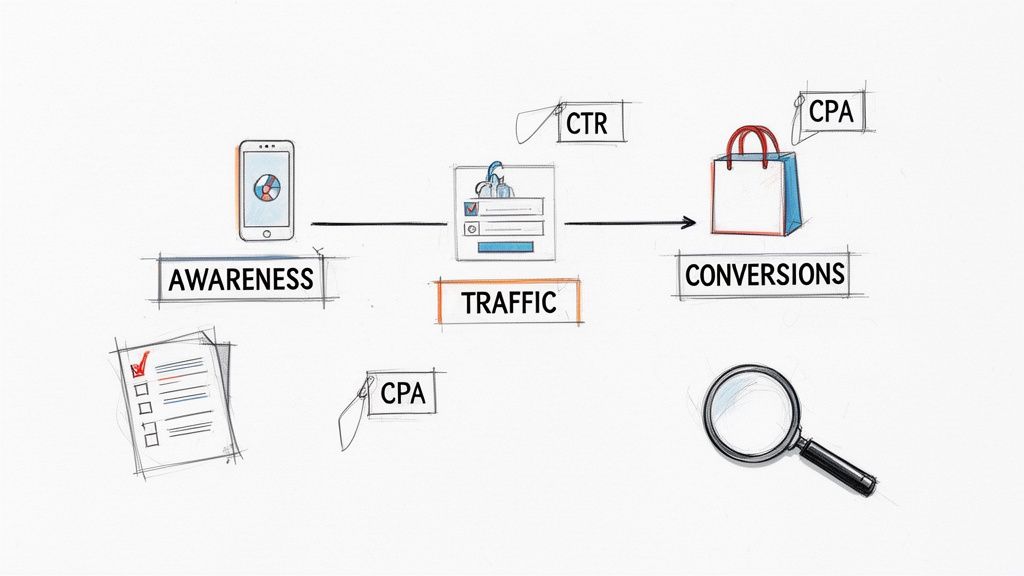
Choosing the right objective from the get-go is critical for getting a positive return on your ad spend.
Aligning Objectives with Business Goals
Inside Ads Manager, you’ll find several objectives like Awareness, Traffic, Leads, and Sales. Your choice here fundamentally changes how the algorithm behaves.
For performance marketers, the most common objectives are:
Awareness: This is for top-of-funnel campaigns where the goal is to get your brand in front of as many new people as possible. It's optimized for reach and ad recall.
Traffic: Use this when your primary goal is driving clicks to a landing page or a blog post. Meta will find people most likely to click your link.
Sales (Conversions): This is the go-to for most performance marketers. It optimizes for specific actions on your site, like a purchase or a lead submission. This objective relies on a properly installed Meta Pixel to track those valuable actions.
Think about it this way: an e-commerce brand launching a new product should absolutely use the "Sales" objective to find buyers. On the other hand, a new mobile game might use "App Promotion" to rack up installs. Your objective defines what success looks like.
To make it even clearer, here’s a quick-reference table that maps Meta's campaign objectives to real-world business goals.
Matching Instagram Ad Objectives to Your Business Goals
Campaign Objective | Primary Goal | Best For | Key Metric |
|---|---|---|---|
Awareness | Reach the most people | Brand launches, top-of-funnel marketing | Reach, Ad Recall Lift |
Traffic | Drive clicks to a website or app | Content promotion, landing page views | Link Clicks, Landing Page Views |
Engagement | Boost interactions on your ad | Building social proof, community growth | Post Engagements, Video Views |
Leads | Collect contact information | Lead generation, newsletter sign-ups | Cost per Lead (CPL) |
App Promotion | Increase app installs and events | Driving mobile app downloads | Cost per Install (CPI) |
Sales | Drive valuable actions on your site | E-commerce, direct-response marketing | ROAS, Cost per Purchase |
This table should help you quickly pinpoint the right objective for your next campaign, ensuring you're telling the algorithm exactly what to optimize for.
A well-chosen objective acts as your North Star. It ensures Meta's powerful algorithm works for you, not against you, by finding users who will actually perform your desired action.
The Power of a Purpose-Driven Campaign
The financial incentive for getting this right is massive. Instagram's ad revenue soared to $70.9 billion in 2024, a 16% jump from the previous year. That growth is fueled by advertisers seeing real results, and those results start with a solid strategy.
Laying this strategic groundwork also primes you for effective testing. When your campaigns are structured logically around a clear objective, you can isolate variables to figure out what’s really driving performance. We dive deeper into how to analyze what works in our guide on using the Instagram Ads Library for competitive research.
With a solid foundation, you can build, test, and scale your Instagram ad creation with precision and confidence.
Choosing the Right Ad Formats and Placements
Okay, you've got your campaign objective dialed in. Now, where will your ads actually live? This is about choosing the right format and placement, and it's way more than a technical checkbox. It's about meeting people where they are and how they want to be talked to.
Get this wrong, and your ad feels like an annoying interruption. Get it right, and it blends in seamlessly, feeling like a native piece of content.
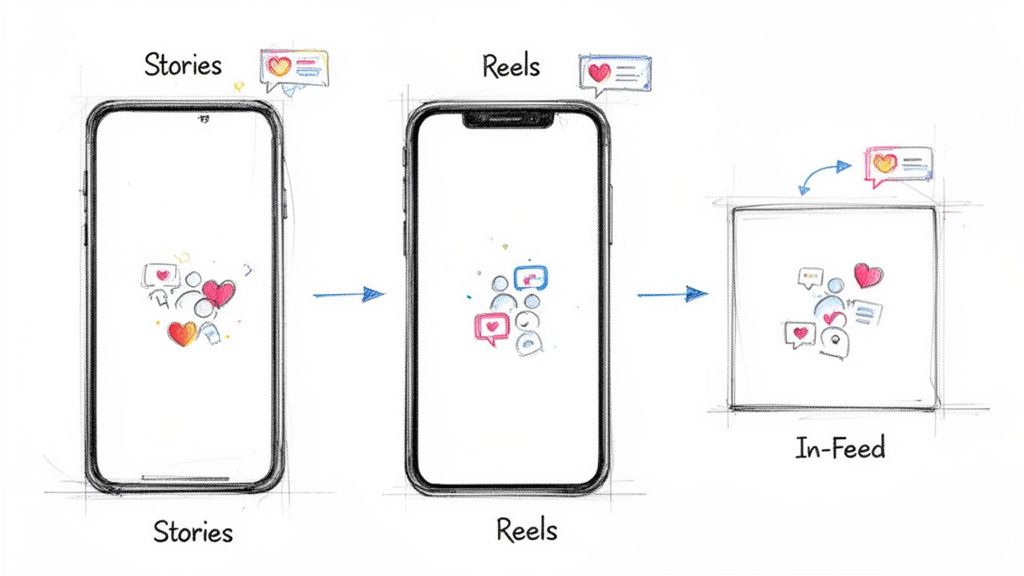
Think about it: you wouldn't jam a long, slow ad in the middle of a bunch of fast-paced, 15-second Reels, right? The context of each placement completely changes the creative rules, making this a critical step in your Instagram ad creation workflow.
Matching Placements to Campaign Goals
Instagram basically gives you three main playgrounds: Reels, Stories, and the good old In-Feed post. Each one has a different vibe and serves a different purpose.
Reels Ads for Discovery: If you want to get in front of fresh eyes, Reels is your spot. People are there to be entertained and find new stuff. Your ad needs to have a killer hook, feel current, and be visually interesting. The best Reels ads don't even feel like ads—they just feel like the next cool video.
Stories Ads for Urgency: Stories are full-screen, immersive, and they disappear. This makes them perfect for creating a little FOMO. Think flash sales, limited-time offers, or authentic behind-the-scenes content and UGC. The "swipe-up" (or link sticker) is your direct line to a landing page.
In-Feed Ads for Storytelling: The main feed is where people catch up with brands and creators they already know. This is your chance to go deeper. Use carousels or longer videos to tell a story, demonstrate a product, or nurture the audience you already have.
Your ad format should never be an afterthought. Aligning your creative to the native experience of Reels, Stories, or the Feed is the difference between an ad that gets scrolled past and an ad that converts.
Adapting Your Creative for Each Format
Let's be real—creating unique creative for every single placement isn't practical, especially when you're trying to move fast and test things. The trick is to design your assets in a modular way.
A 9:16 vertical video you make for Reels can usually be repurposed for Stories with just a few small changes. When you're picking your formats, knowing the technical specs is a must. If you're new to this, taking the time to learn the specific dimensions and requirements for each format is a solid place to start and will save you a lot of headaches.
By picking your formats and placements based on your campaign goals, you make every ad dollar work harder. This isn't just a best practice; it's a non-negotiable part of modern Instagram ad creation that sets you up for higher engagement and a better ROI from the get-go.
Designing Ad Creatives That Actually Convert
You can have the most brilliant campaign strategy and perfectly dialed-in placements, but none of it matters if your creative falls flat. This is where the real work of Instagram ad creation begins—moving from planning on a spreadsheet to actually persuading a person to stop and pay attention.
A high-performing ad isn't just a pretty video. It follows a proven structure designed to grab attention, deliver value, and drive a specific action.
And you absolutely have to stand out. The digital world is noisier than ever. With 3 billion monthly active users on Instagram, your ads aren't just up against competitors; they're fighting for a split second of attention against an endless river of content from friends, family, and creators.
Even with a massive global ad reach of 1.91 billion, organic reach is tanking. We've seen Reels posting jump by 35%, yet their reach dropped by nearly the same amount. This supply-and-demand crunch means you have to be smarter and more strategic with how you build your ads. You can see more on these Instagram statistics and what they mean for marketers on vidpros.com.
The Hook-Body-CTA Framework
The most reliable structure for any performance ad is the Hook-Body-CTA model. It’s simple, it’s effective, and it forces you to get straight to the point.
The Hook (First 3 Seconds): This is your one shot to stop the scroll. It needs to be visually jarring, ask a provocative question, or make a surprising claim. For a skincare brand, a great hook might be a shocking "before" photo or a bold text overlay that reads, "This is why your moisturizer isn't working."
The Body (Middle Section): Once you have their attention, the body of your ad needs to quickly deliver on the hook's promise. This is where you dig into the problem and present your product as the obvious solution. Don't just tell them—show them.
The Call-to-Action (Final Act): End with a crystal-clear, direct instruction. "Shop Now," "Learn More," or "Download the App" should be paired with a visual that reinforces exactly what they'll get by taking that action.
The Problem-Agitate-Solution Formula
A powerful twist on this core framework is the Problem-Agitate-Solution (PAS) model. This approach is gold for products or services that solve a very specific, nagging pain point. It works by tapping into an existing frustration and positioning your brand as the essential fix.
Here’s how a SaaS company with a project management tool might use it:
Problem: Open with a chaotic scene of missed deadlines, scattered sticky notes, and stressed-out team members. The hook is the immediate feeling of professional chaos.
Agitate: Use text overlays like "Tired of projects falling through the cracks?" to really twist the knife on the viewer's frustration.
Solution: Cut to a clean, satisfying shot of a completed project dashboard, followed by a simple "Streamline Your Workflow" CTA.
The point of any creative framework isn't to be a rigid box. It's a reliable skeleton for your story, ensuring your message is clear, persuasive, and logically guides the viewer toward the action you want them to take.
Of course, a great structure needs great copy. Mastering the art of writing is critical for designing Instagram ads that work. You can get a ton of great ideas in this detailed guide on how to write ad copy that actually converts.
And don't forget the technical details. Make sure every asset you create is properly sized for its placement by checking our guide on current social media video specs. These structured approaches are what turn good ideas into ads that drive real results.
How to Automate Your Creative Workflow
For most performance teams I talk to, the real bottleneck isn’t a lack of ideas—it’s the painfully slow, manual grind of producing ad variations. The old-school way of editing one video at a time in CapCut just can't keep up. This is where automation changes the game for your entire Instagram ad creation process.
Imagine going from being reactive with your content to running a proactive testing engine. Instead of burning days on just a handful of ads, you could be generating dozens of high-quality variations in minutes. We've seen top teams use this approach to find winning ads up to 10x faster, leaving their competition stuck in the slow lane.
The Shift to a Modular Framework
The secret is to stop thinking about ads as single, monolithic videos. A modern, high-velocity workflow treats them as modular assemblies of hooks, body content, and calls-to-action (CTAs).
This is the fundamental flow for every ad that actually performs. You can mix and match these core components to quickly find winning combinations.
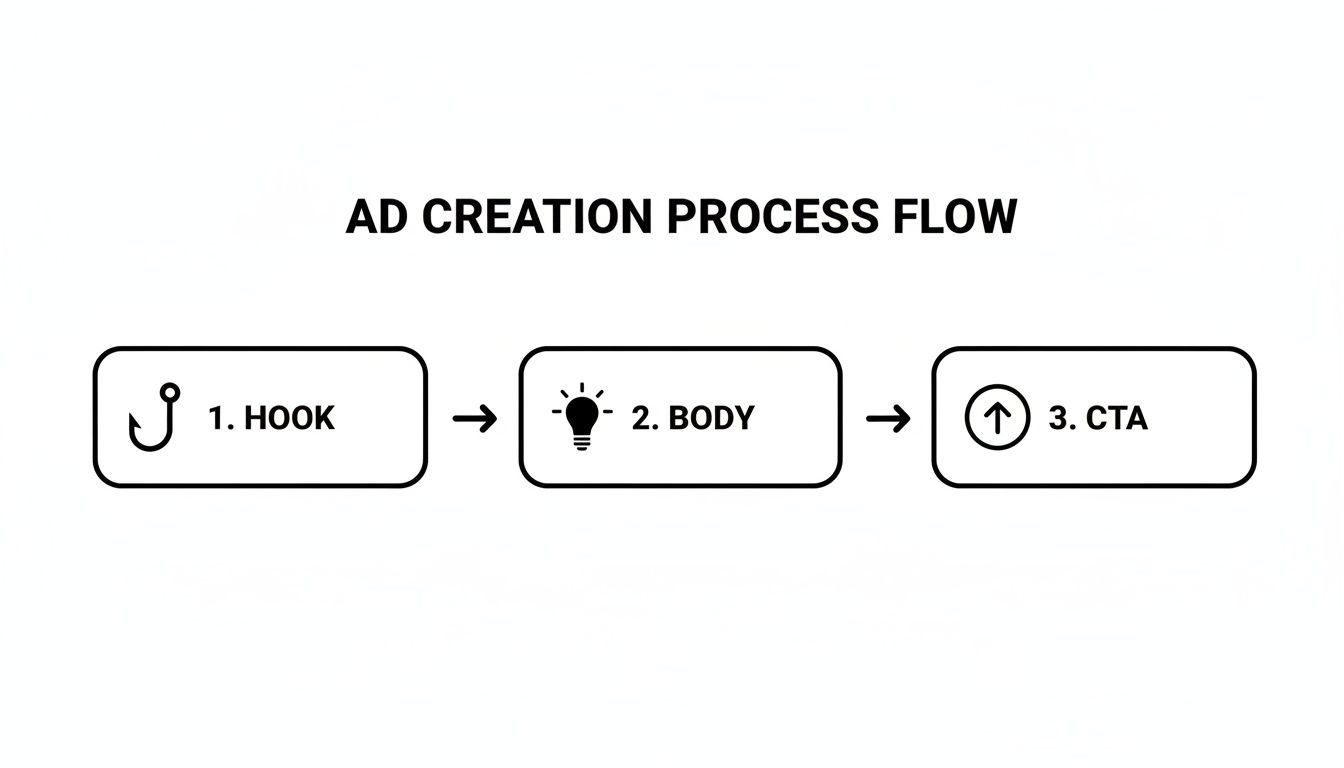
When you break down your ads into these building blocks, you’re creating a system that’s built for speed, iteration, and testing. This is the foundation of an automated creative workflow.
With an AI-powered platform, you can set up a central asset library for all your raw video clips. The AI then automatically tags these clips based on their content, identifying which ones are hooks, problem demonstrations, UGC testimonials, or CTAs. This process transforms your scattered folders of footage into a smart, searchable database.
By tagging assets as modular components, you’re no longer just storing video clips; you’re building an arsenal of persuasion tools ready to be deployed into any ad structure. This systematic approach is the core of scalable Instagram ad creation.
You can see a deeper dive into this on our post about what an AI creative automation platform can do.
Generating Variations at Scale
Once your assets are tagged, the real magic happens. You can define a creative framework, like the classic Problem-Agitate-Solution model, and let the system assemble variations automatically. For example, you could test five different hooks against three different problem demonstrations and two CTAs. This would instantly create 30 unique ad variations (5x3x2).
This level of automation eliminates countless hours of mind-numbing manual editing. It frees up your creative team to focus on what they do best: strategy and coming up with new concepts instead of drowning in repetitive production tasks.
The process essentially batches tasks that used to be done one by one:
Asset Assembly: Automatically combining different hooks, body clips, and CTAs into finished ads.
Text Overlays: Applying different headlines or value props across hundreds of videos at once.
Subtitling: Instantly generating and adding captions to all your ad variants.
This workflow doesn’t just make you faster; it makes you smarter. By launching a high volume of structured tests, you gather performance data much more quickly. This allows you to double down on what’s working and cut what’s not, creating a flywheel of continuous improvement fueled by data-driven creativity.
Alright, you've got your creatives dialed in and ready for the main event. Now it's time to get them live and see what the market really thinks. This is where creative development hands off to media buying, and a clean launch in Meta Ads Manager is the make-or-break moment for your Instagram ad creation to actually pay off.
Before you upload a single file, let's talk about something that seems minor but will save you a world of pain later: a solid naming convention. Seriously. Getting this right from the start makes everything easier. A simple, logical system like [Date]_[Concept]_[Format]_[Variation] works wonders. Think 20241028_UGCReview_Reel_V1. Trust me, when you're digging through data to figure out why one ad worked and another didn't, this little bit of discipline is a lifesaver.
From Upload to Insight
When you're building out your campaign in Ads Manager, you'll be setting up your ad sets to hit specific audiences and placements. If you’ve created modular assets, you can now confidently run ads across Reels, Stories, and the Feed because you’re already optimized for each format. Don't shy away from letting Meta’s algorithm do some of the heavy lifting here. Using Advantage+ Placements often works well, as it automatically pushes your ads to where they’re most likely to perform.
Once you click "Publish," your work isn't done—it’s just getting started. The first 24 to 72 hours are critical. This is when you'll get the raw, unfiltered feedback you need.
Try not to get emotionally attached to your ads. The market is the only judge that matters. Your job in these first few days is to listen to the data, not your gut, and be ready to act on it.
Interpreting Early Performance Data
During this initial learning phase, you have to watch a few key metrics like a hawk. These early signals will tell you if your ad has a fighting chance or if it's dead on arrival.
Here’s what I focus on:
Click-Through Rate (CTR): This is your best measure of whether your hook is actually stopping the scroll. If the CTR is in the gutter, your first three seconds are failing. It's as simple as that.
Cost Per Click (CPC): While the average Instagram CPC hovers around $1.31, that number is all over the place. What really matters is how your CPCs compare across your new ads. If one ad has a CPC that's way higher than the others, it’s a red flag.
Initial Conversion Signals: Are you seeing any "Add to Cart" events? A few early purchases? Even a small number of conversions is a powerful sign that your message and offer are hitting the mark.
With this early data, you can start making quick calls. If an ad has a terrible CTR and zero conversion signals after 72 hours, kill it. It's not going to magically start performing. But if another ad is showing a strong CTR and a few purchase events, that's your green light. Let it run, and maybe even start thinking about giving it more budget. This rapid feedback loop is the engine that drives a profitable and scalable ad account.
Instagram Ads FAQ: Your Top Questions Answered
Even the most seasoned marketers run into questions when trying to scale their Instagram ads. The platform changes, audiences get fatigued, and what worked last week might not work today.
Here are some straight-shooting answers to the questions we hear most often from performance teams trying to get ahead.
How Much Should I Spend On Instagram Ads When Starting Out?
There’s no magic number, but a solid starting point is $20-$50 per day for each ad set you’re testing. This gives Meta's algorithm enough data to find its footing and gives you a clear read on whether you're onto something.
Forget fixating on your total daily spend. Instead, get obsessed with your cost per result. Your only job at the beginning is to find one profitable ad. Once you have a winner, you can pour fuel on the fire and scale the budget with confidence. This approach lets you test more creative angles without risking a ton of cash.
Which Ad Format Is Best: Reels, Stories, or In-Feed?
The real question isn't which format is "best," but which one tells your story most effectively for that specific placement. The strongest ad accounts don't just pick one. They tailor their creative to feel native everywhere and test variations across all placements to see what their audience actually responds to.
Reels: Your best friend for top-of-funnel awareness. Use entertaining, hook-driven videos to grab the attention of people who have never heard of you.
Stories: Perfect for driving urgency. The full-screen, disappearing format is killer for flash sales, limited-time offers, and punchy UGC testimonials.
In-Feed: This is where you have a bit more room to breathe. Use it for more detailed storytelling, product demos, or nurturing audiences who are already familiar with your brand.
Why Are My Instagram Ads Not Generating Conversions?
If your ads are running but the conversions aren't coming, the problem almost always falls into one of three buckets. Before you start blaming the algorithm, you need to diagnose your own work.
First, your targeting. Are you positive you’re reaching the right people? Second, your creative. Does your ad grab attention in the first three seconds? Does it solve a problem or present a crystal-clear offer? Third, your landing page. A killer ad can't save a slow, confusing, or clunky post-click experience.
We always recommend starting with your creative. It’s the variable you can change the fastest, and it almost always has the biggest impact on performance.
How Often Should I Be Refreshing My Ad Creatives?
Creative fatigue is real, and it’s one of the biggest performance killers out there. On high-spend campaigns, it can set in within just a few days. There's no set schedule, so you have to watch your metrics like a hawk—specifically ad frequency, Click-Through Rate (CTR), and Cost Per Acquisition (CPA).
The moment you see performance start to dip, it’s time for a refresh. Elite teams using automation are often launching new creative concepts every single week, if not more often. The goal is to always have fresh ads in the chamber, ready to go. This proactive approach lets you stay ahead of fatigue and constantly find new winning angles, instead of scrambling to fix campaigns after your results have already tanked.
Ready to stop drowning in manual editing and start finding winning ads up to 10x faster? Sovran automates your entire creative workflow, from asset assembly to batch rendering and campaign launching. Start your 7-day free trial and see how much faster you can scale.

Manson Chen
Founder, Sovran
Related Articles
8 High-Converting Static Ads Examples for 2026
Discover 8 high-performing static ads examples from top apps. Learn to create text-overlays, testimonials, and lifestyle ads that convert.
- static-ads
- performance-marketing
- 5 more
How to Turn Link Into Video: Ads That Convert in 2026
Learn how to turn link into video for Meta & TikTok ads. Leverage AI to scale creation, boost ROI, and succeed in 2026.
- ai-video-generation
- link-to-video-ads
- 6 more
A Performance Marketer's Guide to Video to Flipbook Conversion
Learn to convert video to flipbook formats that boost engagement. This guide covers actionable methods for ads, content, and scaling creative with AI in 2026.
- video-repurposing
- performance-marketing
- 4 more