How to Write a Hook for Facebook Ads That Converts (2026)
Jump to a section
- Why Most Facebook Ad Hook Advice Falls Short
- Finding Your Hook Ideas Before You Write a Word
- Four Proven Hook Formulas with Examples and Templates
- How to Test and Measure Hook Performance Scientifically
- Scaling Hook Production from 10 to 1000 with AI
- Your Next Step Towards High-Converting Ads
- Frequently Asked Questions About Facebook Ad Hooks
Most Facebook ad hooks fail because they train Meta on the wrong signals. A flashy opener can lift cheap engagement, but if it pulls in low-intent viewers, CPMs rise, conversion quality slips, and ROAS gets harder to hold.
This points to a qualification problem as much as a hook problem.
The right question is not how to write a more dramatic first line. The right question is how to write an opening that qualifies, earns attention from the right buyer, and gives the algorithm better inputs. That is the difference between a hook that looks good in isolation and one that helps the full ad account perform.
Good hook writing is measurable, but strong performance does not come from chasing one vanity metric. Hook Rate matters because it shows whether the opening is doing its job, yet the winning ads usually come from a tighter system: sharper research, more precise angles, cleaner testing, and faster iteration. Teams that can generate, organize, and test high-volume variations usually find winners faster than teams polishing three concepts for a week.
That is where the gap in most advice shows up. Plenty of guides give formulas. Very few show how to scale hook creation from 3 ideas to 300 without flooding the account with random creative or burning out the team. The practical approach is to connect proven copy frameworks with an AI workflow that can expand angles, structure variations, and keep testing disciplined. Tools like Sovran help teams turn raw research into test-ready hooks at scale, which is the same operating principle behind these common Facebook ad mistakes brands and agencies make.
Why Most Facebook Ad Hook Advice Falls Short
The usual advice says your job is to stop the scroll in the first three seconds.
That advice is incomplete.
A lot of hook tutorials push curiosity, shock, and exaggerated contrast. Those tactics can get attention, but attention by itself is not the goal. One analysis on Facebook ad hooks points out that most content overemphasizes scroll-stopping while ignoring the fact that hooks also need to serve audience targeting. When the opening is not hyper-contextual to the offer, Meta can optimize toward low-intent viewers and damage ROAS. The same analysis argues that hooks need visual, audio, and copy synergy to keep the right people watching past the opening and into the selling part of the ad (YouTube analysis).
Generic attention is expensive
If the hook is broad, the traffic gets broad.
An opening like “This changes everything” can pull in views from people who like novelty, not buyers who need your product. In a Meta account, that creates a nasty trade-off. You might get decent early engagement while your downstream metrics soften. The ad looks alive, but the audience quality degrades.
That is why experienced buyers do not judge hooks by vibes. They look at whether the opening qualifies the viewer.
A better hook sounds more like this:
- Audience-specific callout: “If you run mobile app UA and your creatives burn out fast, watch this.”
- Problem-framed opening: “Your CPM is not the first problem. Your hook is.”
- Mistake framing: “Many app ads lose the right viewer before the product even appears.”
Each version narrows the audience while still earning attention.
The job of the hook is qualification
Good hooks do two things at once. They interrupt the feed and identify the right person.
That is why “stop the scroll” is too shallow as a strategy. The stronger framing is earn qualified attention.
A hook should make the right person feel seen and the wrong person feel indifferent.
This is also where a lot of brands lose money by repeating stale formulas. If every ad starts with the same generic UGC opener, Meta gets another batch of interchangeable inputs. Teams that want cleaner signals need hooks tied to the offer, the market sophistication, and the audience’s problem awareness.
If that sounds familiar, the same pattern shows up in broader creative mistakes that brands make in Meta campaigns, especially when they confuse engagement with buying intent. This breakdown on five mistakes brands and agencies make in Facebook ads is useful because it pushes the conversation beyond surface-level creative tips.
Finding Your Hook Ideas Before You Write a Word
Most weak hooks start with brainstorming.
Most strong hooks start with customer language.
If you want to know how to write a hook for Facebook ads that converts, stop trying to sound clever before you know what your buyer already says in their own words. The best hook ideas usually exist before the copywriter touches the keyboard.
Start with voice-of-customer, not formulas
The benchmark most buyers care about is simple. A Hook Rate above 40 to 50% is a strong sign of scroll-stopping performance in Meta ads, and one expert methodology emphasizes using pattern interrupts in the first 1 to 3 seconds to qualify people by market awareness level. That same approach reports CPA reductions of 20 to 30% in expert tests when the hook matches awareness more closely (Gino Gagliardi’s hook rate guide).
The implication is practical. The hook should not just be punchy. It should be calibrated.
Where to mine hook language
Look in places where people explain the problem without marketing polish:
- Reddit threads with frustrated titles and detailed comments
- App Store and Amazon reviews where buyers describe expectations versus reality
- Support tickets that reveal recurring confusion
- Sales call notes where objections repeat
- Post-purchase surveys that capture what almost stopped the sale
- Competitor comments where users explain why they switched or why they did not
The useful material is rarely the headline complaint. It is usually the phrasing around it.
For example, “I need better analytics” is mediocre hook material. “I can’t tell which creative is dying until I’ve wasted spend” is much stronger. It has urgency, cost, and a concrete failure state.
Sort findings by awareness level
A hook for an unaware viewer should not sound like a hook for someone comparing tools.
Use a rough awareness filter:
Problem-aware They feel pain but do not know the category. Hook angle: identify the pain sharply.
Solution-aware They know the category but not your approach. Hook angle: contrast your mechanism.
Product-aware They know players in the space. Hook angle: differentiate and remove friction.
Most-aware They are close to buying. Hook angle: proof, specificity, risk handling.
A broad-market DTC skincare hook and a mobile app growth hook should not share the same language. If both start with “You need to see this,” neither is doing much qualification.
Build an idea bank before writing ads
A simple workflow works well:
| Research input | What to extract | Hook angle it can produce |
|---|---|---|
| Reviews | Repeated complaints | Pain and agitation |
| Reddit comments | Casual phrasing | Native-sounding callouts |
| Surveys | Desired outcome | Promise or transformation |
| Support chats | Friction points | Objection-led hooks |
Store each phrase with tags like audience, problem, sophistication level, and ad angle. That is where a visual planning system helps. This guide to mind maps for creative strategy is a good model for turning scattered research into hook clusters instead of random notes.
If you cannot point to the sentence that inspired the hook, the hook is probably generic.
The point is not to copy customer language word for word every time. The point is to write from reality instead of from ad-copy clichés.
Four Proven Hook Formulas with Examples and Templates
Once the raw language is clear, formulas become useful. Before that, they usually produce bland copy.
One framework stands out because it gives structure without forcing sameness. The Problem-Agitate-Solution approach has been cited as converting at 15 to 25% higher rates in Meta and TikTok video ads in 2026 benchmarks for app growth marketers, and “Puzzle-Piece” hooks that withhold a key detail have been associated with 40% higher watch time in the same source (YouTube breakdown).
Here are four formulas that work when matched to the right offer and audience.
Facebook Ad Hook Formula Cheat Sheet
| Hook Formula | Best For... | Psychological Trigger | Micro-Template Example |
|---|---|---|---|
| PAS | Pain-led offers | Tension and relief | “Still dealing with [problem]? It gets worse when [agitation]. Here’s the fix.” |
| Curiosity Gap | Demonstrations and mechanisms | Open loop | “We changed one part of [process]. That changed everything.” |
| Proof Hook | Warm or skeptical audiences | Credibility | “We tested [approach]. The winner was not what we expected.” |
| Reframe Hook | Well-informed markets | Pattern break | “Your [metric] problem is not really a [metric] problem.” |
PAS hook
This is the workhorse.
It performs best when the audience already feels the problem and needs a reason to keep watching for the answer. The mistake is making the agitation melodramatic. Keep it specific.
Weak “Struggling with ad performance?”
Better “Your creative is not failing because the offer is bad. It is failing because the first line attracts the wrong click.”
Template “Still dealing with [specific problem]? It usually gets worse when [common mistake]. Try [specific solution angle].”
For a mobile app: “Still paying to test videos that die fast? It gets worse when every variation uses the same opening. Build new hooks before you rebuild the whole ad.”
Curiosity Gap hook
“Puzzle-Piece” logic works here. You give enough context to create tension, then withhold the final link.
It works well for products with a mechanism, process change, or unusual finding.
Weak “This one trick improved our ads.”
Better “We kept the same footage and changed one sentence at the start. That was the part that mattered.”
Template “We did [normal thing], but [unexpected twist] changed the result.”
Use this carefully. If the reveal feels clickbait, watch time can hold while trust drops.
Proof hook
Proof hooks are useful when buyers have seen too many unsupported claims.
Proof does not have to be a giant stat dump. It can be process proof, test proof, or observation proof.
Example “We tested five openings against the same body copy. The winner was the one that disqualified casual viewers.”
That line works because it signals rigor. It also attracts a discerning buyer who cares about process.
Reframe hook
This is my favorite for crowded categories because it attacks a stale assumption.
Example “High CPM is often a symptom. The disease is a weak opening.”
That kind of line works for buyers who are tired of beginner advice.
A useful next step is structuring the rest of the ad so the hook connects cleanly to the middle and close. This walkthrough of hook, body, CTA video ad structure is helpful because it treats the hook as one module in a larger conversion system, not a standalone party trick.
If the body of the ad cannot naturally continue from the hook, the hook is probably too gimmicky.
How to Test and Measure Hook Performance Scientifically
Hook testing gets sloppy fast.
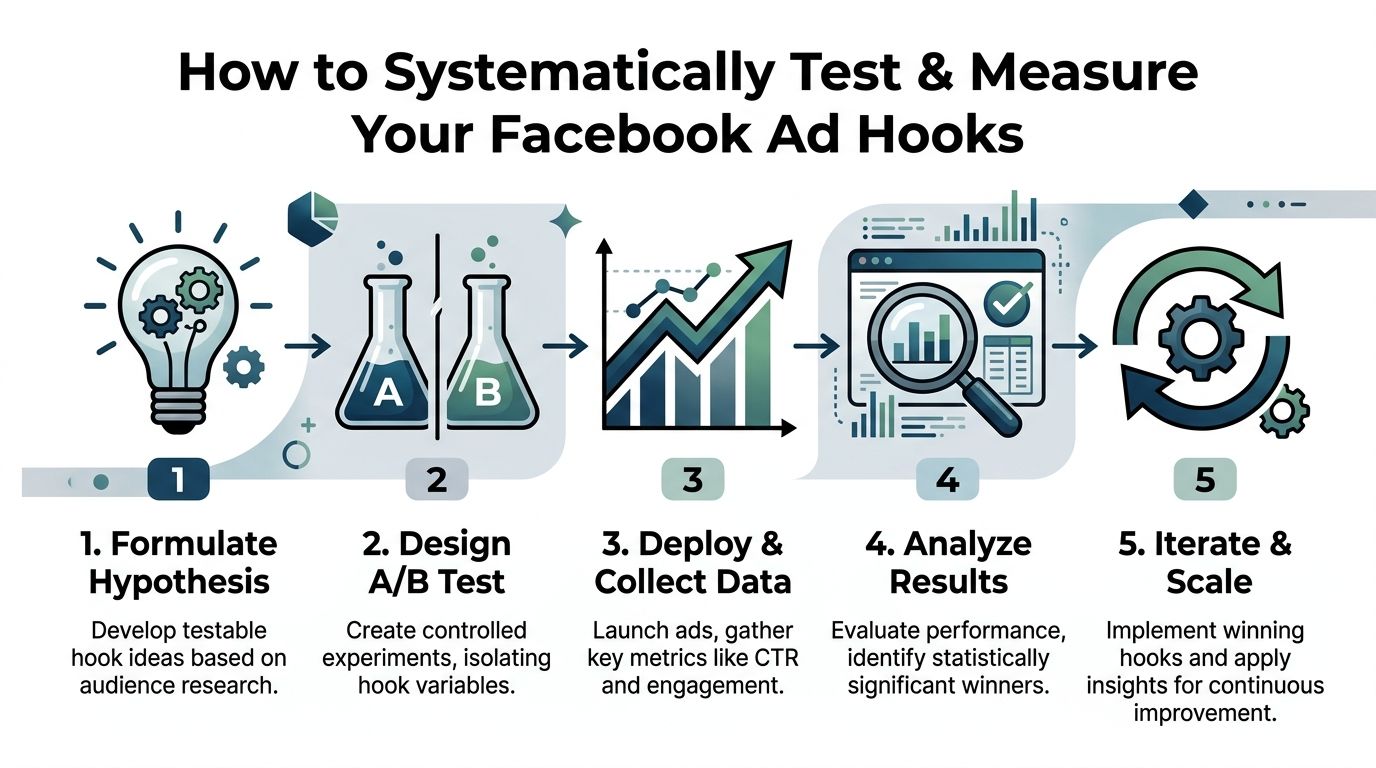
While creative opinions are plentiful, controlled tests give you something you can scale. If five variables changed between Ad A and Ad B, the result is trivia, not a usable insight. You cannot build a repeatable testing system on vibes.
Isolate the opening
A clean hook test keeps the rest of the ad as stable as possible.
- Same body copy
- Same CTA
- Same visual style after the opening
- Same audience setup
- Same offer
Change the first beat only. That usually means the first spoken line, first on-screen text, and first visual pattern interrupt.
Isolating the hook is important because Meta will happily find performance from different places in the ad. A stronger creator can lift watch time. A better offer can rescue a weak intro. Faster cuts can inflate early engagement. If your goal is to improve Hook Rate, isolate the hook.
Track Hook Rate first
Start with the metric closest to the job.
For hook testing, that is Hook Rate, commonly measured as 3-second video plays divided by impressions. Strong ads usually earn attention early. Weak hooks bleed impressions before the body has a chance to work, and that often shows up later as softer efficiency and more pressure on CPM.
Hook Rate is your first filter.
If an opening cannot earn the first three seconds, it should not absorb more spend just because the concept looked smart in review. Kill it, log the lesson, and move on.
Add Hold Rate to separate curiosity from qualified attention
Early stopping power is only half the read.
A hook can spike the first three seconds and still hurt performance if it sets the wrong expectation. Hold Rate helps you catch that. In practice, performance marketers use it to compare longer views against early plays and see whether the opening pulls people into the body or just creates a temporary click of curiosity.
Use the pattern below during review:
- High Hook Rate, weak Hold Rate means the opening grabbed attention but mismatched the body.
- Moderate Hook Rate, strong Hold Rate often means the hook qualified viewers better.
- Weak Hook Rate, weak Hold Rate usually means the angle is dead.
That trade-off matters. Some hooks win cheap attention and lose buyers. Others start a little slower but produce cleaner traffic, stronger scroll-stop quality, and better downstream ROAS.
A useful review question is simple: “Did this opening attract the right viewer for this body and this offer?”
Here is a practical video reference on the broader testing mindset:
Build a repeatable testing loop
The accounts that find winners consistently do not rely on one big brainstorm. They run a system.
Use a workflow like this:
- Write several hook variants from one research theme.
- Launch controlled tests with the same body and close.
- Review Hook Rate first, then Hold Rate, CTR, CPA, and ROAS.
- Cut weak openers fast.
- Turn winning angles into more variants with new wording, visuals, and delivery styles.
At this point, scale starts to matter. Testing three hooks manually can work. Testing 30 to 300 without naming discipline, version control, and clean reporting turns into chaos. Tools such as Sovran help teams render variants, organize creative metadata, and keep the testing structure intact so the learning compounds instead of getting buried in production work.
If your current setup keeps mixing variables together, this guide to Facebook ad creative testing workflows will help you tighten the process.
Scaling Hook Production from 10 to 1000 with AI
The hardest part of hook writing is not writing one good line.
It is turning one good line into a testing system without crushing the creative team under editing work.
That is where most advice breaks. It teaches ideation, not production. You leave with a notebook full of hooks and no realistic way to render, tag, version, and launch them at the pace the account needs.
The main bottleneck is iteration
One source highlighting the gap in hook education argues that overused formulas fail in well-informed markets and notes there is little guidance on AI automation for adapting hooks at scale. The same source suggests a setup where a Context Vault stores review-derived hooks and generates variants with Sora 2 b-roll, while pointing out that existing advice lacks detail on rapid iteration workflows such as producing 100+ hooks per week and finding winners 2.5x faster (YouTube discussion).
That gap is real in day-to-day account work.
A media buyer can identify three promising angles in an hour. Turning those into dozens of distinct video variants with new overlays, new order, new intros, new subtitles, and clean naming is the part that drags.
What an AI workflow changes
The useful AI workflow is modular.
AI tooling becomes operational at this stage, not just conceptual. Platforms such as CapCut, standard DAM tools, and specialized creative systems each cover part of the workflow.
Instead of producing complete ads one by one, you break the ad into assets:
- Hook clips
- Body clips
- CTA clips
- Text overlays
- Proof snippets
- B-roll options
Then you tag each piece so it can be reused across combinations.
That changes the unit of production. You stop thinking in full edits and start thinking in interchangeable components. For performance teams, that is a much better fit for testing because the question is rarely “Which finished masterpiece wins?” It is “Which opening angle pairs best with this offer and this audience?”
One practical tool stack
At this point, AI tooling becomes operational, not conceptual. Platforms such as CapCut, standard DAM tools, and specialized creative systems each cover part of the workflow. Sovran fits here because it tags uploaded clips into reusable building blocks, stores reviews and scripts in a Context Vault, supports natural-language asset search, and bulk-renders Hook-Body-CTA combinations for Meta and TikTok workflows. If you want the product-level view, this page on its AI creative automation platform outlines that operating model.
That matters because scaling hooks is less about “generating copy” and more about compressing the loop between idea, render, launch, and readout.
AI is most useful after strategy, not before it. It multiplies a strong system and accelerates a weak one.
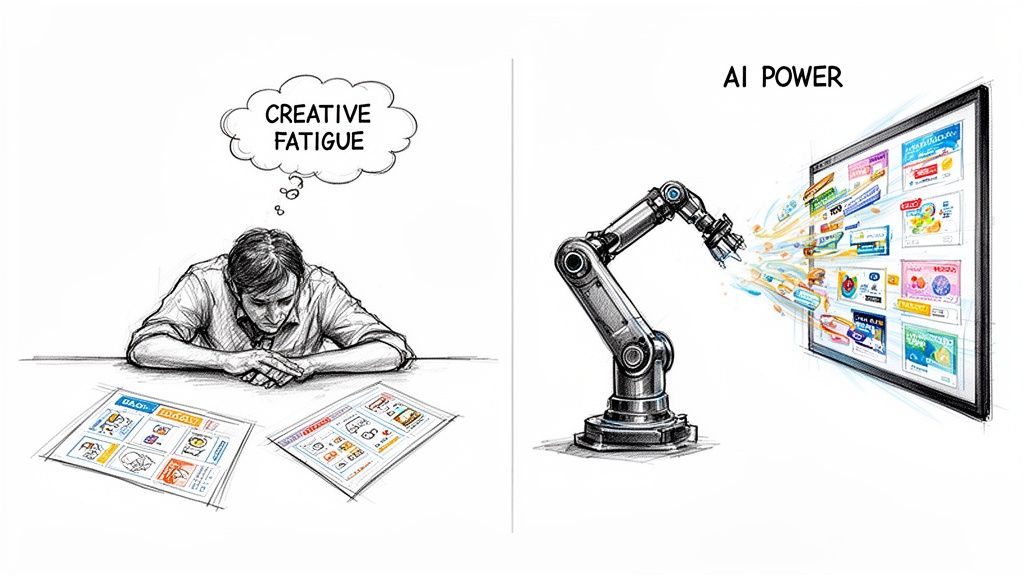
The right setup lets a team turn a winning angle into many ad-ready variants without rebuilding every edit from scratch. That is how you fight creative fatigue without lowering the standard of the work.
Your Next Step Towards High-Converting Ads
High-converting Facebook ad hooks come from a system you can run every week, not a swipe file you read once.
The teams that improve Hook Rate, hold CPM in range, and protect ROAS treat hook creation like an operating process. They do the research, turn one angle into multiple openings, test them in controlled batches, and keep fresh variants ready before fatigue drags performance down. That is the difference between writing a few decent ads and building a pipeline that can find winners consistently.
The practical next step is simple. Audit your last batch of ads and isolate the openings that earned attention. Then map those winners by angle, audience awareness, and proof type. From there, build new hooks as variations on the underlying idea, not minor rewrites of the same line.
That is also where scale starts to matter.
A media buyer can come up with three solid hooks on a good day. Growth gets harder when the account needs 30, 100, or 300 testable openings across offers, audiences, and placements. Formula-based advice usually stops before that point. Strong teams solve it by combining proven direct response frameworks with production systems that let them generate, organize, and ship variants fast enough to learn.
Sovran fits that workflow on the operational side. It helps teams turn approved angles, scripts, and creative assets into a larger testing library without rebuilding the process from scratch each time. Used well, AI does not replace hook strategy. It increases output, shortens the test cycle, and helps creative teams reach more viable shots on goal.
Start there. Build the system, tighten the feedback loop, and scale what already proves it can convert.
Frequently Asked Questions About Facebook Ad Hooks
A few edge cases come up once the basics are in place. These are the ones buyers run into most often.
| Question | Answer |
|---|---|
| Should the hook change by placement? | Yes. Reels, Feed, and other placements create different viewing behavior. Keep the core angle, but adapt pacing, framing, and on-screen text density to the placement. A hook that relies on fast visual interruption may play better in a vertical short-form environment, while a Feed placement may need clearer context sooner. |
| How do I handle hook fatigue? | Do not just swap adjectives. Refresh the angle. Change the pain framing, awareness level, speaker perspective, or proof style while keeping the same body if needed. Fatigue often means the market has seen the opening too many times, not that the product story is broken. |
| Should I use the same hook for cold and retargeting? | Usually no. Cold audiences need qualification and clean relevance. Retargeting can lean more on proof, objections, or direct offer framing because the audience already has some context. If the viewer already knows the product, a broad curiosity hook often wastes time. |
A few practical reminders help:
- Match hook to traffic temperature: Cold audiences usually need context before claim intensity.
- Watch the handoff into the body: Strong openings fail when the next line feels like a different ad.
- Keep a swipe file by angle, not by headline: That makes it easier to remix without repeating stale patterns.
The best hook strategy looks less like inspiration and more like inventory management. You are building a library of proven opening angles, then deploying the right one for the right audience at the right time.
If your team wants to test more hooks without creating a manual editing bottleneck, Sovran gives you a way to turn existing clips into modular Hook-Body-CTA variants, store winning language in a Context Vault, and bulk-render new ads for faster iteration. Start with the free trial and evaluate it like any performance system. By output, speed, and learnings.

Manson Chen
Founder, Sovran
Related Articles

8 Pattern Interrupt Techniques for Video Ads
Customer Journey Mapping for Performance Marketing