How to Make a Commercial That Actually Converts
how to make a commercials: Learn scripting, filming, and scaling ads that actually convert on Meta and TikTok.
Jump to a section
You can’t just wing it and hope for the best when it comes to high-performing commercials. It’s a methodical process: you strategize who you're talking to, script a story they can't ignore, shoot authentic visuals, and then test everything. Forget massive budgets; what you really need is a smart, data-driven creative engine.
Laying the Strategic Foundation for Your Commercial
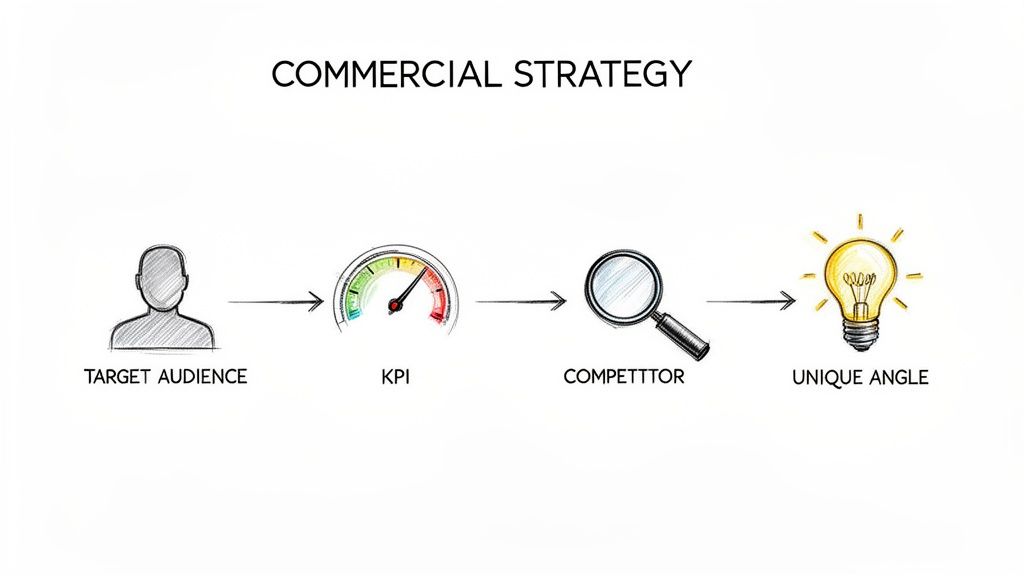
Before you even think about hitting record, you need a blueprint. A winning commercial is born from strategy, not guesswork. This initial planning separates ads that actually convert from those that just become more noise on the feed.
Every decision you make—from the first line of the script to the final CTA—flows directly from this plan. Skipping this is like trying to build a house without architectural plans. You might end up with something, but it’s definitely not what you wanted or needed.
Define Your Target Audience Precisely
Saying your audience is "everyone on TikTok" is a fast track to burning cash. You have to get way more specific. Who are you really trying to reach? Vague demographics aren't enough. You need to get into their heads and understand their psychographics—what keeps them up at night, what they want most, and the exact language they use to talk about it.
For platforms like Meta and TikTok, that means digging into:
Behaviors: What accounts do they follow? What kind of content makes them stop scrolling?
Interests: Are they obsessed with sustainable fashion, deep into mobile gaming, or constantly looking for new productivity hacks?
Pain Points: What specific problem does your product solve in their day-to-day life?
For example, let's say you're selling a time-management app. Your target isn't just "busy professionals." It's more like, "freelance graphic designers, 25-35, who follow productivity influencers and are getting crushed by project scope creep." That level of detail is gold—it tells you exactly how to craft your ad.
Set Clear and Measurable KPIs
What does a "win" actually look like for this commercial? Without clear Key Performance Indicators (KPIs), you're just throwing money at the wall. You can't measure results or justify your ad spend. Your goals will dictate the entire creative direction.
Key Takeaway: Your main KPI should be the north star for your creative. An ad built for brand awareness is going to look and feel completely different from one designed to drive immediate app installs.
Common KPIs for social media commercials usually include:
Return on Ad Spend (ROAS): The ultimate bottom line. Is this profitable?
Cost Per Acquisition (CPA): How much are you paying for each new customer?
Click-Through Rate (CTR): Are people interested enough to click?
Conversion Rate (CVR): Of those who click, how many are actually buying?
Pick one primary KPI to obsess over. If your goal is a $50 CPA, then every creative choice gets filtered through that lens: "Will this help us hit our $50 CPA?" For a deeper look at this, check out our guide on building an effective paid social media strategy.
Analyze Your Competitors and Find Your Angle
Your commercial doesn't exist in a vacuum. Your audience is being bombarded with ads from your competitors every single day. You need to know what they're doing—not to copy them, but to figure out how to be different and better.
Jump into the ad libraries on Meta and TikTok and start spying on your competitors. Pay close attention to their:
Hooks: How are they grabbing attention in the first 3 seconds?
Messaging: What benefits are they hammering home?
Visuals: Is it all slick, high-production studio shots, or are they using raw user-generated content (UGC)?
Offers: What’s the incentive? A discount, a free trial?
By breaking down their approach, you'll start to see patterns and find gaps you can exploit. Maybe their ads are all polished and corporate; your angle could be authentic, behind-the-scenes UGC. Perhaps they all talk about features; you can hit them with the emotional benefit. This is your chance to zig while everyone else zags.
Writing Scripts That Stop the Scroll

Let's be real—on a crowded social feed, your script is everything. It's the one thing that stands between a viewer scrolling right past your ad and actually stopping to see what you have to say.
Forget the long, cinematic brand stories. On platforms like TikTok and Meta, you have seconds, not minutes. Success isn’t about having the slickest production; it’s about understanding the psychology of the scroll and using battle-tested frameworks to build a compelling narrative, fast.
This is where tactical scripting separates the amateurs from the pros who know how to make a commercials that really convert.
The Classic: Hook-Body-CTA
This framework is the foundation of almost every high-performing direct response ad you'll see. It’s simple, direct, and devastatingly effective because it perfectly matches how people consume content on social feeds.
The Hook (First 3 seconds): Honestly, this is your ad. If the first 3 seconds don’t stop someone’s thumb, nothing else matters. Your hook needs to be a pattern interrupt—something visually or audibly disruptive. Think provocative questions, surprising statements, or a direct callout to your target audience.
The Body (3-15 seconds): You’ve earned their attention. Now you have a tiny window to deliver your core message. This is where you quickly show the product's value, demonstrate a key benefit, or tell a quick, relatable story. Stay focused on one single takeaway.
The CTA (Last 3-5 seconds): Tell them exactly what to do next. Don't be clever or subtle. Use direct, unambiguous language like "Shop the Collection," "Download Now," or "Start Your Free Trial."
A fitness app, for example, could use a hook showing someone struggling with a push-up with the text, "Still stuck on these?" The body would then quickly flash through the app's guided workouts, followed by a clear CTA: "Download the app to start your plan."
The Storyteller: Problem-Agitate-Solution (PAS)
The PAS framework is a copywriting classic that taps directly into your audience's pain points. Instead of leading with how great your product is, you lead with a problem they already know all too well.
This approach builds an immediate emotional connection. You’re showing the user you genuinely understand their struggle before you ever mention your product, making your solution feel like a massive relief. We dive deeper into this method in our guide on how to write a script for advertising.
Expert Insight: The "Agitate" step is where most brands drop the ball with PAS. Don't just state the problem—pour a little salt in the wound. Remind them of the frustration, the wasted time, or the annoyance. That's what makes the "Solution" feel so powerful.
Imagine you're selling a meal-prep service.
Problem: "Tired of spending your Sunday nights meal prepping?"
Agitate: Show quick cuts of chaotic grocery stores, a mountain of dirty dishes, and the feeling of a weekend totally wasted.
Solution: Introduce your service with beautiful shots of delicious, healthy meals arriving right at their door.
To create compelling scripts, it's essential to understand what makes people tick. I often find inspiration by looking at viral ad copy examples to see how others are integrating raw, user-centric approaches that feel authentic.
Comparing Popular Ad Scripting Frameworks
Choosing the right framework depends entirely on your campaign goal and your audience's mindset. While Hook-Body-CTA is a fantastic all-rounder for direct response, PAS shines when you need to build a stronger emotional connection around a specific pain point.
Framework | Best For | Hook Focus | CTA Style |
|---|---|---|---|
Hook-Body-CTA | Direct response, clear value props | Pattern interrupt, bold claims | Direct & Urgent |
Problem-Agitate-Solution | Products solving a clear pain point | Highlighting a relatable frustration | The Ultimate Relief |
UGC Mashup | Building trust & social proof | Authentic user experiences | Community-driven, "Join Us" |
Ultimately, the best framework is the one that tells your story most effectively in the shortest amount of time. Don't be afraid to test different structures to see what resonates with your audience.
The Authenticity Engine: Sourcing and Weaving in UGC
User-generated content (UGC) is your secret weapon for building instant trust. It's social proof in its rawest, most believable form. A real customer raving about your product is infinitely more powerful than any polished brand message.
You can get your hands on great UGC by:
Running contests or campaigns that encourage users to share their experiences.
Reaching out directly to customers who have tagged your brand in their posts.
Partnering with creators who genuinely align with your brand's vibe.
Once you have it, don't just tack it onto the end of your ad. Weave it directly into your script. A really effective technique is the "UGC mashup," where you create a high-energy, compelling story by rapidly cutting between multiple customer clips.
Modernizing Your Production Workflow
High-volume ad creation doesn't demand a Hollywood-sized budget or a sprawling team anymore. The real secret is to stop thinking in terms of slow, one-off projects and start building an efficient, scalable production engine. This is how you leave behind the one-by-one commercial grind and begin generating high-performing creative at the speed your campaigns actually need.
The fundamental shift is moving from a manual, soul-crushing process to a system that can pump out hundreds of ad variations in minutes, not weeks. It all starts with a new perspective: treating your existing video assets not as finished products, but as a library of reusable, tagged building blocks.
Building Your Reusable Asset Library
Every piece of footage you own—whether it's raw UGC, slick B-roll, or a simple product shot—is a potential component for your next winning ad. The first real step is to organize these assets into a searchable, modular library. Forget about burying clips in endless nested folders. Think of them as Lego bricks, each with a specific job.
This means tagging clips with descriptive keywords that actually tell you what's inside.
Action: "unboxing," "product in use," "customer testimonial"
Theme: "summer vibe," "tech focus," "problem-solving"
Hook Type: "question hook," "bold statement," "visual pattern interrupt"
An organized library is your single most valuable creative asset. When you need to whip up a new commercial, you're no longer staring at a blank timeline. You're just searching for the right bricks—a hook, a few body clips, and a CTA—and snapping them together.
Automating the Tedious Post-Production Work
Let's be honest, the biggest bottleneck in ad production is almost always the repetitive, manual labor in post-production. Things like adding subtitles, slapping on text overlays, and making sure branding is consistent across dozens of videos can burn entire days. This is where modern tools, especially AI-powered ones, become non-negotiable.
A great production workflow isn't about working harder; it's about automating the low-value tasks so you can spend more time on high-value strategy. If you're manually keyframing text overlays in 2024, you're falling behind.
AI platforms can automate these tedious jobs, freeing up your team to focus on what matters: creative strategy and performance analysis. Imagine uploading a batch of 50 videos and having them all subtitled, branded with your logo, and formatted for TikTok in minutes. This level of speed isn't a luxury anymore; it's a competitive necessity. For a deeper dive, you can learn about the power of an AI video ad generator and how it fits into this modern workflow.
Generating and Sourcing Fresh B-Roll
Even with a killer asset library, you'll eventually need fresh visuals to keep creative fatigue at bay. In the past, this meant pricey and time-sucking B-roll shoots. Today, your options are much more flexible and wallet-friendly.
AI-Generated Video: Tools like Sora and Veo can generate high-quality, hyper-specific B-roll clips from simple text prompts. Need a shot of a "person happily using a smartphone on a sunny balcony"? You can spit out dozens of variations in seconds without ever touching a camera.
Stock Footage Libraries: Platforms like Artgrid or Storyblocks offer cinematic-quality footage that can blend right into your projects. The trick is to pick clips that match your brand's vibe and don't scream "stock footage."
Creator Partnerships: Team up with UGC creators to produce authentic footage that feels native to social media. This is often far more engaging and cost-effective than a traditional, polished production shoot.
The goal is to maintain a constant stream of new visual elements to mix with your proven performers. This lets you refresh your winning ads just by swapping out a single clip, which can extend their lifespan and keep performance high. By modernizing your approach to asset management, post-production, and B-roll sourcing, you transform your entire operation. You're no longer just learning how to make commercials; you're building a system that can consistently produce winning creative at scale.
Implementing a Scalable Creative Testing System
The best commercials aren't born from a single stroke of creative genius. They're discovered through relentless, data-driven testing. If you want to find ads that consistently crush your performance targets, you need to move beyond guesswork and build a structured system for creative iteration.
This isn't just about making better ads; it's your best defense against creative fatigue. A scalable system ensures you always have a fresh pipeline of ideas backed by real performance data, allowing you to sidestep ad burnout and maintain high performance month after month. It's the engine that powers sustainable growth.
A Practical Approach to A/B Testing
Effective A/B testing is all about isolating variables. It’s tempting to change the hook, the music, and the call-to-action all at once, but when you do that, you have no idea what actually moved the needle. The real key is to test one big element at a time to get clean, actionable results.
Start by focusing on the elements that will have the biggest impact on performance. Here’s how I prioritize them:
The Hook (Highest Priority): The first 3 seconds are everything. Test completely different opening scenes, bold on-screen text, or raw user testimonials. The hook is the single most important variable for stopping the scroll.
The Call-to-Action (CTA): Experiment with different offers or direct commands. You'd be surprised how differently "Shop Now" can perform compared to "Get 50% Off Today."
The Core Creative: Pit entirely different ad concepts against each other. For example, a polished, high-production product demo versus a gritty, authentic UGC-style video.
Minor Elements (Lower Priority): Once you find winning combinations, you can start fine-tuning smaller variables like background music, text overlay styles, or even different creators.
Before you even get to production, validating your core ideas with something like concept testing can save you a ton of time and money down the line. It helps you confirm you're on the right track before you invest heavily in shooting and editing.
Here’s a quick breakdown of where to focus your testing efforts for the biggest potential wins.
Creative Testing Variables and Impact
Variable to Test | Potential Impact On | Testing Priority |
|---|---|---|
Hook (First 3s) | Hook Rate, CTR, CVR | Very High |
Creative Concept | Overall Engagement, CPA, ROAS | High |
Call-to-Action (CTA) | CTR, CVR, CPA | High |
Ad Copy & Headline | CTR, CVR | Medium |
Talent/Creator | Engagement Rate, Brand Affinity | Medium |
Background Music | Watch Time, Emotional Response | Low |
Text Overlays/Style | Readability, Brand Recall | Low |
Focusing on the high-priority variables first will give you the most significant performance lifts in the shortest amount of time.
Generating Dozens of Variants with Bulk Rendering
Manually editing dozens of ad variations is a soul-crushing time sink. This is where bulk video rendering completely changes the game.
By treating your ad as a modular structure (Hook + Body + CTA), you can automatically remix your best assets into hundreds of unique combinations in a matter of seconds.
Let's say you have:
5 strong hooks
3 different body segments (each highlighting a unique value prop)
2 proven CTAs
A bulk rendering tool can instantly generate 30 unique video ads (5 x 3 x 2) for you to test. This explosion in creative volume lets you test more ideas with less effort, which dramatically shortens your learning cycle. You’re no longer just making a commercial; you're building a system that discovers winning commercials.
This modern workflow, moving from an asset library to AI-powered editing and mass variation output, is how top teams operate.
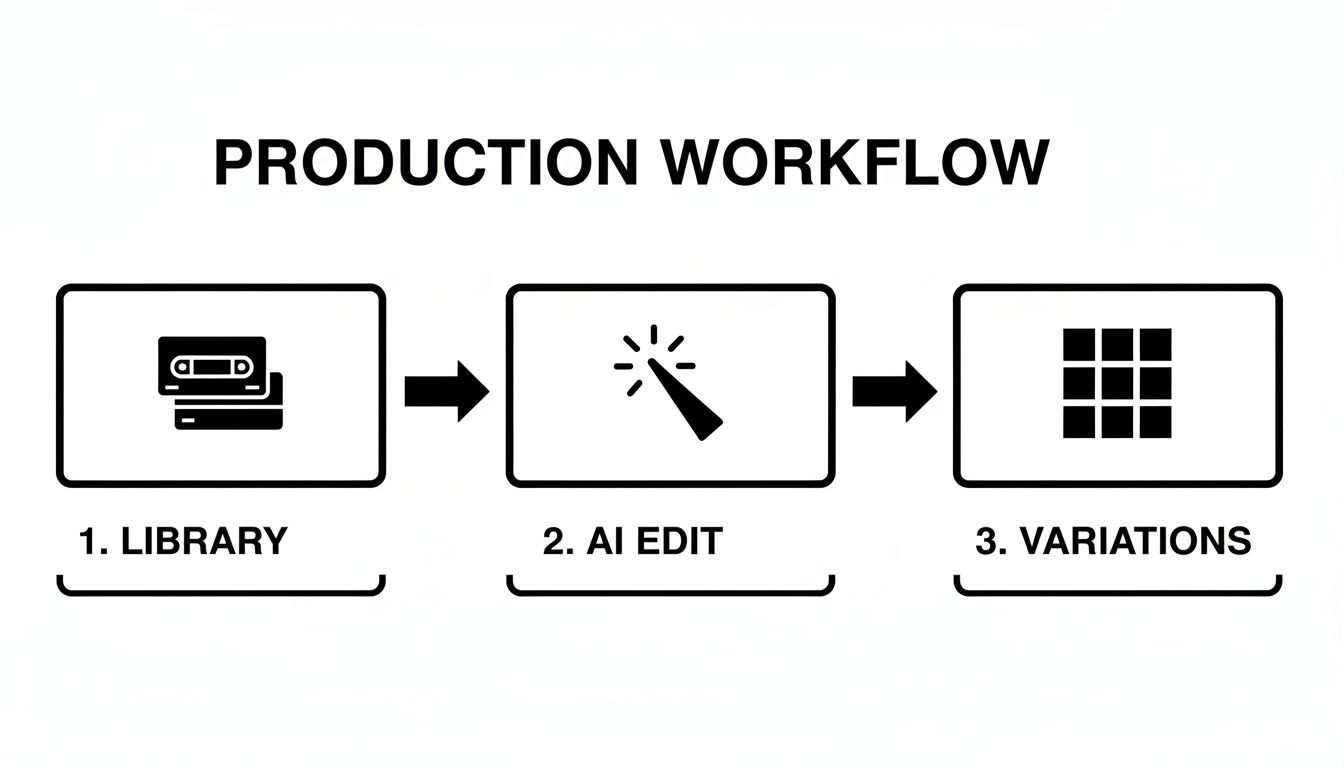
As the diagram shows, an organized asset library is the foundation. It allows you to feed your best clips into an AI editor to rapidly generate the variants you need for robust testing.
Automated Ad Naming for Faster Analysis
When you're launching dozens—or even hundreds—of ad variants, clear and consistent naming conventions are non-negotiable. A messy ad account makes performance analysis a nightmare. You need a system that tells you exactly what you’re looking at with just a glance.
Automated naming conventions for platforms like Meta are a lifesaver.
Pro Tip: Your ad name should function like a data label. It needs to clearly communicate the creative variables being tested so you can quickly filter your reports and find insights without having to click into every single ad.
A solid automated naming convention might look something like this:[Date]_[CampaignObjective]_[Audience]_[CreativeConcept]_[HookID]_[CTA_ID]
For example:240530_Conversions_LAL1-Purchasers_UGC-Mashup_Hook04_CTA-ShopNow
This one line tells you everything: when it launched, the objective, the audience, the creative style, and the exact hook and CTA being tested. When you’re staring at a spreadsheet with rows of performance data, this level of clarity is invaluable.
This systematic approach transforms your creative process from an art into a science, creating a powerful feedback loop where performance data directly informs your next creative sprint.
Managing and Scaling Your Winning Ads
So, you’ve found a winning commercial. That's a huge milestone, but it's really just the starting line. The real challenge—and where a ton of brands get stuck—is figuring out how to scale that winner without running it into the ground.
Your first instinct might be to just crank up the budget, but that's a quick way to hit ad fatigue and watch your performance nosedive. The goal here isn't a single win; it's about building a creative engine that pumps out winners consistently. This means getting smart about how you spend, organizing your assets for lightning-fast remixes, and turning your library of clips into your most valuable long-term asset.
Allocating Budget to Your Top Performers
When an ad is crushing your KPIs, it's tempting to throw your entire budget at it. Don't. A slow-and-steady, data-backed approach is what separates the pros from the amateurs. You need to scale gradually to avoid shocking the algorithm and burning out your audience.
We start by bumping the ad set's budget by 20-30% every 48-72 hours. This little bit of breathing room gives the platform’s algorithm time to adjust to the new spend without completely resetting its learning phase. Keep a close eye on your main KPI, whether that's CPA or ROAS. If the numbers hold steady or even get better, you're good to repeat the process.
This methodical approach prevents the wild performance swings that come from aggressive budget hikes. While you're doing this, you should also be duplicating that winning ad set to test it against fresh audiences. You'd be surprised how often a winner in one segment becomes an absolute superstar in another.
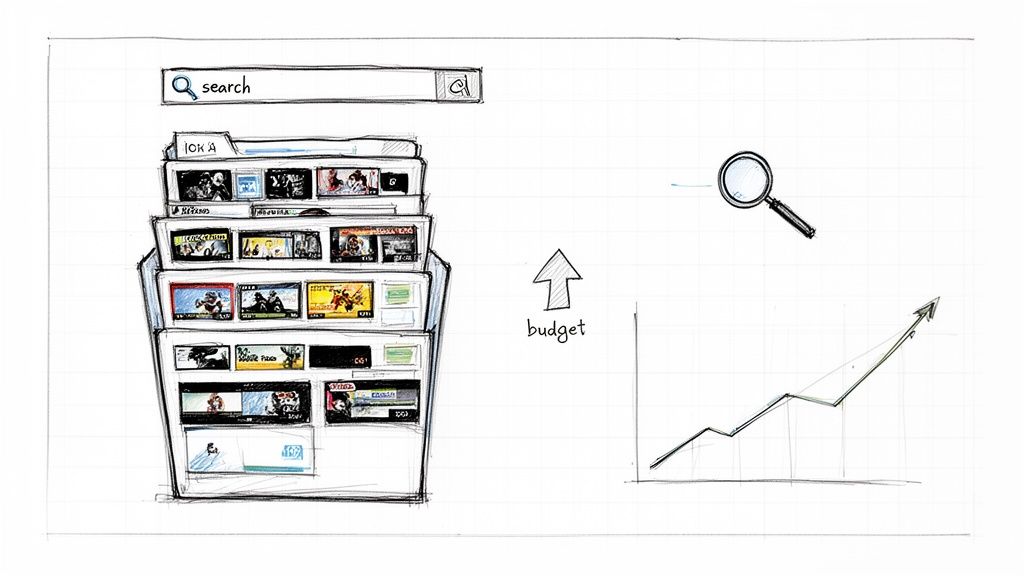
Building a Searchable Creative Library
Over time, your biggest competitive advantage won't be a single ad; it will be your library of proven creative assets. Every clip you film—from a killer UGC testimonial to a simple B-roll shot—is a potential ingredient for your next winning recipe. An organized asset library isn't just nice to have; it's the foundation of scalable production.
This is where you move beyond messy Google Drive folders and start thinking like a database. Implement a tagging system. Tag every single clip with descriptive, searchable keywords so you can find exactly what you need in seconds.
By Hook Type: problem-focused, direct-to-camera, unboxing
By Content: product demo, customer testimonial, benefit showcase
By Creator: creator_name_A, creator_name_B
By Performance: proven_hook, top_performer, testing_clip
This simple system turns your library from a digital junk drawer into an active, strategic tool. Need a new ad concept fast? Just search for a "proven_hook" and a few "product demo" clips, and you’ve got your raw materials ready to go.
Remixing and Refreshing Your Winners
The best defense against ad fatigue is a good offense. You need to constantly introduce fresh variations of your winning ads. Instead of starting from scratch every time, you can pull from your organized library to remix proven elements into new combinations.
Key Takeaway: A winning ad isn't a single thing; it's a collection of high-performing parts. Your job is to identify those parts and recombine them to squeeze every last drop of performance out of them.
This modular approach is incredibly powerful. Take your best-performing ad and create a handful of new versions just by swapping out one piece at a time.
Swap the hook: Keep the body and CTA, but test 3-5 completely new hooks.
Swap the B-roll: Use the exact same script and voiceover, but change the visuals playing in the background.
Swap the creator: Get a different UGC creator to deliver the same core message.
This remixing strategy lets you churn out dozens of new ads that are already built on a foundation you know works. It’s a low-risk, high-reward way to scale that keeps your creative pipeline full and your performance strong.
While financial reports from institutions like the IMF focus on large-scale industrial production and economic data, performance marketers live and die by the micro-trends in their ad accounts. For more on the data guiding global economic policy, you can check out this brief from the IMF. But for us, the real key to mastering how to make a commercials that last is this logic of iteration and remixing. It's how you build ads that not only convert but also have real staying power.
Answering Your Top Commercial-Making Questions
Even when you have a solid game plan, jumping into the nitty-gritty of making commercials always brings up a few questions. I see these pop up all the time with performance marketers and creative strategists, so let's tackle the most common ones.
How Long Should a Commercial Be for Meta and TikTok?
For fast-paced platforms like TikTok and Meta, your sweet spot is almost always 15-30 seconds.
The single most critical part of your entire ad is the first three seconds. You absolutely have to land a powerful hook right away to stop the scroll. If you don't win that battle, nothing else matters.
Sure, there’s a time and place for longer-form ads, especially for deep brand storytelling. But for direct response, the overwhelming majority of winning ads are short, punchy, and designed for quick hits. Your job is to deliver the message before their thumb gets restless.
What's More Important: The Hook or the CTA?
The hook. No question.
Think of it this way: a brilliant Call-to-Action (CTA) is useless if nobody ever sees it. Your hook is what earns you the right to even show the rest of your ad. A great CTA turns that attention into action, but the hook is what buys you the attention in the first place.
Key Insight: Your hook is the price of admission to the rest of your ad. A weak hook means no one gets in the door.
A pro move is to test multiple hooks against a proven ad body and CTA. Once you find a hook that's a clear winner, then you can start iterating on the CTA to squeeze out every last conversion.
How Many Ad Variations Should I Test at Once?
This really comes down to your budget, but a solid starting point is to test 3-5 totally distinct creative concepts at the same time. For each of those core ideas, you might spin up 2-3 different hooks to test against it.
The goal is to give the algorithm enough unique creative to find a winner, but without spreading your budget so thin that no single ad gets enough data to tell you anything useful.
Here’s a rough guide:
Low Budget: Start with 3-5 total ad variants.
Medium Budget: Aim for 10-15 variants, really focusing on different hooks.
High Budget: You can push it to 20+ variants, testing different concepts, bodies, and CTAs.
This is where bulk rendering tools become a lifesaver. They let you create this kind of volume without getting bogged down in the editor, freeing you up to actually analyze performance and find that next winning ad.
Can I Make a Good Commercial Without a Big Budget?
Absolutely. In fact, on platforms like TikTok and Meta, raw authenticity often crushes high-production gloss.
Users on these feeds are wired to engage with content that feels native and real, not like a polished corporate broadcast. Some of the best-performing ads are simple User-Generated Content (UGC), direct-to-camera videos shot on a phone, or even basic screen recordings.
Success here is less about your budget and more about a killer script, a clear message, and a relentless obsession with testing. Modern tools that let you remix existing assets or generate B-roll can slash your costs while dramatically increasing your creative output.
Ready to stop the manual grind and start scaling your ad performance? Sovran automates the entire creative workflow, from asset management and AI-powered editing to bulk rendering and launching. Find your next winning commercial up to 10x faster. Book a Demo.

Manson Chen
Founder, Sovran
Related Articles

Your Ultimate Guide to UGC Style Video Ads
Master UGC style video ads for Meta and TikTok. This guide reveals proven frameworks, scripts, and scaling tactics to boost your ROAS in 2026.
8 High-Converting Static Ads Examples for 2026
Discover 8 high-performing static ads examples from top apps. Learn to create text-overlays, testimonials, and lifestyle ads that convert.
How to Turn Link Into Video: Ads That Convert in 2026
Learn how to turn link into video for Meta & TikTok ads. Leverage AI to scale creation, boost ROI, and succeed in 2026.