Master Your Ads with an AI Script Writer
Discover how to use an AI script writer to generate high-converting video ads. Learn expert tips for Meta and TikTok to scale creative and boost performance.
Jump to a section
If you’re a performance marketer, you know the feeling. That familiar dread of staring at a blank page, trying to come up with the next winning video ad script for Meta or TikTok. The platforms demand a constant stream of fresh creative, and it’s a grind that can burn anyone out.
This is where an AI script writer stops being a nice-to-have and becomes essential. It’s about flipping the script—literally—from a slow, manual chore into a fast, strategic part of your workflow.
Get Off the Creative Hamster Wheel
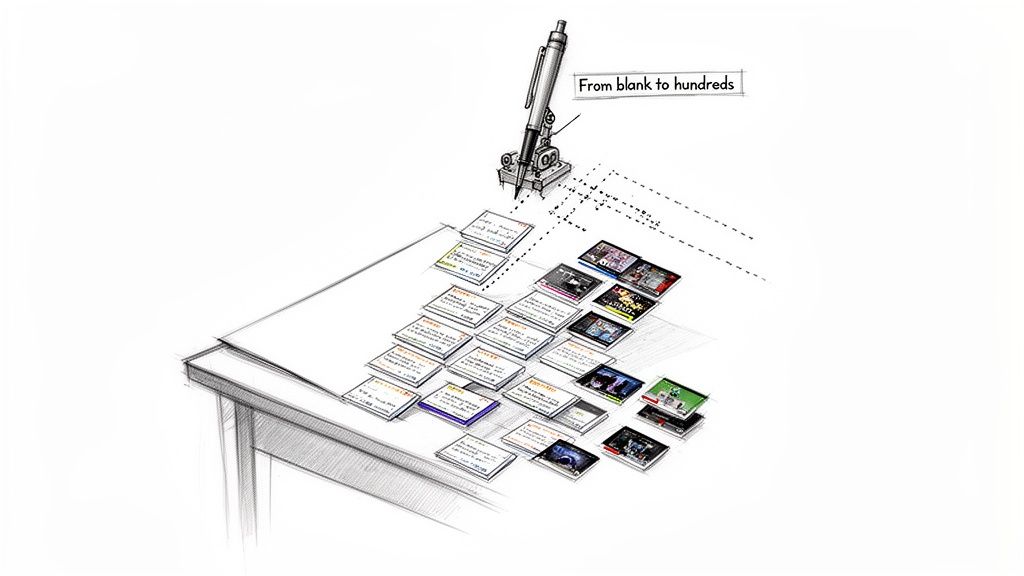
The pressure to feed the algorithm is real. It leads to creative fatigue and, frankly, mediocre ads that just don't perform. For years, we’ve been stuck brainstorming, writing, and revising scripts one by one. It’s a process that simply can’t keep up.
But what if you could change that? Forget painstakingly crafting one script at a time. I’m talking about generating dozens, or even hundreds, of variations in minutes. This isn't just about speed; it's about scaling your creative output in a way that was impossible before. For anyone looking to make this leap, a modern guide to AI affiliate writing offers some great strategies on how to use AI to create and scale content that works.
This approach transforms scriptwriting from a major bottleneck into your core strategic advantage.
Here's a quick look at how the daily grind changes when you switch from traditional methods to an AI-powered approach for video ad scripts.
Manual vs AI Script Writing Workflows
Task | Manual Process (Hours) | AI-Powered Process (Minutes) |
|---|---|---|
Brainstorming & Research | 2-4 hours | 15-20 minutes |
Initial Script Drafts (5 variations) | 3-5 hours | 5-10 minutes |
Revisions & Polishing | 1-2 hours | 10-15 minutes |
Formatting for Production | 1 hour | 5 minutes |
Total Time | 7-12 hours | 35-50 minutes |
The difference is stark. You're not just saving a day's work; you're gaining the ability to test and iterate at a pace that your competition simply can't match manually.
A Smarter Creative Workflow
Top creative strategists I know are already using an AI script writer for more than just speed. They’re using it for smarter, data-informed iteration. The numbers back this up, too. The AI writing market is on track to explode from $2.74 billion in 2026 to $18.27 billion by 2035. Why? Because it works. AI has been shown to cut writing time by an incredible 40%.
In this guide, I’ll walk you through the practical steps to finally get ahead of creative fatigue and start finding your winning ads faster. We’re going to cover exactly how to:
Build a "brand brain" so your AI always sounds like you.
Write prompts that spit out high-converting ad scripts.
Turn those scripts into full-blown campaigns with bulk rendering.
Set up a feedback loop to make your AI smarter over time.
By the end of this, you’ll have a solid framework for plugging an AI script writer into your daily routine. You'll spend less time on the grunt work of writing and more time on the high-level strategy that actually drives results.
Build the 'Brand Brain' Your AI Needs for Success
An AI can't read your mind. This is probably the biggest lesson I've learned working with AI script writers.
Before you let an ai script writer generate a single word, you have to give it the right ammunition. I see so many marketers treat AI like a magic box, feeding it a generic prompt and expecting brilliant, on-brand ideas to pop out. The results are always the same: robotic, bland scripts that feel completely disconnected from their audience.
The solution is to build what I call a "brand brain." In Sovran, this is your Context Vault, and it’s the absolute foundation for every single script the AI will produce. It’s a dedicated space where you teach the AI how to think, talk, and sell like you.
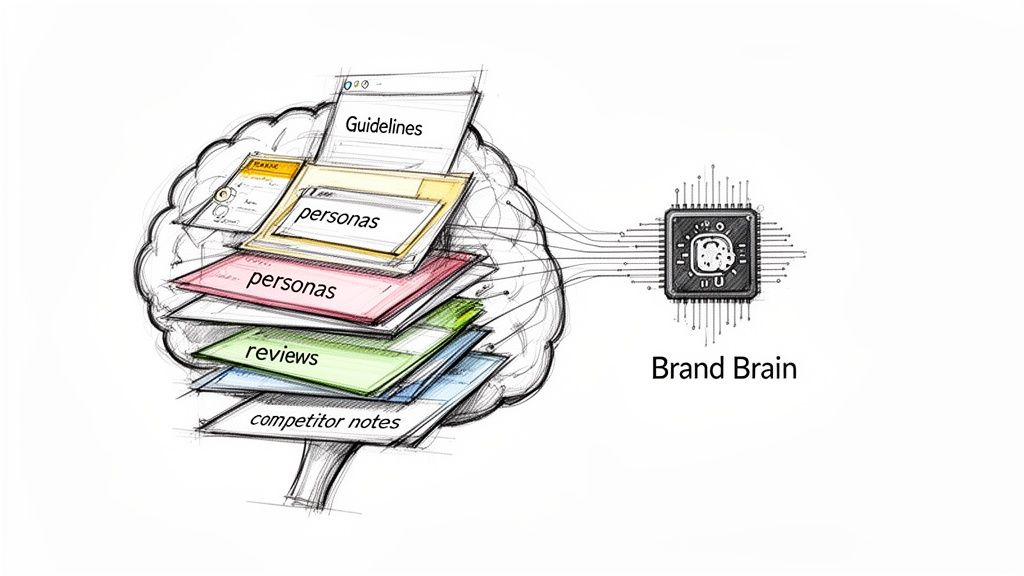
Think of it this way: you'd never hire a new copywriter and give them zero information about your company. You'd load them up with brand guides, customer research, and your best-performing ads. The same principle applies here, but with way more leverage.
What Goes into Your Brand Brain
The quality of your AI's output is a direct reflection of the quality of your input. Your goal here is to create a rich, detailed repository of information that guides every single creative decision. This isn't a set-it-and-forget-it task; it's an ongoing process of refinement.
Start by uploading these essential documents:
Brand Voice & Tone Guidelines: Go way beyond just "friendly and professional." Is your brand witty? Sarcastic? Empathetic? Authoritative? You need to include a "Do's and Don'ts" list with specific word choices.
Audience Personas: Who are you actually talking to? Upload detailed descriptions of your target customers—their goals, what frustrates them, and where they hang out online.
Raw Customer Feedback: This stuff is gold. Seriously. Copy and paste direct quotes from reviews, support tickets, and survey responses. The AI can pull authentic language from these to create incredibly believable UGC-style scripts.
Top-Performing Ad Scripts: Don't forget to upload the text from your past winners. This is how you teach the AI what has already proven to convert, helping it spot the successful patterns in your hooks and calls-to-action.
Building this brand brain is the single most important step. It's what separates generic, soulless AI content from strategic, conversion-focused creative that actually feels authentic and connects with your audience.
Integrating Context into Your Workflow
Okay, so your Context Vault is loaded up. Now what? This is where the magic happens. You can start referencing all that information directly in your prompts. Instead of a vague request, you can give specific, context-aware commands that produce exponentially better results.
If you really want to get good at this, I'd recommend learning more about how a Context Vault acts as your AI's long-term memory. It provides some great insights.
Let’s walk through a real-world example. Imagine you’re selling a productivity app.
A weak, generic prompt might be: “Write a short video ad script about our app.”
A powerful, context-driven prompt would look more like this: “Using the pain points from the ‘Busy Professionals’ persona, write a 30-second TikTok script following the PAS framework. Reference the customer reviews tagged ‘time-saving’ for the solution part.”
See the difference? The second prompt is infinitely more effective. It tells the ai script writer exactly which assets to pull from its "brain," ensuring the final output is not only on-brand but also strategically aligned with what actually resonates with your customers.
This foundational work pays dividends in every single script you generate from here on out.
Craft Prompts That Generate Winning Ad Scripts
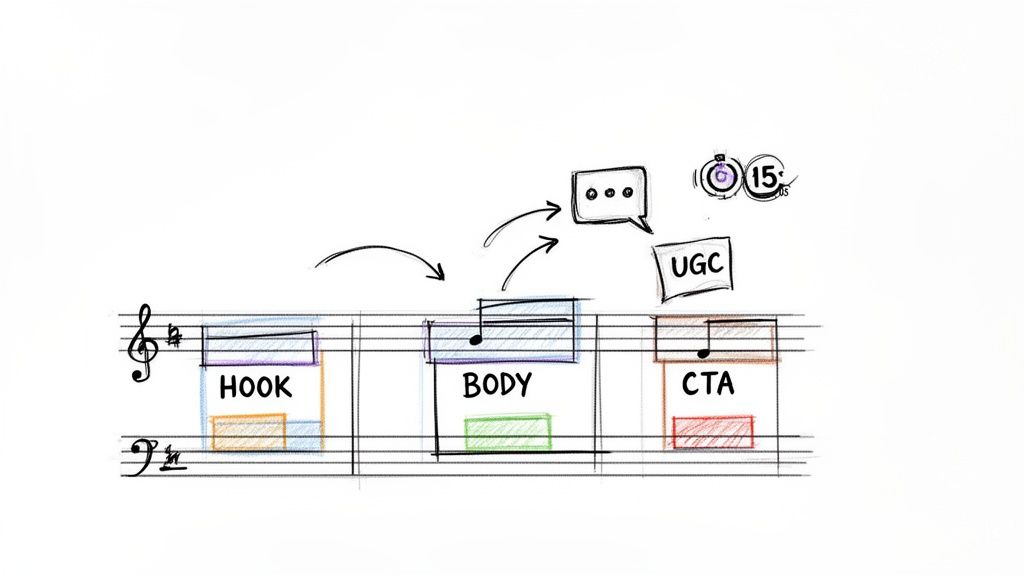
Think of a powerful AI script writer as a finely tuned instrument; your prompts are the sheet music. Now that you've loaded up the "brand brain" inside your Context Vault, it's time to put it to work. The real secret to getting high-performing ad creative out of an AI isn't just asking it to write—it's learning how to direct it with precision.
This is where you shift from being a writer to a creative director. Your job is to feed the AI specific, context-rich commands that steer it toward a script that’s already strategically sound. Vague prompts will get you vague, useless scripts. But sharp, detailed prompts? They produce drafts that are already 80% of the way to being launch-ready.
The market for this kind of tech is exploding. The screen and script writing software market is projected to hit $412.84 million by 2030, largely thanks to AI integration. For performance marketers, this is huge. AI assistants can now automate 30-40% of those repetitive creative tasks, freeing you up to focus on high-level strategy and conversions.
Master Modular Script Frameworks
The best ads you see on TikTok and Meta aren't random; they follow proven formulas. So, instead of asking your AI for a generic "ad script," you need to command it to use specific, modular frameworks. This instantly gives your script a strong, conversion-focused backbone.
For a deeper look, you can find some powerful ad script examples that break down how these frameworks are used in real-world campaigns.
Here’s a quick overview of the most essential frameworks to have in your prompting toolkit. They give the AI a clear structure to follow, which is exactly what you need for direct-response ads.
Modular Script Frameworks for AI Prompts
Framework | Core Components | Best For |
|---|---|---|
Hook-Body-CTA | 1. Hook: Grab attention in the first 3 seconds. | The all-purpose, classic ad structure. Great for nearly any product or platform, especially for quick, punchy messages. |
Problem-Agitate-Solution (PAS) | 1. Problem: State a clear customer pain point. | Direct-response ads where you're solving a very specific, tangible problem. Incredibly effective for driving immediate action. |
UGC Testimonial Mashup | 1. Authentic Voice: Mimic a real customer's tone. | Building trust and authenticity. Perfect for when you want the ad to feel less like an ad and more like a genuine recommendation. |
Listicle | 1. Numbered Hook: "3 Reasons Why..." or "Top 5 Mistakes...". | Grabbing scrollers who love easily digestible, informative content. Works wonders for educational or "secret-revealing" angles. |
Mastering these frameworks is like having a set of reliable blueprints. You're not reinventing the wheel every time; you're just giving the AI a proven structure to build upon with your brand's unique details.
Pro Tip: Always specify the desired length and platform. A prompt for a 15-second TikTok ad is completely different from one for a 60-second YouTube spot. Be explicit about your constraints to get a usable output.
Copy-and-Paste Prompt Templates
Let’s make this super practical. Here are a few prompt templates you can copy, tweak, and use today with your ai script writer. Notice how each one calls on assets from the Context Vault, names a specific framework, and sets clear boundaries.
UGC-Style Testimonial Prompt:"Scan the 5-star customer reviews tagged 'shoe comfort' and 'running' in the Context Vault. Write a 15-second TikTok script from the perspective of a marathon runner who finally found shoes that don't cause blisters. Make it sound authentic and casual, like they're texting a friend."
PAS Framework Prompt:"Write a 30-second Meta ad script using the PAS framework for our new productivity app. Use the pain points from our 'Busy Professionals' persona for the Problem and Agitate sections. For the Solution, highlight the 'time-saving' and 'focus' features mentioned in our brand guide."
Listicle-Style Hook Test Prompt:"Generate 5 different hooks for a 'Top 3 Mistakes' listicle video ad about skincare. The target audience is 'Gen Z, acne-prone skin.' The tone should be slightly edgy and attention-grabbing. Each hook needs to be under 5 seconds."
By using prompts like these, you’re not just asking the AI to write something. You're directing it to create strategically sound, on-brand advertising that is built to perform right out of the gate.
Turn Your Scripts Into Campaigns at Scale
A killer script from an ai script writer is a fantastic start, but it's just text on a page. Honestly, that's the easy part. The real grind is turning that text into a high-volume, test-ready campaign without getting buried in manual editing. This is exactly where a platform like Sovran goes from just a writing tool to a full-on production engine.
Think about it. The process of finding the right video clips, trimming them, adding captions, and slapping on text overlays for just one video is tedious. Now, try doing that for dozens of variations. It's a surefire way to burn out your entire creative team. Automation isn't just a nice-to-have here; it's your most valuable asset.
From Text to Visuals Instantly
A truly seamless workflow connects the script directly to the final video. Imagine your AI script writer spits out a line like, "I was so tired of my phone dying by 3 PM." Instead of you or your editor manually scrubbing through folders of footage, the system can instantly search your media library for clips you've already tagged with "frustration," "low battery," or "phone use."
This is only possible when your media assets live in the same "brand brain" as your scripts. An AI that understands the semantic meaning of a script line can connect it to the visual content in your library, suggesting the perfect clip in seconds.
This completely changes the game. It eliminates countless hours spent just searching and organizing footage. Better yet, it ensures your visuals stay consistent and helps you squeeze more value out of the content you already own.
The Power of Bulk Rendering
Now, let's talk about the real game-changer: bulk rendering. This is how you take one great script and remix it into hundreds of unique ad variants without spending hours in a video editor like CapCut.
It’s pretty simple in practice. You can take:
One winning script
Five different hooks (either text or video clips)
Three different calls-to-action
An integrated AI platform can then automatically combine all these elements, rendering 15 unique video ads for you in the background. It generates the subtitles, applies your text overlays, and formats each video perfectly for platforms like Meta and TikTok. This is where the promise of scaling creative finally becomes a reality.
This move toward autonomous task handling is a huge trend. By the end of 2026, 40% of enterprise applications will feature AI agents that can perform tasks like the script iteration and bulk rendering we're talking about. It's why the Generative AI software market is projected to jump from $63.7 billion in 2025 to a massive $220 billion by 2030, giving marketers the power to scale campaigns faster than ever. You can find out more about these Generative AI trends if you want to dive deeper.
Launching and Testing with Precision
The final piece of the puzzle is getting these ads live. A great workflow doesn't just stop at rendering the videos; it pushes the finished creatives directly to your ad platforms.
A key feature to look for here is automated naming conventions. The system should automatically name each ad based on the variables you used—like the hook, CTA, or audience angle (e.g., UGC_Hook3_Benefit_CTA2_1x1). This gives you perfectly clean A/B testing structures right out of the gate, which makes analyzing performance incredibly straightforward.
When you're ready to go live, you can streamline publishing your campaigns to Meta. This tight integration between script creation, video production, and ad launch is what allows you to test at a speed and scale that’s just not possible with a fragmented, manual process.
Create a Winning Feedback Loop for Your AI
Getting your AI-generated ads live is just the beginning. The real money is made—and where most marketers drop the ball—is in what you learn from them afterward.
A great ai script writer isn’t just a content factory; it’s a learning machine. But it only gets smarter if you feed it the right data. This means building a structured creative feedback loop.
You can't just dump a dozen video variants into a campaign and pray. That’s not testing; it's just burning cash. A real feedback loop is all about precision. You need to structure your campaigns on Meta and TikTok to cleanly test specific variables, isolating one element at a time.
For example, you could run a test where the ad's body and CTA are identical across all videos, but you test five completely different hooks. This isolates the hook's performance, giving you clean, undeniable data on what actually grabs attention.
Isolate and Analyze Key Performance Data
Once your campaign has run its course, it's time to dig into the numbers. Don't just look at what "won." You need to find the why.
Did one style of hook consistently smash your click-through rate (CTR) target? Did a specific phrase in your call-to-action (CTA) drive a higher conversion rate, even if the CTR was lower? These are the golden nuggets that fuel your AI.
You should be hunting for patterns in metrics like:
Hook Rate (3s View Rate): Which opening lines are true scroll-stoppers?
Hold Rate (Avg. Watch Time): What kind of story or pacing keeps people glued to the screen?
Click-Through Rate (CTR): Which hooks and CTAs actually spark enough interest to get a click?
Cost Per Action (CPA): What creative elements are leading to the most efficient conversions?
By zeroing in on these specific metrics, you move beyond guesswork and start making data-backed creative decisions. This is how you stop chasing trends and start setting them.
The core idea is simple but incredibly powerful: Test -> Analyze -> Update AI Context -> Generate Better Variants. This loop is the engine that drives systematic ad improvement, turning your ad account into a creative intelligence machine.
The journey from a script to a batch of ready-to-launch videos, prepped for this loop, looks something like this:
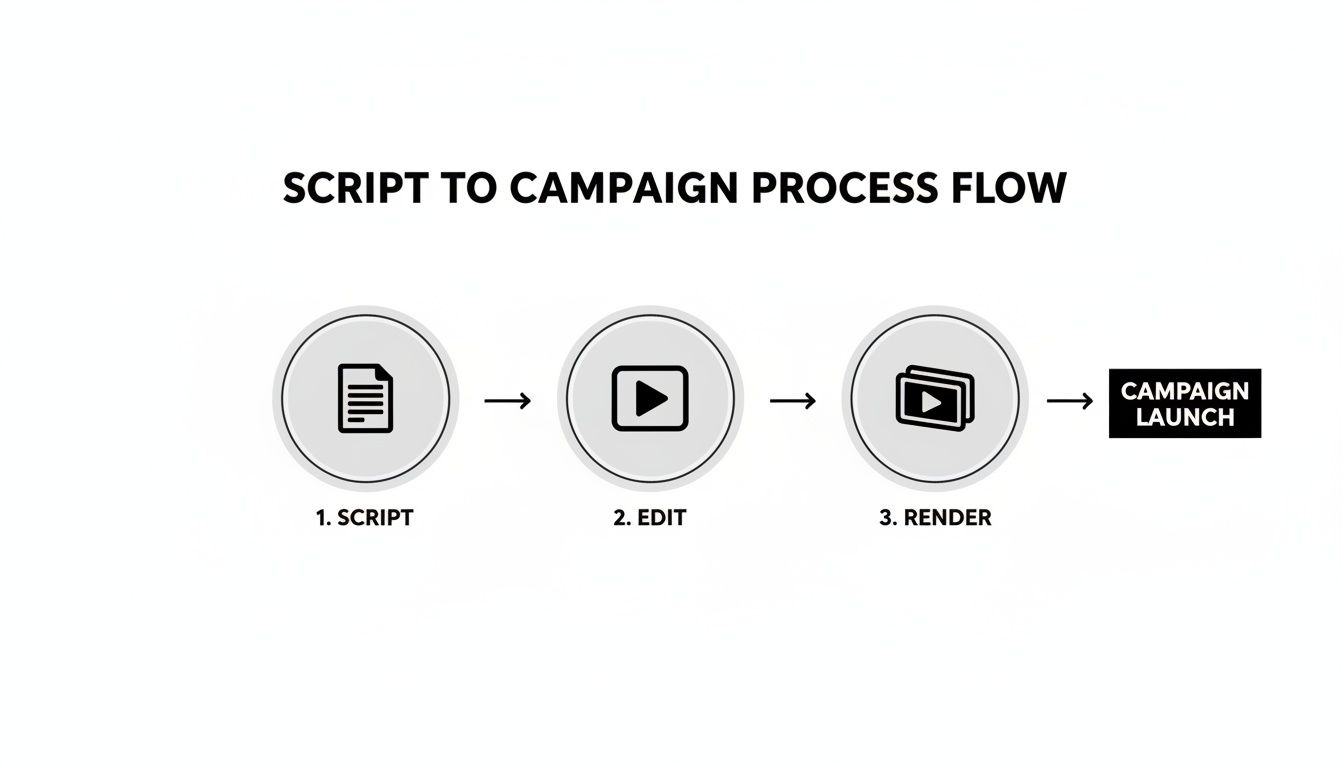
This workflow shows how the initial script moves through production, getting it ready for organized testing and the feedback loop.
Making Your AI Smarter with Every Campaign
Now for the most important part: feeding these learnings back into your AI. Let’s say you discovered that your UGC-style hooks featuring a specific customer pain point had a 50% higher hook rate than your polished, studio-shot hooks.
You don't just make a mental note. You take action.
Hop back into your Sovran Context Vault and update it with this new insight. You could create a new document titled "Winning Hook Formulas" and add a note like: "UGC-style hooks that mention 'XYZ pain point' are top performers for CTR. Prioritize generating more variants like these."
Then, you can tag the scripts of those winning ads with something like "high_ctr_hook" or "top_performer." The next time you prompt the ai script writer, you can reference these tags directly: "Generate 5 new scripts inspired by our 'top_performer' ads, focusing on the UGC framework."
This iterative process ensures your AI collaborator gets progressively better. It stops making random suggestions and starts generating creative that is strategically aligned with what demonstrably works for your audience. This is how you move from guessing to knowing and make your ad performance systematically better over time.
Common Questions About AI Script Writers
When performance marketers first start dipping their toes into AI, it's completely normal to be a little skeptical. Most of the questions that pop up aren't even about the tech itself—they're about how it'll actually affect creative quality, conversions, and even team roles.
Let's get into the honest questions every marketer has when they're thinking about using an ai script writer.
Will an AI Script Writer Make My Ads Sound Robotic?
This is the number one fear, and for good reason. But the short answer is no—not if you use it the right way.
An AI's output is just a reflection of your input. Think of your "brand brain" or Context Vault as your first line of defense against generic, soulless content. When you feed the AI your best-performing organic posts, raw customer reviews, and detailed brand voice guides, you’re not just giving it data; you’re teaching it to sound like you.
The AI becomes a collaborator that gets your specific style, not some robot spitting out cookie-cutter templates. Your job shifts from being a writer to being a creative director. You’re there to refine the AI's drafts, making sure they hit the exact emotional and strategic notes you're aiming for.
How Do I Ensure the AI Writes High-Converting Scripts?
You get high-converting outputs by giving it high-performance inputs. It's as simple as that. To get scripts that actually drive results, you have to feed the AI your performance data.
Don't just give it brand guides. Upload the actual transcripts from your top 10 winning ads and your bottom 10 losing ads.
Tag them clearly. Now, you can give your ai script writer prompts like, "Analyze my winning ad scripts and write 5 new hooks based on their core emotional drivers." This turns the AI from a simple writer into a powerful performance analysis tool that learns directly from what's already working (and what's not).
The real magic of an AI script writer isn't just brainstorming new ideas. It's the ability to analyze, remix, and scale the successful patterns already hiding in your best creative. It finally closes the loop between data and creation.
Will This Tool Replace My Creative Strategist?
Not a chance. It actually makes them way more powerful and a whole lot more efficient. An AI script writer doesn't get rid of the need for high-level strategy; it just automates the most mind-numbing parts of the creative workflow.
The role of a creative strategist just evolves. Instead of spending hours writing every single line from scratch, they now focus on architecting the AI's inputs, curating the best outputs, and spending their time analyzing test results to guide the big-picture creative direction. It frees up your sharpest minds to focus on strategy instead of getting buried in high-volume grunt work.
Does an AI Script Writer Only Write Text?
The best ones do so much more. The AI creative platforms today are integrated ecosystems, not just text generators. If you're looking at different tools, it's worth checking a list of the best AI content generators to see what fits your team's needs.
A solid AI script writer won't just generate text; it'll also suggest visual concepts for each line of the script. For example, you can prompt it to include a shot list or even have it search your media library for clips that match the script's intent. The goal is to bridge that gap between the script and the final video, making the entire production process way faster.
Ready to see how an AI-powered workflow can completely change your ad production? Sovran combines a powerful AI script writer with bulk video rendering and direct-to-platform publishing, helping you find winning ads up to 10x faster. Start scaling with Sovran and experience the difference.

Manson Chen
Founder, Sovran
Related Articles
How to Turn Link Into Video: Ads That Convert in 2026
Learn how to turn link into video for Meta & TikTok ads. Leverage AI to scale creation, boost ROI, and succeed in 2026.
- ai-video-generation
- link-to-video-ads
- 6 more
10 Actionable Ad Creative Ideas That Convert in 2026
Discover 10 actionable ad creative ideas for Meta & TikTok. Get hooks, scripts, and testing frameworks to boost your ROAS and combat creative fatigue.
- ad-creative-ideas
- video-marketing
- 6 more
Your Guide to a Social Media Ad Generator in 2026
Discover how a social media ad generator revolutionizes creative production. Learn to automate video ads, scale testing on Meta & TikTok, and drive performance.
- social-media-ad-generator
- ai-video-creation
- 4 more