Unlocking Growth with AI Ad Creation Software
Discover how AI ad creation software transforms campaign performance. Learn proven workflows and key features to scale creative output and boost your ROI.
Jump to a section
AI ad creation software is your secret weapon for making ad variations automatically, which is exactly what you need to fight off audience fatigue. Instead of spending hours on manual edits, this kind of tool uses artificial intelligence to analyze and reassemble video clips, churning out hundreds of new combinations in minutes. This lets you test hooks, messages, and calls-to-action on a scale that just wasn't possible before.
What Is AI Ad Creation Software?
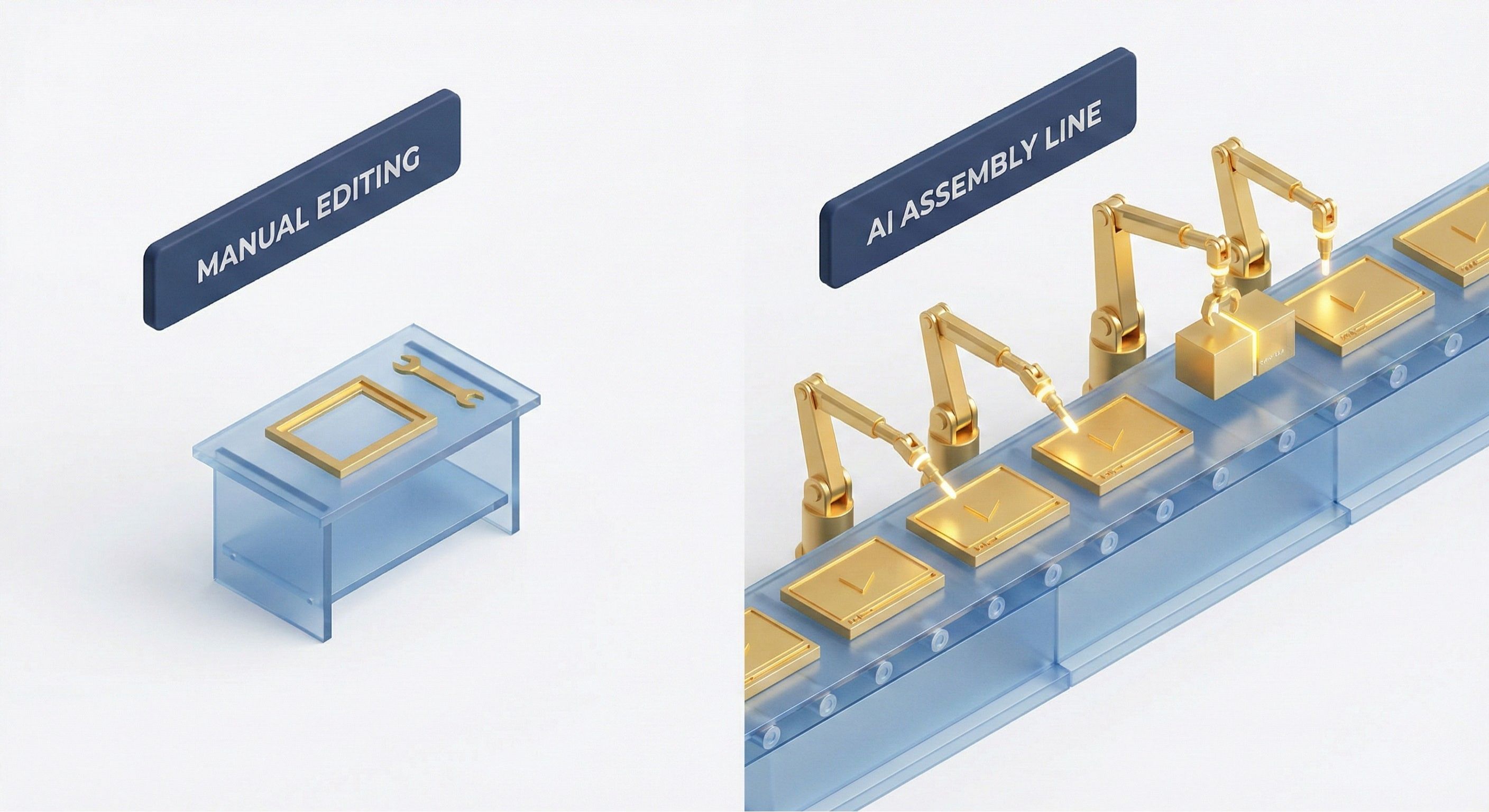
Imagine trying to build a thousand unique cars by hand versus using an automated assembly line. That’s the real difference between old-school ad creation and using AI. This software was built to solve a huge headache for modern marketers: the constant demand for fresh, high-performing ad creative on platforms like Meta and TikTok.
Instead of a designer slowly editing one video at a time in CapCut, AI ad creation software automates the whole production line. You feed it your existing video clips, it uses AI to analyze and tag them, and then it reassembles everything into hundreds of new ad combinations almost instantly.
This approach, known as modular creative, turns your raw footage into a powerful library of reusable assets. For a deeper dive, check out this ultimate guide to AI video editing and repurposing, which breaks down a lot of the core ideas.
Why This Is a Game-Changer for Performance Marketers
The whole point is to stop guessing and start building a data-driven engine for creative growth. Performance marketers and user acquisition (UA) managers can finally test variables at a scale that used to be a fantasy.
This isn’t just a small shift; it’s part of a massive trend. Generative AI has become a powerhouse, responsible for a staggering 46% of all enterprise value creation in 2023. By 2030, it's expected to add US$434 billion to the economy every year. This dominance in marketing shows how tools like Sovran are completely changing how ads get made.
The real power of AI ad creation software is how it turns your creative process from a bottleneck into a competitive advantage. It gives small teams the output of a massive studio, shrinking learning cycles from weeks down to just a few days.
Core Functions and Benefits
So, what does this software actually do? While the features can vary, most platforms are built around a few key things that directly solve the biggest pain points in running modern ad campaigns. It's all about speed, scale, and intelligence.
To see how much this changes things, let's compare the old way with the new way.
Traditional vs AI-Powered Ad Creation Workflow
Stage | Traditional Workflow (Manual) | AI-Powered Workflow (e.g., Sovran) |
|---|---|---|
Briefing | Creative strategist writes a detailed brief for a few specific ad concepts. | Strategist defines target audience, key messages, and uploads raw assets. |
Production | Video editor manually cuts, edits, and adds text for each individual ad. | AI analyzes assets and automatically generates hundreds of ad variations. |
Review | Team reviews a handful of ads, provides feedback, and waits for revisions. | Team reviews a wide range of AI-generated options and selects the best for testing. |
Launch | Manually upload a small batch of ads to the ad platform. | Bulk-launch dozens or hundreds of variations for A/B testing in one click. |
Learning | Wait weeks for enough data to see which of the few concepts worked. | Get clear data on winning elements (hooks, CTAs) within days. |
The difference is night and day. What used to take weeks of back-and-forth now happens in a fraction of the time.
Here are the key benefits you get from making that switch:
Accelerated Testing: Launch dozens of A/B tests on hooks, value props, and CTAs all at once to find what actually works, fast.
Combating Creative Fatigue: Keep feeding the ad platforms fresh variations so your audience stays engaged and performance doesn't tank.
Increased Efficiency: Slash the hours your team spends on boring, repetitive editing tasks. This frees up your creative strategists to think about big-picture concepts and analyze results.
Data-Informed Creativity: Use real performance data to see which creative elements are driving results, leading to smarter, more targeted ads in the future.
Ultimately, this technology isn't here to replace human creativity—it's here to supercharge it. It takes care of the grunt work, so marketers can be more strategic, more analytical, and way more effective.
How AI Turns Raw Footage into Winning Ads
Let’s pull back the curtain on how AI ad creation software really works. It’s less about some black-box magic and more about a seriously smart system for organizing and automating your creative process. The biggest shift? It completely changes how you view your raw video files—turning that chaotic folder of clips into an intelligent, searchable library just waiting to be turned into ads.
It all starts with a crucial first step called AI Asset Tagging. Imagine dumping a massive box of LEGO bricks on the floor. If you needed a specific red 2x4 piece, you'd be in for a long search. AI tagging is like having a robot instantly sort every single brick by color, size, and shape, putting them all into perfectly labeled bins for you.
When you upload your video clips, the AI gets to work analyzing every single frame. It identifies and slaps descriptive tags on everything it sees:
Actions: "A person typing on a laptop," "someone unboxing a product."
Objects: "iPhone," "coffee mug," "blue sneakers."
Emotions: "A user smiling," "a frustrated customer."
Settings: "Office environment," "city street," "home kitchen."
Suddenly, that messy pile of assets becomes a highly structured, incredibly valuable database.
Building Ads with Modular Content Assembly
Once your assets are all tagged and sorted, the system moves on to the fun part: Modular Content Assembly. This is where the real power of automation kicks in. Think of each tagged video clip as one of those pre-sorted LEGO bricks. Now, instead of building from scratch every time, you can just grab a blueprint and assemble exactly what you need, when you need it.
You can set up common advertising frameworks that you know work, like:
Hook: A killer, attention-grabbing first 3 seconds.
Body: The main message or product demo.
Call-to-Action (CTA): The final nudge to get the viewer to act.
The AI treats each of these sections as a slot to be filled. You provide the blueprint, and the software pulls the right "bricks" from your tagged library to construct complete ads in seconds.
This modular approach means a single raw clip isn't just one piece of content. It's dozens of potential hooks, body segments, and visual elements that can be remixed endlessly, squeezing every drop of value out of every second you've filmed.
For example, a user acquisition manager for a mobile app could just type in a search for "a user smiling at their phone." The AI instantly finds every relevant clip, ready to be dropped into the "Body" or "Hook" part of an ad. You can learn more about how this works in our guide to automatic video editing.
The Impact on Creative Velocity and Strategy
This systematic approach—turning raw footage into structured, ad-ready components—has a massive impact on workflow. It's a key reason why the market for AI content creation tools is blowing up, projected to grow from $0.91 billion in 2024 to $1.07 billion in 2025. This is all part of a larger AI marketing trend expected to hit a staggering $217.33 billion by 2034. This growth is fueled by the very needs of growth marketers and indie developers who have to produce a high volume of video ads without hiring huge creative teams. For more on this, check out the great insights about the state of consumer AI on menlovc.com.
This process fundamentally changes your creative workflow. Instead of getting bogged down in the manual labor of finding clips and stitching sequences together, your team can finally focus on high-level strategy. They can spend their time analyzing which types of hooks perform best or which emotional cues drive more conversions, because the AI is handling all the heavy lifting of assembly. This shift turns creative production from a time-sucking chore into a rapid, data-driven process.
A Proven Workflow for Meta and TikTok Ad Production
Knowing the theory behind AI ad creation software is one thing, but actually putting it to work is where you’ll see real growth. Let's walk through a proven, step-by-step workflow that top performance media buyers are using right now. This is how they turn piles of raw footage into winning campaigns on Meta and TikTok, transforming their entire creative process from a bottleneck into a high-speed engine.
This isn't just about making ads faster. It’s about building a smarter, more agile testing system that dramatically shortens your learning cycles. Forget waiting weeks for results—you can get clear signals on winning creative in just a few days.
Step 1: Ingest and Organize Your Best Assets
The journey starts by feeding the machine. Your first move is to upload your highest-performing video clips, user-generated content (UGC), and any existing ad creative you have into the software's asset library. Think of it as stocking your kitchen with the best ingredients before you start cooking.
This initial upload is a game-changer. The AI will analyze and tag everything, creating a structured, searchable foundation for every ad you make from now on. Platforms like Sovran make this totally seamless, letting you centralize your best assets in one spot instead of having them scattered across random folders and hard drives.
Step 2: Train the AI with a Context Vault
Once your assets are in, the next crucial step is to give the AI its brain. You do this by filling out what's often called a "Context Vault" or brand library. This is where you feed it all the strategic bits and pieces that define your brand and messaging.
You'll want to include things like:
Brand Guidelines: Logos, color palettes, fonts, and tone-of-voice rules.
Winning Ad Copy: Your best-performing headlines, body copy, and value props.
Customer Testimonials: Those powerful quotes and reviews that build social proof.
Product Information: Key features, benefits, and unique selling points.
By giving it this context, you're essentially training the AI to think like your brand's best marketer. It ensures that every ad concept the system spits out is not just creative but also on-brand, consistent, and built to convert. This is what turns the AI from a simple video editor into a strategic partner.
This visual shows how the core steps—uploading, tagging, and assembling—form the backbone of an efficient AI-powered ad creation process.
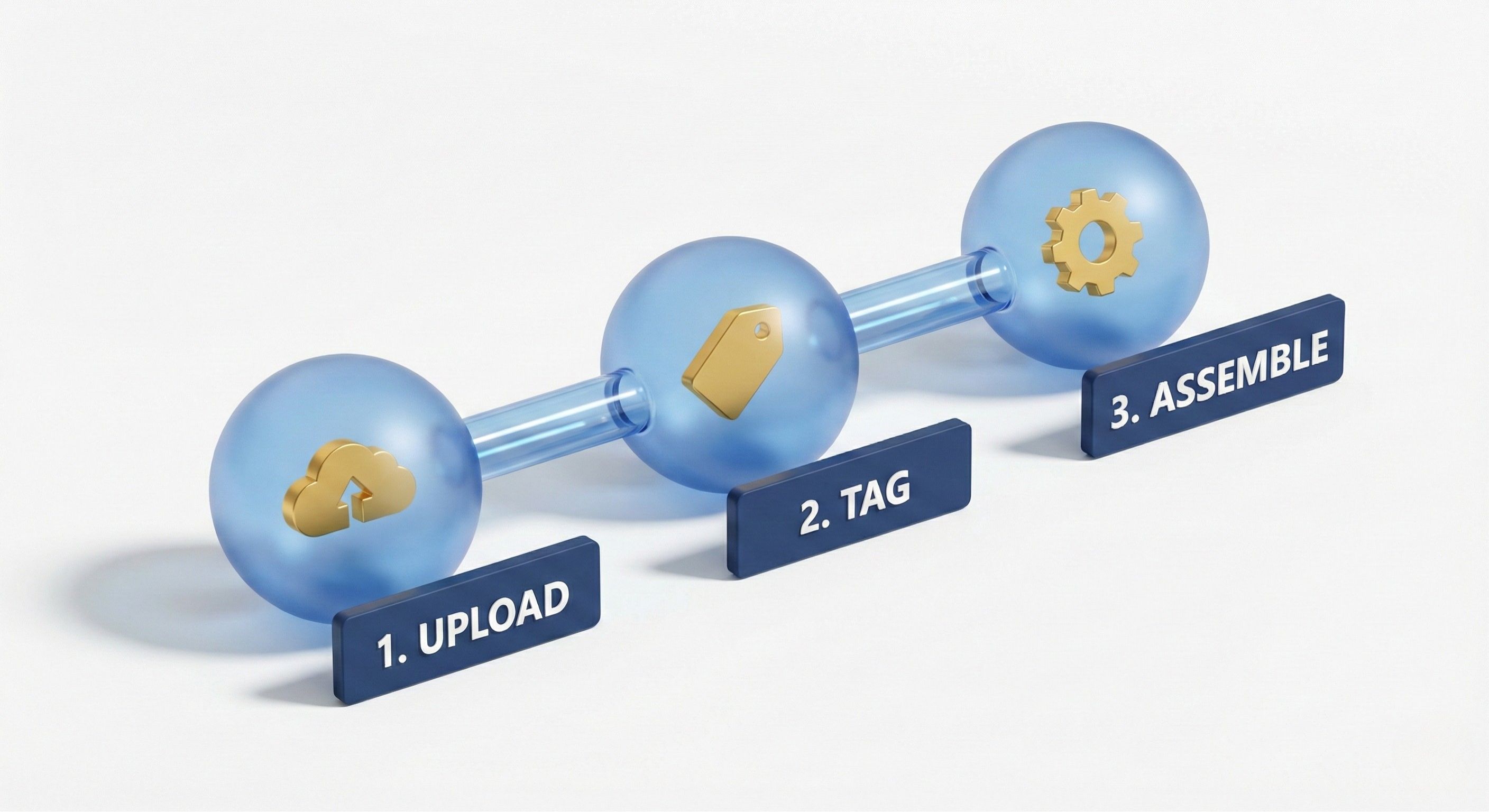
This simple, three-stage flow is all about getting the most value out of your existing assets by turning them into modular, reusable components for rapid-fire testing.
Step 3: Generate Ad Variations at Scale
Now for the part that feels like magic. With your assets tagged and your brand context loaded, you can start generating hundreds of ad variations in minutes. This is the heart of the workflow, where you use bulk rendering features to remix your creative components into countless new combinations.
For example, you could take:
5 different hooks (the first 3 seconds of your video)
4 different body sections (product demos or testimonials)
5 different calls-to-action (CTAs)
The AI can automatically stitch these together to produce 100 unique video ads (5x4x5), each with a slightly different structure or message. This is something that would take a human editor days, if not weeks, to do manually. If you want to dive deeper into this process, check out our guide on creating a powerful AI video ad.
Step 4: Launch and Test with Automated Naming
The final step is to close the loop by pushing your newly minted ad variants directly to the ad platforms. Modern AI ad creation software integrates directly with Meta Ads Manager and TikTok Ads Manager, which means you can launch entire campaigns with just one click.
A key feature here is automated naming conventions. The software automatically names each ad creative based on the specific parts it contains (e.g., "HookA_BodyC_CTA_B").
This might sound like a small detail, but it's a massive time-saver for A/B testing. It gets rid of the tedious manual work of naming and organizing dozens of ads, making it incredibly easy to look at your performance data and pinpoint which hooks, messages, or CTAs are actually driving results.
This whole streamlined workflow shrinks your learning cycle down to almost nothing. You can go from raw footage to actionable performance data in a fraction of the time, letting you double down on what works and scale your winning campaigns faster than ever.
How to Choose the Right AI Ad Software
Sifting through the crowded market of AI ad creation software can feel like a chore. Dozens of platforms pop up, all promising the moon. For user acquisition managers and agencies, the real challenge is cutting through that noise to find a tool that actually works for you.
You're not just looking for a tool that automates production. You need something that plugs into your entire creative testing and optimization loop, making it faster and smarter.
Think of it like building a professional kitchen. You don't just grab the fanciest oven off the shelf. You need a complete system—stovetop, fridge, prep stations—where every piece works together seamlessly to get high-quality dishes out the door, fast. The right software should be the central hub for your whole ad creation workflow.
Let's break down a few key areas to focus on so you can find the software that truly fits your team.
Evaluate Scalability and Production Speed
The first thing to look at is raw output. Can this tool actually keep up? The whole point of bringing in AI is to break free from the slow, manual editing process, so any software you consider has to deliver on the promise of speed and scale.
Don't be shy about asking vendors direct questions. How many unique ad variations can the platform crank out in an hour? A tool that gives you 50 new ads is nice, but one that can generate 500 in that same time? That's a total game-changer for anyone doing high-velocity testing.
This metric is often called Creative Velocity, and it's the bedrock of a solid, data-driven creative strategy. When you have high velocity, you can test more ideas at once. That means finding your next winning ad concept can take just a few days instead of weeks.
Prioritize Seamless Platform Integration
An AI tool that operates in its own little bubble is more trouble than it's worth. The best software connects directly with the platforms where you're actually spending money, like Meta Ads Manager and TikTok Ads Manager. You need a frictionless path from creation to launch.
And this integration needs to be more than just a simple "export" button. Look for these key features:
Direct Campaign Push: The ability to launch new ad sets and campaigns right from the software itself.
Automated Naming Conventions: A system that automatically labels each creative based on its components (e.g., "Hook_A-Body_C-CTA_B"). This makes analyzing A/B test results so much easier.
Asset Library Syncing: This makes sure all your creative assets are consistent across every platform without you having to manually upload a thing.
Without this level of deep integration, your team will just end up wasting time downloading videos and setting up campaigns by hand, which defeats the whole purpose of automation.
To help you vet potential software, here's a quick checklist of the must-have features for any serious performance marketing team.
Key Feature Checklist for AI Ad Creation Software
Use this table when you're talking to vendors to make sure their platform has the core capabilities you need to not just create ads, but to create them smarter and faster.
Feature Category | Essential Capability | Questions to Ask Vendors |
|---|---|---|
Production & Scale | Generate hundreds of ad variations from a single concept. | How many unique video variations can we produce per hour? |
Platform Integration | One-click push to Meta and TikTok Ads Manager. | Can we launch campaigns directly from your platform? |
Brand Governance | Central library for logos, colors, fonts, and messaging. | How do you ensure the AI's output stays on-brand? |
Asset Management | AI-powered search for video clips and assets. | Can we search our asset library using natural language? |
Performance Analytics | Pulls creative-level data (CPA, ROAS, Hook Rate) back into the platform. | Does your tool sync with ad platform performance data? |
Team Collaboration | Features for feedback, approvals, and shared asset libraries. | How does your software support collaboration across our team? |
This checklist isn't exhaustive, but it covers the non-negotiables. A tool that checks these boxes is more likely to become a core part of your workflow, not just another subscription you forget about.
Ensure Brand Consistency and Control
Letting an AI take the wheel on creative can feel a bit scary. That's why strong brand governance features are an absolute must. You need to be sure that whatever the AI spits out will consistently align with your brand's voice, messaging, and visual style.
Look for a platform that offers a central "Context Vault" or brand library. This is where you can upload and store all your core brand elements for the AI to learn from.
A Context Vault is basically the AI's "brand bible." You feed it your official logos, color palettes, approved ad copy, and even customer testimonials. This trains the AI to generate concepts that are not only creative but also perfectly on-brand and ready to convert.
This control is what separates a reliable creative partner from a generic content generator. As you evaluate different AI ad creation software, you might also want to discover the best AI tools for content creation to see how various platforms handle this challenge.
Finally, check out the tool's asset management and analytics support. A great platform should let you use natural language to search your video clips, making it a breeze to find that one specific shot you need. For a deeper dive into the different types of platforms out there, check out our guide on the top AI video creation tools.
Remember, the right software doesn't just make ads; it makes your entire team more efficient and data-driven.
Measuring the ROI of Your Ad Creation Tool
Let's be real—adopting any new software, especially an AI ad creation software, means you have to prove its worth. To get buy-in from your team or stakeholders, you need a solid business case that goes way beyond vanity metrics. It’s all about connecting the dots between faster workflows and actual, bottom-line growth.
Think of it like upgrading a restaurant's kitchen. You wouldn't just brag about how many dishes the new oven can cook. You'd track how much faster orders get to tables, how much food waste you've cut, and most importantly, how much more profit the restaurant is pocketing each night. We're applying that same exact logic here.
Key Metrics for Operational Lift
Before you can even talk about financial impact, you have to measure how the tool is making your team's life easier. The first step is to benchmark your performance before you start using the software. This gives you a clear "before-and-after" snapshot.
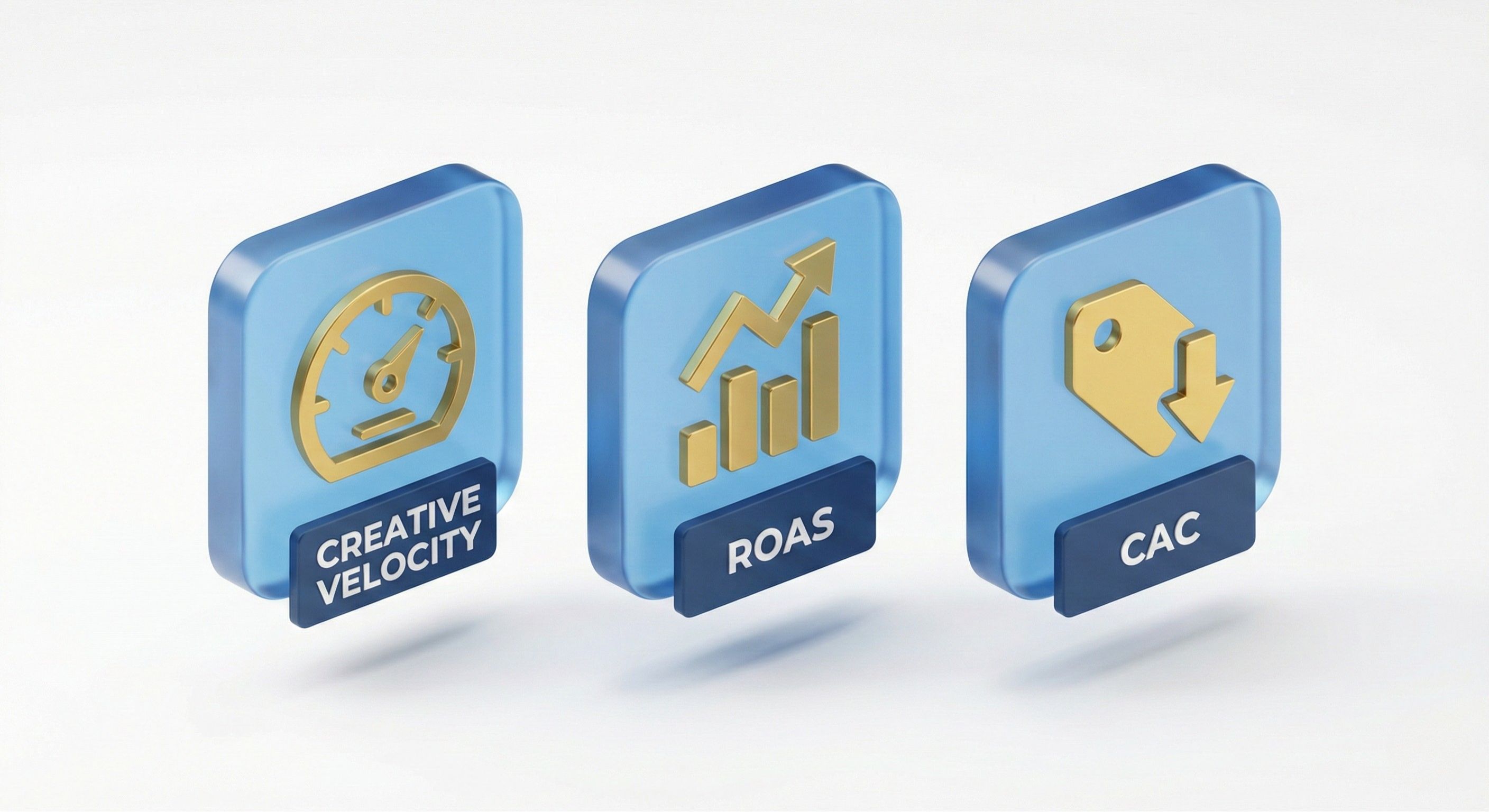
Here are the three operational metrics that matter most:
Creative Velocity: How many unique, launch-ready ad creatives is your team producing per week? A jump in this number is your first big win.
Testing Throughput: This is all about how many new concepts or A/B tests you can push live in a set period. More throughput means you're learning faster and finding winning ads sooner.
Time-to-Live: Track the average time it takes for a new ad idea to go from a concept on a whiteboard to a live campaign in Ads Manager. The right AI tool should slash this cycle time.
When you can quantify the hours your team gets back from tedious manual editing, you can show exactly where that time went. For instance, you could demonstrate that a 15% reduction in manual work directly led to a 20% increase in time spent on strategic analysis. That's a powerful story.
Translating Efficiency into Financial Gains
Operational wins are great, but the real magic happens when they translate into better campaign performance. This is where you connect producing more ads to actually making more money. The end goal is to prove your new workflow is directly improving core business metrics.
The real proof of ROI isn't just making ads faster. It's using that speed to find the winning ads that crush your acquisition costs and let you scale your budget profitably. Faster testing leads directly to smarter spending.
Here are the two financial KPIs to laser-focus on:
Return on Ad Spend (ROAS): When you can test more creative variations, you find and scale the ads that deliver the best returns much more quickly. This has a direct, positive impact on your overall ROAS.
Customer Acquisition Cost (CAC): Finding more efficient ads is the fastest way to a lower CAC. By constantly refreshing your creative and keeping ad fatigue at bay, you can keep your acquisition costs low, even as you ramp up your campaigns.
This isn't just a theory; it's backed by what's happening across the industry. Marketing teams are jumping on AI, with 51% using it to optimize existing content and 50% generating new creative from scratch. This shift pays off—AI-powered campaigns can significantly cut CAC and boost ROI. Some brands have even seen lead generation conversions leap by 25%. You can check out the full research on AI marketing statistics and their impact on SurveyMonkey.com.
By tracking both your operational and financial metrics, you build a powerful narrative. You can walk into any meeting and show stakeholders that the investment in an AI ad creation software didn't just save time—it unlocked a more efficient, data-driven engine for profitable growth.
The Future of Ad Creative Is Here
Let's cut to the chase: AI ad creation software isn't some far-off idea anymore. For performance marketers, it's a competitive must-have, right now. This shift isn't about replacing human strategists. It's about finally giving them tools that can keep up with the breakneck speed and scale of modern ad platforms.
By automating the soul-crushing, repetitive tasks of video production, these tools let your team get back to what they do best. Instead of getting buried in manual edits, they can pour their energy into analyzing performance data, digging up audience insights, and crafting the next winning campaign strategy.
The New Competitive Edge
The real benefits are what separate the leaders from the laggards in today's ad game. The ability to speed up creative testing, fight off audience fatigue with fresh content, and rapidly scale your winning ads—these are the keys to unlocking real, sustainable growth.
And these aren't just fuzzy, theoretical advantages. They translate directly into a smarter, more profitable marketing operation:
Accelerated Learning: Forget waiting weeks for A/B test results. You can get actionable data in days, letting you pivot faster and put your budget where it actually works.
Overcoming Fatigue: You can continuously feed platforms like Meta and TikTok with fresh ad variations, keeping your campaigns effective and your audience from tuning you out.
Strategic Focus: Your creative team stops being a production line and starts being a strategy hub. Their expertise is now used to guide the AI, not just execute tedious tasks.
The question is no longer if you should adopt AI for ad creation, but how fast you can get it into your workflow. The tools to build a data-driven creative engine are here.
Think about it like this: you can have a pit crew with hand tools, or you can have one with pneumatic wrenches. Both are changing tires, but one is operating on a completely different level of speed and efficiency. That's the edge AI ad creation software gives you.
The only question left is whether you'll lead the charge or get left in the dust trying to catch up. The tools are ready and waiting to build a more intelligent, data-driven creative process for your brand.
Frequently Asked Questions
Jumping into AI ad creation software can bring up a lot of questions. As performance marketers, we're always looking at new tech, but it's totally normal to wonder how these tools actually fit into our workflows and teams. Here are some straightforward answers to the questions we hear most often.
My goal here is to give you the clarity you need to decide if integrating AI into your creative process is the right move for you.
Will AI Replace My Creative Team?
Not a chance. Think of this software as a powerful creative assistant, not a replacement for your team's talent. It’s built to take over the most repetitive, mind-numbing tasks—like resizing videos, adding subtitles, or creating a dozen tiny variations of a winning ad.
By automating that grunt work, your human experts are freed up to focus on what really moves the needle. Instead of getting bogged down in an editor for hours, they can sink their teeth into high-level strategy, brilliant concept development, and deep performance analysis. The tool amplifies their skills; it doesn't make them obsolete.
How Much Video Content Do I Need to Start?
You can get going with just a handful of your best-performing video clips. Seriously. This software is designed to squeeze every last drop of value out of what you already have. It does this by breaking your existing videos down into reusable parts—hooks, body segments, and calls-to-action (CTAs).
The AI then gets to work, remixing these components into dozens of fresh ad variations. It breathes new life into your existing assets. While your library will obviously get more powerful as you add more footage, you don’t need a massive archive to see an immediate lift in your creative output.
The whole idea is asset efficiency. A single 30-second video might have three potential hooks and two different value props buried inside. AI unlocks all those combinations, turning one asset into six or more testable ads in an instant.
Is AI-Generated Ad Creative Actually Effective?
Yes, because the best AI ad creation software isn't about letting a robot blindly cook up ads from scratch. It’s a partnership between human insight and machine efficiency.
You bring the proven ingredients: the messaging frameworks, the brand voice, and the raw footage that you already know clicks with your audience. The AI’s job is to scale the production of variations based on those winning components. This combo lets you test new ideas and find winning combinations at a speed that’s just not possible by hand. That faster learning cycle leads directly to better ROAS and lower acquisition costs.
How Quickly Can I Expect to See Results?
The operational perks are almost immediate. Getting set up is quick—you can connect your ad accounts and upload your first assets in less than an hour. It’s completely realistic to generate and launch your first batch of ad variations on day one.
As for tangible performance results, like finding a new winning ad that crushes your old creative, that can often happen within your first week of testing. Because you can launch so many more experiments, your path to figuring out what really works gets a whole lot shorter.
Ready to stop wasting time on manual editing and start scaling your winning ads? Sovran automates your video ad production for Meta and TikTok, helping you find profitable winners up to 10x faster. Start your 7-day free trial today.

Manson Chen
Founder, Sovran
Related Articles
How to Turn Link Into Video: Ads That Convert in 2026
Learn how to turn link into video for Meta & TikTok ads. Leverage AI to scale creation, boost ROI, and succeed in 2026.
Your Guide to a Social Media Ad Generator in 2026
Discover how a social media ad generator revolutionizes creative production. Learn to automate video ads, scale testing on Meta & TikTok, and drive performance.
10 Actionable Ad Creative Ideas That Convert in 2026
Discover 10 actionable ad creative ideas for Meta & TikTok. Get hooks, scripts, and testing frameworks to boost your ROAS and combat creative fatigue.