How to Write a Script for Radio Commercial That Sells
Learn to write a script for radio commercial that gets results. Our guide offers practical tips, structures, and audio-first techniques for high-converting ads.
Jump to a section
A well-written script for a radio commercial isn't just a list of words. It's the entire game plan. It’s the blueprint for an audio experience that has to grab attention, forge a real connection, and drive someone to act—all using nothing but sound. Think of it as the secret weapon that can turn passive listeners into your next customers.
Why Radio Ads Still Cut Through the Noise
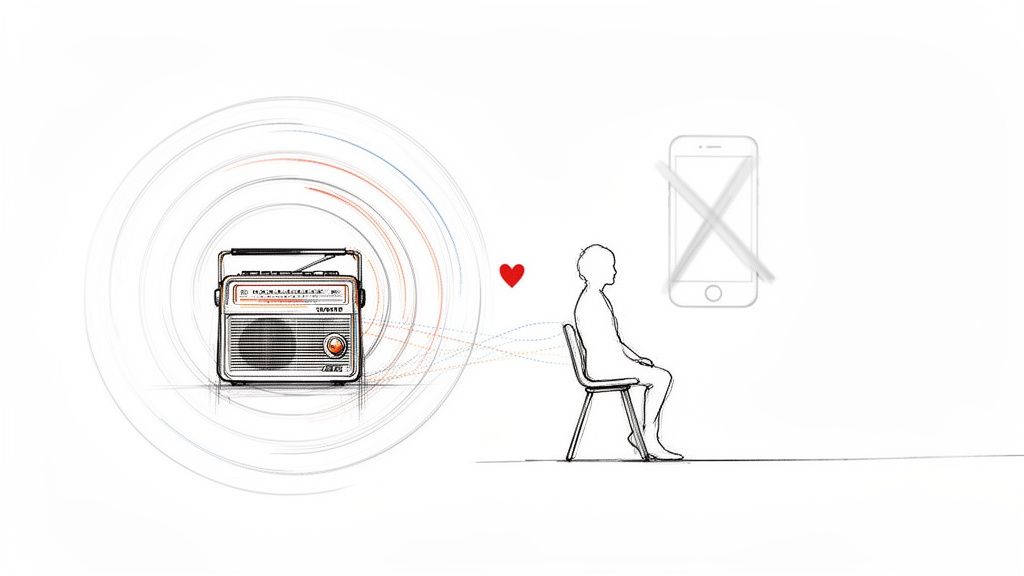
With screens in every pocket, it's easy to assume radio is a relic. But that couldn't be further from the truth. Radio’s power lies in its unique, screen-free format. It gives you a direct, almost intimate, line to a captive audience, especially during those prime commute times when people are actually listening.
Unlike a cluttered social media feed where you're just one post among dozens, a radio ad doesn't have to fight for screen real estate. It creates a "theater of the mind." Your words, mixed with the right music and sound effects, can paint a picture far more vivid than many visual ads. This is how you build a genuine connection.
The Numbers Don't Lie: Radio's Reach and Engagement
Radio isn't just holding on; it's a powerhouse that continues to grow. Here's a quick look at why it remains a go-to for smart marketers.
| Radio Advertising at a Glance | | :--- | :--- | :--- | | Metric | Statistic | Source/Context | | Global Market Value | $26.13 billion | Projected value by 2029 | | Weekly Adult Reach | 85% | Global listenership, demonstrating consistent engagement | | Comparative Performance | Outperforms TV | In key demographics, especially in the US |
These stats paint a clear picture: radio is a thriving medium. This consistent engagement is a golden opportunity for advertisers. A sharp, well-written script for a radio commercial lets you:
Dodge the digital clutter and connect with people when they aren’t glued to a screen.
Zero in on local audiences with incredible precision, ensuring your ad budget works harder.
Build brand recall using the simple, memorable power of sound.
A great radio script understands the medium's intimacy. You’re not shouting at a crowd; you're having a one-on-one chat with someone in their car, at their desk, or in their kitchen. That personal touch is radio's secret weapon.
Why Your Script Is the Linchpin for ROI
The success of any radio campaign ultimately comes down to the script. A weak, confusing, or just plain boring ad is an instant tune-out—and a complete waste of your investment. But a sharp, engaging, and memorable script? That turns your airtime into a lead-generating machine.
To really nail this, you need to understand the full scope of radio marketing solutions. A strong script is the absolute foundation. It’s not about just filling 30 or 60 seconds with talking points. It's about telling a story, solving a problem, and making an emotional connection that makes someone want to act.
Here’s the simplest way to think about it: the radio station delivers the audience, but your script is what gets the conversion. It’s the bridge that takes someone from being a passive listener to becoming an active customer. Before we get into the nitty-gritty of writing, getting this part right is the first step toward crafting a radio ad that actually delivers a return.
The Three Essential Elements of a Winning Radio Script
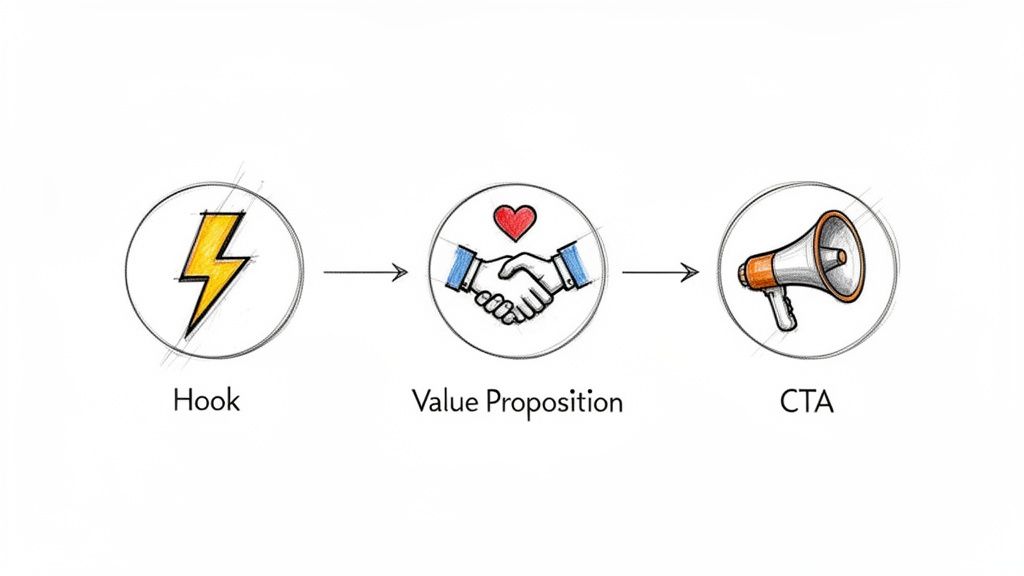
Every great radio ad I've ever produced, no matter the length or the product, comes down to a simple, powerful structure. When you dissect a successful script for a radio commercial, you’ll almost always find three key pieces working together: the Hook, the Value Proposition, and the Call-to-Action (CTA).
Getting these three elements right isn't just theory—it's the practical anatomy of an ad that actually gets results. This structure is designed to take a listener from casual indifference to motivated action in 60 seconds or less.
The Hook That Demands Attention
You have about three seconds to earn a listener's attention. That’s it. In a medium where people are driving, working, or just tuning out, your opening has to slice through the noise. A weak start means your ad is over before it even has a chance.
An effective hook is a "pattern interrupt"—something so unexpected or relevant that it makes the brain stop and listen. This isn’t the time for a polite introduction. It’s time to make a splash.
Here are a few ways I’ve seen this done masterfully:
A Startling Question: "When was the last time you actually enjoyed paying your monthly energy bill?" This instantly frames a common pain point and forces the listener to think.
A Unique Sound Effect (SFX): The sudden sound of a record scratch followed by dead silence can be more powerful than any word. For a mechanic, the sputtering sound of a car failing to start is universally understood and instantly relatable.
A Bold, Contrarian Statement: "Stop stretching before your workout." This challenges a common belief and makes people lean in, curious to hear the why.
The goal of the hook is singular: earn the next ten seconds of their time. It doesn't need to sell anything. It just needs to make them wonder what's coming next.
The Value Proposition That Connects
Once you have their ear, you have to deliver the goods. This is the body of your script, and its job is to connect your product to the listener's life in a meaningful way. This is not where you list features; it's where you sell the feeling, the relief, the outcome.
The Problem-Agitate-Solution (PAS) framework is golden here. You hinted at the problem with your hook. Now, you twist the knife a little by painting a picture of that frustration before swooping in with your brand as the perfect solution. For more on this, check out these tips on how to write effective radio commercials.
Imagine this for a local meal delivery service:
(Problem): "It's 5 PM. You're stuck in traffic, and the last thing you want to think about is what's for dinner."
(Agitate): "You could grab greasy fast food again, or you could face a messy kitchen and an hour of cooking."
(Solution): "Or, you could come home to a fresh, chef-prepared meal from Farmstead Table, ready to heat and eat in minutes. No mess, no stress."
This structure works because it taps into a real, daily struggle and offers a clear, desirable escape. It makes the value emotional and tangible, not just a list of services. Our guide on writing a great script for advertising has even more frameworks you can adapt.
The Call-to-Action That Drives Action
Finally, we get to the most critical piece: the Call-to-Action (CTA). You can have the world's best hook and a heart-stopping value proposition, but it's all for nothing if the listener doesn't know exactly what to do next. Your CTA has to be clear, simple, and memorable.
Radio is unique because listeners can't click a link. This makes crafting a CTA a specific challenge. You have to make it completely frictionless.
Here are a few strategies that always work:
Repeat It: State your website or phone number twice. "Visit FreshClean.com. That's FreshClean dot com." Repetition is king for recall.
Keep It Simple: A vanity URL like "Go to GetMyOffer.com" is far easier to remember and type later. Complex URLs with hyphens or weird spellings are conversion killers on the radio.
Create Urgency: Add a time-sensitive incentive. "Book your appointment before Friday and get 20% off." This nudges people to act now instead of filing it away for "later."
Your CTA is the final command that turns your ad spend into actual, measurable results. By perfecting the Hook, Value Proposition, and CTA, your script transforms from just words into a finely-tuned machine for bringing in new customers.
Scripting for 15, 30, and 60 Second Ad Spots
In radio, time isn’t just money—it’s your entire canvas. The length of your ad spot completely dictates its purpose, structure, and what you can creatively achieve. A common rule of thumb is to aim for about two words per second, but a truly effective script for a radio commercial uses that time strategically. You have to know what job each duration is meant to do.
This isn't just guesswork. Decades of data show that well-structured 30- and 60-second spots with a solid hook and a clear call-to-action can lift brand recall by up to 25% more than their TV counterparts. Why? Because radio is an intimate, one-on-one medium. It's a huge reason why traditional radio still commands a massive 64% share of the ad-supported audio space as of 2025.
So, let's get into how you actually script for the three most common ad lengths.
Before we dive into the specifics of each ad length, it's helpful to have a high-level view of how word count, timing, and strategic goals fit together. The table below breaks down the most common radio commercial formats, giving you a quick reference for planning your next spot.
Radio Commercial Script Length and Structure
Spot Length | Approx. Word Count | Primary Goal | Recommended Structure |
|---|---|---|---|
15 Seconds | 30-40 words | Brand Recall / Single Offer | Hook + Brand Name + Key Info (e.g., event date, sale item) |
30 Seconds | 70-85 words | Driving Action / Lead Gen | Hook + Problem + Solution + Call-to-Action |
60 Seconds | 140-160 words | Storytelling / Brand Building | Narrative Arc (e.g., character dialogue, testimonial, mini-drama) |
As you can see, each format has a distinct role. A 15-second spot is a quick jab, a 30-second ad is your workhorse, and a 60-second spot is for building a deeper connection. Understanding these differences is the first step to writing a script that actually performs.
The 15-Second Blitz: All About Brand Recall
Think of a 15-second spot as a surgical strike. You’ve only got about 30-40 words, so there’s absolutely no room for a winding story. The main goal here is pure brand reinforcement or pushing one, incredibly simple offer.
This format is perfect for:
Event Reminders: "Don't forget the Downtown Farmer's Market this Saturday at 9 AM!"
Brand Name Repetition: Hammering your brand name into the listener’s mind through sheer frequency.
Campaign Echoes: Acting as a quick audio cue that reminds listeners of a longer 60-second ad they’ve already heard.
Your script has to be brutally efficient. It’s like an audio billboard. You need a fast attention-grabber, the brand name, and one key piece of info. A local pizzeria might run something like this:
"[SFX: Loud stomach grumble] Starving? Get a large pepperoni pizza for just $10 at Tony's Pizzeria. Tony's Pizzeria on Elm Street. Order now!"
The 30-Second Workhorse: Built to Drive Action
There’s a reason the 30-second spot is the most popular format. With around 70-85 words, you have just enough room to hook the listener, present a problem, offer your solution, and drive them to a clear call-to-action. This is your go-to for making something happen now.
It usually follows the classic Hook-Value-CTA model. You have enough time to build a mini-narrative that resonates with the listener on an emotional level.
A 30-second ad is the perfect vehicle for the Problem-Agitate-Solution framework. It gives you enough runway to build a relatable scenario that makes your solution feel necessary, not just optional.
For instance, a cleaning service could use this:
"[SFX: Sound of a doorbell ringing, followed by frantic tidying noises] VO: Unexpected guests? Don’t panic. With SparkleClean, your home can be guest-ready in under an hour. Our on-demand service handles the mess so you can relax. Book your first cleaning at SparkleClean.com and get 20% off. That’s SparkleClean.com."
This script quickly hits a familiar pain point, positions the service as the hero, and closes with a compelling offer that creates urgency. For more ideas on how this plays out, you can find a ton of sample scripts for commercials that follow this powerful structure.
The 60-Second Powerhouse: Your Storytelling Canvas
With a generous 140-160 word count, a 60-second ad is a luxury. This is where you get to do some real brand building, dive into deeper storytelling, and forge a lasting emotional connection. While you can use it for direct response, its true power is in crafting a compelling narrative.
Use this extra time for things like:
Testimonial-style ads where a satisfied customer shares their genuine experience.
Mini-dramas that use character dialogue to illustrate a problem and your solution.
Explainer ads for a complex or new product that needs a bit more detail to make sense.
The key to a great 60-second script is pacing. You have time to let moments breathe. Use silence, music swells, and layered sound effects to build an entire world in the listener's mind. You can develop a character, tell a joke with a proper setup and punchline, or walk someone through a "before and after" journey. A financial advisor, for example, could use this slot to tell a short story about a couple planning for retirement, making an abstract concept like financial security feel tangible and deeply personal.
Writing for the Ear, Not the Eye
A great script for a radio commercial isn't literature; it’s a conversation. That’s the single most important thing to remember. People don’t read radio ads—they hear them while driving, working, or making dinner. This means you have to write for the ear, not the eye. Your script has to be instantly understandable, memorable, and sound natural when spoken out loud.
Print copy lets you get complex. A reader can pause, re-read a tricky sentence, or even look up a word they don't know. Radio listeners don't have that luxury. If someone has to stop and think about what a word means, you’ve already lost them. The trick is to use simple, everyday language and short, punchy sentences that are easy to absorb on the first go.
Embrace Conversational Language
The best radio scripts sound like one person talking to another. It’s that simple. Ditch the corporate jargon and stiff, formal language. Instead, lean into contractions (like "it's" or "don't"), ask questions, and write in a way that feels personal and direct.
I always tell writers to think of it this way: you're not addressing a faceless crowd. You're speaking to one person, sitting in their car. Using "you" and "your" throughout the script forges that one-on-one connection that makes radio such an intimate and powerful medium.
Before we dive into more techniques, let's look at the most common ad lengths. The runtime you have directly impacts every single word you choose.
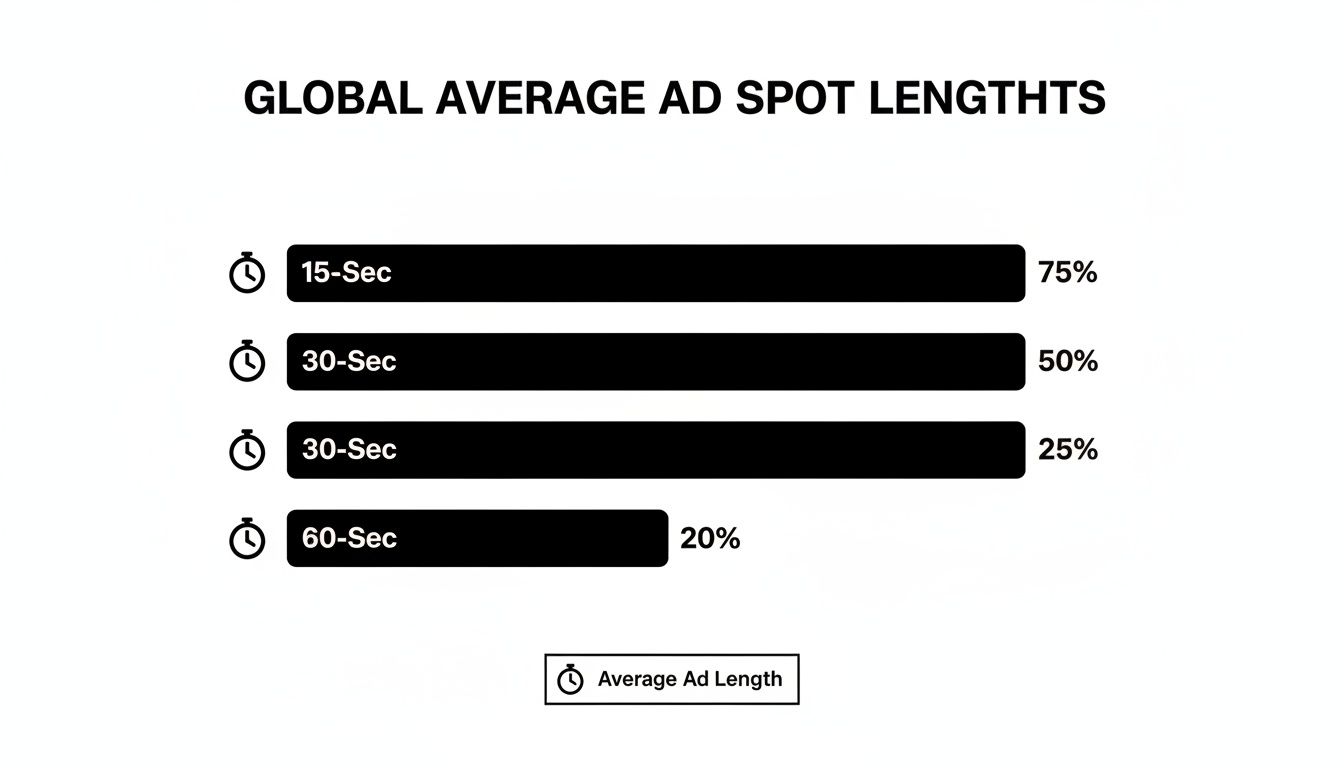
As you can see, the 30-second spot is the industry workhorse. It offers a great balance between having enough time for storytelling and being cost-effective.
Make Your Script Musical
Writing for the ear also means you need to pay close attention to the rhythm and sound of your words. A great script has a musical quality to it, making it pleasant to listen to and much easier to remember. Two classic literary devices are your best friends here:
Alliteration: Repeating the same sound at the start of words (e.g., "fast, friendly, and family-owned"). It adds a catchy, memorable beat to your copy.
Repetition: Don't be shy about repeating a key phrase or your brand name. In the world of audio, repetition is how you build recall. It’s what cements your message in the listener's mind.
A well-written radio script doesn't just inform; it performs. The flow of the words, the deliberate pauses, and the sound of the language all work together to create an audio experience that sticks with the listener long after the ad is over.
Scripting for Sound Design
A script for a radio commercial is more than just dialogue. It's a blueprint for the entire audio production. You need to "direct" the spot from the page by including cues for music and sound effects (SFX). This is how you paint a vivid picture in the listener's mind without any visuals.
Use a simple, standardized format for these cues so the production team knows exactly what you’re picturing. I find placing them in brackets on their own line works best.
Examples of SFX and Music Cues:
[SFX: Car tires screeching to a halt]
[MUSIC: Upbeat, optimistic theme swells and then fades to background]
[VOICEOVER: Sounding excited and energetic]
These cues are what bring the script to life. They transform a flat document into a multi-layered audio story, setting the mood, grabbing attention, and making the scenario feel real.
Before and After: The Audio-First Mindset
Let's look at a quick, practical example. Here’s a script written with a print-first mindset, followed by a version revised for audio.
Before (Written for the Eye): "Our firm, Johnson Financial, provides comprehensive retirement planning services. We utilize sophisticated asset allocation strategies to ensure portfolio diversification and long-term capital preservation for our esteemed clientele."
It's stiff, packed with jargon, and honestly, a bit of a snooze. You can't follow that in the car.
After (Written for the Ear): "[SFX: Gentle, lapping waves on a beach] VOICEOVER (Warm, friendly): Are you ready to relax? At Johnson Financial, we help you build a retirement you can actually look forward to. No confusing jargon. Just a clear, simple plan to protect your money for the long haul. Let's start planning your future. A future you deserve."
See the difference? The second version uses a powerful sound effect to set a scene, speaks in a conversational tone, and focuses on a single, emotional benefit: a stress-free retirement. It’s simple, direct, and written to be heard. This is the shift in thinking you need to make to create a truly effective script for a radio commercial.
Your Radio Script is a Digital Goldmine
Think your finished radio script is a one-and-done deal? Think again. That script is a powerful creative foundation you can and should repurpose across your digital channels. The tight, audio-first nature of a well-written script for a radio commercial makes it the perfect blueprint for modern video ads, especially on fast-scrolling platforms like TikTok and Meta.
When you use the core audio, you're building a unified brand voice that follows your audience everywhere they go. This cross-channel consistency is a huge advantage. It boosts message recall, builds brand recognition, and frankly, drives conversions way more effectively than running a bunch of disconnected campaigns. Your audio becomes a familiar, trustworthy signature.
This integrated mindset is becoming non-negotiable as the line between broadcast and digital blurs. The radio market's steady growth is actually being fueled by this digital integration. While national spot revenue might see a slight dip, digital radio ad revenue is projected to jump 6.5% to $1.75 billion by 2025. For creative teams, this screams one thing: make your assets adaptable.
From Audio Script to Video Voiceover
That classic Hook-Value-CTA structure you perfected for your radio ad? It's the ideal skeleton for a high-performing video ad. You've already done the hard work of trimming down your message and nailing the flow. Now, you just need to add the visuals.
This is how you maintain message discipline while pumping out a high volume of visual content. Your audio track is the constant, while you can swap out video clips to test different creative angles. This is where you can really start to scale your creative output without reinventing the wheel every time.
Let's say you have a 30-second radio script for a coffee shop. That one audio track can power several different videos:
Video 1: A sensory experience with close-ups of espresso shots and perfect latte art.
Video 2: A fast-paced montage of happy customers chatting and working.
Video 3: A "day-in-the-life" view from the barista's perspective.
The core message, delivered by that professional voiceover, stays the same. This consistency builds a powerful, recognizable brand identity, even while you’re testing which visuals hit hardest with your audience.
Maximizing Your Creative Investment
Repurposing your radio script isn't just a time-saver; it’s about making your creative budget work harder. You've already invested in the copywriting, voice talent, and studio time. Treating that final audio as a core brand asset means you can amortize that cost across a much wider set of marketing activities.
Think of your radio script's audio track as the 'master version' of your campaign's message. It’s the source code you can deploy across podcast ads, in-stream audio commercials on Spotify, and as the voiceover for your entire social media video strategy.
This modular approach is incredibly efficient. A 60-second radio script can be sliced and diced. That killer hook? It's now a 6-second YouTube bumper ad. A powerful testimonial from the middle? That's a standalone social media clip. You can dive deeper into this strategy in our guide on repurposing video content, as the same principles apply here.
This method ensures your brand sounds and feels the same everywhere, which is absolutely critical for building trust and recall. A customer who hears your ad on their morning drive and then sees a matching video on Instagram later that day gets a potent, cohesive brand experience. It hammers home your call to action and makes your brand far more memorable.
Got Questions About Your Radio Script?
Even when you have a great plan, a few nagging questions always seem to pop up once you get down to the business of writing a script for a radio commercial. Let's tackle some of those common sticking points that can slow you down.
How Many Times Should I Say My Brand Name and Call to Action?
Finding the sweet spot between memorable and annoying is a real art. A solid guideline is the "Rule of Three" for your brand name. Mention it once near the beginning, once somewhere in the middle, and one final time right at the end with your call to action. This way, even listeners who tune in halfway through will catch who you are.
When it comes to your Call to Action (CTA)—like your website or phone number—repeating it twice in a row at the end is a game-changer for recall. People are usually driving or busy with something else; they can't just jot it down. That second mention gives their brain a much better chance to lock it in.
For example: "Visit FreshBloomFlowers.com to order your bouquet today. That’s FreshBloomFlowers.com." If your URL is a mouthful, seriously consider getting a simple, memorable vanity URL just for your radio spots. You're aiming for zero-effort recall to make every dollar of your ad spend count.
What Are the Biggest Mistakes I Can Make in My First Radio Script?
I see newcomers to radio scriptwriting fall into the same traps time and again. Just by sidestepping these, your ad will instantly sound more professional and work a whole lot better.
Here are the most common pitfalls to watch out for:
Trying to Say Too Much: You have 30 seconds. That’s enough time to land one strong idea. If you try to cram in three different benefits and a list of features, you’ll just create a confusing mess. Pick your single most powerful point and hammer it home.
Using Big, Complicated Words: Remember, there’s no rewind button on the radio. Stick to simple, conversational language and shorter sentences that listeners can absorb instantly. If they have to pause and think, "What does that word mean?" you've already lost them.
Having a Weak or Vague CTA: Your ad is a total bust if the listener doesn't know exactly what you want them to do next. Be direct, be clear, and make the action painfully easy to remember and do.
Forgetting About the Sound: A script with no music or sound effect cues is just a boring lecture. Audio is your secret weapon. Use it to paint a picture, set a mood, and stir up emotion.
Should I Hire a Pro Voice Actor or Just Do It Myself?
Unless you're a trained professional, the answer is almost always to hire a voice actor. Their value is so much more than just having a "nice voice." A real pro is a performer who can inject life into a script with spot-on pacing, the right tone, and genuine emotion.
A professional knows how to make a 30-second script fit perfectly into 30 seconds—an amateur reading the same script could easily run long. A DIY recording, even if you have a decent mic, almost always has an amateurish quality that can make your brand feel less credible.
The cost of a voice actor is a tiny investment compared to your media buy, and it massively elevates the quality and impact of your entire campaign. Even if you're going for that "authentic, regular person" vibe, a pro has the skill to deliver that performance way more effectively than an actual amateur can.
How Can I Make My Radio Ad Actually Stand Out?
Cutting through the noise of a commercial break isn't about being the loudest; it's about being different. Your ad needs a deliberate strategy built on creativity and contrast. The best way to get noticed is to be exceptional in one of three areas: your concept, your sound design, or your offer.
A Unique Concept: Go for unexpected humor, a gripping mini-story, or a truly startling opening line. You need to create a "pattern interrupt" that jolts people out of their listening haze.
Distinctive Sound Design: A custom jingle or a signature sound effect can make your brand instantly recognizable. Just think of the iconic sounds tied to major brands—that's no accident. It's smart audio branding.
A Powerful Offer: Let's be honest, sometimes the most compelling thing you can do is present an irresistible, can't-miss deal. A strong, time-sensitive offer creates urgency and gives listeners a very good reason to act now.
Before you write a single word, tune into your target radio station and listen to the ads. Then, make a conscious decision to create a script for a radio commercial that sounds and feels totally different from everything else you hear.
Ready to stop guessing and start creating high-performing ad creatives at scale? Sovran is an AI platform that automates the production and iteration of video ads for Meta and TikTok. Turn your proven scripts and best-performing clips into hundreds of on-brand ad variants in seconds, eliminating hours of manual editing and accelerating your path to finding winning ads. Start your 7-day free trial and see how much faster you can scale.

Manson Chen
Founder, Sovran
Related Articles
8 Evergreen Sample Scripts for Commercials That Convert in 2026
Unlock high-converting ads with our library of 8 sample scripts for commercials. Get copy-paste templates for Meta and TikTok to scale your campaigns.
- commercial-scripts
- video-advertising
- 5 more
Mastering Direct Response Video Ads for Explosive Growth
Discover how to create, test, and scale high-impact direct response video ads. Learn proven frameworks and data-driven workflows to drive real results.
- direct-response-video
- video-advertising
- 5 more
Storyboard Development: Scale Video Ad Production in 2026
- storyboard development
- video ads
- 3 more