8 Evergreen Sample Scripts for Commercials That Convert in 2026
Unlock high-converting ads with our library of 8 sample scripts for commercials. Get copy-paste templates for Meta and TikTok to scale your campaigns.
Jump to a section
- 1. Hook-Body-CTA (15-30 Second Performance Format)
- 2. Problem-Agitate-Solution (PAS) Format
- 3. User-Generated Content (UGC) Testimonial Mashup (20-45 Seconds)
- 4. Listicle/Educational Format (30-60 Seconds)
- 5. Before-and-After Transformation (15-45 Seconds)
- 6. Storytelling/Emotional Narrative (45-120 Seconds)
- 7. Product Demo/Tutorial Format (30-90 Seconds)
- 8. Trend-Jacking/Meme Format (15-30 Seconds)
- 8 Commercial Script Formats Compared
- From Scripts to Scale: Automating Your Creative Workflow
Creative fatigue is the silent killer of ROAS. When your ads stop converting and cost-per-acquisition metrics climb, the frantic search for 'what's next' begins. But what if you had a proven, repeatable system for generating high-performing video ads without starting from a blank page every single time? This guide delivers exactly that: a curated library of battle-tested, sample scripts for commercials designed specifically for the high-stakes environments of Meta and TikTok.
This is more than just a list of templates; it's a strategic playbook for performance marketers. We will deconstruct the core psychology behind eight powerful advertising frameworks, from the direct-response efficiency of the Hook-Body-CTA format to the persuasive power of a well-executed Problem-Agitate-Solution narrative. You'll move beyond guesswork and into a structured system for creative development that consistently drives results.
For each script, you will receive a comprehensive breakdown that includes:
Line-by-line copy ready for your talent or voiceover artist.
Suggested shot lists to guide your production, whether it's polished studio work or authentic user-generated content.
Precise timing notes to optimize for platform-specific attention spans.
Advanced A/B testing ideas to help you iterate and find your next winning creative variation.
Our goal is to equip you with replicable strategies that you can adapt to any product or service. By mastering these foundational structures, you can build a robust ad creative engine that ensures you never run out of high-impact ideas again. Let's stop guessing and start building.
1. Hook-Body-CTA (15-30 Second Performance Format)
The Hook-Body-CTA is the quintessential framework for modern performance advertising, engineered for the rapid-scroll environments of platforms like TikTok and Meta. Its power lies in its simplicity and modular structure: a 1-3 second Hook to stop the scroll, a concise Body to deliver value, and a clear Call to Action (CTA) to drive conversions. This three-act structure is the backbone of many successful sample scripts for commercials because it aligns perfectly with user attention spans.
This format is exceptionally effective for direct-response campaigns where the goal is immediate action, such as an app install, a purchase, or a sign-up. Its modularity allows for efficient A/B testing; you can test multiple hooks against a single body and CTA to quickly identify the most resonant opening without reshooting the entire ad. For shorter performance formats like these, understanding effective scripting for shorts is crucial to captivate audiences and drive action.
Strategic Breakdown and Application
Brands like Grammarly and Duolingo master this format by leading with a relatable problem or an unexpected visual. A Grammarly ad might open with the text "That one email you can't mess up," instantly creating a high-stakes hook. The body then demonstrates the app's solution in a few seconds, followed by a direct "Download Now" CTA.
Key Tactic: The hook's only job is to earn the next three seconds of the viewer's attention. Don't try to sell the entire product in the first frame. Use a pattern interrupt, a bold claim, or a question to create curiosity.
Actionable Tips for Implementation
Test Hooks in Isolation: Before committing to a full video, run 1-3 second hook-only ads. Analyze which concepts achieve the highest thumb-stop rate and then build out the body and CTA for the winners.
Align Hook and Body: Ensure a logical flow from your attention-grabbing hook to the value proposition in the body. A disjointed narrative will cause viewers to lose interest and scroll away.
Reinforce the CTA: Use on-screen text overlays, voiceovers, and visual cues (like an animated button) to make your call to action impossible to miss.
Maintain Consistency: When creating numerous ad variants, use a tool like Sovran's Context Vault to ensure your brand voice and core messaging remain consistent across all your creative assets. You can discover more advanced strategies in our complete guide to writing for advertising.
2. Problem-Agitate-Solution (PAS) Format
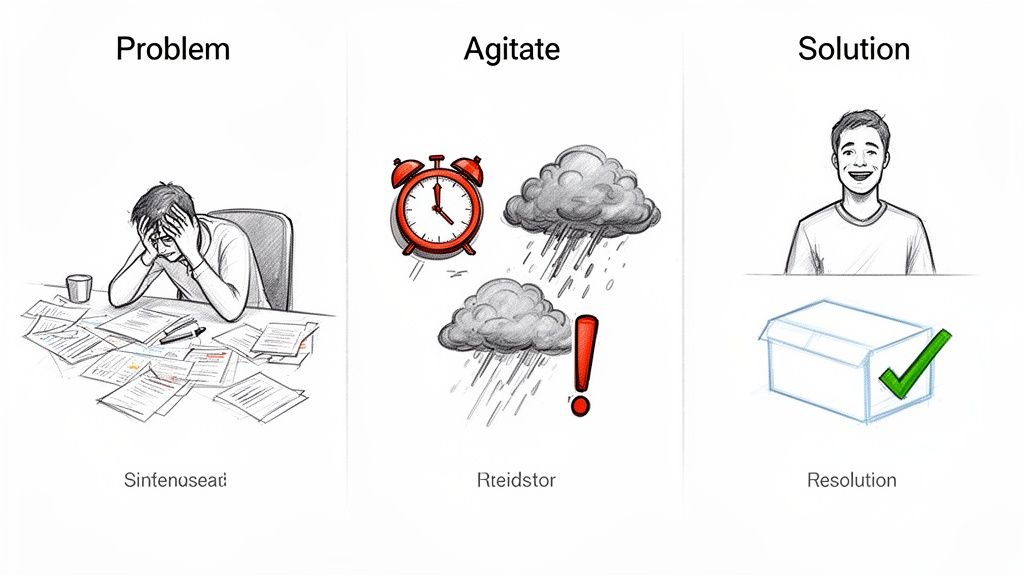
The Problem-Agitate-Solution (PAS) format is a classic direct-response copywriting framework that excels in video. It works by first identifying a customer's pain point (Problem), amplifying the negative emotions associated with it (Agitate), and then presenting the product as the perfect Solution. This narrative structure is highly persuasive because it mirrors the viewer's internal dialogue and builds emotional stakes before offering relief, making it ideal for conversion-focused ads.
Unlike the rapid-fire Hook-Body-CTA, the PAS format takes a more narrative approach, typically suited for 30-60 second spots. It's incredibly effective for products or services that solve a significant, emotionally charged problem. The goal is to make the viewer feel understood and then provide a clear, compelling path to resolution. Many of the best sample scripts for commercials use this structure to create a strong sense of urgency and necessity.
Strategic Breakdown and Application
Mental wellness apps like Calm and BetterHelp use this framework to great effect. A Calm ad might start by showing someone tossing and turning in bed (the Problem). It then cuts to shots of them looking exhausted at work and missing important moments (the Agitation), making the consequences of poor sleep feel tangible. Finally, it introduces the Calm app with soothing visuals and sounds, presenting it as the clear Solution for a restful night.
Key Tactic: The "Agitate" phase is the most critical. Don't just state the problem; show its negative ripple effects. This is where you transform a minor inconvenience into a significant pain point that demands an immediate solution, creating a powerful motivation to act.
Actionable Tips for Implementation
Lead with Relatability: Start your script with a highly specific and relatable problem. Use on-screen text like "Can't focus with all this clutter?" or a visual showing a chaotic workspace to instantly connect with a target segment.
Amplify the Consequences: Dedicate 5-8 seconds to showing the negative outcomes. For a project management tool, this could be missed deadlines, frustrated team members, or a stressed-out manager. Make the pain visceral.
Frame the Solution as Relief: Introduce your product not just as a feature set, but as the resolution to the agitation you've built. The final 3-5 seconds should clearly demonstrate the positive outcome, like a completed project or a peaceful state of mind.
Test Problem Angles: The same product can solve multiple problems. Use a modular approach to create variants that test different opening problems for different audience segments, helping you identify the most resonant pain points.
3. User-Generated Content (UGC) Testimonial Mashup (20-45 Seconds)
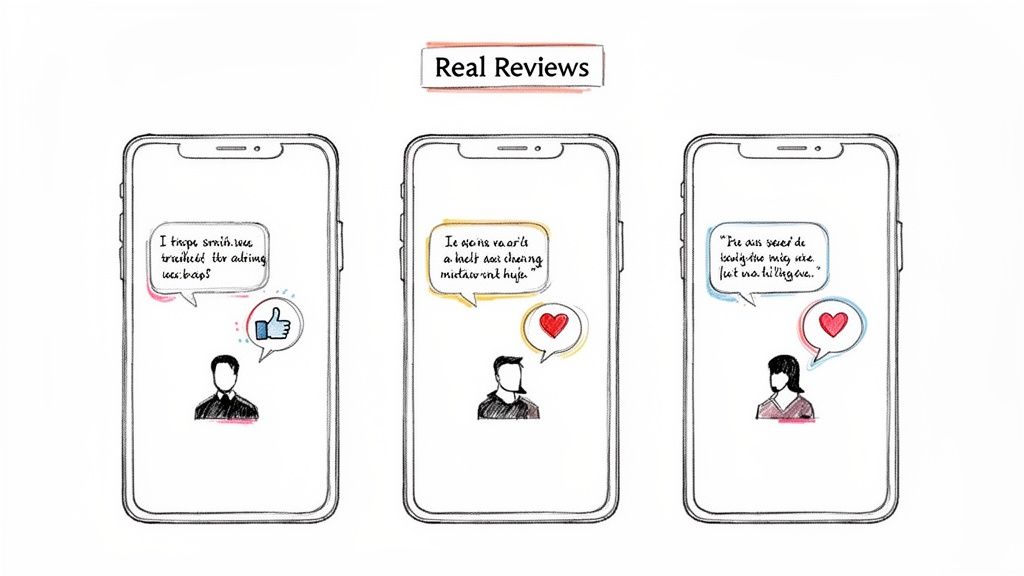
The User-Generated Content (UGC) Testimonial Mashup leverages authentic customer footage to build powerful social proof. This format involves compiling rapid-cut clips of real users unboxing products, sharing reviews, or showcasing results. It thrives on platforms like TikTok and Meta because its raw, unpolished nature mimics organic content, making it feel less like a traditional ad and more like a trustworthy recommendation from a peer.
This approach is highly effective for direct-to-consumer (D2C) brands looking to build credibility and community. By featuring genuine customer experiences, these sample scripts for commercials can overcome viewer skepticism and drive conversions at a lower cost than high-production shoots. The variety of faces, voices, and settings creates a dynamic and relatable narrative that resonates with diverse audience segments.
Strategic Breakdown and Application
Brands like Liquid IV and Ridge Wallet excel with this format by transforming customer enthusiasm into high-performing creative. A typical ad might feature a fast-paced montage of different customers unboxing a wallet or mixing an electrolyte drink, all while their genuine audio praises the product's benefits. The key is the compilation: one testimonial is an opinion, but ten layered together becomes undeniable social proof.
Key Tactic: Focus on emotional authenticity over production quality. A slightly shaky, vertical video of a customer genuinely excited about a result will often outperform a polished studio shot. The perceived realness is the core asset.
Actionable Tips for Implementation
Incentivize Submissions: Create a system to encourage customers to submit videos, such as offering discounts, gift cards, or entry into a giveaway. This builds a steady stream of fresh, authentic content for your campaigns.
Overlay Key Proof Points: Use text overlays to highlight compelling quotes, star ratings, or impressive metrics (e.g., "50,000+ 5-Star Reviews"). This reinforces the message even if the viewer is watching with the sound off.
Prioritize Diversity: Feature a wide range of customer demographics, ages, and use cases. This broadens the ad's relatability, allowing more potential buyers to see themselves in the testimonials.
Systematize Your Workflow: Use a platform with a Context Vault to easily store, search, and access your best testimonials. This allows your team to quickly assemble new mashups and scale your creative production without manual effort. To get started, you can explore our guide on how to start with UGC.
4. Listicle/Educational Format (30-60 Seconds)
The Listicle/Educational format transforms a standard commercial into a value-first piece of content, positioning the brand as an expert. This approach uses a numbered or bulleted list to present 3-5 tips, hacks, or surprising facts, providing immediate utility to the viewer. By delivering education upfront, the product pitch at the end feels less like an ad and more like a helpful recommendation.
This format is ideal for top-of-funnel campaigns on platforms like TikTok and Meta, where educational content thrives. It boosts watch time and shareability by structuring information in a digestible, engaging way. The numbered list creates a curiosity loop, encouraging viewers to watch until the end to get all the tips, making it a powerful tool in a library of sample scripts for commercials.
Strategic Breakdown and Application
Brands like Duolingo excel with this by creating ads like "5 languages to learn for your career." Each point is a quick, visually distinct segment that delivers value before the final tip seamlessly introduces the app as the best way to learn. Similarly, a HelloFresh ad might offer "4 Meal Prep Hacks," with the final hack being their meal kit service that eliminates prep altogether.
Key Tactic: Position your product as the ultimate tip or the solution that simplifies all the previous points. If you list three photography mistakes, your app or course should be presented as the tool to avoid them all. This makes the call to action a logical conclusion, not an abrupt sales pitch.
Actionable Tips for Implementation
Lead with the Strongest Tip: Hook viewers by placing your most surprising or impactful tip first. This immediately establishes value and convinces them to stay for the rest of the list.
Create Visual Consistency: Use consistent text overlays, graphics, and visual pacing for each numbered point. This creates a professional, easy-to-follow rhythm that keeps the audience engaged.
Test List Length: Don't assume one size fits all. Create variants with 3, 5, and even 7 tips to identify the optimal length for watch time and conversions on each specific platform.
Integrate the CTA Naturally: The transition to the call to action should feel earned. Frame the product as the final, most important tip in the list to create a smooth and persuasive flow.
5. Before-and-After Transformation (15-45 Seconds)
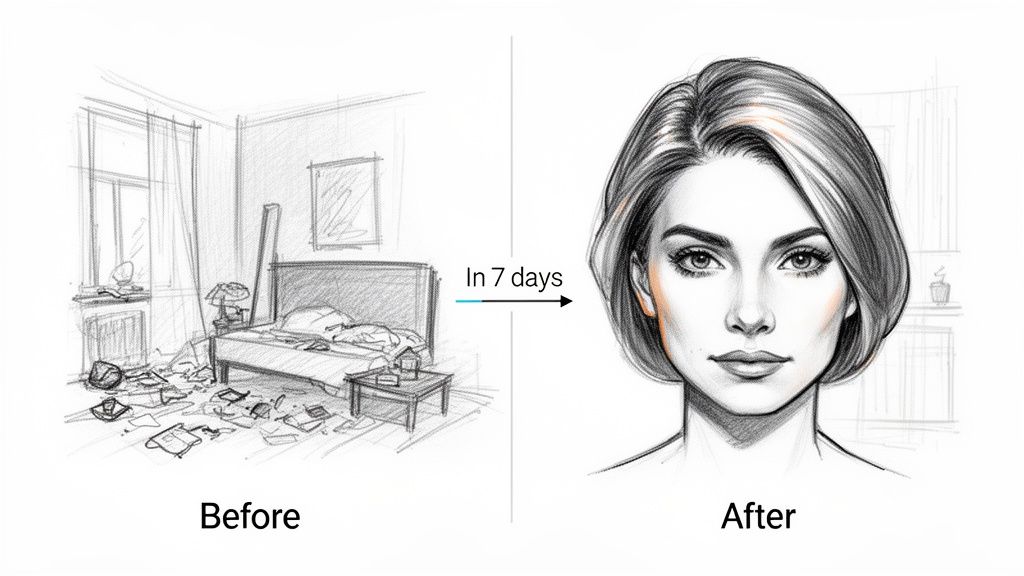
The Before-and-After Transformation is a powerful visual storytelling format that provides clear, undeniable proof of a product's value. It works by establishing a relatable "before" state (the problem) and then revealing a desirable "after" state (the solution), creating an immediate and satisfying narrative. This format is a staple in sample scripts for commercials because it capitalizes on the human brain's natural attraction to progress and resolution.
This approach is exceptionally effective for products with tangible, visible results, such as in the beauty, fitness, home improvement, and even productivity software categories. By visually demonstrating the product's impact, it bypasses the need for lengthy explanations, making the core benefit instantly understandable and compelling in a fast-paced social feed.
Strategic Breakdown and Application
Brands like Dyson and Olaplex have built empires on this format. A Dyson ad might show a split-screen of a dirty carpet next to a pristine one, with the vacuum gliding through the middle, creating a visually gratifying reveal. Similarly, Olaplex ads often feature side-by-side comparisons of frizzy, damaged hair next to smooth, healthy hair, immediately communicating the product's restorative power. The key is the dramatic contrast.
Key Tactic: The power of the transformation is amplified by the speed and satisfaction of the reveal. Use quick cuts, dynamic transitions (like a wipe or snap), and impactful sound design (a 'whoosh' or 'ding') to make the "after" moment a memorable payoff.
Actionable Tips for Implementation
Establish an Authentic "Before": Always shoot the "before" footage first to create a genuine starting point. An overly staged or fake-looking "before" scene can erode trust and diminish the impact of the transformation.
Add Quantifiable Metrics: Enhance credibility by overlaying text that quantifies the result. Phrases like "In just 7 days," "5 shades whiter," or "Cleaned in 60 seconds" make the transformation feel more concrete and believable.
Layer with Social Proof: Combine the visual transformation with a customer testimonial voiceover. Hearing a real person describe their experience while seeing the results happen creates a powerful emotional connection and builds immense trust.
Create Modular Variants: The transformation is a perfect candidate for modular video ads. A single "before" and "after" clip can be repurposed with dozens of different text overlays, timelines ("7-day results" vs. "30-day results"), and CTAs. Explore our guide on how to scale paid growth with modular video ads to learn more about this efficient strategy.
6. Storytelling/Emotional Narrative (45-120 Seconds)
The Storytelling/Emotional Narrative is a classic advertising format that prioritizes brand affinity and emotional connection over immediate conversion. This approach uses a character-driven arc with a clear setup, conflict, and resolution, where the product serves as a subtle enabler rather than the hero. It's designed for longer-form placements like YouTube pre-rolls and aims to build lasting brand equity. These sample scripts for commercials are perfect for consideration or brand-awareness campaigns.
This format is most effective for brands looking to establish a deeper connection with their audience by aligning with their values. It moves beyond product features to tell a human story, making the brand more memorable and relatable. Campaigns like Apple’s ‘Shot on iPhone’ series or Dove’s ‘Real Beauty’ use this technique to build an emotional moat around their brand, fostering loyalty that transcends transactional relationships.
Strategic Breakdown and Application
Brands like Patagonia and Always master this format by weaving their product into a larger cultural or social narrative. The Always '#LikeAGirl' campaign, for instance, doesn’t focus on the product's absorbency; it tackles the societal drop in confidence young girls experience during puberty. The product is implicitly present, but the story's emotional weight is carried by the empowering message, creating a powerful brand association.
Key Tactic: The product should be the catalyst for the character's transformation, not the focus of the story. Introduce it subtly, often past the halfway mark, to ensure the emotional narrative remains the central element.
Actionable Tips for Implementation
Hook with Conflict: Open with an immediate emotional hook or a point of conflict within the first 5 seconds to capture viewer interest before they have a chance to skip.
Build Relatable Characters: Use specific, humanizing details to quickly build a connection between the audience and the protagonist. A name, a specific struggle, or a unique context makes the story feel authentic.
Introduce the Product as an Enabler: The product should appear as a tool that helps the character resolve their conflict, not as a magical solution. Its introduction should feel natural to the storyline.
Focus on Brand-Lift Metrics: Measure success with metrics like ad recall, brand awareness, and favorability rather than click-through rates or direct conversions. These campaigns build value over the long term.
7. Product Demo/Tutorial Format (30-90 Seconds)
The Product Demo or Tutorial format is a mid-funnel powerhouse designed to answer the viewer's core question: "How does this actually work?" By showcasing the product in action, often through screen recordings or direct footage, this format demystifies functionality, highlights key features, and visualizes the path to value. It is one of the most effective sample scripts for commercials aimed at audiences in the consideration or decision stage.
This approach is indispensable for software, apps, and complex tools where seeing is believing. It reduces adoption friction by making the product feel familiar and achievable before the user has even signed up. The goal is not just to show features, but to build confidence and demonstrate a tangible outcome, making the viewer feel capable of achieving the same result.
Strategic Breakdown and Application
SaaS giants like Notion and Slack have made this format an industry standard. A typical Notion ad doesn't just list features; it walks the viewer through creating a project dashboard from scratch in under 60 seconds. It starts with the "messy notes" problem, shows the "clean workspace" solution, and highlights the exact clicks and commands to get there, making a complex tool appear incredibly intuitive.
Key Tactic: Focus on the "Aha!" moment. Don't create a comprehensive user manual. Instead, identify the single most impactful feature or workflow that makes users fall in love with your product and build the entire demo around demonstrating that specific path to value as quickly as possible.
Actionable Tips for Implementation
Frame with an Outcome: Start by stating the problem or desired outcome (e.g., "Build your team's weekly planner in 60 seconds"). This gives the subsequent steps context and purpose.
Show, Don't Just Tell: Use genuine UI and screen recordings. Authenticity is crucial; polished, fictional interfaces can feel deceptive and erode trust with tech-savvy audiences.
Pace and Highlight: Keep the pace brisk but understandable, spending 2-3 seconds on each major step. Use on-screen text callouts, zooms, and colored highlights to guide the viewer's eye to the most important actions.
Use Sound to Enhance: Layer uplifting, focus-driven background music to maintain momentum and create a positive, productive feel. A clear voiceover can narrate the steps, while text overlays reinforce key benefits.
Conclude with Proof: End with a clear shot of the finished product or achieved outcome, reinforcing the value proposition before presenting a direct CTA like "Start Your Free Trial."
8. Trend-Jacking/Meme Format (15-30 Seconds)
The Trend-Jacking/Meme Format involves leveraging current viral sounds, visual trends, and cultural memes to create ads that feel native to platforms like TikTok. This approach prioritizes cultural relevance and entertainment over a hard sell, capturing attention by participating in conversations already happening online. Instead of interrupting the user's feed, the ad becomes part of it, making the brand feel more relatable and current.
This format is ideal for brands targeting younger demographics (Gen Z and Millennials) who value authenticity and humor. It excels at driving top-of-funnel awareness and building brand personality, as the primary goal is engagement and shareability. The rapid nature of trends means this format requires a fast and agile creative process to capitalize on a cultural moment before it fades.
Strategic Breakdown and Application
Brands that master this format, like Duolingo and Wendy's, integrate their product or brand persona seamlessly into a trending meme. Duolingo famously adapts memes like the "quiet kid" to personify its owl mascot, Duo, creating hilarious, shareable content that reinforces its brand identity. The product itself is often a secondary element, mentioned subtly or implied through the context of the meme.
Key Tactic: The primary goal is not to sell but to entertain and participate. Your product should be the punchline or a supporting character in the trend, not the hero. Success is measured in engagement and positive brand association first, conversions second.
Actionable Tips for Implementation
Monitor Trends Daily: Actively browse the TikTok Discover page and Twitter's trending topics. Identify emerging sounds and formats within the first few days to maximize their engagement potential before they become saturated.
Create Trend Templates: Develop a few flexible video templates where you can easily swap out trending audio or on-screen text. This allows for rapid iteration and deployment as new trends emerge, cutting down production time.
Keep Product Integration Subtle: Avoid making the trend feel like a forced advertisement. The humor or relatability of the meme should be the main value proposition, with the brand making a brief, clever appearance.
Establish Brand Voice Guidelines: Define how your brand can authentically participate in trends without compromising its core identity. Have clear do's and don'ts to prevent missteps or awkward adaptations that could backfire.
8 Commercial Script Formats Compared
Format | Complexity 🔄 (Implementation) | Resources ⚡ (Requirements) | Expected outcomes ⭐ (Effectiveness) | Ideal use cases 📊 | Key advantages & tips 💡 |
|---|---|---|---|---|---|
Hook-Body-CTA (15–30s) | Low–Medium — modular, easy A/B testing | Low — simple shoots, reusable assets, fast edits | High engagement & conversion; strong short-term performance | Performance prospecting on Meta & TikTok | Fast test cycles; prioritize 0–3s hooks; A/B 5+ hooks; use text overlays |
Problem-Agitate-Solution (30–60s) | Medium — needs emotional scripting & pacing | Medium — talent, narrative shooting, proof elements | High conversion and persuasion for consideration-stage | SaaS, apps, conversion-focused campaigns | Open with relatable problem; agitate 5–8s; close with solution + social proof |
UGC Testimonial Mashup (20–45s) | Low — assemble and rapid-cut real footage | Low–Medium — source UGC, permissions, editing pipeline | Very high conversion; algorithm-favored authenticity | Performance campaigns prioritizing social proof | Incentivize submissions; request vertical UGC; rotate weekly; overlay ratings |
Listicle / Educational (30–60s) | Medium — plan multiple tips and visuals | Medium — b-roll per tip, consistent text overlays | Good watch-through and authority; shareable | Top-of-funnel, brand authority, educational positioning | Lead with surprising tip; keep tips 5–8s; integrate product as final tip |
Before-and-After Transformation (15–45s) | Low–Medium — needs authentic before footage & reveal | Low–Medium — filming timelines, transitions, compliance checks | High engagement and conversions when results visible | Beauty, fitness, home, visible-result categories | Film 'before' first; use satisfying reveals/metrics; avoid exaggerated claims |
Storytelling / Emotional Narrative (45–120s) | High — scripted arc, casting, cinematic production | High — longer shoots, talent, higher edit/design cost | Highest brand recall & affinity; long-term brand lift | Brand-awareness, consideration, value-driven campaigns | Hook with conflict; introduce product as enabler; measure brand-lift |
Product Demo / Tutorial (30–90s) | Medium — structured walkthroughs, clarity required | Medium — screen recording, UI access, voiceover | Strong conversion; reduces adoption friction for product-aware users | SaaS, tools, onboarding, bottom-funnel audiences | Show fastest path to value; avoid feature overload; end with clear CTA |
Trend-Jacking / Meme (15–30s) | Medium — rapid ideation and timely execution | Low — uses trending audio/formats but needs monitoring | Very high organic reach short-term; virality potential | Gen Z-focused, culturally-relevant quick wins | Move fast; keep product mention subtle; prepare 2–3 backups and brand guardrails |
From Scripts to Scale: Automating Your Creative Workflow
We've explored a comprehensive library of sample scripts for commercials, breaking down eight powerful formats from the rapid-fire Hook-Body-CTA to the compelling Problem-Agitate-Solution and the immersive Storytelling Narrative. You now have a strategic blueprint for crafting ads that not only capture attention but are also meticulously engineered to drive performance on platforms like Meta and TikTok.
The core takeaway is that a great script is more than just words; it's a modular framework. It’s a structured sequence of psychological triggers, visual cues, and persuasive copy designed to guide a viewer from passive scrolling to active engagement in under 30 seconds. By understanding these structures, you can move beyond guesswork and start building a repeatable system for creative development.
Your Path from Template to High-Performing Asset
The true value of this guide isn't in copying these scripts verbatim. It's in internalizing the underlying principles so you can adapt, remix, and innovate. Think of each script format as a different tool in your marketing toolkit, each suited for a specific objective.
For Rapid Testing: The Hook-Body-CTA and Trend-Jacking formats are your go-to for quickly validating new angles and offers.
For Building Trust: UGC Testimonials and Before-and-After transformations leverage social proof and tangible results to overcome skepticism.
For Educating Your Audience: Listicle and Product Demo formats position your brand as an authority and clearly articulate your value proposition.
For Creating Brand Affinity: Storytelling and emotional narratives build deeper connections that can lead to long-term customer loyalty.
Mastering these sample scripts for commercials means you are no longer just making ads; you are strategically deploying creative assets designed to achieve specific business outcomes. The key is to treat every element, from the hook to the call-to-action, as a variable you can test and optimize.
The Bottleneck Isn't Ideas, It's Production Velocity
Having a treasure trove of script ideas is the first crucial step. However, the most common roadblock that stalls growth marketers and creative teams is the manual, time-consuming process of turning those scripts into a high volume of video assets ready for testing. Editing one video at a time in tools like CapCut or Premiere Pro creates a production bottleneck that kills your ability to iterate quickly.
This is where automation becomes a game-changer. The future of creative production isn't about painstakingly crafting a single "perfect" ad. It's about systemizing your workflow to generate hundreds of variations, allowing you to discover what truly resonates with your audience through rapid, data-driven testing. Efficiently turning these scripts into actual commercials is paramount. For teams looking to accelerate this process, exploring tools like a text to video generator can significantly streamline your production and help you bring concepts to life faster.
By adopting a more programmatic approach, you transform your creative strategy from a series of one-off campaigns into a predictable, scalable engine for growth. The frameworks in this guide provide the map, but automation is the vehicle that will get you to your destination faster. The goal is to spend less time editing and more time analyzing performance, learning from the data, and scaling your winners. This shift in focus is what separates good creative teams from great ones.
Ready to stop the endless cycle of manual video editing and start scaling your creative output? Sovran is the creative automation platform built for performance marketers. Upload your assets, store your best sample scripts for commercials in our Context Vault, and generate hundreds of ad variations in minutes, not weeks. Click here to see how Sovran can transform your creative workflow.

Manson Chen
Founder, Sovran
Related Articles
How to Turn Link Into Video: Ads That Convert in 2026
Learn how to turn link into video for Meta & TikTok ads. Leverage AI to scale creation, boost ROI, and succeed in 2026.
10 Actionable Ad Creative Ideas That Convert in 2026
Discover 10 actionable ad creative ideas for Meta & TikTok. Get hooks, scripts, and testing frameworks to boost your ROAS and combat creative fatigue.
Your Ultimate Guide to UGC Style Video Ads
Master UGC style video ads for Meta and TikTok. This guide reveals proven frameworks, scripts, and scaling tactics to boost your ROAS in 2026.