How to Start UGC That Actually Converts
Learn how to start UGC with a proven framework. This guide covers finding creators, managing content, and scaling winning ads on Meta and TikTok.
Jump to a section
Kicking off a user-generated content (UGC) program means swapping out your polished, agency-shot ads for authentic content made by real people. It’s a pretty big shift. The whole process starts with figuring out your goals, finding creators who actually use and love your product, and then giving them briefs that guide—not dictate—what they create.
When you get it right, a UGC strategy isn't just a campaign; it's a scalable machine for pumping out a ton of trustworthy ad creative that you can test and manage effectively.
Why Authentic UGC Is Your New Ad Creative Engine
Let's be honest, traditional advertising has a trust problem. People are just over the slick, overproduced commercials. They're scrolling right past them. Instead, they’re drawn to content that feels genuine and relatable. This is exactly where UGC comes in, and it's quickly gone from a simple social media tactic to a full-blown engine for ad creative, especially on platforms like Meta and TikTok.
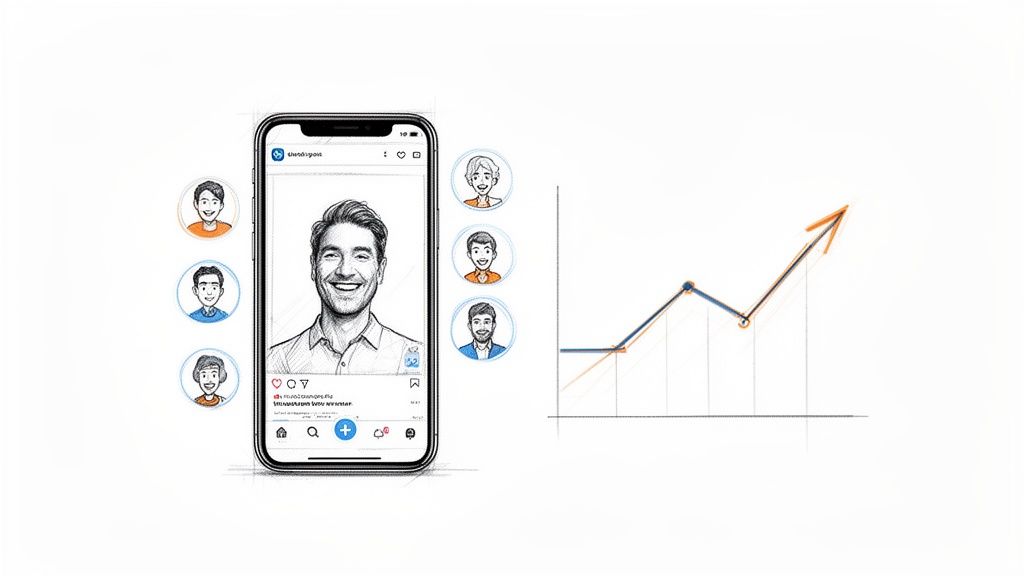
The real magic of UGC is its built-in authenticity. When a potential customer sees someone just like them using and loving a product, it creates instant social proof. This isn't some actor getting paid to read lines; it's a peer, and that kind of endorsement carries so much more weight. You can see this principle working wonders in these high-converting https://sovran.ai/blog/testimonial-ad-examples.
The Shift from Polish to Performance
The numbers don't lie—this isn't just a feeling, it's a massive market shift. The global UGC marketing space hit USD 6.7 billion and is on track to explode to USD 132.73 billion by 2034.
For brands, this translates into tangible results. Check out the difference in performance.
UGC Performance vs Branded Content
Ever wondered just how much better UGC performs? The data is pretty clear. When you put authentic content up against traditional, polished ads, the results speak for themselves. Here's a quick breakdown of where UGC really shines.
Metric | UGC Ads | Branded Ads |
|---|---|---|
Conversion Lift | 29% higher on average | Baseline |
Ad Recall | 2x higher | Baseline |
Click-Through Rate | Up to 4x higher | Baseline |
Trust Factor | Perceived as more authentic | Often seen as biased |
Cost to Produce | Significantly lower | High production costs |
As you can see, the engagement and conversion metrics for UGC are just in a different league. Visitors who interact with UGC convert at a staggering 102.4% higher rate than those who don't.
This incredible performance all comes down to one simple truth: UGC is the raw, unfiltered Voice of Customer. It gives you a direct line into how real people are using and benefiting from your product every single day.
Learning how to start a UGC program isn't just about collecting a few customer videos. It's about building a scalable system to generate authentic, high-performing creative that truly connects with people today.
Building a Scalable Creative System
Thinking of UGC as a one-and-done campaign is one of the biggest mistakes brands make. The real power comes from treating it as an ongoing, scalable system. This means creating repeatable workflows to find creators, manage all the content they send you, and quickly test dozens of ad variations.
Thankfully, modern tools are making this way easier than it used to be. For example, automation platforms like Sovran can do the heavy lifting for you by:
Organizing and tagging all your raw video clips automatically.
Assembling new ad variations in a matter of minutes, not days.
Streamlining the entire testing process so you can find winning ads faster.
When you adopt this kind of systematic approach, you stop chasing sporadic wins and start building a reliable creative engine that consistently drives results.
Building Your Strategic UGC Framework
Diving into user-generated content without a clear strategy is a recipe for disaster. It's like trying to sail without a map—sure, you're moving, but you're probably not heading toward your destination. Before you even think about hunting for creators, you need to lock in your game plan.
This initial strategy is the foundation that makes sure every single piece of content you get actually drives a specific, measurable result for your business.
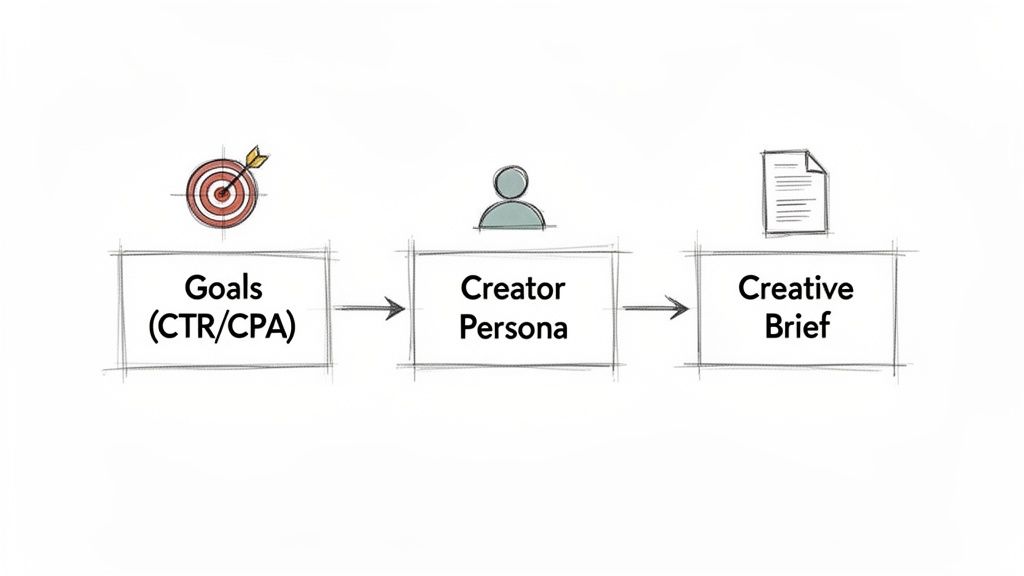
Without this framework, you'll just end up with a folder full of random videos that look nice but don't perform. The goal here is to build a repeatable system that prints money, not just a one-off campaign that fizzles out.
Define Your Key Performance Indicators
First things first: what does success actually look like for your UGC program? Vague goals like "more engagement" are useless. You need to connect your efforts to hard business metrics that actually matter to the bottom line.
Your main goal will dictate everything that follows—the type of content you request, the creators you hire, and the platforms you run on. For instance, if your campaign is all about lowering your Cost-Per-Acquisition (CPA), you'll need direct, benefit-heavy, and super persuasive content.
On the other hand, if your goal is to boost the Click-Through Rate (CTR) on your top-of-funnel ads, you might want to prioritize surprising hooks or entertaining, eye-catching videos.
Don't get lost in vanity metrics. A viral video is worthless if it doesn't lead to conversions. Your strategy needs to be laser-focused on moving the needle on metrics like ROAS, CPA, and overall conversion rate.
Pinpoint Your Ideal Creator Persona
Once you know your goals, you can figure out who should be making the content. The best UGC creators are almost always a mirror image of your ideal customer. Don't get distracted by follower counts; look for genuine fans who get your brand and can speak authentically to your audience's biggest problems.
To build this persona, dig into your own customer data:
Demographics: What's their age, location, and what are they into?
Psychographics: What do they care about? What motivates them? What keeps them up at night?
Platform Behavior: Where do they hang out online? Are they glued to TikTok, scrolling Instagram Reels, or watching YouTube Shorts?
Knowing this helps you find creators who produce content that feels completely native to the platform and instantly clicks with the people you’re trying to reach.
Crafting a Compelling Creative Brief
A great creative brief is a delicate balance. You need to give enough direction to keep the content on-brand and make sure it hits the key messages. But you also have to leave enough space for the creator's personality to come through.
Remember, authenticity is the secret sauce of UGC. A rigid, overly prescriptive brief will kill that vibe instantly.
Your brief should clearly lay out:
The Core Objective: What's the one single thing this video needs to get across?
Key Talking Points: Give them 2-3 essential features or benefits to hit, but let them say it in their own words.
Brand Guardrails: List any hard "dos and don'ts," like not mentioning competitors or avoiding certain words.
A Clear Call-to-Action: Be specific. Tell them exactly what you want the viewer to do next (e.g., "Tap 'Shop Now' to get 20% off").
By setting up these pillars from the start, you create a strategic framework that guides creators to produce high-performing ads time and time again.
How to Find and Partner with Great Creators
Finding the right creators is what makes or breaks your UGC program. You're not just hiring someone to make a video; you're looking for genuine fans who can turn their real experiences with your product into content that actually connects with people. The best part? You don't need a huge budget to get started. Your most powerful advocates might already be right in front of you.

This step is absolutely critical. The creator economy is exploding and is projected to hit a staggering USD 480 billion by 2027. When 90% of users trust recommendations from people they know over brand ads, sourcing authentic voices isn't just a nice-to-have—it's essential for breaking through the noise. Tapping into this high-trust environment is a non-negotiable for growth.
Scouting for Authentic Advocates
Your most powerful creators are almost always your existing customers. These are the people who already get it—they use your product, love it, and understand its value inside and out. The trick is knowing where to look for them.
Social Media Comments and DMs: Start digging through your own social channels. Scan your posts for those super-enthusiastic comments and messages. You're looking for the people already creating content about your brand without you even asking. These are your gold-tier superfans.
Customer Relationship Management (CRM) Data: Your customer list is a treasure trove. Filter for repeat buyers or customers who've left glowing reviews. They've already proven their loyalty and are prime candidates for a partnership.
Creator Marketplaces: When you need to find experienced creators fast, platforms like #paid, Billo, or Insense are great resources. Just make sure you do your homework and vet them carefully to ensure their style matches your brand and ideal customer.
Crafting Outreach That Gets a Reply
Let's be real: creators get spammed with dozens of generic DMs every single day. If you want to stand out, your outreach has to feel personal and show you've actually paid attention. A lazy copy-and-paste message is the fastest way to get ignored.
Keep your first message short, direct, and personalized. Mention a specific video or post of theirs you genuinely liked and explain why you think they’d be a perfect fit for your brand. It’s a small detail, but it shows you respect their work and aren't just blasting out a template.
Ditch the generic "Hey, love your page!" opener. Try something more specific, like, "Hi [Name], I saw your video on [topic] and was really impressed with your storytelling. We think your audience would love [Your Product] because [specific reason]."
Negotiating and Onboarding Smoothly
Once you get a yes, the next step is talking about compensation and setting clear expectations. For newer creators or those with smaller followings, trading your product for content can be a fair exchange. For more established creators, you should be ready to pay a flat fee per video.
No matter the arrangement, always use a simple, clear agreement. It protects both you and the creator and avoids any confusion down the road. Make sure it outlines:
Deliverables: Be specific. How many videos? What format? (e.g., three 9:16 TikTok videos).
Compensation: The exact rate or product exchange details.
Usage Rights: Where can you use the content (e.g., paid ads on Meta and TikTok) and for how long (e.g., 90 days)?
Timeline: Clear deadlines for when they'll submit the content and any potential revisions.
A seamless onboarding process—sending over the creative brief and product right away—sets the tone for a great long-term relationship. This is how you turn a one-off transaction into a true partnership, ensuring you have a steady stream of high-quality UGC for campaigns to come.
Managing Your Content Like a Pro
That first wave of creator videos hitting your inbox is a rush. But what starts as a trickle can quickly become a flood, and without a plan, you'll be drowning in a sea of disorganized MP4 files.
Honestly, your ability to manage all this content is what separates a UGC program that fizzles out from one that scales into a real growth engine. This is where you shift gears from pure creative strategy to rock-solid operational excellence.
The goal? Build a system that turns a messy folder of raw footage into a clean, searchable library of ad-ready assets. Skip this, and you'll waste countless hours digging for that one video with the perfect hook you vaguely remember seeing last week.
Building a Modular Content Library
The single biggest mistake I see brands make is treating each UGC video as one, single file. The pros think differently. They break every video down into its core components: the Hook, the Body, and the Call-to-Action (CTA).
This modular approach is the secret sauce for rapid ad assembly and high-velocity testing.
When a new video comes in, don't just dump it in a folder named after the creator. The real magic happens when you tag it based on its structure and what's actually in it. This creates a flexible, searchable database you can pull from on the fly.
Here’s a simple but powerful tagging system you can steal:
Hook Type: "Question Hook," "Objection Handling," "Unboxing," "Problem-Focused"
Body Content: "Product Demo," "Testimonial," "Benefit Showcase," "How-To Guide"
CTA Style: "Urgency-Driven," "Benefit-Led," "Discount Offer," "Community Invite"
Suddenly, your content library isn't a graveyard for old videos; it's a set of LEGO bricks. Need to spin up a new ad concept? Just grab a high-performing "Question Hook," snap on a compelling "Testimonial" body, and finish it with an "Urgency-Driven" CTA. Boom. You've just created a new ad in seconds without shooting a single new frame.
If you want to go deeper on this, we've written a whole guide on how to build a high-performance video asset management system on our blog.
Your content library should be a living, breathing arsenal of creative assets, meticulously tagged and ready for deployment at a moment's notice.
The Power of Smart Organization
As your library swells from dozens to hundreds (or thousands) of videos, trying to manage tags in a spreadsheet becomes a massive bottleneck. This is where dedicated platforms can give you a 10x boost in efficiency.
The right system lets you receive content, automatically transcribe it, and apply tags based on keywords or even visual cues. Every single clip becomes instantly discoverable.
Imagine you need to find every video where a creator said the phrase "so easy to use." Instead of manually scrubbing through hours of footage, a smart search function can surface every relevant clip in seconds. This isn't a luxury; it's a flat-out necessity for anyone serious about scaling UGC.
This level of organization does more than just save you time. It unlocks a ton of creative potential by making it easy to spot patterns, identify your top-performing elements, and remix winning concepts. By managing your content like a pro from day one, you’re building the foundation you need to launch, test, and iterate on your UGC ads with incredible speed.
Scaling Your UGC Ads with Smart Testing
Here's where the real magic happens. You stop just launching ads and start launching experiments.
Relentless testing is the engine that drives scale, but the old way of doing things—pitting one finished video against another in a simple A/B test—is just too slow and clunky for platforms like Meta and TikTok. The secret to learning fast is to think modularly.
Instead of testing entire ads, you need to be testing the individual components: Hooks, Bodies, and Calls-to-Action (CTAs). By breaking your content down into these reusable building blocks, you can mix and match hundreds of ad variations in minutes, not days. This is how top-tier brands discover the winning formulas that unlock profitable scale.
Think about it. You could test five different hooks against three different testimonials and two different CTAs. That simple setup instantly creates 30 unique ad combinations (5 x 3 x 2). Suddenly, you've got a massive amount of data to tell you what actually resonates with your audience.
The Metrics That Truly Matter
When you're testing at this volume, you have to cut through the noise. Likes and comments are nice for the ego, but they don't pay the bills. Your analysis should be laser-focused on a few key performance indicators that directly impact the bottom line.
Click-Through Rate (CTR): This is your best friend for judging a hook's effectiveness. A high CTR means your opener is doing its job—stopping the scroll and grabbing attention.
Cost Per Acquisition (CPA): This is the ultimate truth-teller. It tells you exactly how much you're spending to get a new customer, showing you an ad's overall profitability.
Return on Ad Spend (ROAS): This ties your ad spend directly to revenue. It gives you the big-picture financial impact of your campaigns.
Interpreting this data is what fuels your next creative sprint. Did one hook consistently crush the others on CTR? Double down on that style. Did a specific creator's testimonial lead to a lower CPA? Get them to film more content. This iterative process is a game-changer, and you can dive deeper into it in our guide to running effective ad creative experiments.
This entire workflow—from receiving raw clips, to organizing them with tags, to assembling them into new ad variations—is the modern content management process.
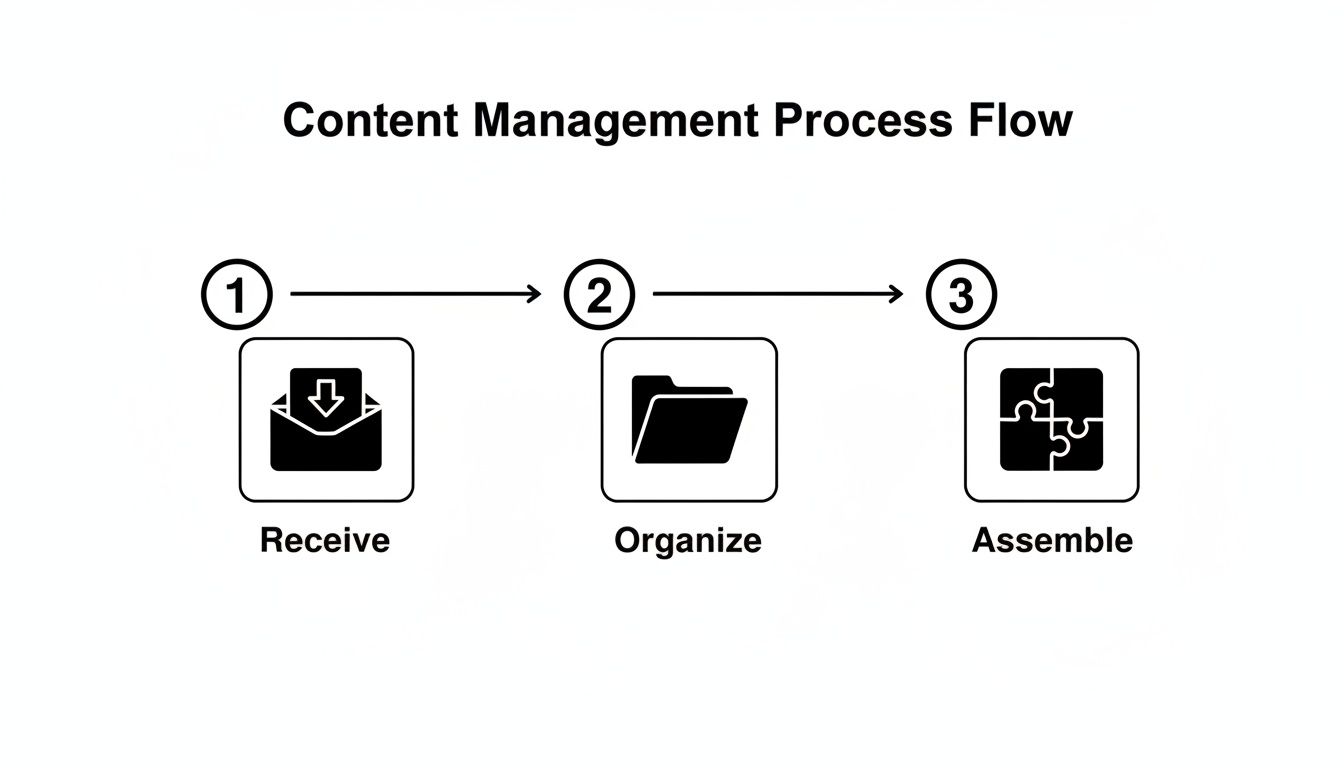
Having a structured system like this is non-negotiable if you want the speed needed to test hundreds of ad combinations efficiently.
Accelerating Your Learning Cycles
This modular testing philosophy is exactly why UGC is so potent for performance-focused brands. The data backs it up, big time. UGC ads deliver a 20% better ROI, and viewers are 161% more likely to convert. On TikTok, the lift is even crazier—UGC boosts engagement by a massive 159%.
There's a reason large enterprises, which hold 63.1% of the UGC market share, rely on its authentic feel to drive results.
The goal is to learn faster than your competition. By systematically testing creative components, you build an invaluable library of insights about what your audience responds to, accelerating your path to profitability and leaving competitors behind.
When you're ready to really pour gas on the fire, figuring out how to scale content creation without quality dropping off a cliff is crucial. This modular system ensures that as your content volume grows, so do your data-driven insights. It turns your creative process from a guessing game into a predictable, scalable system for finding winning ads.
Common Questions About Starting UGC
Diving into user-generated content for the first time always brings up a bunch of questions. I get it. You want to make sure you're setting up a program that actually works without making rookie mistakes.
Let’s run through some of the most common things brands ask when they're just getting their feet wet with UGC.
How Much Should I Pay UGC Creators?
There’s no magic number here—compensation is all over the map. What you pay depends on the creator's experience level, their audience, how complex the video is, and—most importantly—the usage rights you need.
A nano-creator with 1,000-10,000 followers might ask for anywhere from $50 to $250 for a single video. Bump up to a micro-creator, and you could be looking at $250 to $1,000 or more. If you're just starting and want to test the waters, offering free products in exchange for content is a fantastic way to build relationships with up-and-coming creators.
Honestly, the exact dollar amount isn't the most critical piece. What truly matters is having a crystal-clear agreement. Always, always get a contract that outlines payment, deliverables, and exactly how long you can run their content in your paid ads (e.g., 30, 60, or 90 days).
What Makes a Good UGC Creative Brief?
A killer brief is a delicate balance. You need to give creators enough direction to get the content you need for your ads, but not so much that you kill the authentic vibe that makes UGC work in the first place. A brief that’s too buttoned-up will give you stiff, scripted videos, which is the exact opposite of what you’re paying for.
Here’s what your brief absolutely must include to set your creators up for a win:
One Clear Objective: Tell them the single most important thing the video needs to do. For example, "Show how our moisturizer is the perfect fix for dry winter skin."
Key Talking Points: Give them a few must-mention features or benefits, but make it clear you want them to say it in their own words.
Brand Guardrails: List any hard "dos and don'ts." Think tone of voice, or specific claims to avoid.
A Specific Call-to-Action: Don't be vague. Tell them exactly what you want the viewer to do next.
Tech Specs: Keep it simple. Mention things like 9:16 vertical video format and the need for good, natural lighting.
Do I Need Legal Rights to Use UGC in Ads?
Yes. Absolutely. This is non-negotiable.
The second you plan to use a creator's content for commercial purposes—especially in paid advertising—you must have explicit permission and the proper usage rights locked down.
This should all be laid out in a formal agreement or contract before a single video is shot. Your contract has to be specific about where you can use the content (Meta, TikTok, your website), for how long (90 days, in perpetuity, etc.), and whether you have the right to edit or remix it. Skipping this step is a recipe for serious legal and financial headaches down the road.
How Many UGC Ads Should I Test per Week?
There’s no perfect number, but I can tell you this: the brands that scale the fastest are the ones with the highest testing velocity. The old-school approach of creating one or two perfect, polished ads and seeing how they do is just too slow for today's platforms.
A much smarter, modern workflow is to test dozens of variations by swapping out modular pieces—think different hooks, bodies, and CTAs. Start with a volume you can actually handle and analyze, then ramp up as you get your process dialed in. The goal is to learn faster than your competition and get ahead of creative fatigue before it kills your performance.
Ready to stop the manual grind and start scaling your ad creative? Sovran automates the entire process, from organizing your clips to assembling hundreds of ad variations in minutes. Find your winning ads 10x faster and leave creative fatigue behind. Start your free 7-day trial at Sovran today.

Manson Chen
Founder, Sovran
Related Articles
Your Ultimate Guide to UGC Style Video Ads
Master UGC style video ads for Meta and TikTok. This guide reveals proven frameworks, scripts, and scaling tactics to boost your ROAS in 2026.
8 High-Converting Static Ads Examples for 2026
Discover 8 high-performing static ads examples from top apps. Learn to create text-overlays, testimonials, and lifestyle ads that convert.
Your Guide to a Social Media Ad Generator in 2026
Discover how a social media ad generator revolutionizes creative production. Learn to automate video ads, scale testing on Meta & TikTok, and drive performance.