Mastering Direct Response Video Ads for Explosive Growth
Discover how to create, test, and scale high-impact direct response video ads. Learn proven frameworks and data-driven workflows to drive real results.
Jump to a section
- Understanding Direct Response Video Ads and Why They Work
- The Anatomy of a High-Converting Video Ad
- Writing Video Ad Copy That Converts
- Building a Modern Creative Production Workflow
- How to Measure and Optimize Ad Performance
- Scaling Creative Velocity with AI and Automation
- Got Questions? We've Got Answers
Let's be clear: a direct response video ad has one job and one job only: **to get someone to do something right now.Let's be clear: a direct response video ad has one job and one job only: to get someone to do something right now. We're not talking about building fuzzy brand awareness here. These ads are precision-engineered to drive immediate, measurable actions—clicks, installs, sign-ups, or sales.
Understanding Direct Response Video Ads and Why They Work
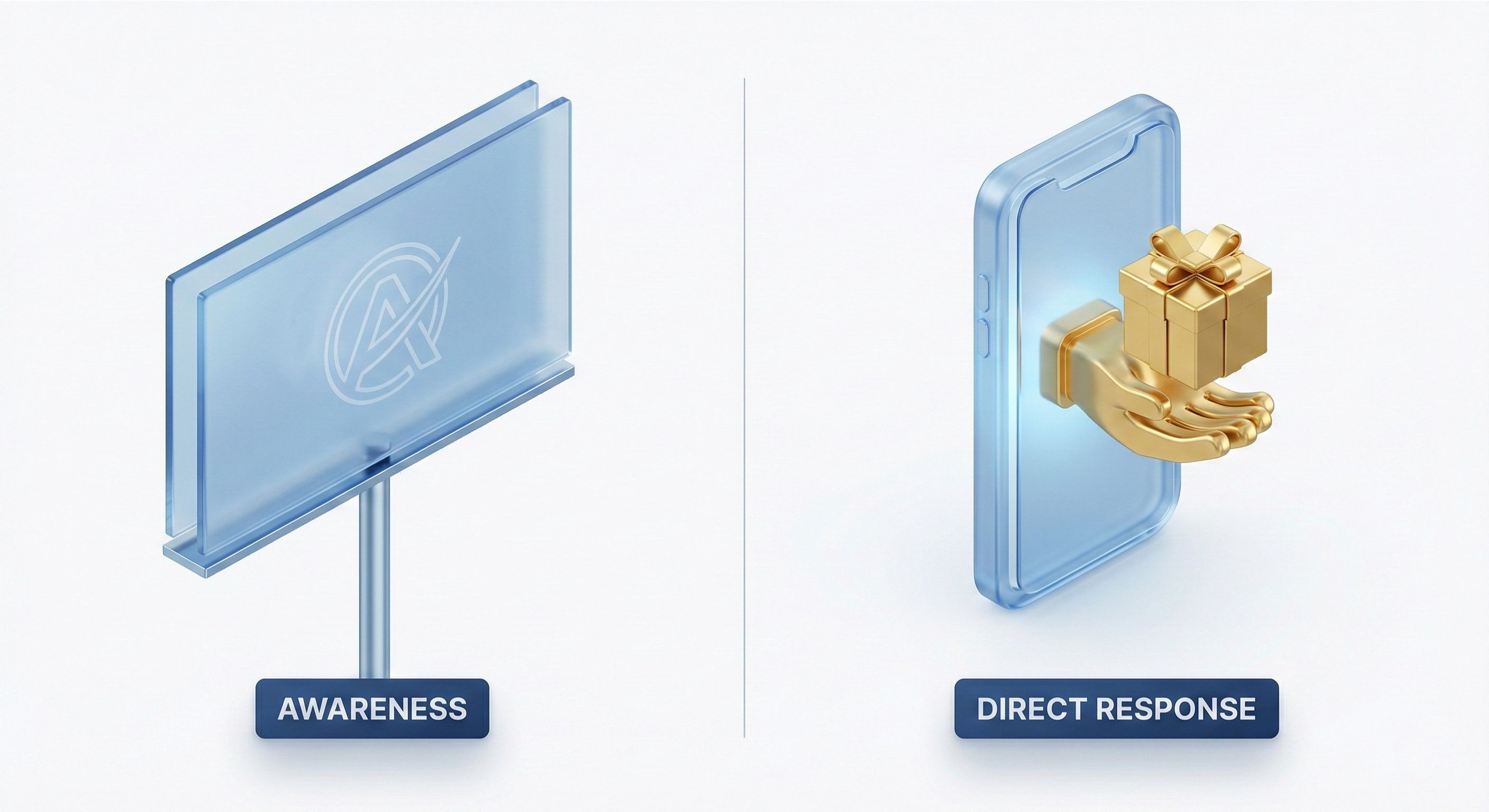
Think about the difference between a giant billboard on the highway and a skilled salesperson standing right in front of you. The billboard just hopes you'll remember the brand later. The salesperson looks you in the eye and asks for the sale.
That's the core difference. Direct response video ads are your digital salesperson. They aren't built for vague impressions or brand lift studies; they are data-driven tools designed to close the deal on the spot. On fast-moving platforms like Meta and TikTok, where you have seconds to capture attention, that immediate action is the only metric that really counts.
The Shift from Passive Viewing to Active Scrolling
The world of linear TV is long gone. We used to sit back and watch, but the rise of DVRs taught us all to skip ads. That behavior is now supercharged on mobile. Today’s users aren’t passive viewers; they're active scrollers, swipers, and tappers, making split-second decisions on what’s worth their time.
This massive shift in behavior makes direct response principles non-negotiable. You don't have 30 seconds to tell a beautiful, meandering story. You have maybe three seconds to stop the scroll and give someone a compelling reason to act.
For performance marketers and user acquisition managers, mastering direct response video ads isn't just an advantage—it's a necessity for driving measurable growth in a competitive digital world.
The market trends back this up completely. The U.S. digital video ad market is set to hit a massive $72 billion next year, a huge leap from $64 billion. This explosive 18% year-over-year jump shows a fundamental change: digital video now eats up nearly 60% of all TV and video ad spending. That demand is almost entirely driven by performance-focused platforms. If you want to dig into more data, Amra & Elma has some great insights on video advertising's impact.
At the end of the day, direct response video is king because it’s perfectly aligned with how modern platforms and people actually behave. It respects the user's fleeting attention while giving advertisers what they crave: real, tangible results.
The Anatomy of a High-Converting Video Ad
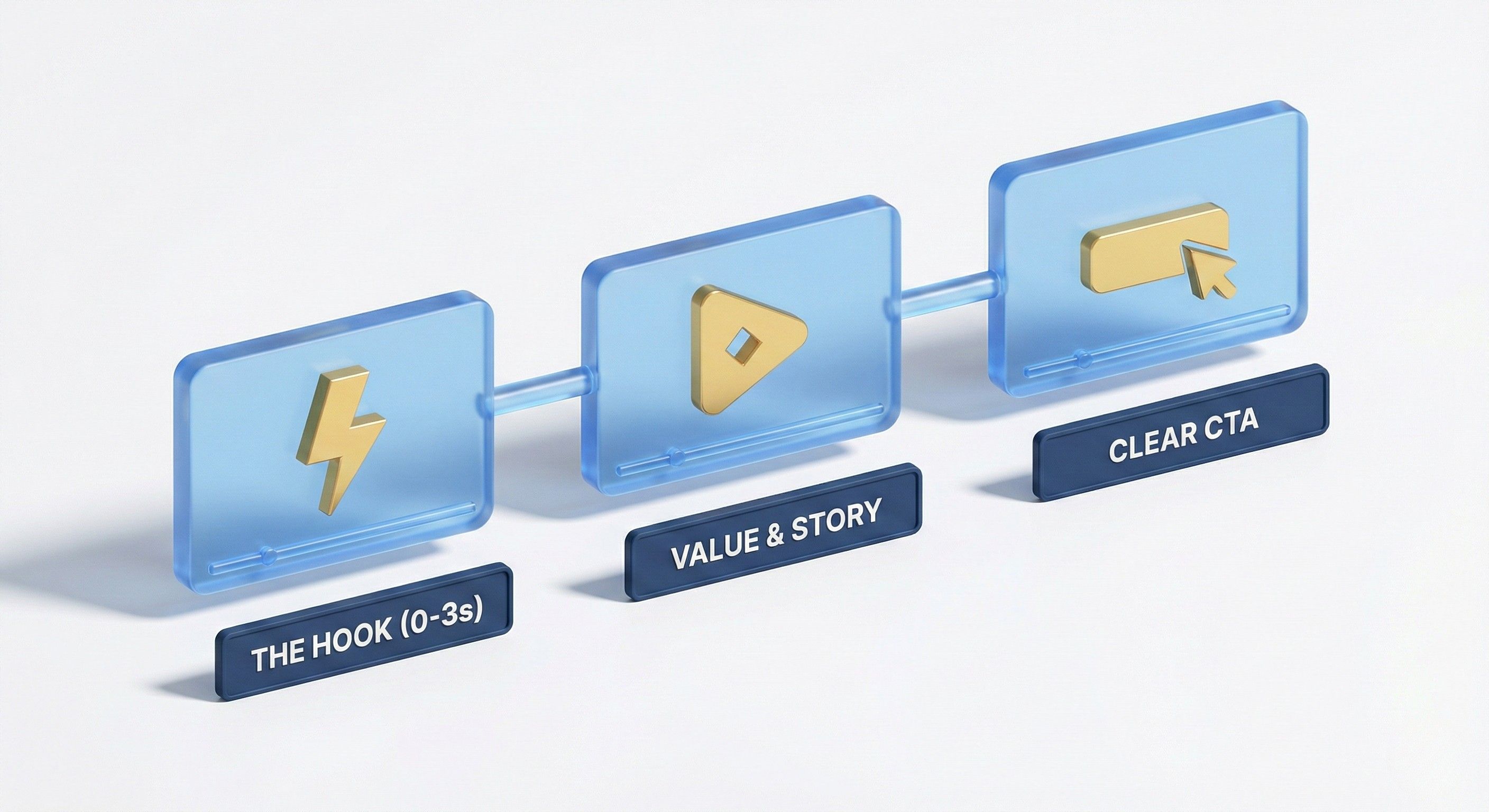
A video ad that actually gets people to click isn't an accident. It's a machine, carefully engineered with a specific psychological goal: guide a viewer from casual scrolling to a decisive action. At their core, every high-converting direct response video ad follows the same simple but ridiculously powerful three-part structure.
This isn't just a creative guideline; it's a psychological roadmap. Getting this anatomy right is the first step to building ads that don't just rack up views, but actually generate revenue.
The Hook: Your First Three Seconds
The first three seconds of your video are the most valuable real estate you'll ever own online. In a feed overflowing with distractions, your hook is the scroll-stopper. Its one and only job is to break the viewer's mindless scrolling pattern and earn you a few more seconds of their attention.
A powerful hook does this by triggering an instant emotional or cognitive jolt. It doesn't tell the whole story—it just opens a loop or poses a question so compelling that the rest of the ad feels like the necessary answer.
A few hook strategies we see work all the time:
A Bold Claim: "This app will save you 10 hours of work this week."
A Surprising Visual: Think of an unexpected unboxing or a product demo that looks completely wild.
A Relatable Problem: "Tired of your phone dying by 3 PM?"
A Direct Question: "Did you know you're overpaying for your insurance?"
The goal here isn't to be clever. It’s to be impossible to ignore. A great hook makes someone pause and think, "Wait, what is this?"
The Body: Delivering the Value
Okay, you’ve got their attention. Now the body of the ad has to deliver the core message. This is where you build your case, show off the value, and convince them your solution is the answer to the problem you just hinted at. The key is to keep the momentum going and directly address the promise you made in the hook.
The most effective direct response video ads don’t sell features; they sell outcomes. The body of the ad must clearly and quickly show the viewer how their life will be better after taking action.
For example, instead of just listing an app's tech specs, you show a user effortlessly blasting through a task that used to be a massive headache. You can agitate a known pain point ("Don't you hate when...") and then immediately position your product as the obvious, simple fix. This is also the perfect place for social proof, like user testimonials or impressive stats, which can be incredibly persuasive.
The CTA: The Final Push
The Call to Action (CTA) is the final, make-or-break piece. After hooking the viewer and proving your value, you have to tell them exactly what to do next. Any hint of ambiguity is the enemy of conversion. A weak or fuzzy CTA will make even the most interested viewer keep on scrolling.
Your CTA needs to be:
Clear and Direct: Use strong, action-oriented verbs like "Shop Now," "Download Free," or "Get Your Quote."
Low-Friction: Make the next step sound easy and risk-free.
Reinforced Visually: The action should be stated in the voiceover, spelled out with on-screen text, and mirrored in the platform's own CTA button.
Every single element in the ad—from the visuals and music to the text overlays—should funnel the viewer toward this one decisive action. This fundamental structure is the blueprint for countless winning campaigns, and you can see it in play across tons of effective video ad examples. Mastering this flow is the key to turning passive views into profitable results.
Writing Video Ad Copy That Converts
Let's be real: a slick-looking video without a killer message is just expensive noise. In the world of direct response video ads, your copy is the engine. It's everything from the script your talent reads to the text splashed across the screen, and its job is to turn a passive scroller into an active customer.
Great ad copy isn't about being clever for the sake of it. It’s about psychological precision. It needs to hook someone in, frame their problem perfectly, show them why your product is the only solution, and then give them a crystal-clear, can't-miss next step. Let’s break down how to write copy that doesn't just get views, but actually gets you paid.
Moving from Features to Benefits
This is probably the most common mistake I see brands make. They get so caught up in what their product is that they forget to talk about what it does for the customer. It's the classic features vs. benefits showdown, and in direct response, benefits win every single time.
A feature is a spec—a technical detail. A benefit is what that spec actually means for someone's life, the emotional payoff.
People don't buy a drill; they buy a hole in the wall. Your copy has to sell the "hole in the wall"—the solution, the feeling of accomplishment, the finished project.
Think about the mental switch:
Feature: "Our app uses an advanced algorithm."
Benefit: "Finish your weekly reports in five minutes flat."
Feature: "This phone has a 5,000 mAh battery."
Benefit: "Go the whole day without ever worrying about your phone dying."
Every line of your copy should be a direct answer to the viewer's silent question: "So what? What's in it for me?" Frame every single message around making their life easier, better, or more enjoyable.
Script Formulas That Drive Action
You don’t need to start from a blank page for every script. Proven formulas are proven for a reason—they tap directly into how people think and feel. One of the absolute best for direct response is Problem-Agitate-Solution (PAS). It’s a simple three-act story that grabs attention by hitting on a viewer's existing frustrations.
Here’s the breakdown:
Problem: Kick things off with a pain point they know all too well. ("Tired of juggling ten different project management tools?")
Agitate: Now, twist the knife a little. Remind them how annoying that problem really is. ("It's impossible to know who's doing what, and you're constantly blowing past deadlines.")
Solution: Swoop in with your product as the hero. Show exactly how it fixes the mess you just agitated. ("This is the only tool you need. See every project in one dashboard and finally hit your deadlines.")
This simple structure creates an emotional journey. By the end, your solution feels less like a sales pitch and more like a massive relief.
Crafting a Compelling Call to Action
Your Call to Action (CTA) is arguably the single most important piece of copy in your ad. It has to be sharp, direct, and urgent. There can be zero confusion about what you want the viewer to do next. Weak, passive CTAs like "Learn More" almost always fall flat because they're vague and don't create any sense of urgency.
Your CTA should be a command that promises a clear, immediate reward.
E-Commerce Gadget Example
Weak CTA: "Check it out."
Strong CTA: "Get 50% Off & Free Shipping – Shop Now!"
Mobile Game Example
Weak CTA: "Find us on the app store."
Strong CTA: "Download Free & Play Now!"
SaaS Tool Example
Weak CTA: "Visit our website."
Strong CTA: "Start Your Free 7-Day Trial Today!"
See the difference? The strong versions create urgency ("Now," "Today") and remove any friction by highlighting a killer offer ("50% Off," "Free"). That directness is what turns a flicker of interest into a click. When you combine benefit-focused messaging, a proven script formula, and a punchy CTA, your copy becomes a true conversion machine.
Building a Modern Creative Production Workflow
Having a killer strategy for direct response video ads is one thing. Actually executing it at the speed today's platforms demand? That's a totally different ballgame.
The old way of making ads is completely broken. It was a slow, linear march from a brief to a script to a single, over-polished video. It’s too expensive, takes forever, and you end up with one asset that either hits or misses. There's no in-between.
That outdated process is like building a car from scratch every single time you need to go somewhere. A modern workflow, on the other hand, is like having an infinite box of high-quality, interchangeable LEGO bricks. You stop trying to build one "perfect" video and instead build a system that can assemble hundreds of potential winners in minutes.
The core idea is a complete mindset shift: you move from being project-based to asset-based. Every piece of footage you own—every testimonial, unboxing clip, product demo, or founder video—is a reusable building block.
Embracing a Modular Creative System
A modular approach completely flips the script on video production. Instead of ending up with one monolithic video file, you create a library of smaller, tagged assets. This is the secret to rapidly mixing and matching components to find the winning combinations for your direct response video ads.
Think about it in terms of the classic Hook-Body-CTA structure. If you have five different hooks, three body sections, and two calls to action, you don't have ten assets. You have 30 potential video ads (5 x 3 x 2) just waiting to be tested.
Manually editing 30 unique videos would take your team days. With a modular system, you can get it done in minutes.
This simple flow is exactly how your ad copy and structure should be organized.
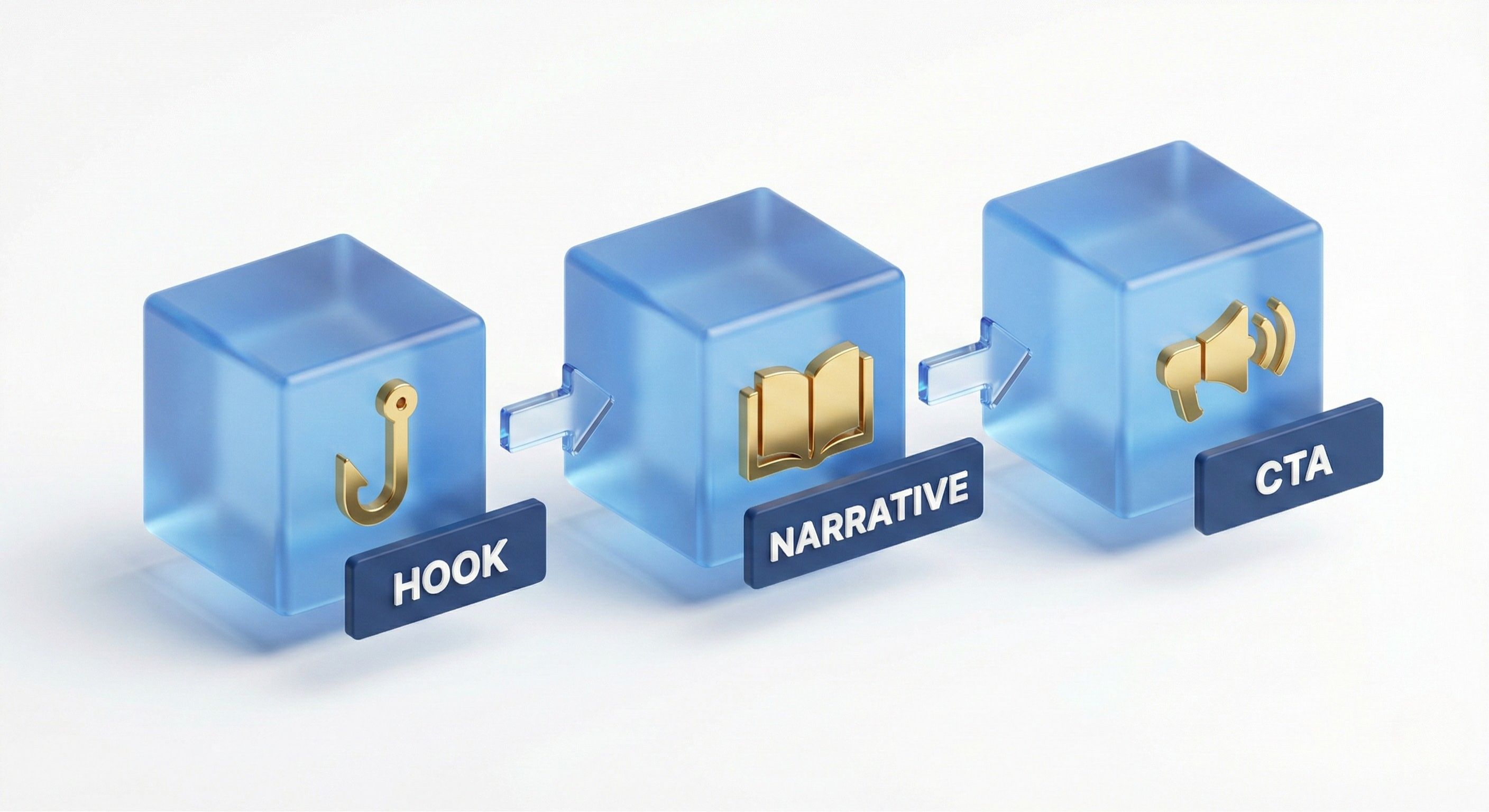
Each element—the hook, the narrative, and the CTA—is a module you can swap in and out to find what really resonates with your audience.
Building Your Asset Library
The foundation of this whole workflow is a well-organized, easily searchable asset library. I'm not talking about a messy folder on a shared drive. This needs to be a dynamic database where every single clip is tagged and categorized so you can find it instantly.
Here’s how to get started:
Gather All Raw Footage: Pull together every piece of video content you have. This includes user-generated content (UGC), slick B-roll, gameplay recordings, founder videos, and customer testimonials. Everything.
Tag Everything Meticulously: Go way beyond simple file names. Use descriptive tags that a creative strategist would actually search for, like 'unboxing-excitement,' 'problem-frustration-shot,' 'testimonial-specific-feature,' or 'app-ui-demo'.
Organize by Ad Component: Create folders or collections specifically for Hooks, Body segments, and CTAs. This makes it incredibly simple to grab the exact type of clip you need when you're building a new ad concept.
A modular asset library transforms your team from video editors into creative architects. The focus shifts from tedious manual labor to high-level strategic thinking about what combinations are most likely to convert.
This system also helps you manage brand guidelines centrally, making sure every video variant stays on-brand. You can apply batch updates, like adding subtitles or text overlays, across dozens of assets all at once. For teams ready to ditch manual editing, the next logical step is to explore tools that can automatically edit videos based on these modular principles to achieve true creative velocity.
Scaling Production with Automation
Once your library is organized, automation tools can take over the heavy lifting. Platforms like Sovran are built from the ground up for this modular workflow. You upload your tagged clips, define your creative frameworks, and the system can generate hundreds of unique video variations in seconds.
The best tools are designed for testing, not just creating. They allow you to quickly assemble and launch new ad concepts, turning production from a bottleneck into a genuine competitive advantage. This is how elite performance teams stay ahead of creative fatigue and consistently find their next winning ad.
How to Measure and Optimize Ad Performance
A killer creative concept is just a nice idea until you can prove it works. For direct response video ads, we don't measure success in likes or views—we measure it in cold, hard business results. This is where we stop talking about art and start focusing on the science, pushing past vanity metrics to zero in on the numbers that actually move the needle.
The game here is to build a predictable engine for success. You don’t just launch an ad and cross your fingers. You launch, measure, learn, and iterate. It’s a constant loop, and this data-driven feedback cycle is what separates the campaigns that limp along from the ones that truly scale.
Focusing on Business-Driving Metrics
In the world of direct response, your dashboard needs to be laser-focused on metrics that tie every ad dollar directly to revenue. Forget about viral potential or brand sentiment for a second. Every cent you spend has to be accountable.
These are the three pillars you need to live and breathe:
Click-Through Rate (CTR): This is your first signal. It tells you if your creative is resonating. A high CTR means your hook is doing its job—stopping the scroll and getting people interested enough to tap. It's the gateway to everything else.
Cost Per Action (CPA): This is the real cost of getting what you want, whether that's a customer, a lead, or an app install. CPA tells you exactly what you’re paying to hit your main objective.
Return On Ad Spend (ROAS): The bottom line. For every dollar you put in, how many are you getting back out? A healthy ROAS is the clearest sign you've got a profitable campaign on your hands.
And video is a powerhouse for driving these outcomes. The proof is in the numbers: 93% of marketers see a positive return on their video investment, and 89% of businesses are now using video in their marketing mix. This isn't just a trend; it's a response to performance, with some brands seeing direct sales lifts as high as 87%. You can dig into the full breakdown in the latest video marketing statistics from The Desire Company.
Identifying and Combating Creative Fatigue
Listen, no ad is a unicorn that works forever. At some point, your audience will see the same creative too many times, and it’ll just stop hitting. That's creative fatigue, and spotting it early is crucial to keeping your performance from tanking.
The warning signs are pretty straightforward if you know what to look for:
Rising Frequency: The average number of times a single person sees your ad is creeping up.
Declining CTR: As people see it more, they start ignoring it. Your click-through rate takes a nosedive.
When you see these two metrics moving in the wrong direction, it’s a flashing red light. Your ad has run its course. It's time to swap in something fresh.
The moment you launch a winning ad, you should already be thinking about its replacement. The goal isn’t to find one perfect video; it’s to build a system that consistently churns out new winners to stay ahead of fatigue.
Implementing the Creative Learning Cycle
This brings us to the most important part of optimization: the creative learning cycle. The best performance marketers don’t see creative as a one-and-done deal. They treat it like an ongoing experiment designed for one thing: constant learning.
It’s a simple but incredibly powerful loop:
Launch Variants: You don't just launch one video. You launch a bunch of variations testing specific things—different hooks, different body copy, different CTAs.
Analyze Data: You watch the numbers roll in. How is each version doing against your core metrics (CTR, CPA, ROAS)?
Identify Winners: You pinpoint what's actually working. Was it that UGC-style hook? The benefit-driven text overlay? That urgent call to action?
Feed Insights Forward: You take those winning ingredients and make them the starting point for your next batch of creative, building new ads based on what you’ve already proven works.
This process turns creative from a guessing game into a data-driven science. If you want to get really granular, you can even apply techniques like A/B testing for YouTube Shorts to really dial in your strategy. By systematically testing and learning, you start to build a real playbook for what your audience wants, allowing you to create better and more effective direct response video ads with every single cycle.
Scaling Creative Velocity with AI and Automation

Let's be honest. The biggest headache in performance marketing isn't finding one winning ad. It's having to find the next one, and the one after that, before ad fatigue kills your campaign. The second you launch a winner, a countdown timer starts. Your audience will get bored, and performance will tank. This cycle puts insane pressure on creative teams to just… make more stuff, faster.
This is where AI and automation become a massive advantage for your direct response video ads. We're not just talking about speeding up old workflows. We're talking about a completely new way to think about producing and testing creative at scale.
Automating the Tedious Manual Work
Imagine your team wants to test a new campaign idea. They map out five different hooks, three body variations, and two distinct calls to action. The math is simple, but the reality is brutal: that’s 30 unique videos (5x3x2). An editor would have to sit in CapCut or Premiere Pro, grinding out each version, one by one.
That manual process is slow, costly, and a huge drain on your most valuable resource: strategic brainpower. AI-powered platforms completely flip this script by automating the soul-crushing tasks.
Automated Asset Tagging: Instead of manually labeling footage, AI can watch your raw clips and automatically tag them, making your entire library instantly searchable.
Bulk Video Rendering: Forget one-by-one exports. An automated system can take your modular pieces—hooks, bodies, CTAs—and assemble all 30 variants in a matter of minutes.
Batch Text Overlays: Need to add subtitles or test different headlines on a dozen clips? Automation handles it with a click, not an afternoon of tedious work.
When you offload this grunt work, you free your team from the assembly line. Their time shifts from mind-numbing execution to high-level strategy—analyzing performance data and dreaming up the next big creative angle.
Using AI as a Creative Partner
Beyond just doing the boring stuff, generative AI is now solving one of the most persistent bottlenecks for advertisers: running out of raw footage and fresh ideas. A high-performing campaign can come to a screeching halt simply because you've exhausted your B-roll library.
Generative AI steps in as a creative partner that can produce new visual assets on demand. Need a shot of someone using your product in a specific setting? AI can create it. Stuck on a new hook? AI can brainstorm dozens of concepts based on your past winners. If you really want to supercharge content production, integrating the best AI video generators into your workflow allows you to create high-quality ads at a massive scale.
The real takeaway here is that AI doesn't replace creative strategists; it gives them superpowers. It automates the 'how' so your team can focus entirely on the 'what' and the 'why'—the core ideas that actually drive results.
This change lets you scale your testing velocity by an order of magnitude. A testing plan that used to take a week to execute can now be done in a single afternoon. You get to learn faster, find your next winner sooner, and stay ahead of the curve.
For a deeper dive into this new reality, our guide on AI for advertisers explores why these tools are becoming non-negotiable for modern growth teams. Platforms like Sovran are built for exactly this workflow, turning your existing assets into a powerful engine for creating, testing, and scaling direct response video ads at a pace your competitors simply can't match.
Got Questions? We've Got Answers
When you're getting into direct response video ads, a few questions always come up. Let's tackle the big ones so you can get your strategy dialed in.
How Long Should a Video Ad Be for Meta and TikTok?
Keep it short. The sweet spot for platforms like Meta and TikTok is right around 15 to 30 seconds.
You have to remember, your real fight is in the first 3-5 seconds. That’s your entire window to hook someone and stop their thumb from scrolling. If you can’t grab them there, the rest of the ad doesn't matter. While a really complex product might need a full 60 seconds to tell its story, shorter, punchier ads almost always win when you're trying to drive an immediate action.
What Is the Biggest Mistake Advertisers Make?
Thinking they can just create one "perfect" video and ride it into the sunset. That’s not how performance marketing works.
The game is all about rapid testing and iteration. So many advertisers fall flat because they don't produce enough creative variations to test different hooks, value props, and calls to action. They get attached to one idea and run it into the ground.
This lack of volume is a direct path to creative fatigue and tanking performance. The only way out is a modular workflow that lets you test at a high volume to constantly find new winners.
Can I Create Effective Video Ads Without a Big Budget?
Absolutely. In fact, a huge budget can sometimes hurt you on platforms like TikTok and Instagram Reels.
Highly polished, big-studio ads can feel out of place and get ignored. What really works is authentic, user-generated-style (UGC) content that feels native to the platform. People respond to videos that feel real.
You can create killer ads with just your smartphone, a screen recording, or some customer testimonials. It's all about authenticity, not a massive production budget.
Ready to stop the manual grind and start scaling your ad creative? With Sovran, you can automate video production, accelerate your testing, and find winning ads 10x faster. Start your free 7-day trial today at https://sovran.ai.

Manson Chen
Founder, Sovran
Related Articles
8 High-Converting Static Ads Examples for 2026
Discover 8 high-performing static ads examples from top apps. Learn to create text-overlays, testimonials, and lifestyle ads that convert.
- static-ads
- performance-marketing
- 5 more
10 Actionable Ad Creative Ideas That Convert in 2026
Discover 10 actionable ad creative ideas for Meta & TikTok. Get hooks, scripts, and testing frameworks to boost your ROAS and combat creative fatigue.
- ad-creative-ideas
- video-marketing
- 6 more
How to Turn Link Into Video: Ads That Convert in 2026
Learn how to turn link into video for Meta & TikTok ads. Leverage AI to scale creation, boost ROI, and succeed in 2026.
- ai-video-generation
- link-to-video-ads
- 6 more