How to Make a Commercial That Actually Converts
Learn how to make a commercial for Meta & TikTok. Our guide covers scripting, AI-powered production, and testing to create ads that drive results.
Jump to a section
Making a commercial that actually converts on platforms like Meta and TikTok isn't about one big, perfect shot. It’s a high-velocity creative system.
The modern process is a rapid cycle: build a solid brief, script a bunch of modular ad concepts, produce them efficiently (often with AI), and then launch continuous tests to find out what resonates right now.
The Modern Playbook for Winning Commercials
Forget the old agency model of dropping a huge budget on one polished, expensive ad. To win on Meta and TikTok, you need an agile, data-first mindset. This isn't about what a focus group liked six months ago; it's about what drives conversions today.
For user acquisition managers and growth marketers, this means embracing a workflow built on speed and constant iteration.
The game has completely changed. Your goal is no longer a single masterpiece but a constant stream of testable creative variations. You're hunting for profitable winners by exploring dozens of concepts, not banking your entire budget on one big swing. This approach slashes your risk and dramatically increases the odds of finding a commercial that genuinely connects and drives results.
Shifting from Tradition to Performance
The traditional advertising world ran on long timelines, massive budgets, and a vague focus on "brand awareness." Commercials were meticulously crafted over months. The modern performance approach, in stark contrast, prioritizes speed, data, and direct-response goals like app installs or sales. It’s a total shift in philosophy, one that respects the short attention spans and rapid trend cycles of social media.
The chart below breaks down this modern, four-step process for making commercials that actually perform.
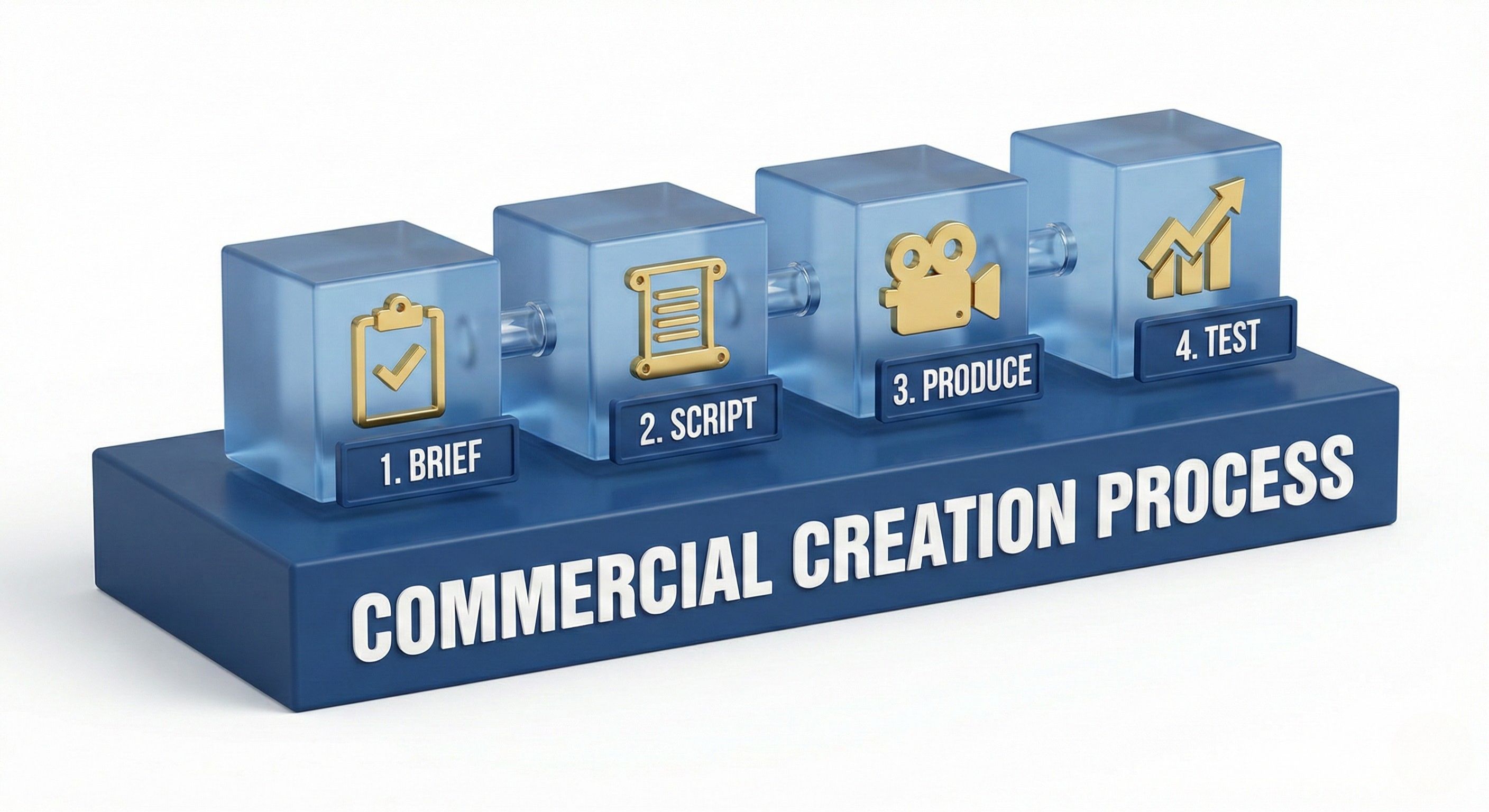
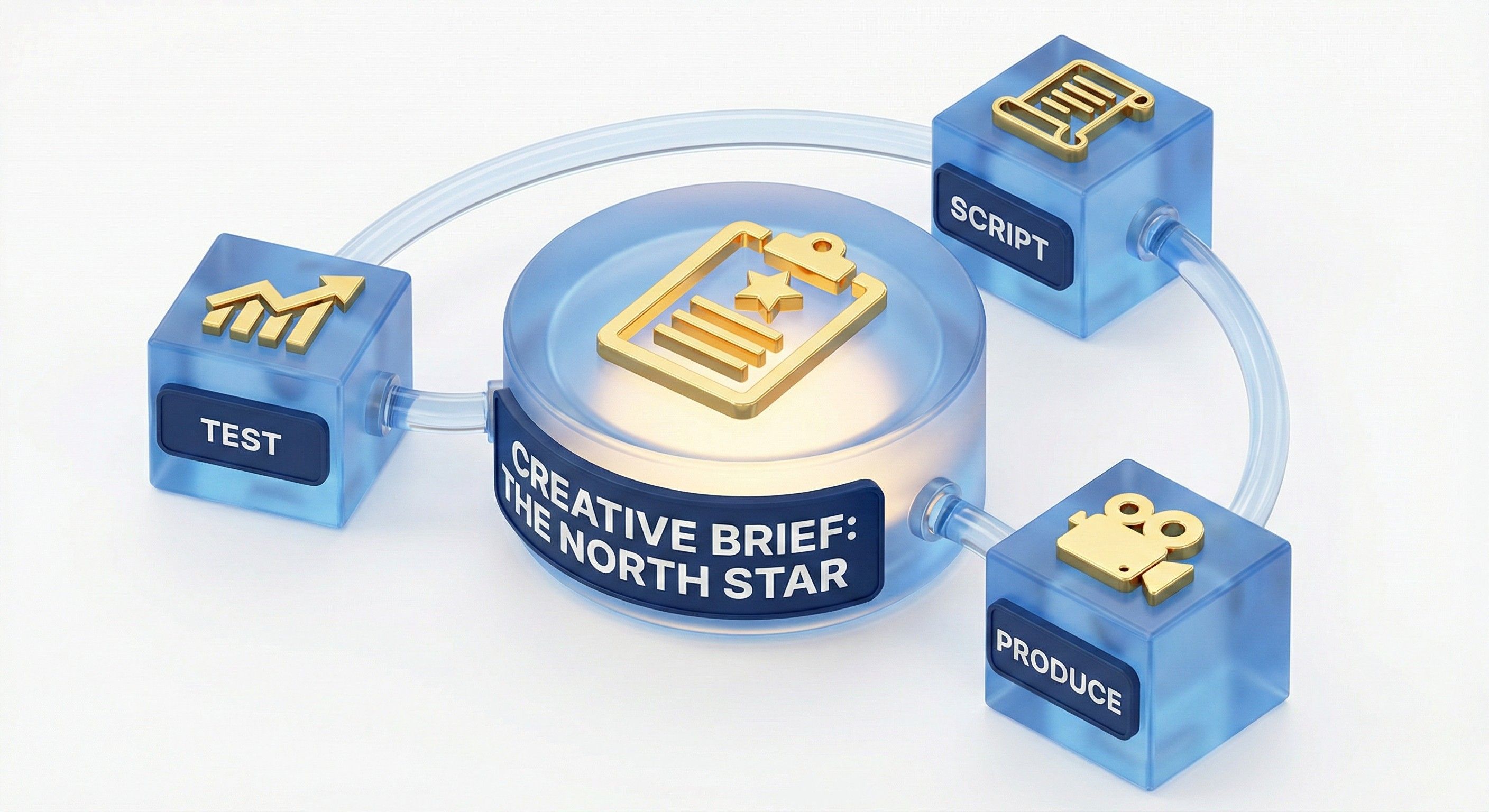
This workflow creates a continuous feedback loop. Insights from your tests feed directly back into your next round of creative briefs, making your advertising smarter with every dollar you spend.
To put this shift into perspective, let's look at how the old and new methods stack up. The differences are stark and highlight why the modern approach is non-negotiable for performance-driven brands.
Traditional vs Modern Commercial Production
Aspect | Traditional Approach | Modern Performance Approach |
|---|---|---|
Goal | Brand awareness, reach | Direct response (conversions, sales) |
Timeline | Months | Days or weeks |
Budget | Large, fixed per project | Smaller, flexible, iterative |
Volume | One "hero" ad | Dozens of variations for testing |
Data Use | Post-campaign analysis | Real-time data to inform iteration |
Success Metric | Vague metrics (views, impressions) | Hard metrics (CPA, ROAS) |
Platforms | TV, broadcast | Social media (Meta, TikTok) |
This table really drives home the point: today's game is about agility and measurable results, not slow, monolithic campaigns.
Why This Agile Approach Is Essential
Adopting this high-velocity system isn't just a good idea; it's a necessity driven by massive market trends. Global spending on video ads is projected to blow past $190 billion in 2025, a hefty jump from $180 billion in 2024, with social media leading the charge. This explosion in spending is exactly why mastering efficient commercial production is the only way to find profitable winners.
This new reality makes tools like Sovran a game-changer for UA managers. When you need to pump out dozens of ad variations, manual workflows in apps like CapCut become a massive bottleneck. The ability to automate production and testing isn't a luxury anymore—it's a core competitive advantage. For more on this, check out our guide on the role of AI for advertisers.
The core principle is simple: test more, learn faster, and scale what works. This iterative cycle is the engine of modern performance marketing and the key to unlocking consistent growth.
Of course, speed doesn't mean sacrificing quality. To ensure a solid outcome from your commercial, following strong video production best practices is fundamental from concept to completion. This modern playbook sets the stage for the practical steps that follow, guiding you from a blank page to a profitable ad campaign.
Building Your Foundation with a Bulletproof Creative Brief
Every great commercial starts with a rock-solid plan, not just a cool idea. Before you even think about scripting or shooting, you need to nail down your creative brief. This document is your North Star. It's the single source of truth that keeps everyone aligned and ensures every decision—from the hook to the final CTA—is driving toward a specific business goal.
For performance ads on platforms like Meta and TikTok, a strong brief isn't just nice to have; it's non-negotiable. It’s what turns abstract goals into an actionable blueprint for your team. This isn't just paperwork; it’s where you win or lose the game before you even start.
Defining Your Core Objective
First things first: what is the one action you want someone to take after seeing your ad? If you can't answer this in a single sentence, your commercial will be a blurry mess that doesn't convert. Your objective has to be specific and measurable.
Forget vague goals like "increase brand awareness." That's not a performance metric. We're talking about tangible outcomes that directly impact your bottom line.
Here are a few examples of concrete objectives we focus on:
Drive app installs for a new mobile game.
Generate qualified leads for a SaaS demo sign-up.
Increase sales of a specific e-commerce product by 15%.
Encourage sign-ups for a free trial or a webinar.
Everything else in your brief—the messaging, the tone, the visuals—will flow directly from this single objective.
Nailing Down Your Target Audience
You can't talk to everyone, so who are you really talking to? "Women aged 25-40" isn't an audience; it's a lazy demographic. To create an ad that actually connects, you need to build a detailed customer persona.
Get into their head. What does their daily life look like? What are their biggest frustrations? What kind of humor do they actually find funny? What problems are keeping them up at night that your product can solve?
A great persona goes deep. Instead of "gamers," you might target "competitive mobile RPG players who value community and spend 2+ hours a day in-game." That level of detail is gold. It’s the difference between shouting into the void and having a real conversation.
A well-defined persona makes it infinitely easier to write compelling copy. You're no longer guessing what might work; you're speaking directly to an individual whose needs and desires you deeply understand.
Articulating Your Unique Selling Proposition
Okay, you know your goal and you know who you're talking to. Now, it’s time to figure out your unique selling proposition (USP). This is the core message of your ad—the one thing a viewer absolutely must remember after scrolling past.
Your USP needs to answer the question: "Why should I choose you over everyone else, including doing nothing at all?" It must be clear, concise, and hit them right where it matters. It’s not a laundry list of features; it's the single most powerful benefit you deliver.
For example, a productivity app's USP isn't its "AI-powered task management." It's that it "gives you back five hours of your week." The benefit is always the hero, not the feature. Get this right, and you're halfway there.
Sourcing Inspiration That Works
Finally, a great brief is never created in a vacuum. You need to gather real-world inspiration to guide your creative direction. Don't start with a blank page—build a swipe file of proven concepts from competitor ads and user-generated content (UGC).
Seriously, spend an hour scrolling through the TikTok Creative Center or the Meta Ad Library. See what your competitors are running. What hooks are they using? What formats are getting traction? Screenshot everything. Save the links.
This isn't about copying. It's about recognizing patterns and understanding what already resonates with your audience on these platforms. By grounding your brief in real-world examples, you shift from pure guesswork to a strategic, data-informed approach that builds ads designed to perform from day one.
Scripting Commercials for Maximum Impact
A killer script is the soul of a high-converting commercial. It’s the bridge between your well-researched brief and a story that actually stops the scroll and gets someone to act.
On platforms like Meta and TikTok, you don't get a slow wind-up. You have less than three seconds to earn a viewer's attention before they're gone forever.
This is why modern scripting isn't about crafting one perfect, linear story. It’s about creating modular, interchangeable parts—hooks, bodies, calls-to-action—that you can remix into hundreds of testable ad variations. This approach lets you find winning combinations fast, giving you a massive edge without having to start from scratch for every new idea.
The Power of Modular Frameworks
Think of your script less like a screenplay and more like a set of LEGO bricks. The most fundamental and effective structure is the classic Hook-Body-CTA framework. It’s simple, direct, and perfectly built for the chaos of a social media feed.
The Hook (1-3 seconds): This is it. Your only shot to stop the scroll. It needs to be visually jarring, emotionally charged, or ask a question that's impossible to ignore. A bold claim, a controversial opinion, or a weird visual—they all work.
The Body (5-15 seconds): Here's the meat of your message. You'll introduce the problem, show off your product as the solution, and build up its value. Keep it tight, clear, and laser-focused on benefits, not just a list of features.
The Call-to-Action (1-3 seconds): Tell them exactly what to do next. "Shop Now," "Download for Free," "Get Yours Here." No ambiguity.
When you treat these three pieces as separate modules, the magic happens. Imagine you come up with three different hooks, two body sections, and two CTAs. Just by mixing and matching, you can instantly create 12 unique ads from that single core concept.
Before we dive into more advanced formulas, here's a quick cheat sheet for some of the most reliable scripting frameworks we use.
Modular Scripting Frameworks at a Glance
This table breaks down the go-to frameworks that consistently deliver results on social. Knowing which one to pull out for a specific campaign or audience is half the battle.
Framework | Core Components | Best For |
|---|---|---|
Hook-Body-CTA | 1. Attention-grabbing opening | General purpose, direct-response ads where clarity and speed are key. The workhorse of performance creative. |
PAS | 1. Problem: State the viewer's pain point. | Building an immediate emotional connection. Perfect for products that solve a nagging, relatable problem. |
UGC Mashup | 1. Hook with a strong quote/reaction. | Building massive trust and social proof. Excellent for top-of-funnel campaigns to skeptical audiences. |
Each of these frameworks gives you a repeatable starting point, making it easier to churn out creative that feels fresh but is built on a foundation you know works.
Proven Scripting Formulas Beyond the Basics
While Hook-Body-CTA is your bread and butter, a couple of other psychological frameworks can make your commercials incredibly persuasive.
Problem-Agitate-Solution (PAS)
This is a copywriting classic for a reason—it hits people right where they live by focusing on their pain points.
Problem: Kick things off by stating a problem your audience knows all too well. (e.g., "Tired of your phone dying by 3 PM?")
Agitate: Now, pour a little salt in the wound. Remind them how frustrating that problem really is. (e.g., "It always happens right when you need directions or want to capture a perfect moment.")
Solution: Ride in on a white horse and introduce your product as the hero that makes the pain disappear. (e.g., "Our new power bank gives you three full charges, so you never have to worry again.")
PAS works so well because it validates the viewer's frustration before you ever mention your product. You build trust first, so the solution feels like a genuine relief, not just another sales pitch.
UGC Testimonial Mashup
User-generated content is pure gold on social media. It offers authentic social proof that no polished, high-budget ad can ever truly replicate. A testimonial mashup is simply a quilt stitched together from short, punchy clips of real customers.
This format feels native and immediately tears down purchase anxiety. Your happiest customers are essentially writing the script for you, making this one of the most powerful tools for building trust with cold audiences. To go deeper, check out our full guide on how to write a script for advertising that folds in these powerful methods.
Nailing Production and Post-Production at Scale
Alright, you've got a killer script. Now it's time to bring it to life. This is where the magic happens, turning those words on a page into actual video assets that can make you money. But let's be clear: production for Meta and TikTok isn't about chasing Hollywood-level perfection. It's all about authenticity, speed, and getting your message across clearly.
Whether you're setting up a more formal shoot or just whipping out a smartphone for some scrappy UGC, the core principles for vertical video are the same. You need to focus on what actually gets people to stop scrolling: solid lighting, clear audio, and dynamic shots that keep the viewer’s attention.

But for most performance teams, the shoot isn't the real headache. The true bottleneck is the mind-numbing, manual post-production grind that comes after. The goal isn't just to edit a video; it's to build a system that can take one core idea and spin it into dozens of unique versions in minutes, not days.
Production Essentials for Vertical Video
On social media, perfection is the enemy of profit. TikTok and Instagram users are so used to seeing raw, unfiltered content that overly polished ads can feel out of place and fake, often tanking performance.
So, instead of stressing about cinematic quality, just nail these fundamentals:
Crystal-Clear Audio: Bad audio is an instant scroll. If your sound is muffled or full of static, you've lost. Even a cheap lavalier mic clipped to a shirt makes a world of difference. To really step up your game, check out this creator's guide on how to enhance sound in video and make your ads sound professional.
Good, Simple Lighting: Forget the complex lighting rigs. Natural light from a window is your best friend. If you're shooting inside, a basic ring light is all you need to get clean, flattering light and kill any weird shadows.
Engaging Framing: Vertical video doesn't give you much space to play with, so make it count. Keep your subject front and center and use tight shots for a more personal feel. A little bit of movement—even just a slight camera drift—holds attention way better than a static, boring shot.
These aren't complicated rules. Stick to them whether you're directing a creator or filming yourself, and you'll end up with raw footage that's easy to work with and won't slow you down.
Revolutionizing Post-Production with AI
This is where you can really get an edge. Post-production is your assembly line—it's where you transform raw clips into a high-speed testing machine. If you're trying to manually edit every single ad variation in an app like CapCut, you're never going to scale. It's just not sustainable.
The secret to winning with commercials is understanding where your time and money deliver the best ROI, and right now, the data is screaming for AI automation. Global ad revenue is projected to hit $1.14 trillion in 2025, and commerce ads are set to reach $178.2 billion, beating TV for the first time. Performance buyers on Meta and TikTok, where 91% of businesses post videos, know that speed is everything. Still, 62% of marketers are stuck with in-house teams battling creative burnout. This is exactly where a platform like Sovran comes in. You upload your assets once, and the AI builds endless variations from your modular pieces.
The modern post-production workflow isn't about editing one video perfectly. It’s about building a system to generate hundreds of testable assets from a single set of raw clips, allowing you to learn and iterate at an unprecedented pace.
This system is all about letting AI handle the repetitive, soul-crushing tasks. Platforms like Sovran are designed specifically for this, letting you automate everything from tagging your raw footage to rendering hundreds of finished ads.
Building Your Automated Editing Workflow
To break free from the manual editing trap, you have to think about your post-production process in a more structured, scalable way. It starts with organizing your assets and ends with tools doing the heavy lifting for you.
Here's what that new workflow looks like:
Organize and Tag Raw Footage: Get all your raw clips—hooks, body segments, testimonials, CTAs—into one central asset manager. AI can automatically tag and categorize everything, making it all searchable and ready to go.
Automate Subtitles and Text Overlays: An incredible 85% of social media videos are watched on mute. Subtitles aren't optional. Manually transcribing and timing captions for dozens of ads is a complete nightmare. Use a tool that can automatically generate and style subtitles across all your videos at once.
Generate AI B-Roll: Need some extra visuals to keep things interesting? Instead of digging through stock footage sites, use AI to generate custom B-roll that actually matches your script and brand. It keeps costs down and makes sure your ads always look fresh and unique.
Bulk Render Your Variants: This is the ultimate game-changer. Instead of exporting videos one by one, an automated system can take all your modular parts and render hundreds of unique combinations in seconds. Imagine having 5 hooks, 4 body variations, and 3 CTAs. With a few clicks, you have 60 ready-to-test ads.
When you adopt this approach, post-production stops being a bottleneck and becomes your biggest strategic advantage. You can dive deeper into how to automatically edit videos at scale in our full guide. This is how you stop wasting hours on tedious tasks and start spending your time on what actually moves the needle: analyzing performance and finding your next winning commercial.
Launching and Optimizing Your Ads for Profitability
Making the commercial is only half the battle. The real work—and where the real profit is found—begins the moment you hit "launch."
A great creative asset is just potential energy. Turning it into a profitable, scalable campaign requires a methodical, data-driven approach to testing and optimization. This isn't about guesswork. It's about letting your audience tell you exactly what they want to see with their wallets.
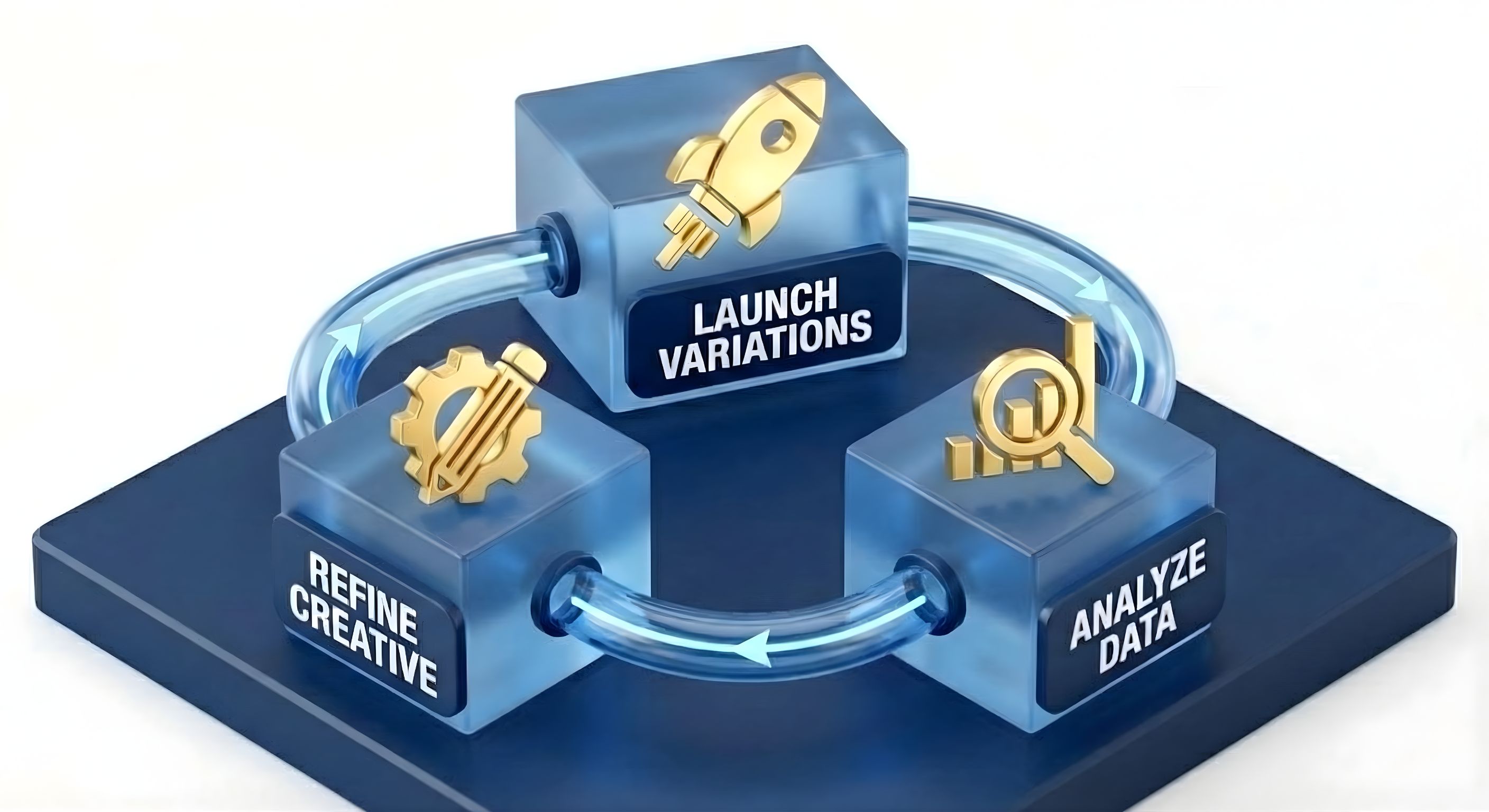
The goal is to move from a single ad concept to a powerful feedback loop. You'll launch variations, analyze the data, and use those insights to inform your next round of creative. This rapid, structured iteration is the only sustainable way to beat creative fatigue, find consistent winners, and turn ad spend into a predictable revenue engine.
A Structured A/B Testing Strategy
Throwing a dozen random ads into a campaign and hoping for the best isn't a strategy—it's just lighting money on fire. A structured A/B testing plan lets you isolate variables and learn what’s actually driving performance. You have to test one core element at a time to get clean, actionable data.
Start by focusing on the highest-impact elements of your commercial. Here’s a practical testing hierarchy that we use every day:
Test the Hook First: The first three seconds are everything. Test three to five completely different hooks against the same body and CTA. This could be a controversial question, a surprising visual, or a direct problem statement. The hook has the single biggest impact on whether someone stops scrolling, making it your top priority.
Iterate on the Body/Angle: Once you have a winning hook, pair it with two or three different body sections. Each body can present a different angle or benefit of your product. This helps you understand which value proposition actually resonates with your audience, not just the one you think should.
Optimize the Call-to-Action (CTA): Finally, test your winning Hook + Body combination with a few different CTAs. Sometimes a simple change from "Shop Now" to "Get 50% Off" can dramatically lift conversion rates.
This methodical process ensures you’re building on what works, rather than starting from scratch every single week.
Key Performance Indicators That Actually Matter
It's easy to drown in data. The trick is to focus on the key performance indicators (KPIs) that tell the full story of your commercial's performance, from that initial glance to the final conversion.
Here are the metrics that should be on your primary dashboard:
Hook Rate (3-Second View Rate): This tells you if your opening is working. A low hook rate means people are scrolling right past, and no amount of amazing body content will fix that. It's the first gate.
Click-Through Rate (CTR): CTR measures how compelling your ad is overall. It's a signal that the combination of your visual, hook, and core message was persuasive enough to earn a click.
Cost Per Acquisition (CPA): This is your true north. CPA tells you exactly how much you're paying to get a new customer or lead. It’s the ultimate measure of an ad's financial viability.
Return on Ad Spend (ROAS): ROAS measures the gross revenue generated for every dollar spent on advertising. While CPA focuses on cost, ROAS shows you the direct return, making it crucial for e-commerce and direct-sale campaigns.
A high CTR with a low conversion rate often points to a mismatch between your ad's promise and your landing page's offer. The data doesn't just grade your ad; it diagnoses problems across your entire funnel.
Streamlining Your Launch Process
The faster you can get tests live, the faster you can learn. Slow, manual launch processes are a major roadblock to scaling creative. This is where automation can give you an almost unfair advantage.
Imagine having dozens of ad variations ready to go. Manually uploading each one, writing unique copy, and setting up tracking is tedious and prone to human error. Platforms like Sovran solve this by letting you push ads directly to Meta with automatic, standardized naming conventions.
This systematic naming—for example, Campaign_AdSet_HookVariant_AngleVariant_CTAVariant—is absolutely critical. It keeps your ad account organized and makes it incredibly easy to analyze performance data in your reporting dashboard. You can instantly see which creative components are driving results without having to manually dig through messy, inconsistent reports.
This automated workflow transforms launching from a time-sucking chore into a streamlined, strategic process. By removing the manual friction, you empower your team to focus on what truly matters: interpreting the data, finding winning patterns, and scaling the commercials that are actually making you money.
Frequently Asked Questions About Making Commercials
Diving into social media ad production always brings up a few common questions. Let's get straight to the practical answers for the challenges that trip up most marketers.
How Long Should My Commercial Be?
For platforms like Meta and TikTok, shorter is almost always better. The sweet spot usually lands somewhere between 15 and 30 seconds.
That’s just enough runway to land a solid hook, get your main message across, and push for a clear call-to-action before you lose someone's attention.
But honestly, the "right" length is all about your goal. A top-of-funnel ad meant for brand awareness might stretch a bit longer to tell a quick story. On the other hand, a retargeting ad hitting a warm audience with a specific offer needs to be brutally efficient—get in, make the point, and get out.
Never stop testing this. You'll be surprised how often a punchy 9-second ad can crush a 25-second version for a certain audience.
Do I Need a Big Budget to Make a Commercial?
Absolutely not. This is probably the biggest myth holding marketers back.
On TikTok and Instagram, authentic and relatable often performs way better than a slick, high-production-value shoot. Some of the best-performing ads out there are shot on a smartphone with decent lighting and clear audio.
The quality of your idea and the clarity of your message are far more important than the cost of your camera. Funnel your resources into testing more creative concepts, not blowing it all on a single, expensive "hero" ad.
Think about allocating your budget strategically:
Creative Testing: A huge chunk should be dedicated to running multiple ad variations to see what actually resonates.
Creator Partnerships: Paying for authentic user-generated content (UGC) can deliver a massive return.
The Right Tools: Investing in smart software for editing or automation pays for itself ten times over in the time you get back.
How Many Ad Variations Should I Test at Once?
There's no single magic number, but a great starting point is to test 3 to 5 distinct variations of one core element at a time.
For example, when you're launching a new concept, you might test five completely different hooks against the exact same body and CTA. It keeps the test clean.
Once you have a clear winner for your hook, you can move on to testing 2 to 3 different body angles or value props. The biggest mistake people make is overloading a single campaign with too many variables. It turns your data into a mess and makes it impossible to know what’s actually driving performance.
The goal is to gather clean, actionable insights so you can make smart decisions and build on what's working.
Can I Make a Commercial Using Only AI?
We’re getting closer every day, but we’re not quite there. Think of AI as an incredibly powerful co-pilot, not a replacement for human strategy.
You can absolutely use AI to generate scripts, find b-roll footage, and even produce entire voiceovers. It's a game-changer for speeding up the production workflow.
But that initial creative brief—the part where you deeply understand the audience, define the objective, and figure out the core message—that still requires human insight. The best workflow combines human creativity with AI-powered execution. Use your strategic brain to guide the AI, and then let it do the heavy lifting.
Ready to stop the manual grind and start launching more winning ads? Sovran automates the entire creative workflow, from AI-powered scripting and bulk rendering to direct campaign launches on Meta. Find your next profitable commercial up to 10x faster. Start your 7-day free trial today.

Manson Chen
Founder, Sovran
Related Articles
How to Turn Link Into Video: Ads That Convert in 2026
Learn how to turn link into video for Meta & TikTok ads. Leverage AI to scale creation, boost ROI, and succeed in 2026.
10 Actionable Ad Creative Ideas That Convert in 2026
Discover 10 actionable ad creative ideas for Meta & TikTok. Get hooks, scripts, and testing frameworks to boost your ROAS and combat creative fatigue.
Your Ultimate Guide to UGC Style Video Ads
Master UGC style video ads for Meta and TikTok. This guide reveals proven frameworks, scripts, and scaling tactics to boost your ROAS in 2026.