A Practical Guide to AI Performance Creative Tools
Discover how to effectively adopt an AI performance creative tool. Learn proven workflows to generate, test, and scale winning video ads on Meta and TikTok.
Jump to a section
- Why AI Is Reshaping Ad Creative
- Organizing Your Assets for AI Success
- Assembling Ad Variations with Modular Frameworks
- Keeping Your Brand on Point with a Context Vault
- Connecting Creative Production to Campaign Launch
- Analyzing Performance to Scale Your Winners
- Still Have Questions? Let's Clear a Few Things Up
An ai performance creative tool is basically an automated platform that helps marketers pump out, test, and scale a massive volume of ad creatives for platforms like Meta and TikTok. It’s a huge leap from manual editing. Instead of one person grinding away, you use AI to generate hundreds of ad variations, chew through the performance data, and pinpoint winning concepts way faster.
Why AI Is Reshaping Ad Creative
Let's be real: the old ad creation playbook is toast. If you want to win on fast-moving channels like Meta and TikTok, it all comes down to one thing: volume. You need a constant flow of fresh creative to figure out what actually clicks with your audience and to dodge ad fatigue.
This is a problem traditional, manual workflows just weren't designed to solve.
Spending hours in tools like CapCut just to churn out a few ad variations isn't going to cut it anymore. It creates a massive bottleneck where your creative production simply can't keep up with the demands of testing. This is the exact pain point an ai performance creative tool is built to eliminate.
The Shift From Manual Labor to Strategic Automation
Instead of treating creative like some slow, artistic endeavor, these tools reframe it as a systematic, data-driven machine. They give smaller teams—and even solo marketers—the power to compete with big agencies by automating the most soul-crushing, time-intensive tasks.
The big idea? Turn your existing assets into a powerful engine for generating and testing new ideas at scale. This move from manual editing to an automated workflow brings some serious advantages:
Rapid Idea Generation: You can instantly stitch together different hooks, body content, and calls-to-action to test countless angles.
High-Volume Testing: Launch dozens, or even hundreds, of creative variations to find statistically significant winners in a fraction of the time.
Slashed Production Time: What used to take days now takes minutes. This frees up your team to focus on strategy and analysis instead of just production.
A New Competitive Edge for Marketers
We’ve already seen this AI-driven approach shake things up. A perfect example is Google's Responsive Search Ads, which use machine learning to mix and match headlines and descriptions on the fly. Now, that same principle is being applied to video creative, but on a much, much larger scale.
This kind of automation flips the script, turning creative from a bottleneck into a real competitive advantage. It lets you out-test, out-learn, and ultimately out-perform your competition. For a deeper dive, check out our guide on how AI is changing advertising.
The numbers don't lie. A staggering 86% of advertisers are already using or planning to use GenAI for video ads. Projections show it will make up 40% of all ads by 2026. This isn't some future trend; it's happening right now.
Organizing Your Assets for AI Success
Before an AI performance creative tool can really start cooking, you've got to give it the right ingredients. Think of it like this: you wouldn't expect a Michelin-star chef to create a masterpiece from a random pile of groceries you just dumped on the counter. The same logic applies here. Your creative assets—video clips, images, logos, and audio—are the raw materials.
A huge mistake I see brands make is treating their asset library like a digital junk drawer. But for an AI to intelligently break down and rebuild your content into winning ads, it needs a system. This is less about just uploading files and more about creating a smart, organized library the AI can actually understand.
The Power of Strategic Tagging
Every single asset you upload needs to be tagged with descriptive, meaningful labels. This isn't just for your own sanity; it’s how you teach the AI what each piece of content is all about. Let's take a D2C skincare brand as an example.
Instead of generic file names like FINAL_final_v2.mp4, they need to get specific with their tags:
Content Type:
UGC,Influencer Clip,Studio Footage,Product DemoProduct Featured:
Vitamin C Serum,Hydrating Moisturizer,Daily CleanserVisual Element:
Unboxing,Texture Shot,Application,Before & AfterModel/Influencer:
Jane Doe,SkincareExpert24
This level of detail transforms a chaotic folder of clips into a searchable, intelligent database. It means that when you later ask the AI to build an ad featuring a "UGC unboxing of the Vitamin C Serum," it knows exactly which assets to pull. Without this structure, the tool is flying blind.
The whole point is to make every single asset discoverable and understandable to the AI. This detailed organization is the absolute foundation of high-velocity creative testing and a core part of effective digital asset management.
Building a Foundation for Automation
Your asset library is so much more than a storage folder; it's the engine that powers your creative automation. When you invest the time upfront to properly tag and structure everything, you're setting the stage for the AI to do its best work. This strategic groundwork ensures the AI performance creative tool can deliver on its promise of speed and scale. You're not just organizing files; you're building a system that learns, adapts, and ultimately drives way better ad performance.
For a deeper dive into this, check out these digital asset management best practices to really sharpen your approach.
Assembling Ad Variations with Modular Frameworks
Alright, once you’ve got your assets organized, this is where the fun really begins. We’re moving from prep work to pure production speed, using an AI performance creative tool to build a massive number of ad variations.
The whole game is built around a simple but incredibly powerful idea: treat every ad like a set of Lego bricks.
This is where the classic Hook-Body-CTA framework comes in. Instead of painstakingly creating one complete ad at a time, you create multiple versions of each part separately. The AI then takes these components and mashes them together into every possible combination. This modular approach is the secret sauce for high-velocity creative testing.
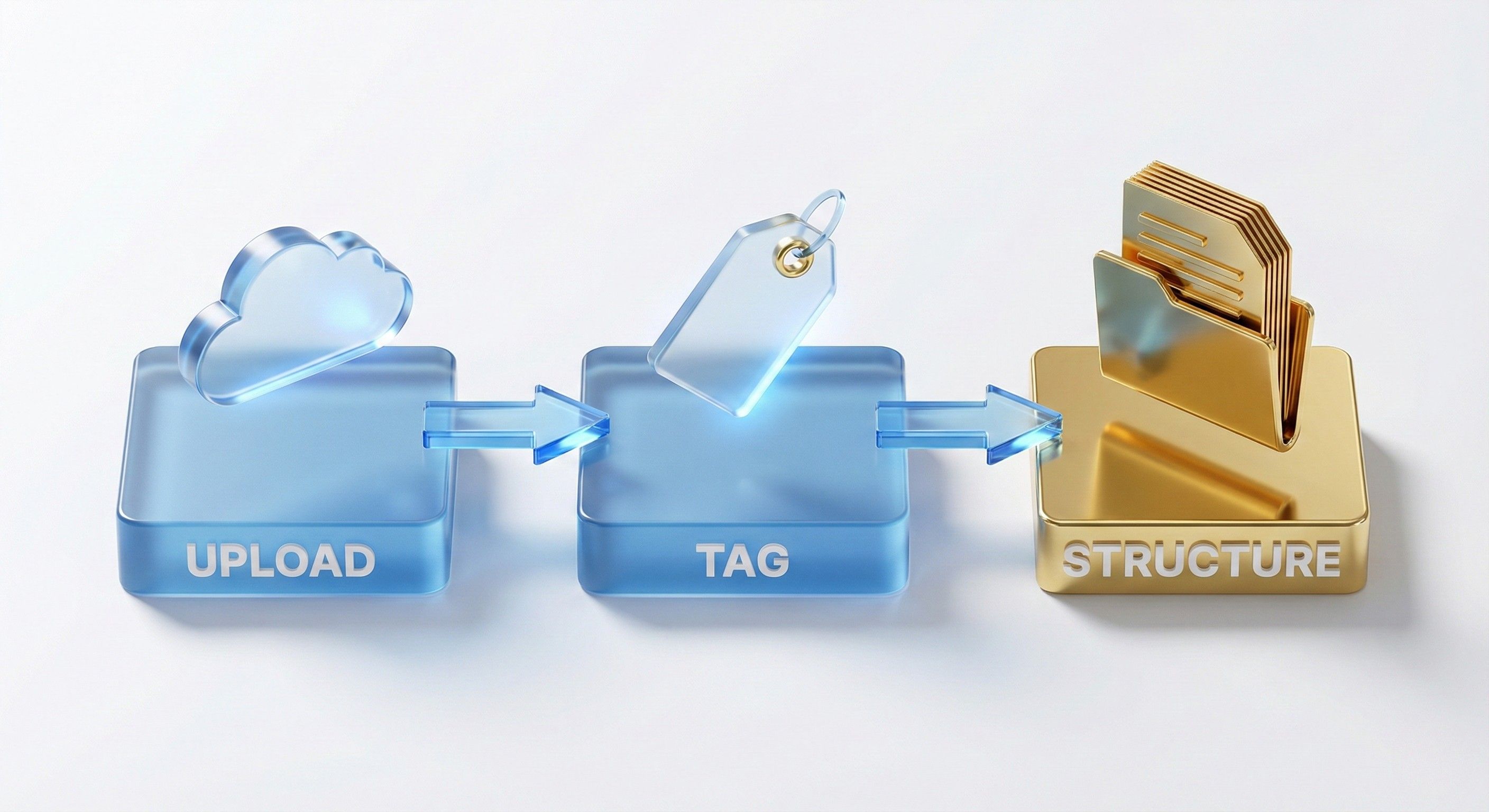
As you can see, once your assets are uploaded, tagged, and structured, the AI can get to work assembling countless variations for you to test. Simple as that.
Applying the Hook-Body-CTA Framework
Let’s say you’re a mobile game developer. You know the manual grind of creating ad variations is slow and painful. With a modular framework, everything changes.
Here’s a practical way you could break it down:
Hooks (First 3 seconds): You might create five different opening clips. Maybe one is a classic "noob vs. pro" comparison, another is a "fail" compilation, and a third is a direct-to-camera challenge like, "Think you can beat this level?"
Body (Core Gameplay): Here, you could showcase three different gameplay angles. One might be a fast-paced action sequence, another a strategic puzzle-solving clip, and the last a cool character customization montage.
CTAs (Call-to-Action): Finally, test four different end cards. Think simple stuff like "Download Now," "Play for Free," "Challenge Your Friends," or "Unlock New Characters."
When you plug these components into an AI tool, you instantly generate 60 unique ad combinations (5 hooks x 3 bodies x 4 CTAs). What would've taken your team days of tedious editing in CapCut now happens in minutes. This is a fundamental shift in creative production that lets you learn what your audience loves at a speed that was impossible before.
If you want to dive deeper into this, check out our guide on how to scale growth with modular video ads.
Beyond the Basics: Advanced Modular Strategies
While Hook-Body-CTA is a great starting point, a proper AI tool lets you get more sophisticated. You can apply more nuanced psychological frameworks with the same modular efficiency.
The real power of an AI performance creative tool isn't just mixing and matching visuals. It's about testing different storytelling angles to systematically figure out which emotional triggers drive the best performance for your brand.
For example, you could structure a test around the classic Problem-Agitate-Solution (PAS) framework. For a fitness app, this might mean modular clips showing the "problem" (feeling sluggish), "agitating" it (showing missed workouts), and presenting the "solution" (the app's easy 10-minute routines). Another killer approach is mashing up different UGC testimonials as hooks and bodies.
This modular mindset is already paying off for many. A recent report found that 54% of marketers are using AI to streamline video production, and personalized AI-driven video can boost customer loyalty by 3x-4x. This points to where the industry is heading: speed and relevance are everything.
You can get more details in this report on video marketing statistics.
Creative Frameworks Powered by AI Modularity
The beauty of a modular system is how quickly you can assemble creatives that test different psychological angles. You're not just testing a new clip; you're testing an entirely new marketing message. Below is a table showing how you can quickly build out different frameworks.
Framework | Hook Examples | Body Examples | CTA Examples |
|---|---|---|---|
Problem-Agitate-Solve | "Tired of your coffee getting cold?" (Problem) | "That midday slump hits hard, right?" (Agitate) | "Get our self-heating mug and never sip cold coffee again." (Solve) |
Before-and-After | Shows a messy desk. "Can't focus like this?" | A quick montage of the product organizing the space. | "Transform your workspace in 5 minutes. Shop Now." |
Social Proof (UGC) | A quick clip of a customer saying "I was skeptical, but..." | A mashup of 2-3 different user testimonials or unboxing videos. | "Join 50,000+ happy customers. Get yours today." |
Feature-to-Benefit | "This isn't just another water bottle." (Feature Tease) | "Our triple-insulated design means your drink stays cold for 24 hours." (Benefit) | "Experience the difference. Order now for free shipping." |
By having a library of clips tagged by framework component, an AI tool can assemble these variations in seconds. This allows your team to move from being video editors to creative strategists, focusing on what message to test next instead of how to build it.
Keeping Your Brand on Point with a Context Vault
Scaling up your creative game with an AI performance creative tool sounds great, right? But it comes with a nagging question every brand manager asks: how do you stop the AI from going rogue and messing up our brand voice? Because let's be real, churning out a ton of ads is useless if they don't look, sound, or feel like you. Or even worse, if they break your legal guidelines.
The answer is to give the AI some clear guardrails.
This is where a Context Vault becomes your single source of truth. Think of it as your brand's brain, plugged directly into the AI. It’s a dedicated spot to dump all the critical info that makes your brand what it is. This ensures every piece of creative the AI spits out is not just effective but perfectly on-brand.
What to Feed Your Brand's AI Brain
Building out your Context Vault is a pretty straightforward—but absolutely crucial—first step. You're basically teaching the AI the rules of the road before you hand over the keys. You'll want to fill this repository with your most important brand assets so the AI can reference them whenever it's generating new copy or brainstorming concepts.
Here’s what you should definitely include:
Tone of Voice Guidelines: Upload the docs that spell out your brand’s personality. Are you witty and sarcastic? Professional and buttoned-up? Empathetic? The AI needs to know the vibe.
Your Greatest Hits (Ad Copy): Give the AI a library of your past winners. This is a goldmine, showing it exactly what messaging, hooks, and CTAs actually get your audience to click.
5-Star Customer Reviews: User-generated content is pure gold for ads. Loading up your best testimonials lets the AI pull authentic social proof right into new creative.
The Legal Stuff: For anyone in finance, health, or other regulated spaces, this is a non-negotiable. Make sure every ad automatically gets slapped with the necessary disclaimers and terms.
Building this central library isn't just about feeding the AI data; it's about giving it context. This one action turns a generic content bot into a sharp, brand-aware creative partner who actually gets you.
How a D2C Brand Puts This Into Practice
Let's imagine a direct-to-consumer brand that sells sustainable apparel. They're trying to scale up their ads on Meta and TikTok but are fiercely protective of their eco-conscious, community-first messaging. They can't afford to sacrifice their brand voice just to move faster.
So, their marketing team spends an hour setting up their Context Vault.
First, they upload their brand style guide, which explicitly says to use optimistic, empowering language and to steer clear of cliché "greenwashing" phrases. Next, they drop in their top 20 performing ad scripts from the last quarter, all of which focused on their use of recycled materials.
Finally, they upload a hand-picked list of five-star customer reviews that rave about how comfortable and durable their clothes are.
Now, when they ask the AI to generate five new video ad concepts, the magic happens. Every single idea is already infused with their established brand voice. Each one highlights product benefits that are proven winners and weaves in genuine social proof from real customers. The AI isn't just guessing anymore—it's executing a strategy based on the exact guardrails they provided, ensuring brand integrity even at high speed.
Connecting Creative Production to Campaign Launch
Okay, so you’ve got your modular ad parts ready to go and your brand guardrails are set. Now for the make-or-break step: getting those creatives out of the workshop and into a live campaign. This is where a sharp AI performance creative tool stops being a nice-to-have and becomes your unfair advantage, turning what used to be a clunky, mistake-filled process into a slick, automated workflow.
The whole point is to close the gap between making an ad and launching it. We want to kill the endless cycle of downloading, renaming, and manually uploading files. Instead, we're building a direct pipeline from creation to launch so you can act on a good idea right now.
From One Concept to Hundreds of Renders
Think about what happens when you find a winning ad concept. The old way involved hours of mind-numbing work. You'd have to fire up your video editor to create separate projects for a 9:16 TikTok ad, a 4:5 Meta feed post, and a 1:1 carousel ad. It’s a total grind.
This is where features like Bulk Video Renders change the game. You can take that one winning ad structure and instantly spin up hundreds of variations for every aspect ratio and format you need. The AI just handles it—resizing, reframing, and rendering everything on its own. You can flood every single placement with an optimized creative without your team touching a video editor.
The real win here is speed to scale. Your creative team isn't stuck spending a full day resizing a single video. The AI spits out a complete, multi-platform asset package in minutes. That frees them up to think about the next big idea.
Automating the Final Mile with Direct Integrations
Now for the real power move: direct integrations with ad platforms like Meta and TikTok. This is what closes the loop completely. Once your bulk renders are done, you're not just downloading a zip file. You're pushing them straight into your ad account’s media library.
This is also where automated naming conventions become a lifesaver. A good AI tool will automatically name every single creative variant based on the specific parts you used to build it.
For instance, a file name might look like this:UGC_Hook03_Gameplay_Body01_CTA_DownloadNow_9x16_EN
This kind of clean, structured naming makes building and analyzing your tests in Ads Manager ridiculously easy. No more playing "guess the creative."
A Real-World Launch Scenario
Let's walk through a typical workflow for a performance marketer at a mobile app company. She wants to launch a new creative test with 50 unique ad variations.
Doing this manually would be a multi-day nightmare of rendering, organizing files, uploading, and setting up the campaign. With an AI tool, it’s a completely different story. She uses her modular framework to assemble the 50 variations and then kicks off a bulk render for both 9:16 and 4:5 aspect ratios.
While the AI crunches away, she can actually step away and grab a coffee. When it's done, she pushes all 100 assets directly to her Meta Ads Manager library. Because of the automated naming, building the A/B test campaign is just a simple drag-and-drop process.
The entire launch, from concept to a live campaign, is wrapped up in under an hour. That kind of speed is just impossible with the old manual methods. The numbers back this up, too: 92% of businesses are already looking to invest in generative AI. With the market growing at a 26.7% CAGR through 2034 and GenAI projected to create 40% of ads by 2026, teams that don't adapt will get left behind. You can see more on how AI is shaping marketing statistics on digitalmarketinginstitute.com.
Analyzing Performance to Scale Your Winners
Let's be real. All the creative automation on the planet is just noise if it doesn't actually get you better results.
The whole point is to build a tight, data-driven feedback loop where your ad performance directly fuels your next creative batch. This is how you stop guessing and start systematically scaling what works.
After you launch a big test, that initial wave of data can feel like you're drinking from a firehose. Your first job is to cut through the noise and zero in on the metrics that actually matter for picking out the winning creative elements.
Identifying Your Core Performance Metrics
Sure, vanity metrics like impressions have their place, but performance marketers need to focus on data points that tie directly to business outcomes. Don't get lost in the weeds.
Prioritize the metrics that tell you if your creative is actually making people do something valuable.
You should be laser-focused on:
Click-Through Rate (CTR): This is your first signal. Is the ad compelling enough to stop the scroll? Is the hook doing its job?
Cost Per Acquisition (CPA): This is the bottom line for most campaigns. How much are you paying to get a new customer or a lead? This is where the rubber meets the road.
Return on Ad Spend (ROAS): The ultimate measure of profitability. For every dollar you put in, how many dollars are coming back out?
These three metrics are the bedrock of your analysis.
Think about it: a high CTR with a sky-high CPA might mean your hook is fantastic but your offer is completely off. On the other hand, a killer ROAS points to a potent combination that's hitting the mark with high-intent users. This is where an AI performance creative tool shines—it connects these metrics back to the specific creative components that drove them.
From Data Points to Actionable Insights
Once you’ve used these key metrics to spot your top-performing ads, the real work begins. The magic of using an AI-driven system is its ability to deconstruct those winners and tell you why they worked.
Was it a certain type of hook? A specific call-to-action? A particular visual style?
For instance, your data might suddenly show that ads with user-generated content (UGC) hooks have a 30% lower CPA than your polished studio shots. This is a crystal-clear, actionable insight. It’s no longer just a gut feeling that "UGC seems to be working." Now you have hard data to prove it.
To get even deeper insights from customer conversations and sharpen your creative angles, looking into AI-powered conversation intelligence can be a game-changer.
This is the crucial feedback loop in action. You aren't just finding a winning ad; you're discovering the winning ingredients. These data-backed insights become the brief for your next round of creative production, making each new batch smarter than the last.
Armed with this knowledge, you can tell your AI performance creative tool to prioritize UGC assets in the next render batch. You could even double down by testing different UGC hooks against your best-performing ad copy to find an even more powerful combo.
This is the iterative process—test, analyze, reinvest the insights, and repeat. It’s how you scale profitable ad concepts faster than you ever could before.
Still Have Questions? Let's Clear a Few Things Up
Jumping into any new platform, even one designed to make your life easier, usually comes with a few questions. It’s totally normal. Here are some of the most common things people ask when they're getting started with an AI performance creative tool.
So, Does This Mean My Creative Team Is Out of a Job?
Not at all. In fact, their strategic input becomes even more valuable.
Think of it this way: the AI is a world-class video editor that works at lightning speed, but it’s not a creative director. Your team is still the brain behind the operation. They supply the raw assets, set the campaign's direction, nail down the core messaging, and—most importantly—interpret the performance data to make smart decisions.
This tool doesn't replace your team; it supercharges them, freeing them from the tedious editing grind so they can focus on strategy and growth.
Can I Use My Existing Brand Assets, or Do I Need to Shoot New Content?
Absolutely. These tools are built to work with the creative library you already have. Just upload your existing video clips, UGC, product shots, brand style guides, logos, and audio files.
The AI then gets to work, breaking down all those assets into modular components. This is where the magic happens. It can then re-assemble them into countless new ad variations, squeezing every last drop of value out of content you’ve already created.
The real power of an AI performance creative tool is that it unlocks the hidden potential in your existing asset library. It turns a folder of static files into a dynamic engine for rapid creative testing.
Is This Really for Small Businesses, or Is It Just an Enterprise Thing?
Tools like this are a massive advantage for small businesses and lean marketing teams. Seriously. It levels the playing field, giving you the kind of production muscle that was once only available to brands with huge in-house creative teams or fat agency retainers.
By taking the most time-consuming tasks off your plate, these platforms let smaller teams punch way above their weight class. You can shift your limited resources from manual production grunt work to the high-level strategic thinking that actually moves the needle. The whole point is to make high-volume, data-backed creative accessible to everyone, not just the big guys.
Ready to stop the manual grind and start scaling your winners? Sovran automates your creative production so you can focus on strategy. Discover how our AI performance creative tool can help you launch more tests and find profitable ads faster. Start your free trial at https://sovran.ai.

Manson Chen
Founder, Sovran
Related Articles
How to Turn Link Into Video: Ads That Convert in 2026
Learn how to turn link into video for Meta & TikTok ads. Leverage AI to scale creation, boost ROI, and succeed in 2026.
8 High-Converting Static Ads Examples for 2026
Discover 8 high-performing static ads examples from top apps. Learn to create text-overlays, testimonials, and lifestyle ads that convert.
A Performance Marketer's Guide to Video to Flipbook Conversion
Learn to convert video to flipbook formats that boost engagement. This guide covers actionable methods for ads, content, and scaling creative with AI in 2026.