How to Make Marketing Videos That Get Sales on Meta and TikTok
Learn how to make marketing videos that drive real results. Our guide covers proven strategies for creating high-converting video ads for Meta and TikTok.
Jump to a section
- Why High-Velocity Video Is Winning on Social Media
- Building Your Foundation for High-Converting Videos
- Scripting Videos That Stop the Scroll
- Your Guide to Smart Production and Asset Management
- How to Assemble and Launch Video Ads at Scale
- Measuring Performance to Find and Scale Winners
- Got Questions? We've Got Answers

Here's the truth: making marketing videos that actually convert isn't some dark art. It boils down to a simple, repeatable process: strategize your goal, script a scroll-stopping hook, produce authentic content, and test relentlessly. This is the secret to moving beyond one-off viral hits to build a consistent pipeline of high-performing ads for platforms like Meta and TikTok.
Why High-Velocity Video Is Winning on Social Media
Before we get into the nuts and bolts of how to make these videos, let’s talk about why the old playbook is completely broken. We're in the middle of a massive shift in how brands and customers connect, with short-form, high-energy video totally taking over platforms like Meta and TikTok.
Think about it. Those traditional, overly polished ads? They're becoming wallpaper. They feel like ads, they look like ads, and your audience has gotten incredibly good at tuning them out. What they crave is content that feels native to their feeds—relatable, human, and direct.
This isn’t just a fleeting trend. It’s a fundamental change in how people consume media. This is precisely why user-generated content (UGC) and lo-fi videos so often crush slick, high-budget productions. They feel real.
The Problem of Creative Fatigue
One of the biggest hurdles for any modern performance marketer is creative fatigue. This is the cliff your ad falls off when it's been shown so many times that its effectiveness just plummets. Your audience gets bored, they tune it out, and your campaign performance tanks.
In the old days, you might have been able to run a single "winning" ad for months. On today's platforms, an ad's peak lifespan can be just a few weeks, sometimes even days. To stay in the game, you need a system for pumping out a steady stream of new video creative.
This is where "high-velocity" video production comes in. It’s not about churning out garbage; it’s about building a workflow that allows for rapid creation, testing, and iteration.
The goal is to build a content engine, not just a single masterpiece. A continuous flow of fresh creative is what keeps your campaigns profitable and scalable in an environment where audience attention is the most valuable currency.
The Financial Imperative of Modern Video
The numbers don't lie. In 2024, global spending on digital video ads blew past $190 billion, outpacing traditional TV ads for the very first time. This explosion highlights a critical lesson: you have to prioritize short-form content optimized for mobile.
On social platforms, videos generate 1200% more shares than text and images combined. If you're not focusing your budget and effort here, you're leaving a massive amount of money on the table. You can dive deeper into the latest video marketing statistics to see just how big this shift is.
This financial reality forces a new approach. Thriving today means mastering the art of rapid, scalable video production. It’s no longer a "nice to have"—it’s essential for survival and growth. This guide will show you exactly how to build that system from the ground up.
Building Your Foundation for High-Converting Videos
Great video ads are never a happy accident. They’re the direct result of a smart, disciplined, and strategic pre-production phase.
Before you even think about hitting "record," laying a solid foundation is what separates ads that get skipped from ads that drive sales. This upfront work ensures every second of video you create has a clear purpose and a high probability of converting.
First things first: get ruthlessly clear on your campaign goals. A video designed to get app installs for a mobile game will look and feel completely different from one trying to capture leads for a B2B SaaS product. You need to define your primary objective with precision.
Awareness: The goal here is just to introduce your brand to a new audience. The video needs to be entertaining, memorable, and maybe even shareable.
Consideration: You want to educate potential customers about your solution. This is where demo videos, explainers, and myth-busting content absolutely shine.
Conversion: This is about a specific action—a purchase, a sign-up, a download. The video has to be direct, persuasive, and feature a crystal-clear call-to-action.
Understand Your Audience Platform by Platform
Once your goal is set, you have to know who you're talking to. The user scrolling through TikTok has a totally different mindset and set of expectations than someone browsing their Facebook feed. Don't make the classic mistake of assuming one video will work everywhere.
For example, a TikTok audience often responds best to authentic, trend-driven, and user-generated content (UGC). A Facebook audience, on the other hand, might be more receptive to a slightly more polished problem-solution story or a compelling testimonial that builds social proof. You have to tailor your message, tone, and visual style to the platform's native environment.
Create Your Centralized Context Vault
This is the secret weapon for scaling video production without your quality or consistency taking a nosedive. A Context Vault is just a centralized hub—think a shared Google Drive folder or a dedicated space in your project management tool—that houses all your foundational brand and marketing assets. It becomes your single source of truth for creating on-brand, high-converting videos.
Organizing your assets this way completely transforms your workflow. Instead of hunting for logos or scrambling to find customer quotes, everything you need is right there. This system is what makes rapid iteration and testing not just possible, but easy.
Your Context Vault isn't just a storage folder; it's a strategic asset. By centralizing your winning messages, customer insights, and brand guidelines, you empower your team to build new video concepts from proven components, dramatically increasing your creative velocity and success rate.
Here's what your Context Vault should include:
Brand Guidelines: This means your logo, brand colors, and approved fonts. Consistency builds trust and recognition, and having these assets ready prevents any off-brand creative from slipping through.
Customer Testimonials and Reviews: Screenshot positive reviews, record customer video testimonials, and save powerful quotes. Authentic social proof is one of the most persuasive tools in your entire arsenal.
Proven Ad Copy and Messaging: Keep a running list of headlines, hooks, and body copy from past campaigns that performed well. These are proven messaging angles you can easily repurpose into new video scripts.
Ideal Customer Personas: Document the pain points, desires, and objections of your target audience for each platform. This ensures every video speaks directly to their needs and motivations.
By building this foundation first, you ensure every video concept is strategically sound from the get-go. This methodical approach is how you move from just guessing what might work to knowing exactly how to make marketing videos that consistently deliver results.
Scripting Videos That Stop the Scroll
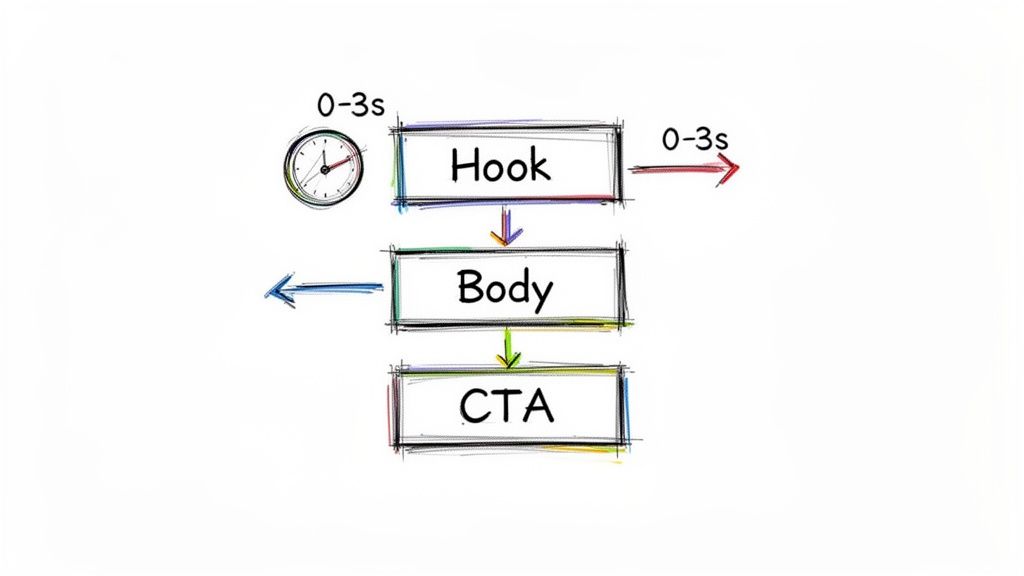
A killer video ad starts long before you even think about hitting the record button. It all begins with a script engineered to win in the first three seconds. On platforms like TikTok and Meta, your script is the single biggest lever you can pull for better performance.
This isn't about writing an Oscar-worthy screenplay. The real goal is to build a repeatable, modular framework that lets you test ideas fast. For that, nothing beats the simple but incredibly powerful Hook-Body-CTA formula.
This structure is the basic DNA of pretty much every successful short-form marketing video out there. When you break your script into these three parts, you can treat them like Lego bricks—mixing and matching different hooks with various body concepts to figure out what actually resonates with your audience.
The All-Important Hook
You have less than three seconds to give someone a reason to stop scrolling. If your hook fizzles out, the rest of your video is dead on arrival because nobody will stick around to see it.
A truly great hook doesn't just grab attention; it qualifies the viewer. It sends a clear signal that this content is for them.
Here are a few proven hook archetypes you can adapt right away:
The Problem Hook: Go straight for a specific pain point. Something like, "Tired of your video ads dying after just one week?" instantly connects with anyone battling creative fatigue.
The "Secret" Hook: Frame your solution as a little-known hack or an insider tip. "Here's the one thing top marketers do to scale their video ads..." sparks immediate curiosity.
The Visual Hook: Sometimes, the visual is the hook. Kick things off with a surprising, oddly satisfying, or jarring clip that makes people stop and ask, "What is going on here?"
A classic mistake is easing into the video with a fancy logo or a slow pan. On social feeds, that's a death sentence. Your video has to start at peak energy and deliver value from the very first frame.
The only way to figure out what works is to test your hooks relentlessly. Plan on scripting at least three to five different hooks for every single video concept you produce.
Structuring the Body of Your Video
Alright, you’ve earned their attention. Now the body of your video has one simple job: deliver on the promise your hook just made. This section needs to be tight, focused, and provide clear value, whether that's through a quick tutorial, some entertainment, or a product demo.
Keep the body between 5 and 15 seconds. Any longer, and you're just asking for people to swipe away. The key is to stick to one core idea and get your point across as efficiently as possible.
Here are a few popular ways to structure the body:
Problem-Agitate-Solution (PAS): You hooked them with the problem. Now, use the body to twist the knife a bit. "It's a constant struggle to produce enough content, and your CPAs just keep climbing." Then, you sweep in with your solution.
Quick-Cut Demo: Don't just tell them; show them. Use fast, rapid cuts to demonstrate your product or service in action, focusing only on the most compelling features or the incredible end result.
UGC Testimonial Mashup: Nothing builds trust faster. String together short, punchy clips from multiple customer testimonials to build massive social proof in a matter of seconds.
For a deeper dive into scripting, you can find more advanced techniques and examples in our comprehensive guide to writing an effective script for advertising. It's a great resource for refining your body content.
High-Impact Video Scripting Frameworks
To give you a head start, here’s a breakdown of some of the most reliable scripting formulas we see working on Meta and TikTok right now. Think of these as proven templates you can adapt for your own products.
Framework | Hook Example (1-3s) | Body Concept (5-10s) | CTA Example (2-3s) |
|---|---|---|---|
Problem/Solution | "Still struggling with [common pain point]?" | Show the old, frustrating way of doing things, then reveal how your product makes it effortless. | "Fix your [problem] today. Tap to learn more." |
Us vs. Them | "Stop using [competitor category]. Here's why." | A rapid-fire comparison showing your product's key advantages over the traditional alternative. | "Make the switch. Shop now." |
Social Proof | "This is why our [product] has over 10,000 5-star reviews." | A fast-paced montage of user-generated content, positive comments, and glowing testimonials. | "Join thousands of happy customers. Get yours here." |
Benefit-Driven | "Imagine getting [desired outcome] in just [timeframe]." | Visually demonstrate the amazing result or feeling a customer gets after using your product. | "Experience the difference. Try it now." |
These frameworks aren't rigid rules, but they provide a solid foundation. The real magic happens when you start testing different combinations to see what clicks with your specific audience.
Designing a Clear Call-to-Action
The final piece of the puzzle is the Call-to-Action (CTA). This is where you tell the viewer exactly what you want them to do next. Don't be subtle. Ambiguity is the enemy of conversion.
Your CTA should be both verbal and visual. Have the person on screen say the action out loud while you also use bold text overlays to hammer the message home.
A few tips for framing effective CTAs:
Be Command-Oriented: Use strong, direct action verbs. Think "Download our app," "Shop the collection now," or "Sign up for your free trial."
Reduce Friction: Make the next step sound easy and low-commitment. Adding words like "now" or "today" creates a little urgency. For example, "Tap the link below to get started."
Align with Your Goal: This is critical. Your CTA has to match your campaign objective. If you're running for app installs, the CTA must be "Download the app," not "Learn more."
By mastering these three modular components—Hook, Body, and CTA—you stop creating one-off videos and start building a system. This approach lets you systematically test, learn, and identify winning formulas, creating a predictable engine for high-converting video ads.
Your Guide to Smart Production and Asset Management
Let's kill a common myth right now: you do not need a Hollywood budget or a professional film crew to make marketing videos that actually convert. Especially in the world of Meta and TikTok, authenticity almost always crushes overly polished, high-production content. Your smartphone is more than enough to capture footage that feels native to the feed and genuinely connects with people.
The real secret to efficient production isn't about expensive gear; it’s about having a smart strategy. It all starts with shooting in a modular way. Instead of trying to film one perfect, complete video, think about it like you're capturing individual building blocks—separate clips for hooks, product demos, testimonials, or CTAs. This approach is the key to building a flexible content library that you can remix and reuse for months.
Lightweight Production Tips for High-Quality Footage
Even if you're just using a smartphone, a few simple tricks can dramatically level up the quality of your raw footage. The goal here is to look professional without losing that raw, user-generated feel that performs so well on social media.
Steady Your Shot: A shaky camera is distracting and an instant scroll-trigger. Grab a small, inexpensive tripod, or just prop your phone up against a stack of books. This one tiny step makes your content look way more intentional and easier to watch.
Master the Lighting: Forget fancy studio lights. Natural light is your best friend. Just make sure you're facing a window to get soft, even light on your face. Never have a bright light source (like a window) behind you, or you'll turn into a silhouette.
Prioritize Clear Audio: Muffled, unclear audio will make viewers scroll away faster than anything. Using the microphone on your headphones or a simple lavalier mic that clips to your shirt is a small investment that pays off big time in sound quality.
When you're filming yourself or someone else, go for a natural, conversational delivery. You want to sound like a real person sharing a useful tip, not an actor reading a script. Honestly, small imperfections—like a slight stumble over a word or a genuine laugh—can make the content feel more relatable and trustworthy.
Don't aim for perfection; aim for connection. Highly produced videos can feel like traditional ads, which users are hardwired to ignore. Authentic, handheld-style footage feels more like a post from a friend, which immediately lowers the viewer's guard.
Building Your Modular Asset Library
This is where you build a real competitive advantage. A modular asset library is just a system for organizing all your video clips as reusable components. Instead of a messy folder full of random, finished videos, you have a structured collection of individual hooks, body segments, and CTAs.
This system completely changes your creative workflow. It goes from being a slow, one-by-one process to a rapid assembly line. Need to test a new angle? Just swap in a different hook clip, and you've got a brand new ad variant ready in minutes, not hours.
Think about the different types of shots you’ll need and capture each one as its own separate file:
Hook Variations: Film 5-10 different opening lines or visual gags.
Product Demos: Get close-up shots of your product in action from a few different angles.
User Testimonials: Record each person's testimonial as a standalone clip.
B-Roll Footage: Capture extra shots of your workspace, product packaging, or lifestyle imagery that you can layer in as background visuals.
A well-organized library is the engine that powers high-velocity testing. For a deeper dive on structuring this, our guide on video production project management has some great insights for keeping your assets tidy and ready to go.
Technical Details That Matter
Finally, there are a few technical details that are simply non-negotiable for social media. Getting these right ensures your videos are optimized for the platforms where your audience is actually hanging out.
Aspect Ratios Are Crucial Always, always, always shoot your videos vertically. The standard 9:16 aspect ratio is essential for platforms like TikTok, Instagram Reels, and YouTube Shorts because it fills the entire mobile screen. Posting a horizontal video with black bars at the top and bottom is a rookie mistake that immediately screams, "This is an ad, and I don't belong here."
Design for Silent Viewing A huge percentage of people watch videos with the sound off. If your message is only in the audio, it’s going to be completely missed.
Add Captions: Always burn captions directly into your video. It makes your content accessible and ensures your message lands, even in a silent environment.
Use Text Overlays: Reinforce your key points, highlight benefits, and display your call-to-action with big, easy-to-read text on the screen. These visual cues guide the viewer's attention and communicate your core message without them ever needing to turn the sound on.
When you combine these production techniques with a modular asset strategy, you create a seriously powerful system. You’ll be set up to produce a high volume of quality creative, making it possible to test, learn, and scale your winning video ads faster than ever before.
How to Assemble and Launch Video Ads at Scale
Having a library of modular assets is a huge step, but it's only half the battle. Your real competitive edge comes from how fast you can stitch those pieces together into fresh ad variations and get them live. This is where you graduate from slow, one-off edits in apps like CapCut and start building a high-velocity system that actually scales.
The whole game is modular assembly. Instead of painstakingly building one video at a time, you're combining your pre-shot hooks, bodies, and CTAs to pump out dozens of unique ads. This is the secret to effective A/B testing—it lets you isolate variables and truly understand what’s driving your performance.
Beyond Manual One-Off Edits
Doing this all by hand is a massive bottleneck. Just imagine you want to test five different hooks against three different body concepts. Right there, you're looking at 15 unique videos to edit, render, and upload. That old-school approach just can't keep up when you're trying to fight off creative fatigue.
This is exactly where modern creative platforms change the game. They handle the assembly for you, letting you generate hundreds of variations in seconds—each with different text overlays, music, or captions.
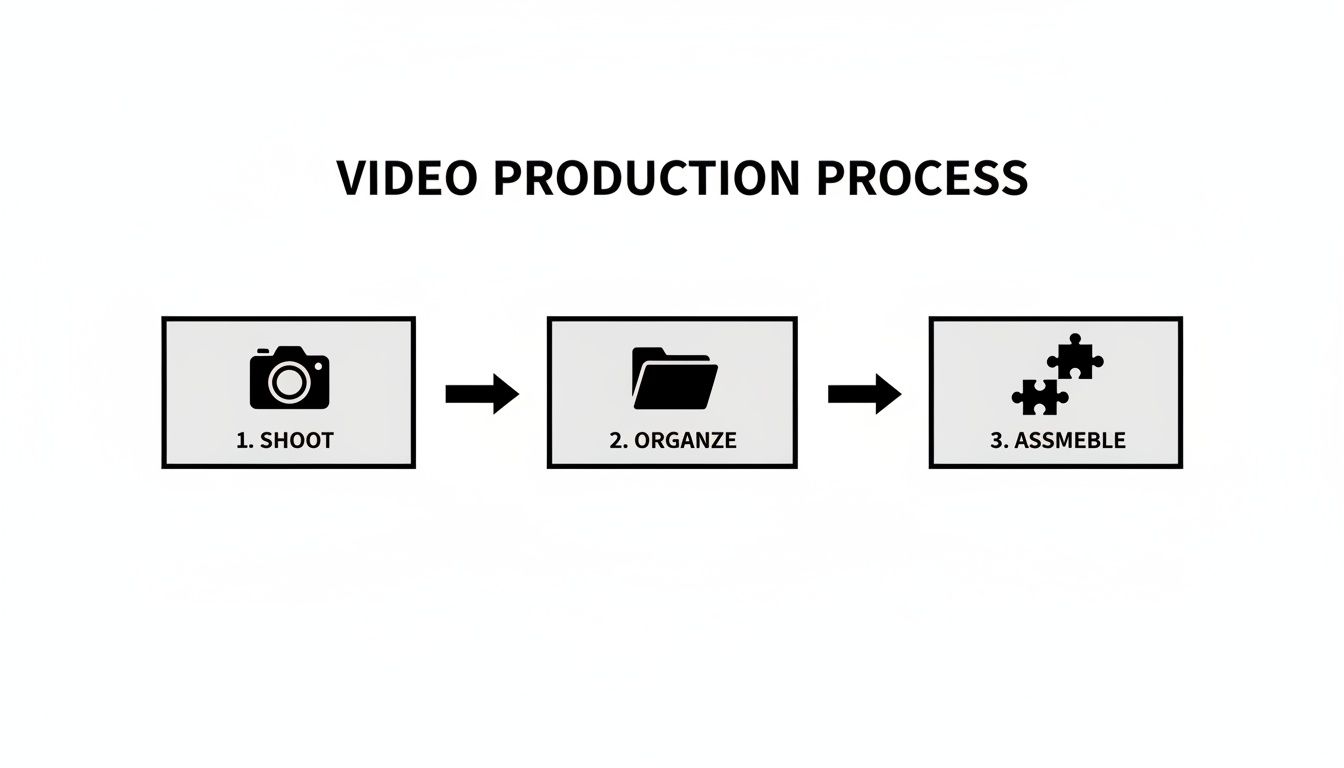
This workflow is simple but powerful: shoot your raw footage, organize it into a modular library, and then rapidly assemble new ad variations. The key insight is that assembly becomes the fastest part of the process, which is what allows you to test at a high volume.
Streamlining the Assembly and Launch Process
A truly efficient workflow connects your asset library straight to your ad platforms. This completely cuts out the tedious cycle of downloading renders, manually uploading them to Ads Manager, and then writing ad copy for each one.
Here’s what that streamlined process looks like in practice:
Select Your Components: Dive into your organized asset library and pick the hooks, bodies, and CTAs you want to test against each other.
Automate Variations: Let a tool automatically combine these pieces into every possible combination. This is also where you can layer on different text overlays or music tracks to create even more variants.
Push Directly to Ad Platforms: The finished videos get pushed straight to Meta and TikTok as draft ads, ready for a final review before you hit "launch."
The goal is to minimize manual touchpoints. Every minute you're not spending on repetitive editing and uploading is a minute you can spend on strategy and digging into the results to find your next winning angle.
This automated approach isn't just a timesaver; it also enforces consistency. As you get deeper into launching campaigns, especially on social, it’s always a good idea to reference an ultimate guide to Facebook Ads to make sure your strategy is dialed in for platforms like Meta.
Using AI to Supplement Your Asset Library
Even with a great asset library, you'll eventually need fresh material. What do you do when you need a specific shot of B-roll you didn't film? Or when you want to test a wild new hook concept without booking a whole new shoot?
This is where generative AI becomes an incredible assistant. AI video generation tools can create supplementary assets for you on the fly.
Generate Unique B-Roll: Need a clip of someone typing on a laptop in a busy coffee shop? You can generate it in seconds instead of digging through stock footage sites.
Create Novel Hooks: Test abstract or out-there visual hooks that would be a pain (or super expensive) to film in real life.
Platforms like Sovran build these capabilities right into the workflow. You can generate and add new AI-powered clips to your library and mix them in right alongside your real footage.
Automated Naming Conventions for Simpler Testing
One of the most overlooked parts of launching ads at scale is just keeping everything organized. When you have dozens of ad variants running, a messy naming system can make it impossible to figure out what's actually working.
A great system will automatically name each ad variant based on the components you used to build it. For example, an ad name might look something like this: Hook03_Body-PAS_CTA-ShopNow_MusicA.
This simple, automated label tells you instantly what’s in the ad. It makes it dead simple to look at your analytics and see which specific elements are driving results. Mastering how to make marketing videos at this level means building systems that make your data clean and actionable. This is what turns creative testing from a chaotic mess into a precise, data-driven science.
Measuring Performance to Find and Scale Winners
Getting your video ads live isn’t the finish line—it’s the starting gun. Now the real work begins. As the data starts trickling in, you enter the most critical phase: optimization. This is where you find out which ads are burning cash and which ones are ready to print it.
To do this right, you need a structured approach. Concepts like A/B testing in marketing aren't just jargon; they're your roadmap to continuous improvement. By testing variables in a controlled way, you can figure out what's really driving performance. Is it the hook? The offer? The editing style? Without testing, you're just guessing with your budget.
Key Metrics Beyond Vanity Views
It's tempting to get excited about view counts, but views don't pay the bills. When you're running marketing videos on Meta and TikTok, you have to lock in on the metrics that actually connect to performance and profit.
These are the numbers that tell the real story:
Hook Rate (3-Second View Rate): This is your first signal. It shows the percentage of people who saw the very first frame and stuck around for at least three seconds. If this number is low, your opening is failing to stop the scroll.
Hold Rate: This metric tracks how far people are watching into your video. See a huge drop-off at the 5-second mark? That's a red flag that your transition from hook to body isn't landing.
Click-Through Rate (CTR): The percentage of viewers who actually clicked your call-to-action. CTR is a direct measure of how persuasive your video was at getting someone to take the next step.
Cost Per Acquisition (CPA): This is the ultimate bottom-line metric. It tells you exactly how much you're spending to get a customer, whether that's a sale, a lead, or an install. It’s the final word on an ad's profitability.
A Simple Framework for Interpreting Results
Once you've let your tests run long enough to gather solid data, it’s time to play detective. Don't jump to conclusions after just a handful of conversions. You're looking for clear trends and statistically significant differences between your variations.
Let's walk through a common scenario. Say you tested three different hooks while keeping the body and CTA exactly the same.
Video A (Problem Hook): Low Hook Rate, high CPA. Video B (Secret Hook): High Hook Rate, high CPA. Video C (Visual Hook): High Hook Rate, low CPA.
Here, Video C is your undisputed champion. The data is telling a clear story: both the "Secret" and "Visual" hooks were great at grabbing attention, but only the "Visual" hook led to conversions at an efficient cost. That insight is pure gold.
(For a deeper dive, our guide on Facebook ad creative testing breaks down more frameworks for situations just like this.)
This process kicks off a powerful feedback loop. You take your winning element—the visual hook—and promote it to your new "control" ad. Then, you start testing new challenger hooks against it, always trying to beat your best.
This methodical iteration is how you build a library of proven creative assets, dramatically speeding up your journey to profitable, scalable campaigns. It's not about luck; it's about a system for testing and learning what makes your audience tick.
Got Questions? We've Got Answers
You're not alone. Navigating the world of social media video brings up a lot of questions. Here are some quick, real-talk answers to the most common ones we hear from performance marketers deep in the trenches.
How Long Should My Marketing Videos Be for Meta and TikTok?
Keep it short and sweet. For platforms like Meta and TikTok, the magic window is usually between 15 and 60 seconds.
But honestly, the most critical part is the first three seconds. That's your entire window to hook someone. If you don't grab them immediately, they're gone. While you might see longer, story-driven videos out there, performance campaigns almost always win with concise, high-impact content that gets the message and call-to-action across fast.
Do I Really Need a Pro Camera to Make Ads?
Absolutely not. In fact, for TikTok and Instagram Reels, you're often better off without one. Videos shot on a modern smartphone tend to outperform those slick, high-production ads. Why? They just feel more real and native to the platform.
Your audience is looking for content that feels genuine, not another polished TV commercial. Focus your energy on a clear message, crisp audio, and good lighting. Your smartphone is probably the most powerful tool you have.
How Many Different Videos Should I Be Testing at Once?
There isn't a single magic number, but a solid starting point is to test 3-5 totally different creative concepts at the same time. Once you have your core concepts, you can then start testing smaller variations within each one—things like a different hook, a new call-to-action, or even just swapping out the music.
This is where trying to do everything manually becomes a massive bottleneck. Imagine trying to edit dozens of tiny variations by hand. A platform that automates this process is a game-changer, making it possible to test hundreds of micro-variations simultaneously. You can pinpoint the winning combinations way faster without getting buried in repetitive edits.
Ready to break the endless cycle of manual editing and actually scale your video ad performance? Sovran automates the whole workflow, from managing your assets to launching hundreds of ad variations directly to Meta and TikTok. Find your winning creative 10x faster with a free 7-day trial.

Manson Chen
Founder, Sovran
Related Articles
Your Ultimate Guide to UGC Style Video Ads
Master UGC style video ads for Meta and TikTok. This guide reveals proven frameworks, scripts, and scaling tactics to boost your ROAS in 2026.
10 Actionable Ad Creative Ideas That Convert in 2026
Discover 10 actionable ad creative ideas for Meta & TikTok. Get hooks, scripts, and testing frameworks to boost your ROAS and combat creative fatigue.
How to Turn Link Into Video: Ads That Convert in 2026
Learn how to turn link into video for Meta & TikTok ads. Leverage AI to scale creation, boost ROI, and succeed in 2026.