Ad Testing Software: 12 Creative Testing Tools Compared (2026)
Choose ad testing software for the work you need to do. Compare 12 tools for video variants, platform experiments, creative analytics, and pre-launch research, with current price bases and clear limits.
Jump to a section
- Quick Answer: Best Ad Testing Software by Use Case
- What Counts as Ad Testing Software?
- Choose a Test Before You Choose a Tool
- 1. Sovran
- 2. Meta Ads Manager Experiments
- 3. TikTok Ads Manager Split Test
- 4. Google Ads Experiments
- 5. Motion
- 6. Vidmob
- 7. CreativeX
- 8. System1 Test Your Ad
- 9. Kantar Marketplace LINK AI
- 10. Ipsos Creative|Spark
- 11. Neurons
- 12. Heatseeker
- Other tools for campaign production and research
- How to Choose a Creative Testing Platform
- Best Platforms for Testing Video Ad Effectiveness
- Watch: Creative Testing Workflows in Sovran
- Proof From Teams Using Sovran
- Related Creative Testing Guides
Ad testing software covers several different jobs. Some tools produce video variations. Others run experiments, explain results, or predict how people may respond before launch. Choose the tool for the decision you need to make.
This guide compares 12 creative testing tools for performance marketers. It shows what each tool does, how its pricing works, and what you still need beside it. Sovran publishes this guide and is included in the comparison.
Product and pricing sources reviewed September 7, 2026. Prices shown below use each vendor's stated billing basis. A quote, annual commitment, or media budget is not the same as a monthly software fee.
Quick Answer: Best Ad Testing Software by Use Case
If you need more usable video variants, start with Sovran's creative testing workflow. If you have finished ads and need a controlled campaign test, start with your ad platform. Use analytics to compare patterns across live creative. Use research or prediction when you need feedback before launch.
| Tool | Main purpose | Supported workflow | Price basis | Main limit for this buying decision |
|---|---|---|---|---|
| Sovran · Pricing | Produce video ad variants | Organize footage; build reusable hooks, bodies, and calls to action; export ad batches | Base: $99/month with monthly billing, or $66/month billed yearly; 50 modular video ads | A production workflow does not establish which variant wins in a controlled live test |
| Meta Ads Manager Experiments | Compare live Meta ad approaches | A/B tests for Facebook and Instagram campaigns, including Reels creative | Campaign media budget; check account-specific test requirements | You must supply the creative and define a useful comparison |
| TikTok Ads Manager Split Test | Compare live TikTok campaign variables | Creative, targeting, and other supported test variables | Campaign media budget; requirements depend on the test type | Supported variables and campaign combinations have restrictions |
| Google Ads Experiments | Compare campaign changes | Campaign experiments, including video experiments | Traffic and media budget allocated to the experiment | Available tests depend on the campaign type |
| Motion | Analyze live creative | Creative reporting, tags, ad comparisons, and shared findings | Starter: $750/month for up to $50,000 in monthly ad spend | Historical performance patterns do not by themselves prove cause |
| Vidmob | Connect creative attributes to performance | Creative analytics and scoring | Request current pricing for your data and service needs | Requires a measurement plan and relevant creative/performance data |
| CreativeX | Measure creative quality and consistency | Content scoring and creative/media measurement | Request current pricing for your organization | Quality criteria do not answer every campaign performance question |
| System1 Test Your Ad | Measure consumer response before launch | Human emotional-response research; separate AI screening option | Request current test pricing | A research result differs from the result of a live paid campaign |
| Kantar Marketplace LINK AI | Predict creative effectiveness | AI assessment for digital, TV, static, and creator content | Pay as you go or subscription; depends on market, ad count, service, and options | Predictions need the right market and format context |
| Ipsos Creative|Spark | Diagnose audience response | Creative research across campaign formats; self-service or full service | Request pricing for the study, market, and service you need | Confirm whether the proposed study uses people or the separate AI product |
| Neurons | Predict attention and consumer response | Creative analysis, predictions, and visual recommendations | Quoted Starter, Pro, and Scale packages | A prediction is not a measured acquisition or sales result |
| Heatseeker | Validate messages in a market | Live market experiments and synthetic validation | Base: $55,000/year; one-off project: $29,000 for a three-month engagement | Project scope and commitment suit a different buying need from a small editing subscription |
For tools priced by proposal, request a quote for your intended work. Budget separately for the ads used in platform experiments. Confirm the available test types and account requirements with the platform. Follow each vendor link for the exact plan or study you need.
What Counts as Ad Testing Software?
Ad testing software helps teams create, run, measure, or assess ad variations. These roles can work together, but their outputs answer different questions.
- Creative production: Can we make the variants needed for a test? This includes reusable footage, editing, naming, and export.
- Live experiments: Did one treatment perform differently under the test conditions? These run through an ad platform.
- Creative analytics: What patterns appear across the ads we have run? These findings can guide the next test.
- Human research: How did sampled people respond to the ad? Research can examine understanding, emotion, and brand response.
- AI prediction: What response does a model predict? Use the result to guide decisions, with a clear view of what the model measures.
For example, if you have one winning body clip and three new hooks, production software can make three finished ads. A platform experiment can compare the ads. An analytics tool can retain the results and help the team plan another round.
Choose a Test Before You Choose a Tool
Write down the decision first. “We want more creative” is a production goal. “We want to know which opening gets more qualified leads” is a test question. Each requires different work.
For a hook test, keep the body, offer, and call to action consistent. Record the hook used in each file name. Choose the outcome and test conditions before launch. Use the ad platform's guidance for budget, duration, and supported setup.
If you change several parts at once, you can compare complete concepts, but you cannot confidently assign the difference to one part. Start with a test you can explain to another person. Then buy the software that removes the next constraint.
1. Sovran
Sovran supports teams whose constraint is producing enough video variations. Organize source footage, create reusable hook, body, and call-to-action clips, then build finished combinations. A call to action tells the viewer what to do next.
The production process stays connected to your footage. This is useful when you want to reuse a product demo, customer statement, or body clip across several new openings.
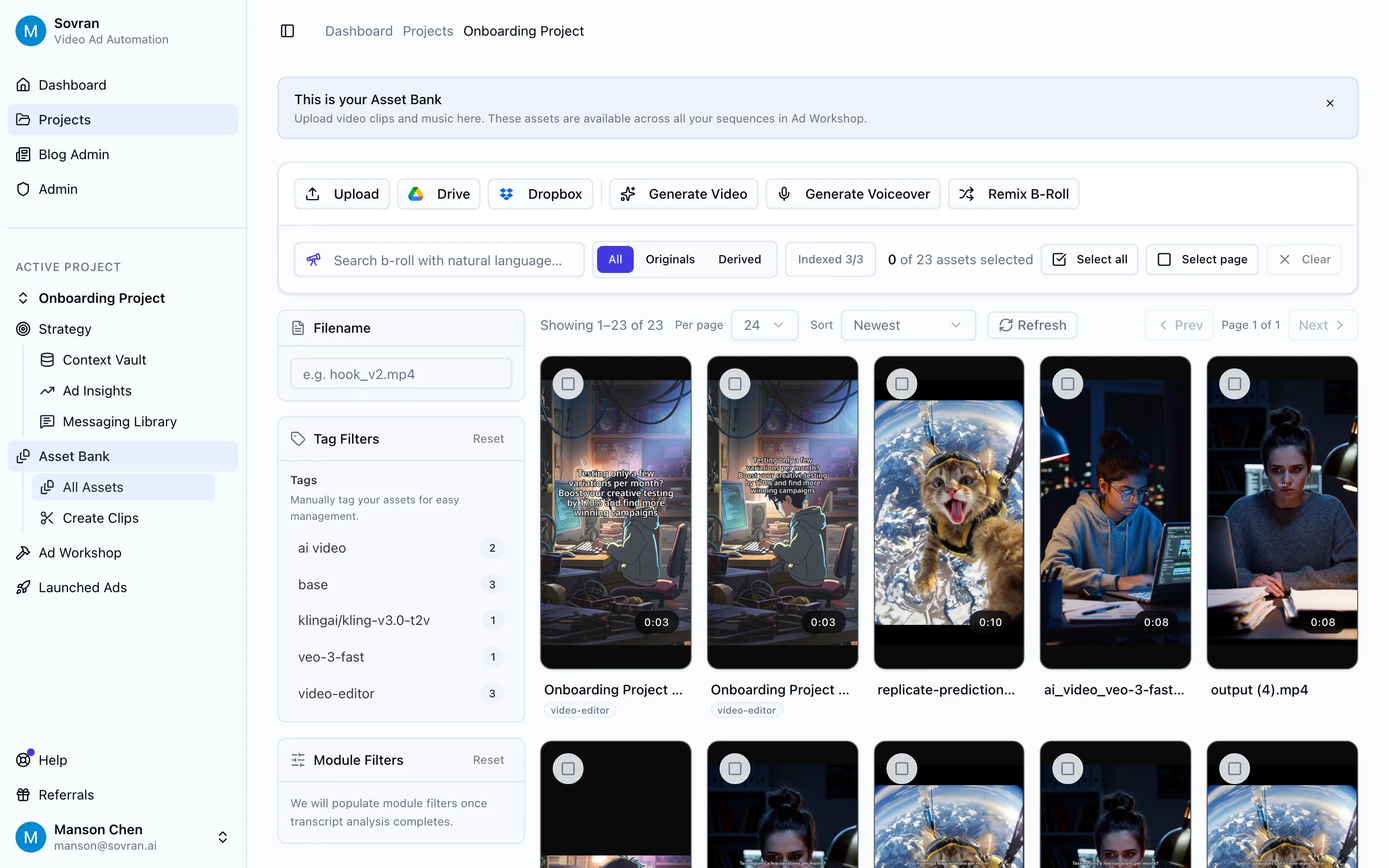
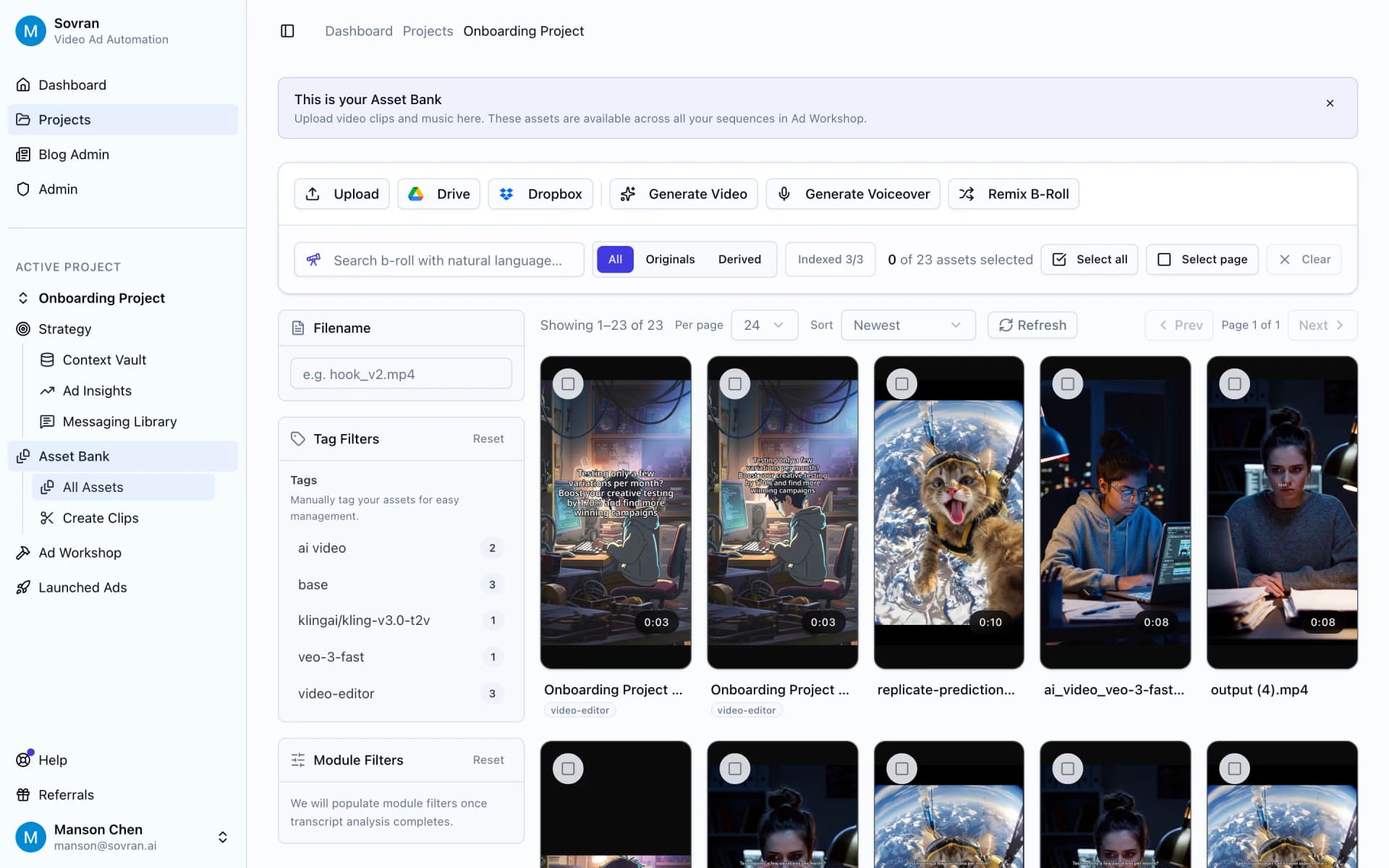
The Asset Bank keeps source clips and reusable creative parts together before the next test.
For example, three hooks and one approved body can become three ads with a common offer. Keep the differences clear when you export the batch, so the team can connect each result to its source clips.
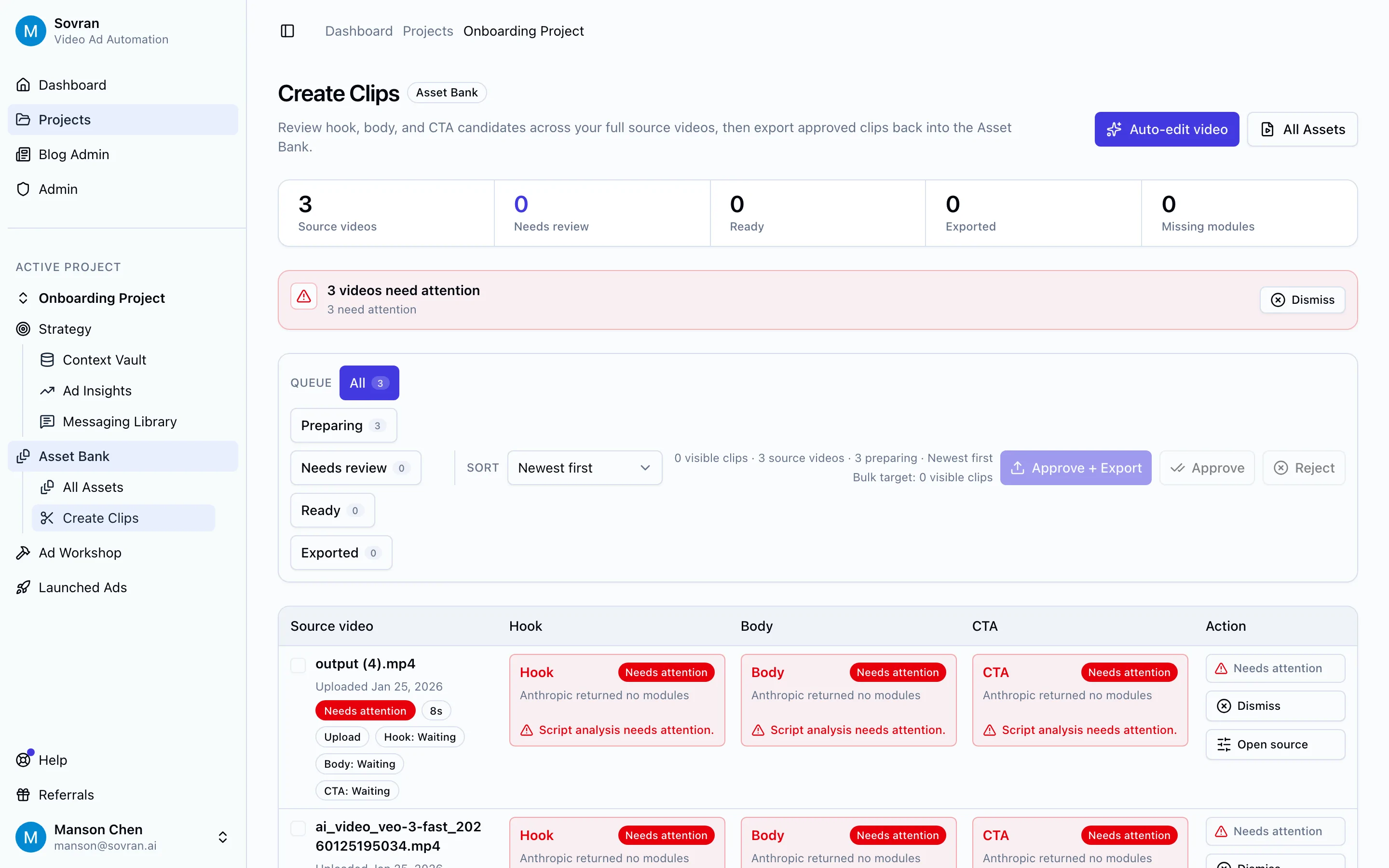
Create Clips helps turn source videos into reusable hooks, bodies, and calls to action.
Best fit: paid social teams, agencies, and app marketers that need more variants from their current footage.
Price basis: Base includes 50 modular video ads at $99/month with monthly billing or $66/month billed yearly. See current Sovran plans.
Limit: use a platform experiment or suitable measurement tool to evaluate live results. Sovran's production workflow does not replace a consumer research study or establish a causal lift in sales.
2. Meta Ads Manager Experiments
Meta is a practical starting point when your finished ads will run on Facebook or Instagram. Its official Reels guide describes using A/B testing to assess Reels approaches and creative.
Keep the comparison tied to a clear campaign question. Prepare the assets first, then confirm the available experiment setup in your ad account. Plan for the campaign media budget.
Best fit: advertisers with finished Meta assets and a specific live comparison to make.
Limit: experiment setup does not supply a repeatable creative production process. Test options and eligibility must be checked in the account; this guide does not promise access to every lift study.
3. TikTok Ads Manager Split Test
TikTok's split-testing documentation lists supported creative, targeting, and other campaign variables. It also lists combinations that are not supported.
For a creative test, prepare variants made for the intended placement. Choose one supported question and budget for the live campaign. Check the current table before setup, since not all campaign options can be combined with each test type.
Best fit: teams that want to compare TikTok campaign or creative changes using the platform's experiment workflow.
Limit: a split-test result applies to its conditions. You still need footage, creative judgment, and enough media delivery to support the comparison.
4. Google Ads Experiments
Google Ads Experiments lets advertisers test campaign changes. The available options include video experiments, where teams can compare video ads in experiment groups.
This fits teams whose video testing includes YouTube. Start with the campaign type and question, then allocate the traffic and media budget required by that experiment.
Best fit: advertisers that need to test a supported Google campaign change or video creative comparison.
Limit: campaign experiments do not solve every creative task. Confirm the experiment type before you prepare the assets; Search, video, and Performance Max do not share one universal test setup.
5. Motion
Motion helps teams examine creative performance across live ads. Its plans include creative analytics, tags, and ad comparisons. This can help creative and media teams share findings and decide what to try next.
Best fit: teams with live ad data that need a common way to review creative performance.
Price basis: the current Starter plan is $750/month for up to $50,000 in monthly ad spend. Review the vendor's plan limits before purchase.
Limit: a pattern in past results is a lead for further investigation. It does not establish that one creative feature caused the result. Use a suitable experiment when that distinction matters.
6. Vidmob
Vidmob connects creative analytics and scoring. Its analytics methodology describes classifying creative attributes and connecting them with performance data.
This supports questions such as which creative characteristics appear in stronger campaigns. A useful evaluation starts with the data sources, attributes, and business outcomes the team needs to examine.
Best fit: organizations that want structured analysis of creative attributes across their campaigns.
Price basis: request current pricing for your data and service needs.
Limit: the value depends on relevant data and a clear measurement question. Do not treat an attribute's correlation with performance as proof of cause.
7. CreativeX
CreativeX supports creative and media measurement, including content scoring. Its Creative Quality documentation explains metrics based on creative guidelines.
Use this type of tool when consistency across teams, markets, and assets matters. First define the standards to measure and how teams will act on the results.
Best fit: organizations that need shared creative quality standards and visibility across content.
Price basis: request current pricing for your organization.
Limit: meeting a quality guideline is a different result from winning a campaign experiment. Keep both measures visible when evaluating performance.
8. System1 Test Your Ad
System1 Test Your Ad uses consumer emotional response to assess creative. System1 also offers Test Your Ad Screen, a separate AI screening product. Specify which method you need when requesting a proposal.
Best fit: teams that need evidence about emotional and brand response before a wider campaign.
Price basis: request current test pricing for your chosen method.
Limit: consumer research and live acquisition campaigns answer different questions. Use research findings to improve the ad, then measure the campaign against its own outcome.
9. Kantar Marketplace LINK AI
Kantar LINK AI predicts creative effectiveness for digital, TV, static, and creator content. It is available with self-service or Kantar support. Its outputs include creative diagnostics and predicted brand and behavioral responses.
Best fit: teams that want to assess more assets before launch or compare creative across a supported market and format.
Price basis: pay as you go or a subscription. Kantar lists market, ad count, service level, and added features as pricing factors.
Limit: LINK AI is a predictive product. If you need a new study with people, specify that need instead of assuming every Kantar test uses the same method.
10. Ipsos Creative|Spark
Ipsos Creative|Spark provides creative assessment across campaign formats. It measures audience response and offers self-service and full-service options. Ipsos also has a separate Creative|Spark AI product, so confirm the research method in the proposal.
Best fit: teams that need a diagnosis of how people respond to an ad, including attention, feeling, and brand response.
Price basis: request pricing for the study, market, and service you need.
Limit: choose the sample, market, and method for the decision. Research results do not replace the campaign results you will measure after launch.
11. Neurons
Neurons offers predictions of attention and consumer response. It can help teams review creative before launch and identify changes to assess.
Best fit: teams that want predicted response and visual recommendations during creative review.
Price basis: Starter, Pro, and Scale packages use quotes. Package details include analysis and predictions, recommendation allowances, and user or service options.
Limit: a prediction is not an observed acquisition result. Cost per acquisition and return on ad spend still need live measurement. Ask what each score measures before making it an approval rule.
12. Heatseeker
Heatseeker supports live market experiments and synthetic validation for messaging decisions. These are distinct methods: live experiments observe market behavior; synthetic validation uses modeled responses.
Best fit: teams with a defined positioning, messaging, or demand question that warrants a structured validation project.
Price basis: the current pricing page lists Base at $55,000/year and a one-off project at $29,000 for a three-month engagement. The project description includes media cost. Confirm scope and currency in the proposal.
Limit: this commitment serves a different need from a small video-editing subscription. Specify which findings come from live buyers and which come from modeled responses.
Other tools for campaign production and research
The 12 tools above cover common production, experiment, analytics, and research needs. These five alternatives from our earlier comparison are also worth considering when your requirements are more specific.
| Tool | Relevant capability | What to check before buying |
|---|---|---|
| Smartly | Video templates, feed-based personalization, and creative updates informed by performance data. | Confirm the channels, media integrations, and review process needed for your campaigns. |
| Celtra | Modular creative production across formats, audiences, and markets, with review and activation workflows. | Check template setup, approval controls, and how your team will supply brand assets. |
| Madgicx | Ad generation, Meta ad launching, and creative performance analysis. | Confirm which image and video operations your plan supports and how tests reach your Meta account. |
| Zappi | Consumer research that presents social video ads in a simulated platform context. | Specify the audience, platform, sample, and question you want the research to answer. |
| Lumen Research | Eye-tracking tests, attention reports, and surveys about responses to creative. | Check the viewing environment and audience. Compare attention findings with your campaign results. |
Do not compare these tools on output volume alone. A production tool helps create assets. An experiment measures a controlled change. Consumer research and attention testing answer different questions again. Choose the missing step in your workflow before comparing plans.
If you need more variants from footage you already own, review Sovran's creative testing workflow. If you already have finished ads, decide whether your next need is platform testing, performance analysis, or research before adding another production tool.
A short buying checklist
- Use the same source assets and test brief when comparing shortlisted tools.
- Check exports, account connections, and review permissions with your actual workflow.
- Ask what the quoted price includes: users, workspaces, media spend, generated assets, research samples, or support.
- Agree on a success measure before the trial or demo. Examples include time to an approved variant, clean experiment setup, or an answer to a defined research question.
How to Choose a Creative Testing Platform
Use these checks before a demo:
- Name the missing output. It may be an edited batch, a test result, a pattern across ads, or audience feedback.
- Bring one real example. Use an existing clip, campaign, or draft concept to see whether the tool supports your work.
- Check the cost unit. Compare monthly fees, annual commitments, media spend, research studies, usage limits, and support costs separately.
- Check the handoff. Confirm how assets, labels, and results reach the next person or system.
- Define success. Choose a useful outcome, such as preparing the next test batch or answering a specific creative question.
A small team may need only its current ad platform and a better way to make variations. A larger team may also need shared analytics or research. Buy the missing capability when the need is clear.
Best Platforms for Testing Video Ad Effectiveness
The right combination follows the decision you need to make.
| Testing job | Useful layer | Examples in this guide |
|---|---|---|
| Make comparable variations from source footage | Creative production | Sovran |
| Compare finished ads in live campaigns | Platform experiments | Meta, TikTok, Google Ads |
| Find patterns across existing ad results | Creative analytics | Motion, Vidmob |
| Apply and measure shared creative standards | Quality measurement | CreativeX |
| Assess consumer response before launch | Human research | System1 Test Your Ad, Ipsos Creative|Spark |
| Review predicted response before launch | AI prediction | Kantar LINK AI, Neurons |
| Validate a market message | Live market experiments and synthetic validation | Heatseeker |
A production tool prepares the alternatives. An experiment measures a defined comparison. Analytics, research, and prediction help teams decide what to try or investigate next. Keep those roles clear when judging a creative testing platform.
Watch: Creative Testing Workflows in Sovran
These existing walkthroughs show the production stage:
- How to remix your video ads and get fresh variations in minutes with Sovran.ai
- This Hook Body CTA Video Editor Systematizes Creative Production
- How to test video ad hooks and 10x customer acquisition
The last link retains the video's published title. Its title is not a promised result for your campaign.
Proof From Teams Using Sovran
These are existing customer statements published by Sovran. They describe those customers' results, rather than a forecast for every team.
“Sovran allowed us to boost creative testing on our largest UA channel by 170% month-over-month. By exploring new combinations of hooks and body videos, we not only discovered new top-scaling ads but also identified themes that we might not have tested otherwise.”
Dan Brosseau, Head of User Acquisition, Rewardify
“We supercharged our creative output with Sovran. That velocity helped us cut CAC by 40% and scale spend efficiently.”
Jonathan Lee, CEO, Fuelin
“Working with Sovran has been a game-changer for our paid media strategy. They helped us streamline our creative testing process, significantly increasing the number of creatives we test. As a result, we were able to scale our monthly media spend while consistently hitting our KPIs.”
Dominik Meyer, Head of Growth, Pickup Music
Here, UA means user acquisition. CAC means customer acquisition cost. KPIs are the measures a team uses to judge performance.
Related Creative Testing Guides
- Ad creative testing platform: see Sovran's production workflow.
- Multivariate ad testing tool: plan tests that involve several creative parts.
- Performance video ad software: compare the production work behind paid social ads.
- How to approach creative testing with Meta Ads: plan Meta campaign tests.
- Facebook ad creative testing: review a Meta-specific testing process.
- State of Video Ad Creation: read Sovran's report and its measurement context.
- Best AI tools for content creation: explore the broader content tool set.
- Free ad template: choose a starting structure for your next ad.
Need more video variants for the next test? Use Sovran to organize footage, create reusable hooks, bodies, and calls to action, and build variations from assets you already have. See the workflow or compare plans.
Frequently asked questions

Manson Chen
Founder, Sovran
Related Articles
Storyboard Development: Scale Video Ad Production in 2026

8 Pattern Interrupt Techniques for Video Ads