7 High-Converting Commercial Scripts Examples to Scale Your Ads in 2026
Unlock winning ad creative with our deep dive into high-converting commercial scripts examples. Get actionable breakdowns & templates for Meta and TikTok.
Jump to a section
- 1. Hook-Body-CTA (Hook-Benefit-Call-to-Action)
- 2. Problem-Agitate-Solution (PAS) Framework
- 3. Listicle Script Format ("7 Ways", "5 Reasons", etc.)
- 4. UGC Testimonial/Social Proof Mashup Script
- 5. Storytelling/Narrative Arc Script (Hero's Journey Simplified)
- 6. Demonstration/Before-After Script Format
- 7. Rapid-Cut Highlight Reel / Feature Showcase Script
- 7 Commercial Script Formats Compared
- From Framework to Performance: Activating Your Scripts at Scale
Staring at a blinking cursor, trying to write an ad that stops the scroll and drives action? You're not alone. In a hyper-competitive ad space, the difference between a viral success and a budget burner often comes down to the script. A powerful commercial script is more than just words; it's a strategic framework designed to hook attention, build desire, and compel action in under 60 seconds.
This guide moves beyond generic advice. We provide a strategic playbook of 7 powerful commercial scripts examples, complete with detailed breakdowns for platforms like Meta and TikTok. We'll dissect the psychology behind why these formats work, provide actionable templates, and show how you can adapt them for maximum impact. Each example is built on a specific conversion framework, from the classic Hook-Body-CTA to the compelling Problem-Agitate-Solution model.
To truly make your commercial ads convert, understanding the fundamentals of video scripting is key. For a detailed guide on structuring engaging video content from the ground up, see how to craft a proven script for a YouTube video. This foundational knowledge will help you better leverage the specific ad-focused examples we're about to explore.
Forget the guesswork. Here, you'll find everything you need to turn proven frameworks into scalable, high-performing video ads, complete with conversion-oriented tweaks and A/B test variants. We’ll even provide quick implementation notes for automated creative platforms, enabling you to produce hundreds of variations efficiently. Let's dive into the scripts that get results.
1. Hook-Body-CTA (Hook-Benefit-Call-to-Action)
The Hook-Body-CTA framework is the bedrock of modern direct-response video advertising, especially on fast-paced platforms like Meta and TikTok. This foundational structure prioritizes immediate engagement, efficient message delivery, and a clear conversion path, making it one of the most reliable commercial scripts examples for performance marketers. Its power lies in its simplicity and psychological effectiveness.
The structure works by sequencing information to match viewer behavior on social feeds:
Hook (1-3 seconds): Captures attention instantly. This can be a provocative question, a surprising visual, a relatable problem, or a pattern-interrupting sound or motion. Its sole job is to stop the scroll.
Body (5-20 seconds): Delivers the core message. This section quickly demonstrates the primary benefit of the product or service, showing the "after" state or solving the problem introduced in the hook.
Call-to-Action (CTA) (1-3 seconds): Directs the viewer. A clear, concise instruction tells the audience exactly what to do next, such as "Download Now," "Shop the Collection," or "Start Your Free Trial."
Strategic Breakdown & Example
This framework is highly effective for mobile app user acquisition, e-commerce product features, and SaaS tool demonstrations.
Example: A SaaS Productivity App
Hook: A quick shot of a messy, chaotic digital calendar with overlapping appointments. On-screen text reads: "Is this your schedule?"
Body: The interface smoothly transitions into the app's clean, organized dashboard. It shows a user easily dragging and dropping tasks, automatically finding open slots, and integrating with other tools in just a few taps. The focus is on the benefit of effortless organization, not just the features.
CTA: The app logo appears with a clear button and text: "Get Your Free Trial."
Actionable Takeaways & Implementation Notes
To master the Hook-Body-CTA structure, focus on testing and modularity. The hook is the most critical variable for performance, as it dictates whether the rest of your ad is even seen.
Key Insight: Treat each part of the Hook-Body-CTA script as an independent, interchangeable component. A high-performing "Body" can be paired with dozens of different "Hooks" to find a winning combination without re-shooting the entire ad.
Here are specific tips for implementation:
Lead with the Strongest Benefit: Your body section should immediately answer the viewer's question, "What's in it for me?" Focus on the emotional outcome (e.g., less stress, more time) rather than the technical feature (e.g., AI-powered scheduling).
Vary Your Hooks: Test multiple hook concepts for the same ad. Try a question-based hook, a problem-focused hook, and a user-generated content (UGC) style testimonial hook.
Align CTA with Narrative: The CTA should feel like the natural conclusion to the story you just told. If the body showed a problem being solved, the CTA offers the tool to solve it.
For teams looking to scale this approach, automating the creation of these variations is key. You can explore how to automate Hook-Body-CTA video ad variations with Sovran AI to rapidly test and deploy dozens of ad creatives. This method allows you to find winning combinations faster, maximizing your return on ad spend.
2. Problem-Agitate-Solution (PAS) Framework
The Problem-Agitate-Solution (PAS) framework is a classic persuasive copywriting structure adapted with incredible success for video advertising. It excels at creating a strong emotional connection by focusing on a viewer's specific pain point. This approach is one of the most powerful commercial scripts examples for products that solve a clear, tangible problem, from SaaS tools to wellness apps.
The psychological sequence of PAS is designed to build tension and then provide satisfying relief:
Problem (1-3 seconds): Immediately present a relatable and specific pain point the target audience experiences. This validates their struggle and hooks them in.
Agitate (4-15 seconds): Amplify the emotional consequences of the problem. This isn't about just restating the issue; it's about showing the frustration, stress, or negative downstream effects it causes, making the need for a solution feel urgent.
Solution (3-10 seconds): Introduce the product or service as the clear, elegant resolution to the agitated problem. This section demonstrates the "after" state, focusing on the feeling of relief and newfound capability.
Strategic Breakdown & Example
This framework is highly effective for health and wellness apps, financial technology, and productivity software where users are actively seeking a solution to a persistent annoyance.
Example: A Meditation App
Problem: A quick shot of a professional looking stressed, staring at a screen filled with urgent emails and notifications. On-screen text: "Can't turn your brain off?"
Agitate: The scene cuts to them tossing and turning in bed, then looking exhausted during a family dinner. It visually connects work stress (the problem) to its negative impact on personal life and health (the agitation).
Solution: The user is shown opening the meditation app before bed. The scene transitions to them sleeping peacefully and waking up refreshed and smiling the next morning. The app's logo appears with a clear CTA: "Find Your Calm."
Actionable Takeaways & Implementation Notes
To effectively implement the PAS framework, authenticity in the "Problem" and "Agitate" stages is paramount. The pain points must feel real and not exaggerated to the point of disbelief.
Key Insight: The "Agitate" section is where most PAS scripts succeed or fail. The key is to amplify the emotional cost of the problem, not just its logistical inconvenience. Connect the problem to a deeper fear, frustration, or desire.
Here are specific tips for implementation:
Source Pain Points from Reviews: Use your app store reviews, customer support tickets, and community forums to find the exact language your customers use to describe their problems. This makes your "Problem" and "Agitate" sections more authentic.
Test Agitation Angles: For a single problem, create multiple agitation variations. Does the problem lead to professional failure, personal stress, or financial loss? Test which emotional trigger resonates most with your audience.
Show, Don't Just Tell: Visually demonstrate the solution's benefit. Instead of saying the app brings peace, show a character who is visibly calm, happy, and in control after using it. The transformation should be clear and immediate.
For teams aiming to scale creative production, mastering the PAS structure is a strategic advantage. You can learn more about how to structure a compelling script for advertising that resonates emotionally and drives action. This framework provides a repeatable formula for creating high-impact ads that convert.
3. Listicle Script Format ("7 Ways", "5 Reasons", etc.)
The Listicle Script Format borrows a powerful principle from content marketing and adapts it for high-velocity video advertising. By structuring a script around a numbered list, such as "5 Ways to…" or "3 Reasons Why…," it promises a finite, valuable, and easily digestible piece of information. This makes it an excellent example of commercial scripts examples that build credibility by stacking value points, which is highly effective for educating users on multifaceted products or services.
The structure organizes the ad's narrative into clear, distinct segments:
Hook (1-3 seconds): The title of the listicle itself acts as the hook. It presents a compelling, benefit-driven headline like "3 Reasons Why 2M+ Users Chose This Trainer."
Body (10-25 seconds): This section is composed of the individual list items. Each point is presented sequentially, often with a quick title card or a voice-over announcing the number ("Reason #1..."). Each point demonstrates a specific feature or benefit.
Call-to-Action (CTA) (1-3 seconds): After delivering the promised value, the CTA provides the next logical step. It often summarizes the collective benefit, such as "Ready to unlock all 5 benefits? Download Now."
Strategic Breakdown & Example
This framework is ideal for showcasing feature depth in apps, demonstrating multiple use cases for a product, or building a case for a service by layering social proof and benefits. It works exceptionally well for fitness apps, productivity tools, and mobile games.
Example: A Fitness App
Hook: Bold on-screen text over an energetic workout montage reads: "3 Reasons Why 2M+ Users Chose This Trainer."
Body:
#1: Personalized Workouts: A quick demo shows a user answering a few questions and receiving a custom workout plan.
#2: Real-Time Feedback: The video shows the app using a phone's camera to provide on-screen form correction during an exercise.
#3: Proven Results: A rapid-fire sequence of user testimonials and before-and-after transformation photos.
CTA: The app logo appears with the final message: "Join 2 Million Users. Start Your Transformation Today."
Actionable Takeaways & Implementation Notes
To make listicle ads work, you need to maintain momentum and ensure each point is a self-contained "aha!" moment for the viewer. Pacing is everything.
Key Insight: Treat each list item as a modular micro-story. This allows you to test not only the order of the points but also which points to include. A "5 Reasons" ad can be easily reconfigured into a "3 Reasons" ad by removing the two lowest-performing points.
Here are specific tips for implementation:
Front-load Your Best Point: Don't save your most compelling benefit for last. Start with your strongest argument to capture and hold viewer interest through the rest of the list.
Use Visual Consistency: Employ a consistent visual template or graphic for each numbered point. This creates a rhythmic, easy-to-follow viewing experience that performs well on social feeds.
Test List Length: The optimal number of points varies. A 3-point listicle is quick and punchy, ideal for TikTok, while a 5-point list may be better for building a more detailed case on platforms like Meta or YouTube. A/B test different lengths to find what resonates.
Leverage Captions for Clarity: Since each point introduces a new concept, on-screen text captions are critical. They ensure 100% comprehension, especially for users watching with the sound off, and help reinforce the key value of each item.
4. UGC Testimonial/Social Proof Mashup Script
The UGC Testimonial Mashup is a high-impact commercial structure that leverages authenticity to drive conversions. Instead of a single narrator, this format rapidly cuts between multiple pieces of user-generated content (UGC), layering testimonials, reactions, and transformation stories into a powerful narrative. It’s one of the most compelling commercial scripts examples for building trust and demonstrating real-world product impact.
This approach bypasses traditional advertising skepticism by using the customer's own voice as the primary marketing tool. Its power comes from its density and authenticity, creating a chorus of social proof that is hard for new customers to ignore.
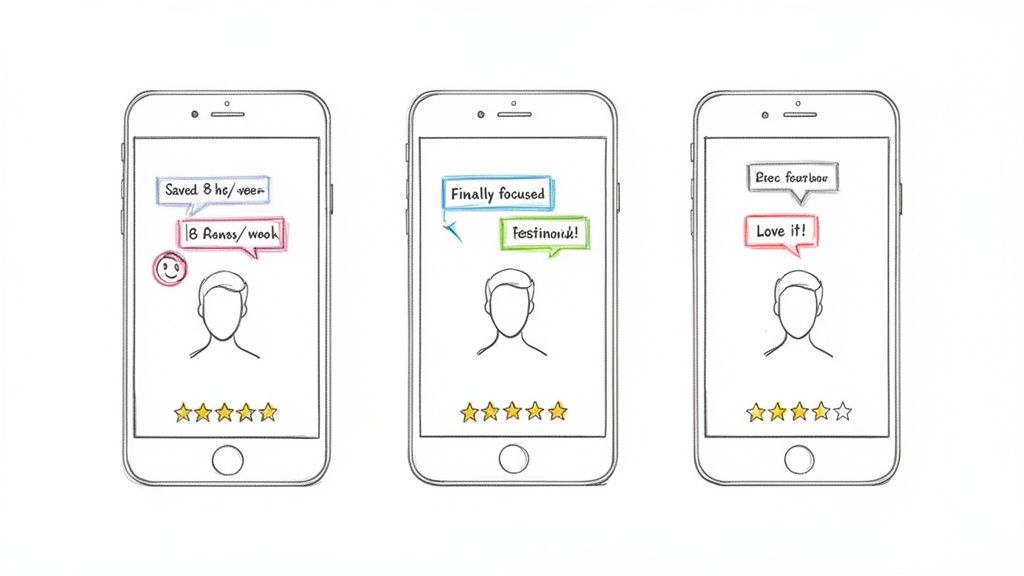
The structure works by assembling a montage of credible voices to reinforce a core benefit:
Hook (1-3 seconds): A powerful, out-of-context quote from the strongest testimonial. For example, "I honestly didn't think this would work, but..."
Body (10-25 seconds): A rapid-fire sequence of 2-4 different users sharing their results or experiences. The script is essentially the edited highlights of multiple testimonials, often supported by on-screen text overlays with key data points (e.g., "Saved 8 hours/week").
Call-to-Action (CTA) (1-3 seconds): A final user quote that leads into the CTA, such as "You have to try this for yourself," followed by the "Download Now" or "Shop Now" prompt.
Strategic Breakdown & Example
This format is exceptionally effective for fitness apps, language learning tools, SaaS products, and any brand where user results are the main selling point. The goal is to overwhelm the viewer with positive, relatable proof.
Example: A Fitness App
Hook: A user holds up a pair of old, oversized jeans to the camera and says, "I haven't fit into these in five years!"
Body: Quick cuts between three different users. User A shows a before/after picture on their phone. User B films their app screen, showing a workout completion streak. User C is at the gym, saying, "I finally have the confidence to come here alone." On-screen text highlights "Lost 15 lbs," "90-Day Streak," and "Newfound Confidence."
CTA: The montage ends with the app's logo and a clear text overlay: "Join Thousands Transforming Their Lives. Start Your Journey Today."
Actionable Takeaways & Implementation Notes
The key to a successful mashup is a systematic process for collecting and organizing testimonials. Raw authenticity is crucial; over-polishing the footage can destroy the credibility you’re trying to build.
Key Insight: The power of a UGC mashup lies in its diversity. Combining multiple voices, demographics, and use cases makes the social proof feel universal and broadly applicable, increasing the chance that a new viewer will see themselves in one of the testimonials.
Here are specific tips for implementation:
Systematize Collection: Create automated email flows, in-app prompts, or community incentives to consistently gather new testimonials. Make the submission process as easy as possible.
Organize by Outcome: Use a system to tag and organize testimonials by the specific benefit or outcome they describe (e.g., "time saved," "money earned," "confidence boost"). This allows you to quickly assemble ads for different campaign angles.
Test the Sequence: Experiment with the order of your testimonials. Does leading with the most dramatic transformation perform better, or does building up to it create a more compelling story?
Layer Data Overlays: Enhance raw testimonials with on-screen text or graphics that quantify the results. A user saying they saved time is good; adding a caption that says "Saved 8+ Hours Every Week" is much better.
For brands looking to implement this at scale, mastering how to make UGC is the first step. Creating a repeatable system for sourcing, organizing, and editing this content is essential for consistently refreshing your creative and keeping acquisition costs low.
5. Storytelling/Narrative Arc Script (Hero's Journey Simplified)
The Storytelling or Narrative Arc script adapts the timeless "Hero's Journey" for short-form video advertising. This framework creates an emotional connection by taking the viewer on a relatable, transformative journey. It’s one of the most powerful commercial scripts examples because it builds brand affinity and makes the product's value feel earned and meaningful, rather than just presented.
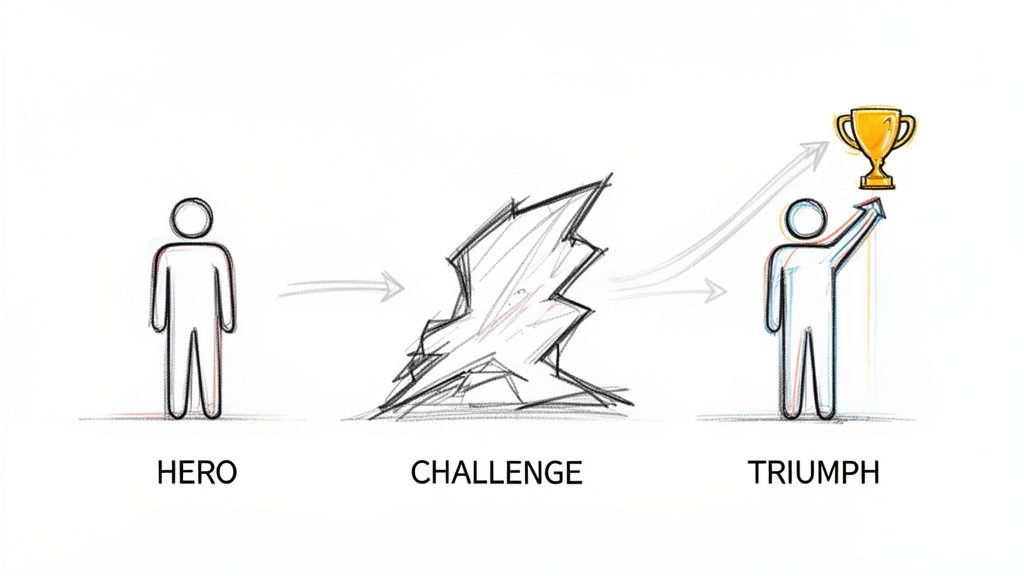
This structure condenses a classic narrative into a 30-60 second ad:
Relatable Character & Problem (5-10 seconds): Introduce a protagonist facing a specific, visceral struggle. This character must be instantly relatable to the target audience.
The Guide/Solution (5-15 seconds): The product or service appears not as a forceful sales pitch, but as a natural "guide" or "tool" that empowers the hero.
The Transformation (5-15 seconds): The hero uses the product to overcome the challenge, showing a clear, visible transformation or triumphant "after" state.
The Resolution (3-5 seconds): A closing scene reinforces the aspirational outcome, often with a clear Call-to-Action that invites others to begin their own journey.
Strategic Breakdown & Example
This framework excels for brands in the wellness, productivity, fitness, and gaming sectors, where personal transformation is a core value proposition. It works by making the viewer feel like the hero of their own story.
Example: A Meditation App
Relatable Character & Problem: Quick cuts show a stressed professional at their desk, rubbing their temples, then tossing and turning in bed at night. On-screen text: "Can't shut your mind off?"
The Guide/Solution: The character picks up their phone and opens the meditation app. The interface is shown briefly, highlighting a "Sleep Stories" feature. The mood shifts with calming music.
The Transformation: The scene transitions to the character sleeping peacefully. The next morning, they wake up looking refreshed and smiling, ready to start their day with energy.
The Resolution: The final shot shows the app logo with a clear CTA: "Find Your Calm. Download Free."
Actionable Takeaways & Implementation Notes
The success of a narrative script hinges on emotional resonance and authenticity. The product should feel like an organic part of the hero’s success, not a clumsy interruption.
Key Insight: The "hero" is your customer, not your brand. Your product is the magical sword or wise mentor that helps them defeat their dragon (the problem). This distinction is critical for building trust.
Here are specific tips for implementation:
Establish a Relatable Hero Fast: Use casting, wardrobe, and setting to make the character and their problem instantly recognizable to your target audience within the first few seconds.
Show, Don't Just Tell: Instead of a testimonial saying, "I feel less stressed," show the character going from a chaotic environment to a peaceful one. The visual transformation is more powerful than any claim.
Control the Emotional Arc with Pacing: Use quick, jarring cuts to establish the initial problem and shift to smoother, calmer editing and uplifting music as the solution is introduced and the transformation occurs.
This narrative approach is ideal for testing different character archetypes and problem angles. You can use a modular platform to assemble and test dozens of narrative variations, swapping out different "heroes" (e.g., a stressed student vs. a busy parent) and "challenges" (e.g., deadline anxiety vs. social burnout) to discover which stories resonate most deeply with your audience segments.
6. Demonstration/Before-After Script Format
The Demonstration/Before-After format is a visual-first structure that immediately communicates product value through stark contrast. It leverages a fundamental psychological principle: our brains are wired to notice change. By showing a clear, measurable transformation from a relatable "before" state to a desirable "after" state, these ads bypass lengthy explanations and prove their worth instantly. This makes it one of the most compelling commercial scripts examples for products with tangible results.
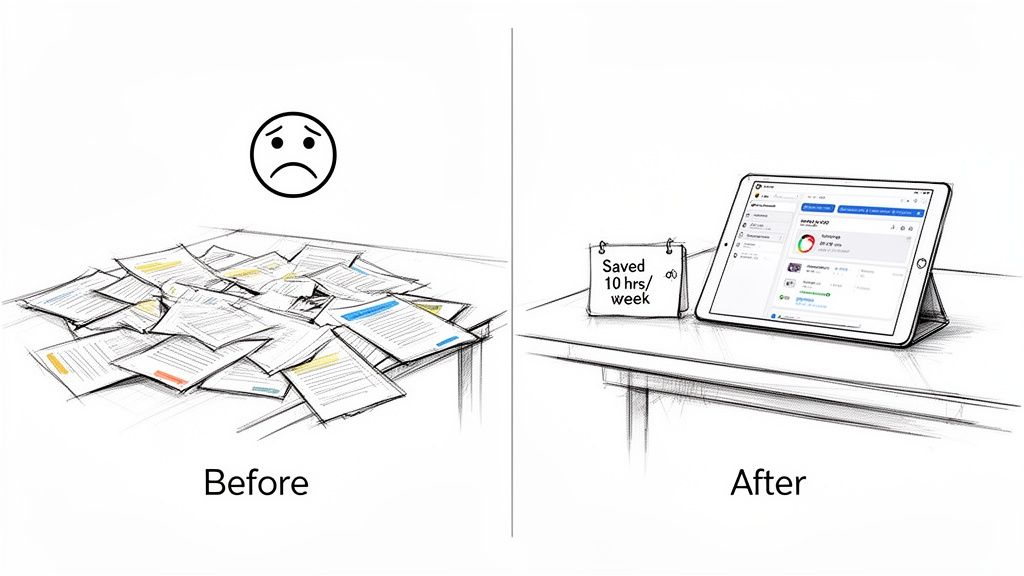
This script format is built on a simple yet powerful sequence:
Before (1-3 seconds): Establishes the problem state. This is a quick shot of the struggle, the inefficiency, or the unsatisfactory result without the product.
Transition (0.5-1 second): The moment of change. A satisfying swipe, a quick cut, or a sound effect (like a "whoosh" or a "ding") signifies the product's intervention.
After (3-10 seconds): Reveals the solution state. This shows the improved, organized, or successful outcome, often accompanied by a metric (time saved, score improved, etc.) that quantifies the benefit.
Strategic Breakdown & Example
This format is exceptionally effective for software that organizes digital spaces, fitness apps showing physical progress, and any tool that provides a visible enhancement. The key is making the transformation both dramatic and believable.
Example: A Photo Editing App
Before: A quick shot of a dull, flat-looking user photo on a phone screen. The colors are muted, and the subject doesn't stand out. On-screen text: "Your photos could be better."
Transition: A finger taps a "Magic Enhance" button on the app's interface, triggering a satisfying "shimmer" sound effect and a quick wipe transition.
After: The same photo is now vibrant, with rich colors and perfect contrast. A small text overlay appears: "+85% Vibrancy." The ad ends with the app logo and a clear CTA like "Try It On Your Photos."
Actionable Takeaways & Implementation Notes
To maximize the impact of the Before-After format, focus on the clarity and satisfaction of the transformation. The visual payoff is everything.
Key Insight: The "Before" state must be relatable, not exaggerated. If the problem looks unrealistic, viewers will dismiss the solution as unbelievable. Authenticity in the "before" shot builds trust for the "after" result.
Here are specific tips for implementation:
Quantify the Improvement: Don't just show the change; prove it with numbers. Display metrics like "Time Saved: 45 Minutes," "Score Increased by 200%," or "Cleaned in 5 Mins." This adds a layer of credibility.
Use Satisfying Transitions: The moment of change is critical. Use sound design like a click, whoosh, or success chime to make the transition feel rewarding and draw attention to the product's action.
Maintain Visual Consistency: Keep the camera angle, lighting, and framing identical between the "before" and "after" shots. This ensures the product's impact is the only variable, making the comparison fair and clear.
For teams running numerous campaigns, this format is ideal for scaled production. Platforms like Sovran allow you to create hundreds of before-after video variations by programmatically adding different text overlays (e.g., testing "50% Faster" vs. "Saves 10 Mins") to your video pairs, enabling rapid A/B testing to find the most persuasive metric.
7. Rapid-Cut Highlight Reel / Feature Showcase Script
The Rapid-Cut Highlight Reel is a high-energy, pattern-interrupt format designed to showcase a product's breadth and dynamism in seconds. It thrives on platforms like TikTok and Instagram Reels by leveraging quick cuts, trending audio, and constant visual novelty to hold viewer attention. This approach is one of the most effective commercial scripts examples for apps with multiple features, games with diverse gameplay, or any product with various compelling use cases.
The structure is built around a relentless pace to maximize engagement and convey a sense of excitement:
Hook (1-3 seconds): The first few cuts are the most impactful. They show the "stickiest" or most visually satisfying moments of the product to prevent the scroll.
Body (5-15 seconds): A rapid-fire sequence of 1-2 second clips demonstrating different features, benefits, or user experiences. Text overlays often add clarity amidst the fast-paced visuals.
Call-to-Action (CTA) (1-3 seconds): A final, clear end card that resolves the energy with a single directive, such as "Download & Play" or "Explore All Features."
Strategic Breakdown & Example
This framework is ideal for mobile games, social media apps, and feature-rich software where demonstrating variety is key to showing value. The goal is to overwhelm the viewer with positive experiences, creating a strong impression of a deep, engaging product.
Example: A Mobile Game
Hook: An explosive clip of a player defeating a massive final boss, immediately followed by unlocking a rare, glowing character. On-screen text: "UNLEASH YOUR POWER."
Body: A quick succession of clips: a fast-paced multiplayer race, customizing a character with unique armor, opening a loot box that reveals a legendary item, and a snippet of a fun seasonal event. Each cut is perfectly synced to the beat of a trending audio track.
CTA: The game's logo animates onto the screen with a vibrant background and a clear button: "PLAY NOW FOR FREE!"
Actionable Takeaways & Implementation Notes
To succeed with the highlight reel format, you need a system for rapid assembly and testing. The core strength of this script is its modularity, allowing for endless remixing of feature clips.
Key Insight: The performance of a highlight reel isn't just about the clips themselves, but their sequence and synchronization with audio. A winning reel feels more like a music video than a traditional ad, creating an emotional and rhythmic impact.
Here are specific tips for implementation:
Organize Your Assets: Create a content library organized by feature, benefit, or moment (e.g., "Boss Battles," "Character Unlocks," "Social Moments"). This allows for quick assembly of different reel variations.
Sync Cuts to Audio: Use the beat drops and rhythm of trending audio as your guide for when to cut. A perfectly synced edit feels more professional and satisfying to watch, boosting retention.
Use Visual Pacing: Employ jump cuts, zoom effects, and dynamic transitions to maintain momentum. Every 10-12 cuts, consider a slightly longer (2-second) "breath" moment to reset engagement before speeding up again.
Lead with Your Best: The first three seconds must contain your most visually arresting or exciting content. Assume you have less than a second to stop the scroll and hook the viewer.
7 Commercial Script Formats Compared
Format | Implementation 🔄 | Resources ⚡ | Expected Outcomes 📊⭐ | Ideal Use Cases 💡 | Key Advantages ⭐ |
|---|---|---|---|---|---|
Hook‑Body‑CTA (Hook‑Benefit‑CTA) | Low — modular 3‑part assembly; rapid varianting | Low — short clips, captions, pre‑tagged assets | 📊 High engagement & CTR on short‑form; ⭐ Proven conversion for 15–60s ads | Meta/TikTok short ads, app installs, e‑commerce | ⭐ Fast to test; modular; high thumb‑stop potential |
Problem‑Agitate‑Solution (PAS) | Medium — needs setup and emotional build | Medium — staged scenes or testimonials; ~30–60s | 📊 Strong persuasion and urgency; ⭐ High resonance for problem‑aware users | Productivity, wellness, finance, SaaS, coaching | ⭐ Drives emotional engagement; addresses objections |
Listicle Script Format ("7 Ways", "5 Reasons") | Low — repeatable numbered blocks | Low — consistent templates, text overlays | 📊 High information density & shareability; ⭐ Fast comprehension | Educational content, feature highlights, Shorts/TikTok, carousels | ⭐ Scannable; easy to rearrange and scale |
UGC Testimonial / Social Proof Mashup | Low–Medium — curation and sequencing focused | Low — user clips scale but require collection & releases | 📊 Highest trust & conversion lift; ⭐ Very authentic performance | Social commerce, review‑driven campaigns, performance ads | ⭐ High credibility; low production cost; algorithm‑friendly |
Storytelling / Narrative Arc (Hero's Journey) | High — casting, pacing, cohesive arc in short runtime | Medium–High — production, music, continuity | 📊 Strong brand recall & engagement; ⭐ Memorable and shareable | Brand building, top‑of‑funnel awareness, aspirational products | ⭐ Emotional connection; higher completion & recall |
Demonstration / Before‑After | Medium — paired framing and fair comparison | Medium — visual proof, consistent lighting, metric overlays | 📊 Immediate value clarity; ⭐ High conversion for tangible benefits | Physical products, UI improvements, transformation services | ⭐ Visual proof; language‑agnostic; measurable claims |
Rapid‑Cut Highlight Reel / Feature Showcase | Medium–High — tight editing, sync to audio | High — large footage library, trending audio, skilled edits | 📊 Very high watch‑through & replay rates; ⭐ Exceptional algorithm performance | Gaming, entertainment, feature showcases, retargeting | ⭐ High rewatchability; broad moment appeal; trendable |
From Framework to Performance: Activating Your Scripts at Scale
Navigating the landscape of modern advertising requires more than just a single great idea. As we've explored through the diverse collection of commercial scripts examples in this article, the real power lies not in a single framework but in a systematic approach to creative development, testing, and scaling. The journey from a basic concept to a high-performing ad campaign is paved with strategic iteration and a deep understanding of what makes an audience take action.
You've seen how foundational structures like Hook-Body-CTA and Problem-Agitate-Solution (PAS) serve as reliable blueprints. You’ve also explored more dynamic formats like UGC mashups and rapid-cut highlight reels, which are essential for grabbing attention on fast-paced platforms like TikTok and Meta. Each framework offers a unique psychological entry point to connect with your target user.
Key Takeaways for Immediate Action
The difference between a good campaign and a great one often comes down to the speed and intelligence of your testing. The core lesson from these examples is to treat your scripts not as static, one-off documents, but as modular, adaptable systems.
Deconstruct to Reconstruct: Break down every script into its core components: the hook, the core message or benefit (the body), and the call-to-action. This modularity is your key to rapid A/B testing. You can swap one hook across five different body sections or test three different CTAs with your winning hook-body combination.
Embrace Platform Nuance: A script that works on YouTube will not perform the same way on TikTok without adaptation. As demonstrated, simple edits like adding text overlays, changing the pacing, or using trending audio can dramatically alter an ad's effectiveness. Always adapt, never just repurpose.
The Hook is Your First Hurdle: In today's saturated ad environment, the first three seconds determine everything. Your primary focus for iteration should always be on the hook. Test questions, bold statements, surprising visuals, and user-generated content to find what consistently stops the scroll.
Moving from Theory to Scalable Execution
Mastering these script formats is the first critical step. However, the true competitive advantage is unlocked when you can operationalize this knowledge. A winning script is only a winner for a limited time due to creative fatigue. The real challenge is building a system that continuously finds the next winner without burning out your team or budget. Successfully activating your commercial scripts at scale depends heavily on strategic Media Planning And Buying Strategies to ensure optimal reach and impact. Aligning your creative variations with a sophisticated media plan prevents you from wasting your best ads on the wrong audience segments.
This is where the paradigm shifts from manual creation to automated assembly. Imagine your best hooks, customer testimonials, product demonstrations, and brand assets as building blocks. Modern creative platforms allow you to programmatically combine these elements based on your proven script frameworks. You can generate hundreds of on-brand ad variants in the time it would take to manually produce a few, accelerating your learning cycle from weeks to mere hours. This approach allows you to stop guessing what might work and start letting data guide you to what actually does, consistently and at scale.
By internalizing these frameworks and leveraging automation, you transform your creative process from a bottleneck into a growth engine, ensuring your message not only reaches your audience but resonates powerfully enough to drive meaningful conversions.
Ready to stop manually editing scripts and start scaling your creative output? Sovran uses AI to assemble high-performing video ads in minutes, turning your existing assets and script frameworks into a limitless supply of campaign-ready content. See how our platform can help you execute on the commercial scripts examples from this guide by visiting Sovran today.

Manson Chen
Founder, Sovran
Related Articles
10 Actionable Ad Creative Ideas That Convert in 2026
Discover 10 actionable ad creative ideas for Meta & TikTok. Get hooks, scripts, and testing frameworks to boost your ROAS and combat creative fatigue.
- ad-creative-ideas
- video-marketing
- 6 more
How to Turn Link Into Video: Ads That Convert in 2026
Learn how to turn link into video for Meta & TikTok ads. Leverage AI to scale creation, boost ROI, and succeed in 2026.
- ai-video-generation
- link-to-video-ads
- 6 more
8 High-Converting Static Ads Examples for 2026
Discover 8 high-performing static ads examples from top apps. Learn to create text-overlays, testimonials, and lifestyle ads that convert.
- static-ads
- performance-marketing
- 5 more