8 Best Hooks for Video Ads That Convert in 2026
Jump to a section
The first three seconds of your video ad determine its fate. A weak opening means wasted ad spend, dismal engagement, and missed conversions. In the fast-paced scroll of social feeds, your ad isn't just competing with other brands; it's up against everything from creator content to family photos. This presents a critical challenge for performance marketers: how do you consistently develop hooks that stop thumbs, capture attention, and drive action without exhausting your creative team and budget?
Traditional creative production is too slow for platforms like TikTok and Meta, where ad fatigue can crush performance in just a few days. You need a reliable system for generating effective openings. Understanding how to build effective advertisements is vital, particularly when it comes to creating social media ads that convert and ensuring your marketing spend delivers a return. A powerful hook is the single most important element for achieving that goal.
This guide is your swipe file for the best hooks for video ads. We’re moving beyond generic advice to provide you with a structured collection of high-performing frameworks. You'll get specific scripts, platform-specific examples, and a look at the psychology behind why these hooks work. We'll explore actionable strategies for systematically testing and scaling your creative output, turning your ad hooks from a recurring problem into your most significant growth driver. Let's dive into the eight essential hooks your team should be using right now.
1. The Pattern Interrupt Hook
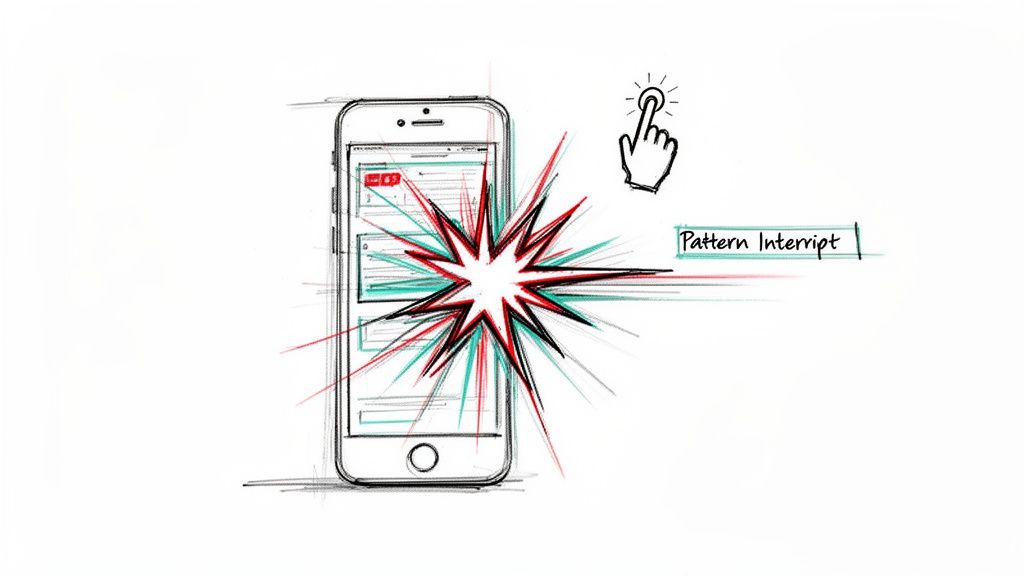
The modern social media feed is a relentless, high-speed stream of content. To succeed, your video ad must instantly break through this hypnotic scrolling trance. This is the core function of the Pattern Interrupt, a technique designed to stop viewers by using an unexpected visual, audio, or narrative element within the first 1-3 seconds. It works by violating the user's expectations, forcing their brain to pause and process the anomaly.
This method isn't just about being loud or flashy; it's about being unpredictable. Imagine an ad for accounting software that opens with a rubber chicken falling onto a keyboard, or a cooking tutorial that begins with someone dropping a full carton of eggs. The viewer's brain, conditioned to expect a certain type of content, is jolted into paying attention. This jolt is your window of opportunity to present your message.
Why It Works So Well
This hook is one of the best for video ads because it directly counters autopilot scrolling behavior. It leverages the brain's natural orientation response, an instinct to notice anything new or sudden in the environment. By presenting something that doesn't fit the established pattern of the feed, you create an open loop that the viewer feels compelled to close.
- Platform Versatility: Extremely effective on fast-paced platforms like TikTok and Instagram Reels where users make snap judgments.
- Broad Applicability: Works across nearly any vertical, from mobile gaming (unexpected character animations) to B2B SaaS (a typically formal chart suddenly shattering).
- Memorability: The surprise element makes the ad more memorable than a standard, predictable opening.
Actionable Tips for Implementation
Creating an effective pattern interrupt requires more than just a random surprise. The disruption must be sharp, immediate, and relevant enough to keep the viewer engaged past the initial shock.
- Amplify with Audio: Layer a jarring sound effect over your visual disruption. Think record scratches, sudden silence, a surprising voiceover line, or an unexpected musical shift. The combination of audio and visual interruption is much more powerful.
- Focus the First Frame: Your opening frame is your most valuable asset. Make it the highest-contrast, most visually strange moment of the entire hook. This captures attention even before the video fully plays.
- Test for Your Audience: What interrupts one demographic may not affect another. Use a tool like Sovran's AI to bulk-generate 5-10 variations with different visuals or sounds to discover what truly stops your specific audience.
- Connect to the Core Message: The interrupt earns you attention; the rest of the ad must keep it. Ensure a logical, if not immediate, connection back to your product or message. A random explosion is useless if the viewer immediately scrolls away in confusion.
Key Insight: Monitor your ad's watch-time and drop-off rates. A successful Pattern Interrupt will show a high 3-second view rate but also maintain a steady retention curve afterward. A sharp drop-off post-hook means your interruption is disconnected from your ad's body content.
2. The Question Hook
Instead of shouting for attention, some of the best hooks for video ads begin with a simple question. The Question Hook works by posing a direct, emotionally resonant question in the first 1-3 seconds, making viewers feel personally addressed. This technique activates natural human curiosity and a psychological principle known as the Zeigarnik effect, where the brain remains fixated on incomplete tasks or unanswered questions, compelling viewers to watch for the solution.
This method immediately puts the viewer at the center of the narrative. An ad for a meal-kit service asking, "Tired of planning meals every night?" instantly connects with a common frustration. Similarly, a B2B SaaS ad posing, "Are you still manually creating video ads?" directly targets a specific professional pain point. The viewer's internal "yes" is the first step toward engagement, creating a personal stake in the ad's message.
Why It Works So Well
This hook is powerfully effective because it initiates a dialogue rather than a monologue. It bypasses a viewer's passive consumption state by demanding a mental response. By framing a problem the viewer recognizes, you establish immediate relevance and position your product as the answer they are now primed to hear.
- High Engagement: Questions encourage active mental participation, which is a strong predictor of ad recall and message retention.
- Direct Qualification: It quickly filters the audience, speaking directly to those who experience the specific problem your product solves.
- Problem-Centric: This approach perfectly sets up the Problem-Agitate-Solution (PAS) framework, a proven copywriting formula for driving conversions.
Actionable Tips for Implementation
A great question hook isn't just any question; it's a strategic probe into your audience's deepest needs and frustrations. The goal is to make the viewer feel understood before you ever mention your product.
- Be Hyper-Specific: Vague questions get ignored. Instead of "Want to be more productive?", try "Still using 12 different tools to organize your work?". The latter is specific, visual, and highlights a concrete problem.
- Keep it Concise: On mobile, your window is small. Aim for questions under 10 words that are easy to read and comprehend instantly, whether presented via text overlay or voiceover.
- Use an Emotional Voiceover: A natural, relatable voiceover delivers the question with much more emotional weight than text alone. The tone should match the emotion you're targeting, whether it's frustration, aspiration, or curiosity.
- Test Emotional Angles: The same core problem can be framed in multiple ways. Test variations of your question: one focused on the pain ("Tired of low ROAS?"), one on the aspiration ("What if you could triple your conversions?"), and one on curiosity ("Why do 92% of app installs come from video?").
Key Insight: A strong question hook creates an immediate information gap. Pair your question with a follow-up statement or statistic that builds credibility and promises a valuable answer. For example, "Can't sleep? You're not alone. 68% of adults struggle to fall asleep at least once a week. Here's a 2-minute trick that actually works."
3. The Trend-Jacking Hook
Riding the wave of popular culture is one of the fastest ways to gain immediate relevance and viewer connection. The Trend-Jacking Hook involves borrowing from trending audio, memes, challenges, or content formats that are already dominating social media feeds. Instead of creating interest from scratch, you tap into existing engagement momentum, making your ad feel less like an interruption and more like a natural part of the user's discovery experience.
This approach works by creating instant familiarity. When a user hears a recognizable TikTok sound or sees a format like the "She's a 10 but..." meme, their brain immediately categorizes the content as relevant and engaging. Brands like Duolingo have mastered this, integrating their brand mascot into viral video formats, making their ads feel like organic, entertaining content. It’s a powerful method to make your brand part of the cultural conversation, not just a commercial break.
Why It Works So Well
This hook is one of the best for video ads because it shortcuts the battle for attention by using a pre-validated engagement trigger. You're entering a conversation the audience is already having, which significantly lowers the barrier to entry and makes your message more receptive.
- Native Feel: It makes your ad look and feel like organic content, reducing the viewer's natural resistance to advertising.
- Built-in Virality: Trends already have viral potential. By aligning with them, you increase the chances of your ad being shared, liked, and commented on.
- Speed to Market: It allows for rapid creative development. Instead of brainstorming new concepts, you adapt existing successful ones, a perfect strategy for agile marketing teams.
Actionable Tips for Implementation
Success with trend-jacking hinges on speed and authenticity. A trend that's hot today might be old news by next week, so you must act fast and ensure the connection to your brand feels genuine, not forced.
- Move with Urgency: The ideal window for a trend is often just 3-7 days. Monitor the TikTok "For You" Page and Instagram Reels tab daily. When you spot a fit, act immediately. Plan for sprint-based campaigns rather than long-term strategies.
- Generate Variations at Scale: A single trend can be interpreted in many ways. Use a tool like Sovran's AI to quickly render 10-15 video variations with different captions or product angles. This allows you to test simultaneously and find the winning combination before the trend dies.
- Ensure Authentic Connection: Don't force your product into a trend where it doesn't belong. The audience will see right through it. The best trend-jacking ads, like Chipotle adapting popular humor formats, feel clever and natural.
- Organize Your Assets: Trends expire quickly. When you create a trend-based ad, save it in a "Context Vault" and tag it with an expiration date. This prevents you from accidentally running an ad that's culturally irrelevant and out of date.
Key Insight: Treat trend-jacking as a high-frequency testing strategy. The goal isn't for every attempt to be a viral hit. The goal is to consistently put trend-aligned content into the market, because the one that does hit can deliver outsized results and valuable audience insights.
4. The Contrast Hook
Humans are naturally drawn to transformation. The Contrast Hook capitalizes on this by immediately presenting a clear, visual comparison between two opposing states: the 'before' and the 'after'. This technique instantly communicates the value of a product or service by showing the problem and the solution side-by-side or in quick succession. It’s one of the best hooks for video ads because it answers the viewer's core question, "What's in it for me?" in a purely visual language.
This hook works by creating a tangible sense of progress and relief. Think of an ad for a productivity tool showing a chaotic desk filled with sticky notes, which then cleanly morphs into an organized digital dashboard. For skincare, it's the shift from dull, uneven skin to a glowing, smooth complexion. The viewer sees a relatable pain point and is immediately shown the ideal outcome, making the product's benefit undeniable and easy to grasp within seconds.
Why It Works So Well
The Contrast Hook is incredibly effective because it simplifies the value proposition into a direct visual payoff. It taps into the brain's desire for resolution and improvement, creating a powerful psychological connection between the viewer's problem and your solution.
- Instant Value Communication: It's the fastest way to demonstrate a product's core benefit without lengthy explanations. The transformation speaks for itself.
- Highly Relatable: The 'before' state is designed to be a common pain point, making viewers think, "That's me!" This personal connection increases engagement.
- Clear and Persuasive: There is no ambiguity. The viewer sees the positive change, making the ad’s message highly persuasive and easy to trust.
Actionable Tips for Implementation
Executing a strong Contrast Hook is about more than just showing two different clips. The transition and relatability are critical for it to land effectively.
- Maintain Framing Consistency: For maximum impact, keep the camera angle, lighting, and subject position as similar as possible between the 'before' and 'after' shots. This makes the transformation the only variable, highlighting your product's effect.
- Amplify the Transition: Use audio to signal the change. A depressing, minor-key sound for the 'before' state that shifts to an uplifting, bright sound for the 'after' can double the emotional impact of the visual contrast. A simple "swoosh" or "ding" also works well.
- Make the 'Before' Painfully Relatable: Dig into your customer research. The 'before' state must accurately reflect your audience's struggles. The more they recognize themselves in the problem, the more they will desire your solution.
- Label for Clarity: Don't be afraid to be direct. Use a tool like Sovran to batch-apply 'Before' and 'After' text overlays across multiple ad variations. This simple addition removes any guesswork and reinforces the message, especially in sound-off environments.
Key Insight: The power of the Contrast Hook is in the delta between the two states. Test variations where you exaggerate the 'before' state (more chaotic, more tired, more cluttered) and amplify the 'after' state (brighter colors, more serene, more organized) to find the combination that generates the strongest emotional response and highest click-through rate.
5. The Fear of Missing Out (FOMO) Hook
Humans are psychologically wired to avoid loss more than they seek equivalent gain. The Fear of Missing Out (FOMO) hook taps directly into this powerful behavioral principle. It frames your offer not just as a benefit to be gained, but as an opportunity that will soon be lost, creating a sense of urgency that compels immediate action. This hook works by highlighting scarcity, exclusivity, or time limitations to make inaction feel like a significant disadvantage.
This is a classic and effective hook for video ads because it short-circuits the viewer's tendency to procrastinate. An ad for an online course that opens with "Only 12 spots remaining" or an e-commerce promotion showing a countdown timer immediately changes the viewing dynamic. The ad is no longer just information; it’s a time-sensitive event that demands a decision, pushing viewers from passive observation to active consideration.
Why It Works So Well
This hook is one of the best for video ads because it creates a direct and compelling reason to act now. It moves the purchase decision from a "maybe later" category to a "must-do today" priority by introducing the risk of a negative outcome, such as paying more, missing out on a feature, or losing access entirely.
- Drives Immediate Conversions: Ideal for last-minute retargeting campaigns and flash sales where the goal is a quick conversion.
- Enhances Perceived Value: Scarcity makes products and offers seem more valuable and desirable. Limited-edition drops and exclusive early-bird pricing are built on this principle.
- Effective in Competitive Markets: When multiple options exist, highlighting a limited-time advantage can be the deciding factor that wins the customer.
Actionable Tips for Implementation
Deploying a FOMO hook requires a balance of urgency and credibility. The viewer must believe the limitation is real for it to have any impact.
- Use Genuine Scarcity: Fabricating urgency is a quick way to destroy brand trust. Only use FOMO with real deadlines, authentic stock limits, or genuine cohort caps.
- Combine with Trust Signals: Pair urgency with social proof to lower hesitation. A video showing "Sale ends in 2 hours" is more powerful when followed by a customer testimonial or a shot of your 5-star reviews.
- Visualize the Urgency: Don't just say it, show it. Use text overlays with countdown timers, animated stock level indicators ("97% claimed!"), or visuals of a calendar with a date circled in red. These visual cues reinforce the message.
- Test Urgency Language: A/B test different ways of framing the scarcity. Compare the performance of "only 3 spots left" versus "97% of spots are filled" or a specific deadline like "prices increase at midnight."
Key Insight: Monitor the long-term value (LTV) of customers acquired through FOMO campaigns. If these customers churn significantly faster, it may indicate that the urgency is attracting lower-intent buyers. Adjust your targeting or the intensity of your FOMO messaging to ensure you're attracting a sustainable customer base.
6. The Social Proof Hook
In a market saturated with bold claims, viewers have become skeptical. The Social Proof Hook cuts through this skepticism by opening with immediate, undeniable evidence of your product's value. This technique establishes authority and builds trust from the very first second by showing that others - peers, experts, or a large community - already trust and benefit from your brand.
It works by borrowing third-party credibility. An ad that begins with a screen full of five-star reviews, a direct quote from a happy customer, or a counter showing millions of users instantly answers the viewer's subconscious question: "Can I trust this?" By showcasing user success stories, impressive stats like "Rated 4.8⭐ by 50,000 users," or endorsements from well-known figures, you bypass the need to sell and instead let satisfied customers do it for you.

Why It Works So Well
This hook is one of the best for video ads because it taps into a fundamental psychological principle: people are heavily influenced by the actions and opinions of others. It’s a powerful shortcut to building brand trust, especially for D2C, SaaS, and app-based products where user experience is everything.
- Instant Credibility: It immediately overcomes viewer skepticism by presenting objective proof, which is more persuasive than brand-generated claims.
- Reduces Perceived Risk: Seeing that thousands of others have had a positive experience lowers the barrier to entry for a new user, making them more likely to try your product.
- High Relatability: Featuring real user testimonials, especially on platforms like TikTok, creates an authentic connection that makes the viewer feel like the product is for "people like me."
Actionable Tips for Implementation
An effective social proof hook is specific, authentic, and visually compelling. Generic praise is easily ignored; detailed, verifiable proof is what stops the scroll.
- Prioritize Specificity: Instead of "Our users love it," use a direct quote like "I learned Spanish in 30 days using this app." Tangible outcomes are far more powerful than vague compliments.
- Show, Don't Just Tell: Use visuals to reinforce your proof. Animate star ratings, show a rapid-fire sequence of positive user comments, or feature a video testimonial from a real person. Authenticity in presentation is key.
- Test Peer vs. Expert Proof: For some audiences, a relatable peer testimonial ("This app helped me save 10 hours a week") will outperform a polished celebrity endorsement. Test which type of social proof resonates most with your target customer.
- Blend Multiple Testimonials: Use a fast-paced UGC (User-Generated Content) mashup. Quickly cutting between several different users all praising your product creates a sense of overwhelming positive consensus.
Key Insight: The most effective social proof feels genuine and unscripted. Use user avatars, names, and even on-screen text that mimics the platform's native style to increase authenticity. A raw, phone-shot video testimonial often outperforms a slick, studio-produced one because it feels more trustworthy.
7. The Storytelling Hook
Humans are fundamentally wired for stories. The Storytelling Hook taps into this deep-seated instinct by opening with a narrative arc that immediately pulls viewers into an emotional journey. It establishes a character and their conflict within the first few seconds, making the audience curious to see the resolution.
This technique moves beyond simple product features and instead builds a connection. An ad for a wellness app might open with, "I couldn't fall asleep for 3 years. Then I discovered..." Similarly, a SaaS founder could start with, "I was rejected by 47 VCs. Here's what changed..." The viewer is invested in the protagonist's struggle and stays to learn how it was solved, which is where your product comes in.
Why It Works So Well
This hook is among the best for video ads because it builds instant emotional resonance and context. Instead of just presenting a solution, it first establishes the problem in a relatable, human way. This creates a powerful 'before and after' framework that perfectly positions your product as the turning point.
- Builds Trust: Authentic stories, especially user-generated ones, feel less like an ad and more like a genuine recommendation, increasing credibility.
- Emotional Investment: By creating a character and conflict, you make the viewer feel something. This emotional investment makes the ad’s message stick.
- Drives Curiosity: A well-crafted story creates an open loop. Viewers feel a psychological need to see the story's conclusion, dramatically improving watch time.
Actionable Tips for Implementation
An effective storytelling hook must be concise and compelling, establishing the entire setup in seconds. The goal is to create a miniature narrative arc that culminates with your product as the hero.
- Establish the Protagonist & Conflict Immediately: Your first frame should introduce the main character. By the 2-second mark, their challenge must be clear. Use specific, sensory language like, "I woke up at 5:47 AM, my heart racing..." to make the story feel real.
- Use Real Stories When Possible: User-generated content (UGC) or genuine founder narratives often outperform scripted acting. Authenticity is key to making the story believable and impactful.
- Keep the Arc Concise: The entire setup, from character introduction to conflict, should happen in 4-6 seconds. Your product should appear as the resolution by the 5-second mark to retain viewers who are there for a solution.
- Test Different Protagonists: Use a tool like Sovran to create story variations with different characters or emotional angles. A story that resonates with one demographic might not work for another. Test these variations to find the most effective narrative for your target audience.
Key Insight: The power of a story lies in its specificity. "I was always tired" is generic. "My daughter asked why I was always too tired to play with her. That’s when everything had to change" is a story. Use concrete details to ground your narrative and make it unforgettable.
8. The Demonstration Hook
Sometimes, the most effective way to grab attention isn't a shocking surprise, but undeniable proof. The Demonstration Hook gets straight to the point by showing your product in action, solving a problem, or delivering its core benefit within the first 2-3 seconds. Instead of telling the audience what your product does, you show them, providing an instant "aha!" moment that builds immediate credibility and desire.
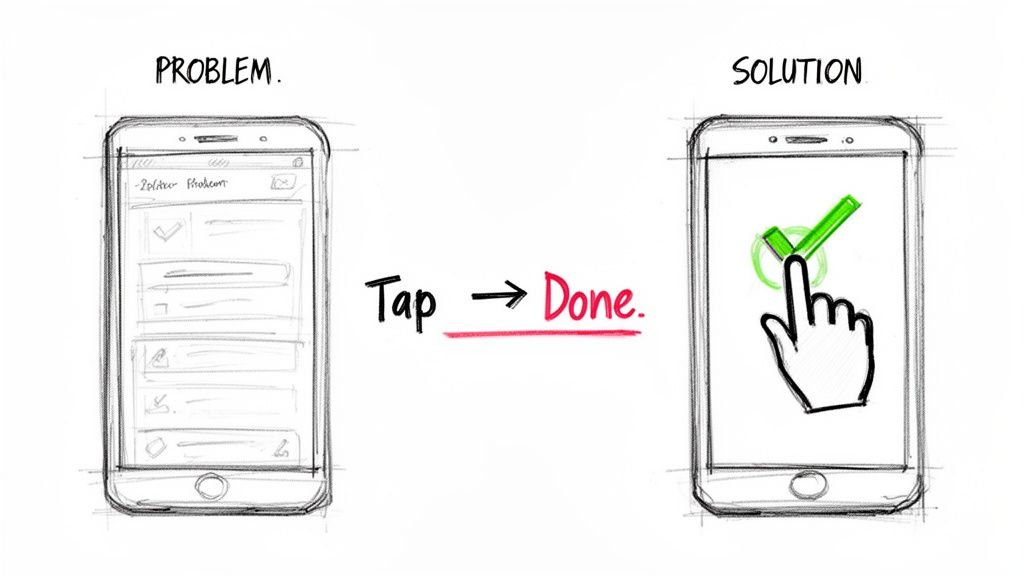
This hook is perfect for apps, software, and tools where the value is in the functionality. Think of an ad for a photo editing app that opens with a single tap transforming a dull photo into a vibrant one, or a productivity app instantly organizing a chaotic to-do list. The viewer immediately understands the value proposition without needing a lengthy explanation. It’s a "show, don't tell" approach tailored for the speed of social media.
Why It Works So Well
This hook is one of the best for video ads because it bypasses skepticism and gets directly to the solution. It answers the viewer's implicit question, "What's in it for me?" with a clear, visual answer. By showing the product delivering a result, you create a tangible sense of value that is much more persuasive than abstract claims.
- Builds Instant Trust: Seeing the product work is more convincing than hearing about it. This is especially true for SaaS and mobile apps where functionality is everything.
- High Clarity: There is no room for confusion. The viewer either sees the value in the demonstration or they don't, making it an efficient way to qualify your audience.
- Encourages Desire: Watching a problem get solved smoothly creates a desire to experience that same ease and efficiency, driving clicks and conversions.
Actionable Tips for Implementation
A great demonstration is clear, concise, and focused on the most compelling outcome. The goal is not to show every feature, but to highlight the one that solves the biggest pain point.
- Focus on the "Magic Moment": Identify the single most impressive action or result your product delivers. Start your video with that moment to hook the viewer immediately.
- Use Text Overlays and Speed Ramps: Clearly label the features you're showing with on-screen text. Speed up slower, less critical transitions and slow down during the key feature moments to add emphasis and maintain pace.
- Optimize for Visual Quality: Record your screen demo in the highest resolution possible. A crisp, clear demonstration looks more professional and trustworthy than a pixelated or blurry one.
- Add Subtle Sound Design: Use satisfying clicks, chimes, or swooshes to emphasize actions and successful outcomes. This audio feedback makes the demonstration feel more polished and gratifying to watch.
Key Insight: Before filming, script out the single user journey you want to show. A common mistake is trying to demo too much at once, which confuses the viewer. Focus on one clear problem-to-solution path, like "messy inbox to organized inbox" or "blank page to finished design."
Top 8 Video Ad Hooks Comparison
| Hook | 🔄 Implementation complexity | ⚡ Resource / efficiency | 📊 Expected outcomes | ⭐ Key advantages | 💡 Tips |
|---|---|---|---|---|---|
| The Pattern Interrupt Hook | Low–Medium; quick templates but creative testing needed | High efficiency at scale once templates exist; low per-asset cost | Very high stop-rate; risk of short retention if overdone | Exceptional scroll-stopping performance across demos | Test 5–10 variants; use high-contrast first frame; pair with strong body content |
| The Question Hook | Low; simple format but requires audience insight | Very efficient—text overlay + VO; easy to scale | High engagement and audience self-selection | Strong engagement on Meta; effective with UGC testimonials | Research pain points; keep question <10 words; follow with proof/stat |
| The Trend-Jacking Hook | Medium–High; needs constant monitoring and fast execution | Fast to produce for each trend but demands rapid turnaround | Quick algorithmic boosts and viral reach; very short shelf-life | Immediate platform relevance and momentum | Move within 3–7 days of trend peak; ensure authenticity |
| The Contrast Hook | Medium; needs deliberate framing and visual planning | Moderate resources; higher production quality improves clarity | Clear comprehension of benefit; high retention and recall | Instantly communicates transformation without heavy copy | Keep framing consistent; use audio shift at reveal; reveal ~3–5s |
| The FOMO Hook | Low–Medium; simple concept but legal/ethical care required | Efficient for promos; needs real-time data (timers/stock) | High conversion for time-limited offers; short conversion window | Strong urgency trigger; reduces decision time | Use genuine scarcity; pair with trust signals; prefer retargeting |
| The Social Proof Hook | Medium; requires testimonial sourcing and permissions | Resource-intensive to collect/clear UGC but reusable assets | Increased trust and lower friction for high-consideration buys | Dramatically boosts credibility and conversion intent | Prioritize specific outcomes; verify authenticity; rotate content |
| The Storytelling Hook | High; needs strong script, direction and editing | Resource-heavy (talent, production) but very brand-building | Deep emotional connection; superior memory retention and shareability | Builds long-term brand equity and emotional resonance | Establish protagonist immediately; keep arc concise (4–6s hook) |
| The Demonstration Hook | Low–Medium; depends on product clarity and UX | Efficient for software/apps—screen recordings scale well | High comprehension and conversion for product-centric offers | Shows proof-of-concept instantly; reduces skepticism | Use high-res recordings; label features; show realistic data and CTA |
From Hook to High-Performer: Scaling Your Creative Workflow
You now have a powerful arsenal of the eight best hooks for video ads, from the jarring Pattern Interrupt to the compelling Social Proof hook. We've deconstructed why they work, how to build them, and where they perform best. But possessing a list of great ideas is only the first step. The true differentiator between campaigns that stall and those that scale is the operational system built around them. Success isn't about finding one "perfect" hook; it's about building a machine that rapidly tests many hooks to discover what resonates right now with your audience.
The core challenge for growth marketers and creative teams isn't a lack of ideas, but a production bottleneck. Manually creating, editing, and exporting dozens of variations for each hook framework is a time-intensive process that drains resources and slows down learning. This is where your focus must shift from pure ideation to strategic implementation.
Key Takeaways: From Theory to Actionable Strategy
Mastering video ad hooks requires a mindset change. Instead of viewing hooks as isolated "tricks," see them as modular components within a larger creative system. Here are the essential principles to carry forward:
- Never Stop Testing: The effectiveness of any hook is temporary. Audience tastes change, trends fade, and platforms evolve. Your top-performing "Question Hook" from last quarter might be ignored today. A continuous testing pipeline is not optional; it's fundamental to sustained performance.
- Context is King: A hook doesn't exist in a vacuum. A "Demonstration Hook" that works wonders for a SaaS product on LinkedIn might fail completely for a mobile game on TikTok. Always adapt the hook's execution to the platform's native style and the audience's expectations.
- Combine and Conquer: The most potent ads often blend multiple hook types. You can start with a "Pattern Interrupt" visual, immediately follow it with a "Question Hook" in the voiceover, and then flash "Social Proof" on screen. Treat these frameworks as building blocks to be combined for greater impact.
- Iterate, Don't Reinvent: Found a winning "FOMO Hook"? Don't just move on. The next step is to iterate. Test that same hook with a new visual, a different voiceover, or slightly altered headline copy. Small changes can lead to significant performance gains and extend the life of a winning concept.
Building Your Creative Velocity Engine
The gap between knowing the best hooks for video ads and consistently profiting from them is bridged by your workflow. Manually editing variants in tools like CapCut or After Effects is a recipe for creative fatigue and slow feedback loops. To truly scale your creative workflow and turn hooks into high-performers, developing an ultimate content creation workflow guide is paramount for your team's internal processes.
Strategic Insight: Your competitive advantage is not the quality of your ideas, but the speed at which you can test them. A team that can test 100 ad variations a week will always outperform a team that tests 10.
This is where an AI-powered system becomes a game-changer. Imagine uploading your core assets-visuals, voiceovers, music, and text-just once. An AI platform can tag and organize these into a reusable library. From there, you can define rules based on the hook frameworks we've discussed.
- Want to test a "Contrast Hook"? Select two opposing visuals, pair them with five different headlines, and let the system generate every possible combination in minutes.
- Need to refresh a "Storytelling Hook"? Keep the winning narrative but swap in UGC from new customers stored in your asset library.
By automating the repetitive, manual tasks of video production, you empower your creative strategists and media buyers to focus on what truly matters: analyzing data, understanding the audience, and developing high-level creative strategy. This accelerates your learning cycle, allowing you to find profitable ad creatives faster and combat ad fatigue before it even starts. The goal is to move from a linear, one-at-a-time process to a scalable, parallel-path system where testing and iteration happen at an exponential rate. Your next breakout ad is waiting to be discovered, and a smarter workflow is the map that will lead you there.
Ready to stop the endless cycle of manual video editing and start scaling your creative output? Sovran uses AI to build a modular creative system, allowing you to test hundreds of ad variations in minutes, not weeks. Turn your best hook ideas into high-performing campaigns at the speed your business demands.

Manson Chen
Founder, Sovran
Related Articles
8 Pattern Interrupt Techniques for Video Ads
- pattern interrupt techniques
- video ad hooks
- 3 more
Customer Journey Mapping for Performance Marketing
- customer journey mapping
- performance marketing
- 3 more
Production Schedule Optimization for Scalable Ad Testing
- production schedule optimization
- creative testing
- 3 more