10 Best Hook Testing Tools for Video Ads (2026)
I've tested 10 hook testing tools for short-form video across TikTok, Reels, and YouTube Shorts. Here's the 2026 ranking for DTC brands and performance marketers.
Jump to a section
- What I Look For in a Hook Testing Tool
- 1. Sovran — Best for Creating and Testing 50+ Hook Variations in One Workflow
- 2. Foreplay — Best for Hook Inspiration From Competitor Ads
- 3. OpusClip — Best for Turning Long-Form Into Hook-Led Shorts
- 4. VidIQ — Best for YouTube Shorts Hook Analytics
- 5. TubeBuddy — Best for A/B Testing Titles and Thumbnails on YouTube
- 6. Motion — Best for Creative Performance Analytics Across Meta and TikTok
- 7. Kapwing — Best for Manual Frame-Level Hook Swaps
- 8. Metricool — Best for Cross-Platform Hook Performance Tracking
- 9. Descript — Best for Script-First Hook Iteration
- 10. Syllaby — Best for AI Hook Generation
- Side-by-Side Comparison
- How I Actually Test Hooks Systematically
- Common Hook Testing Mistakes I See Marketers Make
- Start Testing Hooks at Scale
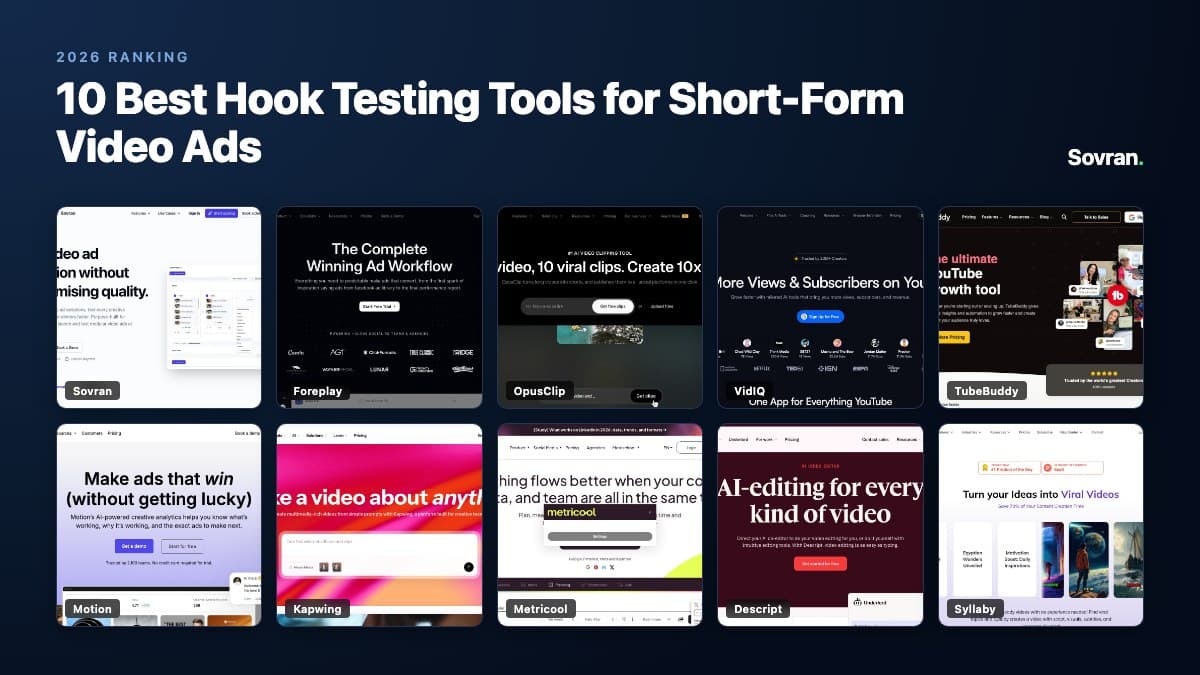
The first three seconds of a short-form video decide everything. If the hook does not stop the scroll, nothing else in the ad — the demo, the proof, the CTA — gets seen. I've been running paid short-form video at Sovran for long enough to know that every serious performance marketer builds a hook testing pipeline before they build anything else.
The tricky part is that hook testing is not one job. It's three: generating enough hook variations to test, publishing them systematically, and measuring which ones earn watch time. Most tools only cover one of those jobs. A few cover two. Almost none cover all three.
Here's my ranking of the 10 best hook testing tools for short-form video in 2026, based on how well each one handles each stage of the loop. I focused on tools I'd actually trust for paid short-form video ads on TikTok, Meta Reels, and YouTube Shorts — not just organic posting.
What I Look For in a Hook Testing Tool
Before the ranking, here's the evaluation framework I used. A strong hook testing tool should do at least two of the following well:
- Variation generation — can I create 10, 20, or 50 hook variants from a single source clip without re-editing from scratch?
- Platform-native publishing — does it plug into Meta Ads, TikTok Ads Manager, or YouTube so I can actually run the test?
- Hook-rate analytics — does it surface the 3-second hook rate, thumb-stop ratio, or average watch time per hook variant, not just the ad as a whole?
- Inspiration library — does it give me swipe files of hooks that are currently winning in my category?
- Speed to iterate — how fast can I kill a losing hook and swap in a new one?
In my experience, the best setup is usually two tools: one that generates and iterates variations fast, and one that reads the numbers and tells me what to kill. Here's the 2026 ranking.
1. Sovran — Best for Creating and Testing 50+ Hook Variations in One Workflow
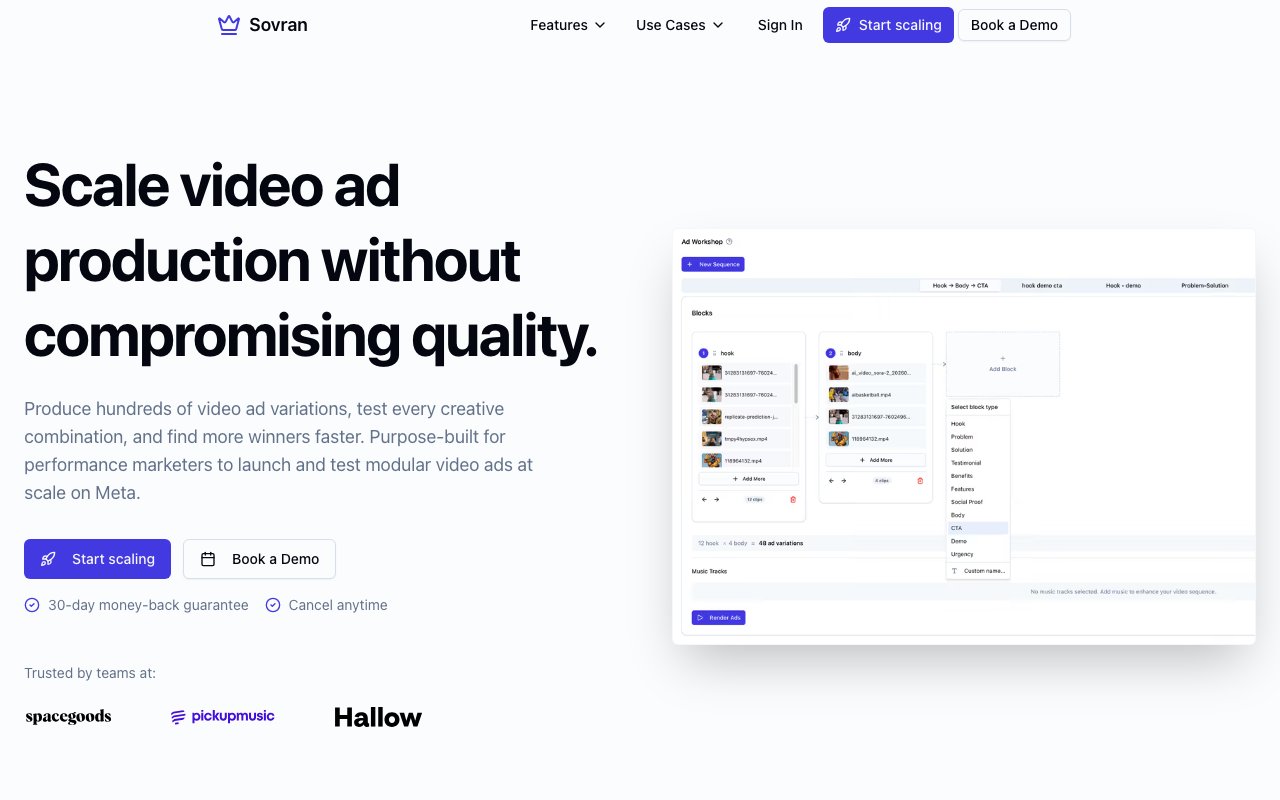
Starting price: $99/month (Base plan, 50 video ads). Subscriptions start immediately and include a 30-day money-back guarantee.
I built Sovran for performance marketers who treat hooks as a volume problem, not a creativity problem. Instead of writing one hook, editing one ad, and hoping it works, I define hooks as a modular layer and let the platform produce every combination automatically.
The math is simple. I upload 5 hook clips, 5 body clips, and 2 CTAs. Sovran renders all 5 × 5 × 2 = 50 unique ad variations in a single batch, exported in 9:16, 4:5, 1:1, and 16:9. Each file name is tokenized so I can track which hook wins once the data comes in. This is the same workflow I've seen the top DTC creative teams use when they need to feed Meta's Advantage+ algorithm with fresh creative every week.
What makes it a hook testing tool — not just a video editor — is the loop. Kill a losing hook, swap in a new one, and Sovran re-renders only the variations that changed. I can go from "idea for a new hook" to "25 new ads running on Meta" in under an hour.
Best for: DTC brands and agencies running paid video ads on Meta, TikTok, and YouTube who need to test 20–100 hook variations per week.
Weakness: Sovran does not scrape competitor hook libraries. I pair it with Foreplay (below) when I need inspiration before I generate.
2. Foreplay — Best for Hook Inspiration From Competitor Ads
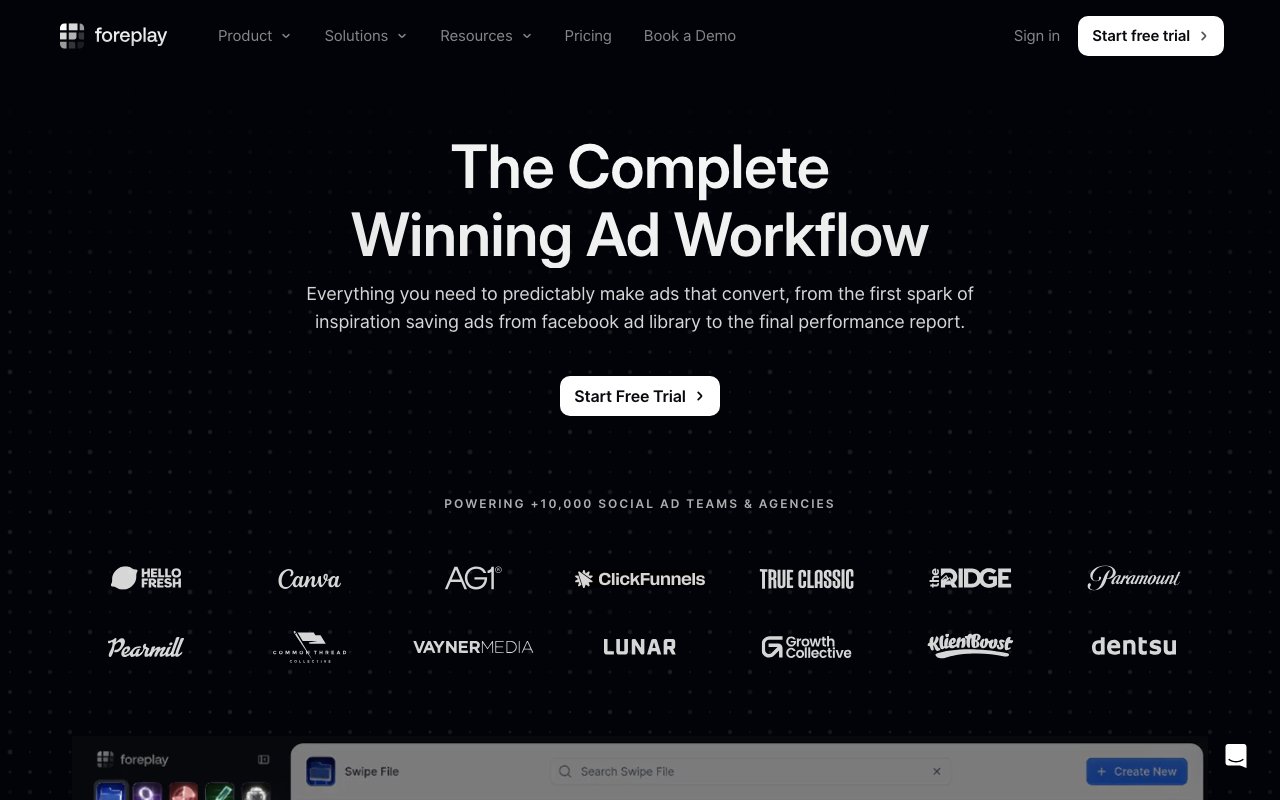
Starting price: $49/month.
Foreplay is my go-to swipe-file tool. It indexes tens of thousands of Facebook, Instagram, and TikTok ads so I can search by hook style, brand, angle, or vertical. When I need 30 fresh hook ideas for a skincare client before Monday, Foreplay is the fastest way I've found to gather them.
What Foreplay does not do: actually produce the variations, publish them, or measure hook rate. It's purely a research layer. I use it at the top of the funnel, then hand the shortlist to whatever tool I'm using for production.
Best for: creative strategists and UGC teams who need a constant stream of new hook angles pulled from top-performing ads in their category.
3. OpusClip — Best for Turning Long-Form Into Hook-Led Shorts
Starting price: $9/month (Starter), $29/month (Pro).
OpusClip uses AI to find the highest-potential moments in a long podcast, webinar, or interview and cut them into vertical shorts with captions and hook overlays. For creators repurposing long-form content, I've found it genuinely useful.
For paid-media hook testing, it's weaker. OpusClip picks moments that look like hooks based on engagement models, but I can't systematically test 20 hook variants on the same body clip the way a modular tool allows. I treat it as a "first pass" for organic short-form, not a rigorous testing tool.
Best for: podcasters, YouTubers, and founders who already have long-form content and want to extract short-form clips quickly.
4. VidIQ — Best for YouTube Shorts Hook Analytics
Starting price: $7.50/month.
VidIQ is the closest thing the YouTube Shorts ecosystem has to a dedicated hook analytics tool. It shows me title click-through rates, retention curves, and outlier performance against channel average. If YouTube Shorts is my primary short-form channel, VidIQ pays for itself in the first month.
It does not help with production. I still need a video editor and a variation tool to generate the hooks I'm going to test.
Best for: solo creators and small teams whose primary short-form distribution is YouTube Shorts.
5. TubeBuddy — Best for A/B Testing Titles and Thumbnails on YouTube
Starting price: $9/month.
TubeBuddy has genuine A/B testing built into its Pro and Legend plans. I can run two titles, two thumbnails, or both against each other on the same YouTube video and let the platform split traffic. That's hook testing in the classic sense.
The limitation: YouTube only. No TikTok, no Reels, no Meta ads. And it tests two variants at a time, not 20. If I want statistical power, I outgrow it fast.
Best for: YouTube channels that want controlled A/B tests without leaving the platform.
6. Motion — Best for Creative Performance Analytics Across Meta and TikTok
Starting price: $150/month.
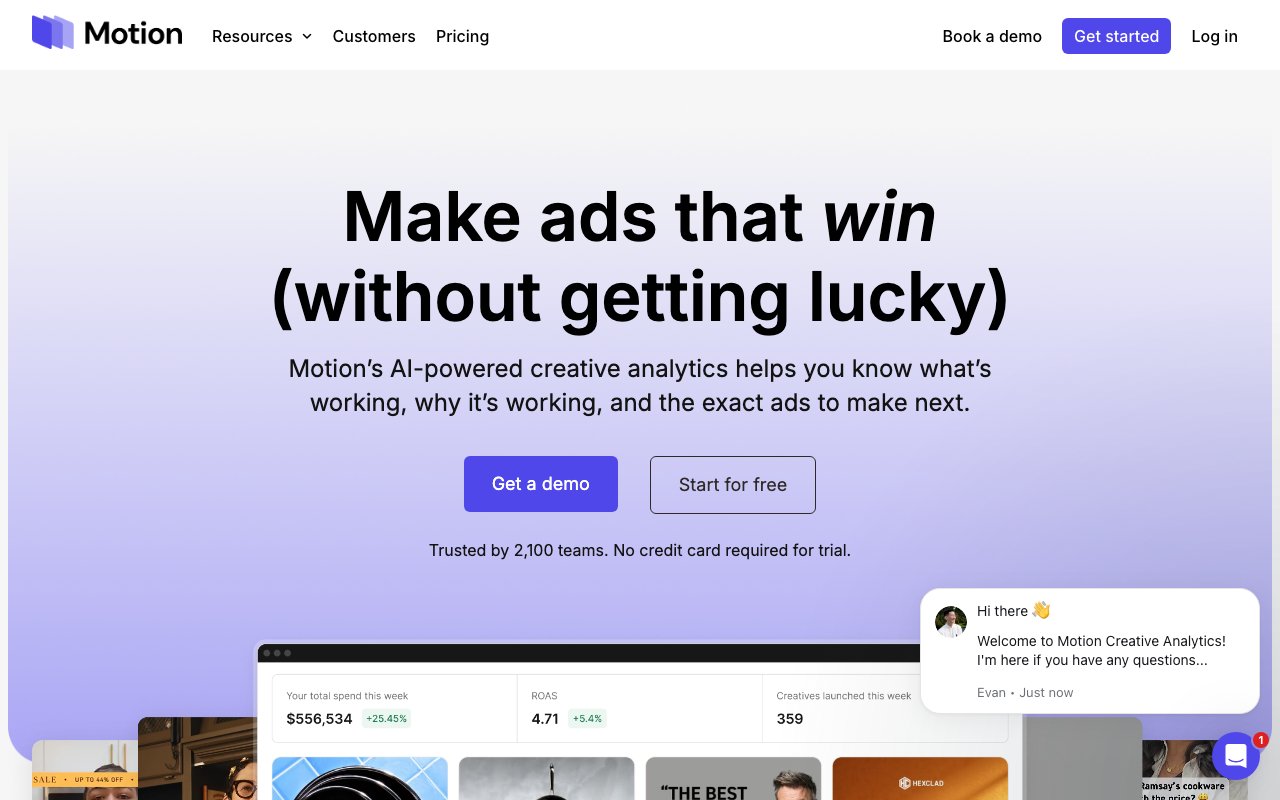
Motion pulls ad-level performance data from Meta and TikTok and breaks it down by creative element: hook, body, CTA, voiceover, talent. When I tag my hooks consistently at upload, Motion tells me which hook styles are winning at the account level — across dozens of ads at once.
It's not cheap, and I'd only recommend it once you're spending at least $20K/month. Below that, I get most of the same insight from Meta Ads Manager with good naming conventions.
Best for: DTC brands and agencies spending $20K+/month on paid video who need hook-level performance reporting without manual spreadsheets.
7. Kapwing — Best for Manual Frame-Level Hook Swaps
Starting price: Free tier available, $16/month for Pro.
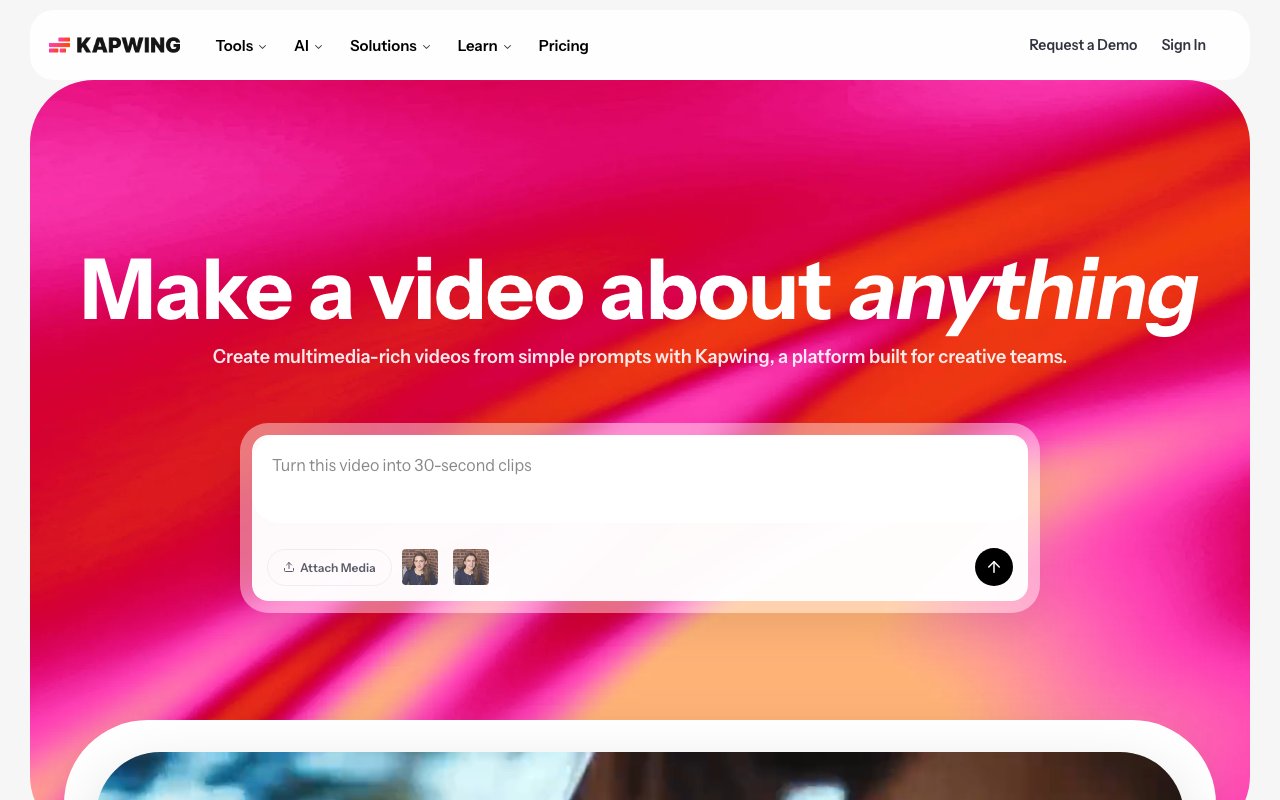
Kapwing is a browser-based video editor that makes it easy to duplicate a project, swap the first 3 seconds, and re-export. When I'm helping a team that's just starting with hook testing, it's a low-friction way to produce 5–10 variations manually.
The ceiling is low. Once I need 50 variations per week, manual swapping in Kapwing gets painful fast. It also has no analytics layer, so I need a separate tool to read the numbers.
Best for: early-stage teams producing fewer than 10 hook variations per week.
8. Metricool — Best for Cross-Platform Hook Performance Tracking
Starting price: $22/month.
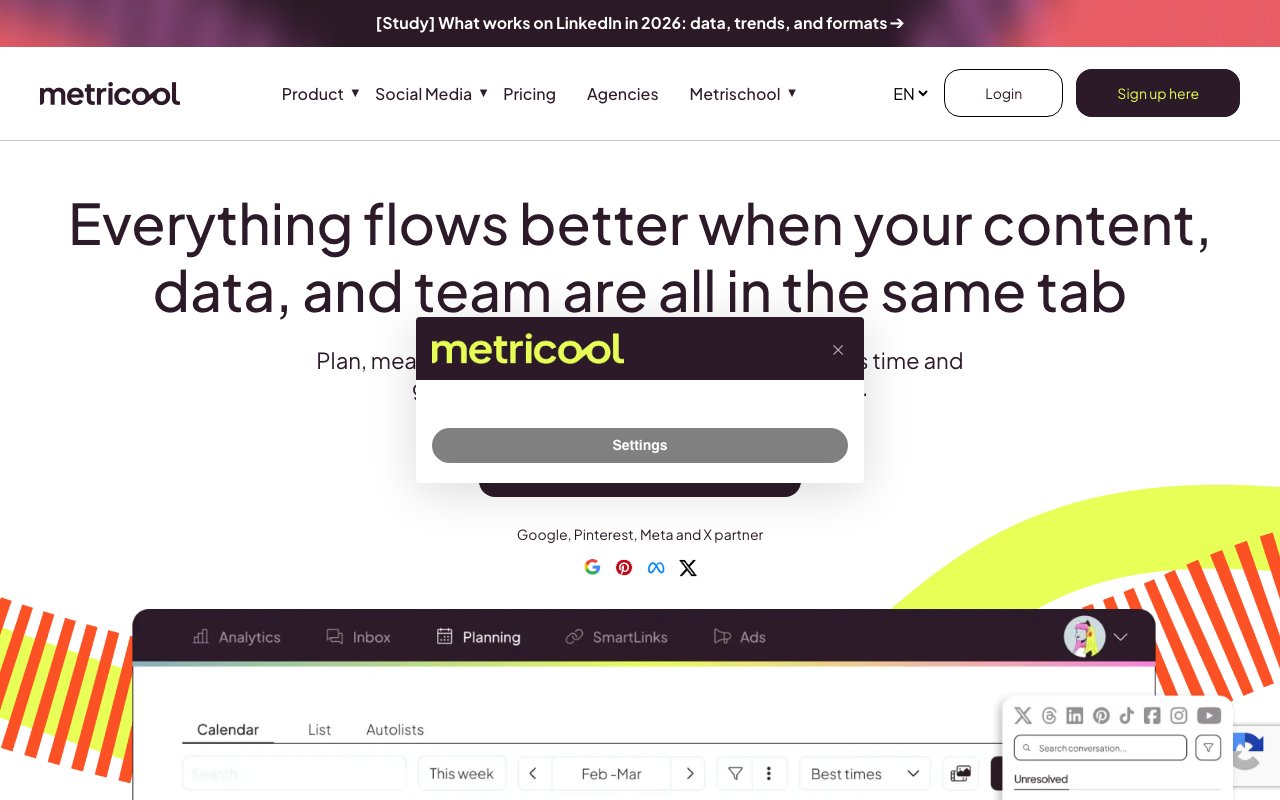
Metricool unifies organic and paid performance across TikTok, Reels, YouTube, and LinkedIn in one dashboard. For hook testing specifically, I like it because I can see how the same hook performs across platforms — something most native analytics cannot show me.
It doesn't generate variations. I pair it with a production tool.
Best for: brands posting the same short-form video across 3+ platforms who want a single source of truth for hook performance.
9. Descript — Best for Script-First Hook Iteration
Starting price: $12/month.
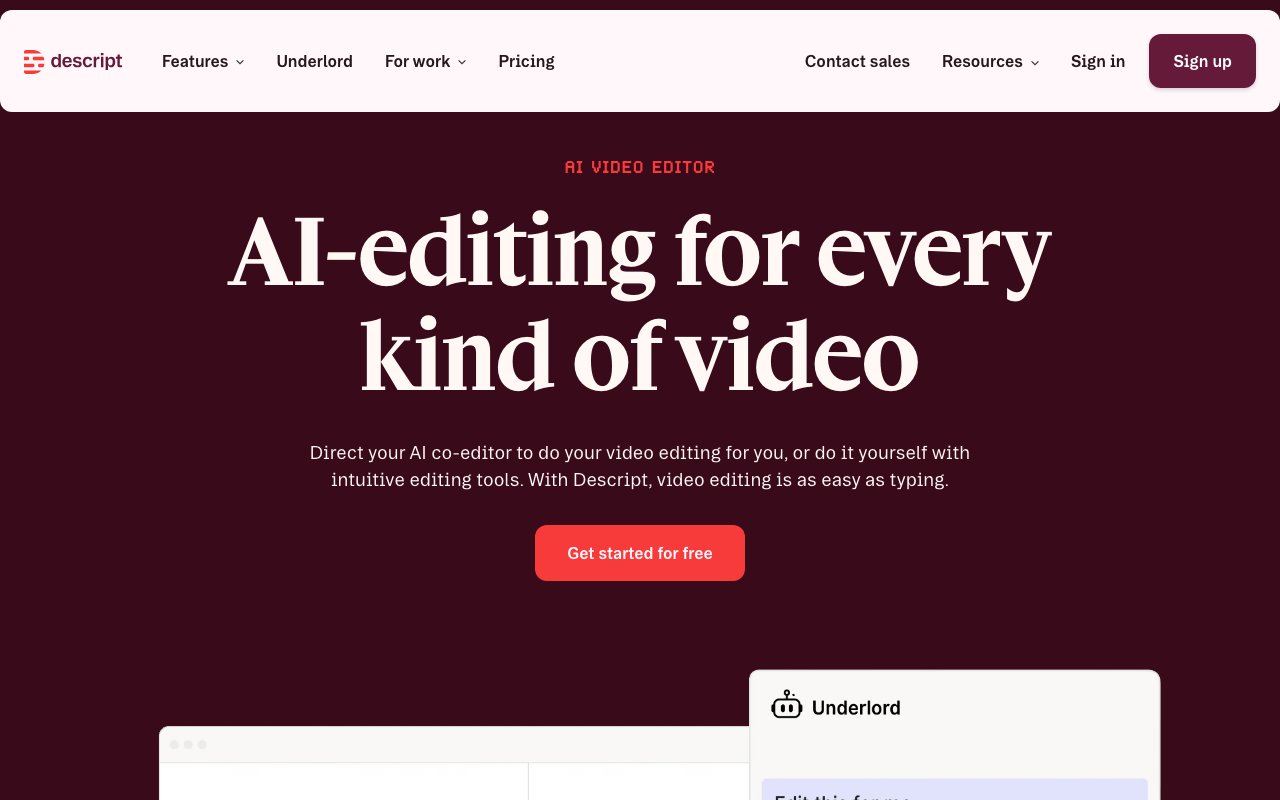
Descript is a script-based editor. When my hooks are voiceover-led — "Stop scrolling if you've ever…" — I can write 20 hook scripts, generate the audio with AI voices, and splice them onto the same body clip in under an hour. That's a real workflow for certain hook styles.
Descript is weaker for visual-first hooks (text overlays, pattern interrupts, first-frame swaps). I use it specifically when the voiceover is doing the hooking.
Best for: UGC and voiceover-led ad formats where the script carries the hook.
10. Syllaby — Best for AI Hook Generation
Starting price: $49/month.
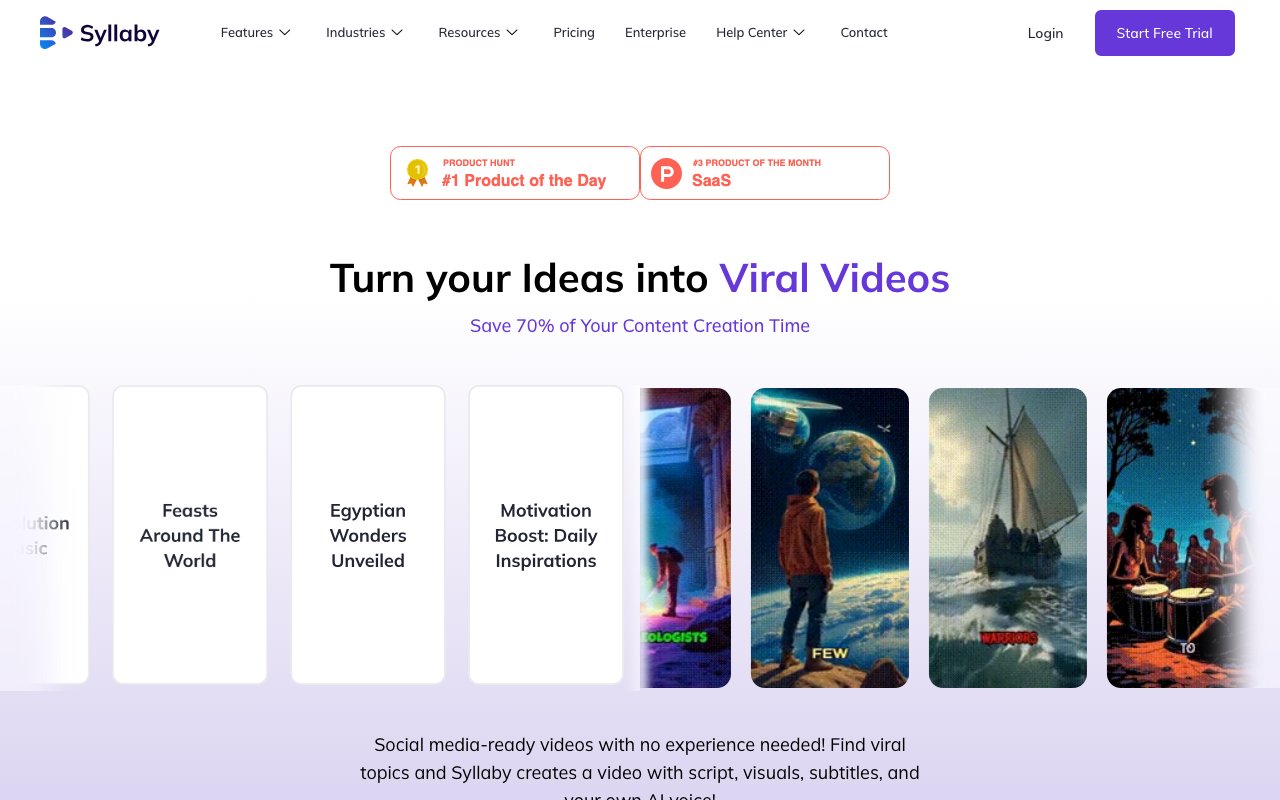
Syllaby (and similar tools like AdCopy) generate hook copy and full short-form scripts using large language models trained on viral short-form data. I paste a product or topic and get a ranked list of hook lines and scripts I can hand straight to a production tool. Quality varies — I throw out 60–70% — but the hit rate is high enough to be useful as a brainstorming layer.
It's not a standalone solution. I still need a production tool to turn the copy into video and a measurement tool to validate which hooks actually work.
Best for: copy-first strategists who want volume brainstorms for text-overlay and voiceover hooks.
Side-by-Side Comparison
| Tool | Best for | Starting price | Creates variations | Hook analytics |
|---|---|---|---|---|
| Sovran | 50+ variations per project | $99/mo | Yes (modular) | Via ad platform |
| Foreplay | Hook inspiration | $49/mo | No | No |
| OpusClip | Long-form to shorts | $9/mo | Limited | No |
| VidIQ | YouTube Shorts analytics | $7.50/mo | No | Yes (YouTube) |
| TubeBuddy | YouTube A/B tests | $9/mo | No | Yes (YouTube) |
| Motion | Creative reporting | $150/mo | No | Yes (Meta/TikTok) |
| Kapwing | Manual hook swaps | $16/mo | Manual | No |
| Metricool | Cross-platform tracking | $22/mo | No | Yes |
| Descript | Voiceover hooks | $12/mo | Limited | No |
| Syllaby | AI hook copy + scripts | $49/mo | No (copy only) | No |
How I Actually Test Hooks Systematically
A tool is only as useful as the process it supports. Here's the hook testing loop I run consistently for DTC teams spending $10K–$1M per month on paid video.
- I start with 5–10 hook angles, not 50. I pick distinct patterns: bold claim, question, stat, UGC testimonial, pattern interrupt. Testing 50 variations of the same angle teaches me nothing.
- I hold the body and CTA constant for the first round. I want to isolate the hook as the variable. I use the same 20-second body clip and the same 3-second CTA across all hook variants.
- I launch all variants in the same campaign or ad set. I let the algorithm split traffic. I never run each hook in its own ad set — I'd never get statistical significance.
- I read the 3-second hook rate, not CTR. Hook rate (3-second video plays / impressions) is the cleanest signal for whether the first three seconds worked. CTR mixes hook performance with offer performance.
- I kill anything below account average after 48–72 hours. I never wait a week. In short-form, a hook is either working by day 3 or it is not.
- I double down on winners with new body variants. Once I have a winning hook, I pair it with 5 new body variations for the next round. Now I'm testing what works after the hook.
This is the loop I built Sovran to run. Every step from "generate 50 variations" to "kill the losers and swap in replacements" happens in one project, not across five different tools.
Common Hook Testing Mistakes I See Marketers Make
- Testing too few variations. Two hooks is not a test. You need at least 5–10 variants in the same campaign to separate signal from noise.
- Changing multiple variables at once. If you change the hook and the CTA at the same time, you cannot attribute the performance change to either one. I've watched teams kill this way for years.
- Reading CTR instead of hook rate. CTR tells you whether people clicked. Hook rate tells you whether the first three seconds stopped the scroll. Very different metrics.
- Giving losers too long. In short-form, engagement compounds. A hook that is not working on day 3 will almost never recover by day 7.
- Forgetting to tag hooks consistently. If you cannot identify which hook is in which ad, your winners are invisible. I use file-name tokens and UTMs to track hook variants on every project.
Start Testing Hooks at Scale
Testing hooks is a volume game. If you can only produce two variants per week, you'll spend months finding your first winner. If you can produce 50 per week, you'll find winners in days and scale spend on them while your competitors are still editing their second draft.
I built Sovran for that volume. Upload a handful of hooks, bodies, and CTAs, render every combination, push them to Meta, kill the losers, and iterate. Subscribe now and launch your first 50-variation hook test this week.
Frequently asked questions

Manson Chen
Founder, Sovran
Related Articles

Storyboard Development: Scale Video Ad Production in 2026

8 Pattern Interrupt Techniques for Video Ads