AI Video Ad Generator Creative Marketing at Scale
An AI video ad generator is a platform that automatically cranks out on-brand, campaign-ready video ads. Don't think of it as just another editing tool. It's...
Jump to a section
An AI video ad generator is a platform that automatically cranks out on-brand, campaign-ready video ads. Don't think of it as just another editing tool. It's more like an automated assembly line for your creative assets, letting you produce hundreds of customized, high-quality ad variations in minutes, not weeks.
Your Strategic Engine for Creative Scaling
Imagine trying to build a unique car by hand for every single customer. That's how most teams still approach video ad creation—it’s slow, expensive, and impossible to scale.
Now, picture a modern car factory pumping out thousands of customized vehicles a day. That's what a true AI video ad generator brings to the table for performance marketing. It’s a strategic engine built to crush the biggest bottleneck growth teams face: the relentless demand for fresh ad creative.
These platforms go way beyond basic templates. They plug directly into your brand assets, messaging, and even performance data to put the entire creative lifecycle on autopilot. This is a game-changer for any team that relies on high-volume testing to find winning ads and scale their campaigns.
From Manual Labor to Automated Velocity
The core idea is simple but powerful. An AI video ad generator takes all your creative components—your hooks, product shots, testimonials, and CTAs—and turns them into a library of modular building blocks. The AI then intelligently assembles these parts into countless unique combinations, all while staying perfectly on brand.
This process gives you the creative velocity you need to combat ad fatigue on fast-moving platforms like Meta and TikTok.
The visual above hints at the foundational tech that makes this possible. AI's ability to analyze and manipulate video content is what allows these systems to understand, tag, and reassemble your creative assets with such precision.
To get a clearer picture, let's break down the old way versus the new way.
Traditional Video Production vs AI Video Ad Generation
This table shows just how different the two workflows really are:
Aspect | Traditional Video Production | AI Video Ad Generator |
|---|---|---|
Process | Manual, linear, and siloed | Automated, modular, and integrated |
Speed | Days or weeks per video | Hundreds of variations in minutes |
Cost | High per-asset cost | Low, fixed cost for high volume |
Scalability | Extremely limited; linear effort | Nearly infinite; scales instantly |
Testing | Difficult and expensive | Built for rapid A/B testing |
Output | A few polished "hero" videos | A massive volume of testable variations |
The takeaway is pretty clear: one process is built for a bygone era of advertising, while the other is designed for the high-speed demands of modern performance marketing.
Why This Technology Matters Now
The shift toward AI-driven creative isn't just a trend; it's a fundamental change in how marketing gets done. It enables teams to produce engaging video at a fraction of the time and cost. For context, some text-to-video AI platforms already have over 800,000 active users, which shows just how mainstream this has become. You can dig into the market's explosive growth in this detailed report.
To get a feel for the current landscape, it's worth checking out some of the best AI video generators available today to see how their features and workflows compare. And if you want to go deeper on the production side, you can learn more about how automated video editing software is completely changing the game for marketers.
How AI Ad Generators Automate Creative Production
Think of an AI video ad generator as a hyper-efficient assembly line for your creative assets, not just another video editor. Instead of painfully building every single ad from the ground up, this system breaks down your creative into reusable pieces, letting you automate production on a massive scale. It all comes down to a few core ideas working together.
The main principle here is modular assembly. The secret is to stop seeing your best-performing ads as one-off videos. Instead, look at them as a collection of winning parts: a scroll-stopping intro (the hook), a persuasive value proposition (the body), and a clear call-to-action (the CTA). An AI generator lets you treat these elements like interchangeable building blocks.
The Power of Smart Asset Management
For this modular magic to work, the AI has to understand what it's looking at. That’s where automated asset tagging comes in. The platform scans your uploaded video clips, images, and copy, then automatically identifies and labels the key elements. A clip might get tagged as "UGC testimonial," "product unboxing," or "problem-focused hook."
This intelligent organization makes every asset instantly searchable and ready to be plugged into a new ad. It turns a messy folder of random video files into a structured, strategic library of creative components.
The real power of an AI video ad generator isn't just making one video faster; it's about creating a system that can generate hundreds of context-aware, on-brand variations with minimal human effort.
This whole system is anchored by a Context Vault. This is basically the central hub for your brand’s DNA—logos, fonts, color palettes, approved messaging, product details, you name it. The AI uses this vault as its single source of truth, making sure every ad variation it spits out is perfectly on brand without you needing to check every single one. This kind of system is becoming essential; the global AI video generator market is projected to hit USD 2.56 billion by 2032. You can read more about this explosive industry growth.
From Theory to Practice
So, what does this look like day-to-day? Imagine you’ve got 5 winning hooks and 10 different value props you want to test.
The Old Way: Creating every combination would mean 50 separate video projects. That’s weeks of work for a creative team, easily.
With an AI Generator: You just select the hooks and value props you want to mix. The system uses bulk rendering to automatically generate all 50 unique ads in minutes.
This unlocks a level of testing speed that was just a fantasy a few years ago. You can learn more about this workflow by checking out how to automate hook, body, and CTA variations in a real-world scenario. By getting the tedious production work off their plates, teams can finally focus on what really matters: creative strategy and finding the next winning ad.
Boosting Performance on Meta and TikTok
If you're running ads on fast-paced platforms like Meta and TikTok, you know that creative is king. But you've probably also seen your best-performing ad suddenly fall off a cliff. That's creative fatigue in action—your audience has seen your ad so many times it just becomes background noise, and your performance tanks.
The most powerful weapon against this expensive problem is an AI video ad generator.
The name of the game on these platforms is creative velocity. It's all about how fast you can churn out and test new ad variations. Trying to create a handful of ads manually is a slow, expensive grind. But an AI-powered system? It lets you generate dozens, or even hundreds, of unique, on-brand ad variations in minutes. This opens the door to continuous testing and iteration at a scale you just can't match by hand.
This speed isn't just about making more ads; it's about making smarter decisions, faster. When you constantly feed the algorithm fresh creative, you keep engagement high, your cost-per-acquisition (CPA) stays low, and you squeeze every last drop of performance out of your ad spend.
Adapting Creative at Machine Speed
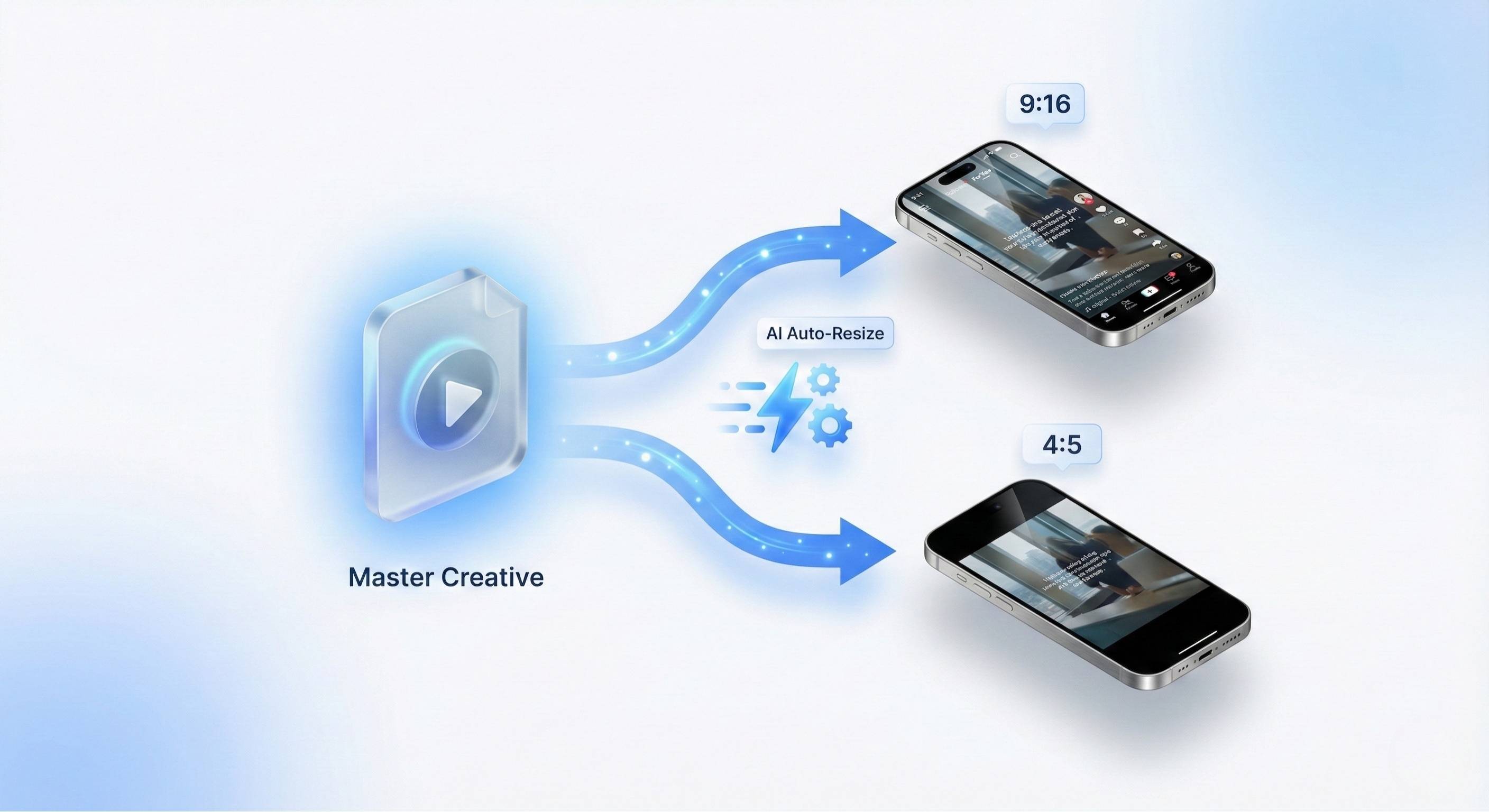
Think about the unique demands of each platform. TikTok is all about that vertical, fast-cut, 9:16 video format. Over on Meta, a 4:5 aspect ratio usually performs best in the feed. Manually reformatting a single video for every single placement is a mind-numbing task.
An AI video ad generator completely automates this. It can instantly resize and reformat your best concepts for every placement, making sure each ad feels native to the platform it’s on. The same goes for localization. Need to launch a campaign in three different languages? The AI can swap out text overlays and voiceovers across all your ad variations automatically, without you lifting a finger.
The goal here is to shift your entire workflow. Stop creating a few "hero" ads and just hoping they work. Instead, build a system where you are constantly testing hundreds of variations to find what truly clicks with your audience. This data-driven approach is what separates the good campaigns from the great ones.
The Direct Impact on Your Bottom Line
Every single element of an ad—from the first three seconds to the final call-to-action—can be tested and optimized. An AI video ad generator makes this possible at a scale that manual teams simply can't compete with.
For instance, you can finally test everything you've always wanted to:
5 different hooks against 3 different value props.
Raw, authentic user-generated content (UGC) versus polished brand footage.
Different B-roll clips to see which visuals are the most captivating. You can find a full breakdown of high-impact b-roll examples for Meta and TikTok ads in our guide.
By automating the production of these test variants, your team is freed up to focus on what really matters: analyzing performance data and doubling down on the winning combinations. This creates a powerful feedback loop where data from live campaigns directly informs the next wave of creative, systematically driving down your CPA and boosting your campaign's profitability.
Integrating AI into Your Growth Team Workflow
So, how do you actually get an AI video ad generator working for your team? It’s a bigger shift than just buying a new piece of software. You’re moving away from one-off creative briefs and building a scalable system for making ads. For growth and user acquisition teams, this all starts with laying the right groundwork.
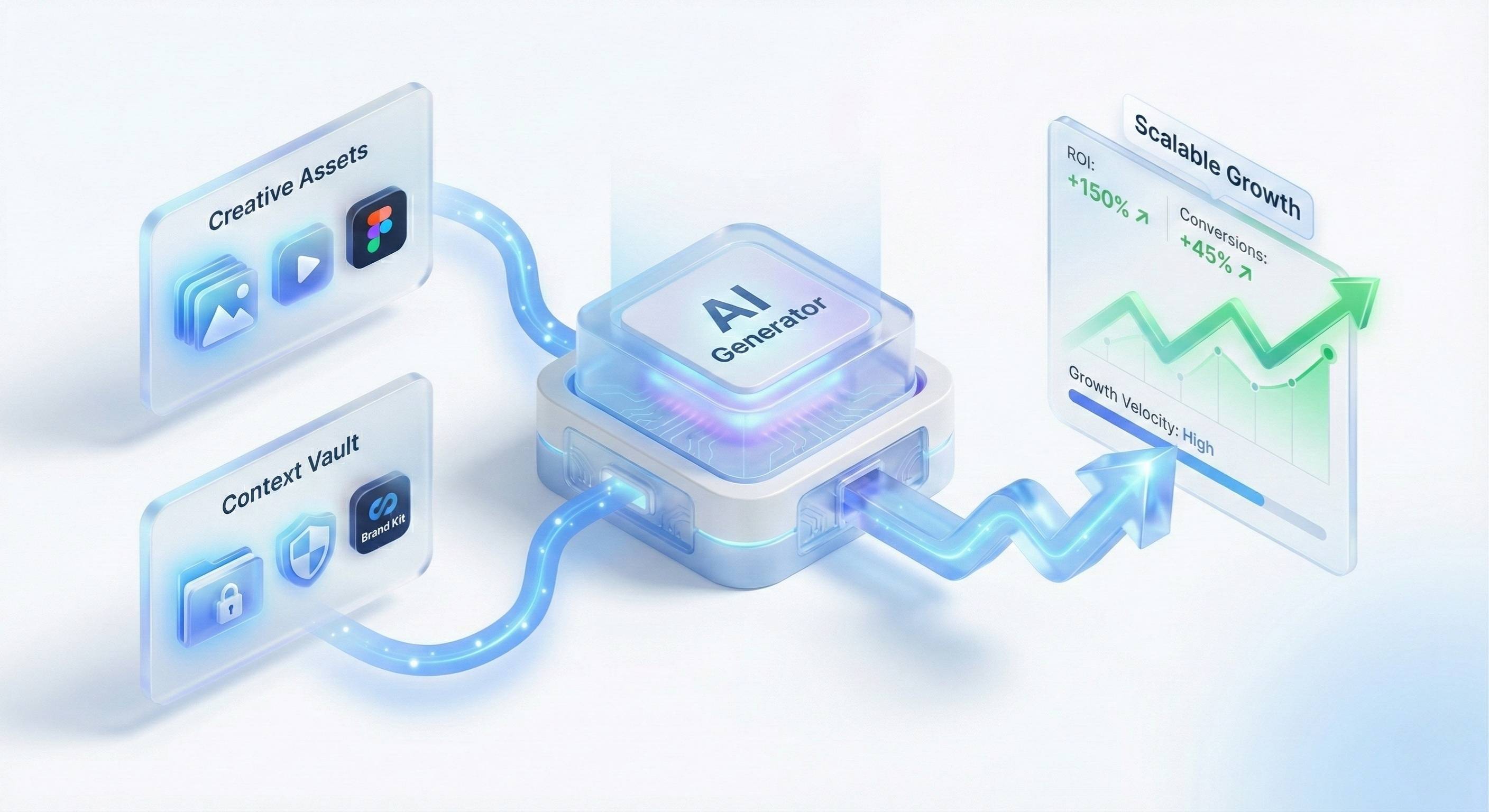
First things first: you need to get your creative house in order. That means pulling all your existing assets—every video clip, piece of UGC, image, and brand element—into one central, organized library. Think of it like a chef prepping their ingredients before service; a messy, scattered setup will just kill your momentum.
Next up, you'll build out your Context Vault. This becomes the single source of truth for the AI. It’s where you’ll store your brand guidelines, approved messaging, winning ad copy, and product details. Getting this right means every ad the AI creates is automatically on-brand and aligned with your goals, cutting out the painful back-and-forth of manual reviews.
Templatizing Your Winning Concepts
With your assets organized, the fun part begins. Go find your top-performing ad concepts—the ones that have consistently delivered results for you. Your job is to deconstruct what makes them work and turn them into modular templates. Stop seeing a great ad as a single, perfect video and start breaking it down into its core components.
The Hook: What's the opening scene or line that stops the scroll?
The Body: What are the key value props or product demos you’re showing?
The Call-to-Action (CTA): What’s the final push that gets someone to click?
When you templatize these elements, they become reusable building blocks. An AI video ad generator can then mix and match these proven parts to create hundreds of new variations, all built on a foundation of what you already know works. This turns creative ideation from a guessing game into a data-driven science.
Establishing a Structured Testing Framework
With your modular templates in place, the final piece of the puzzle is a rigorous testing framework. This is about moving beyond random creative tests and adopting a more scientific approach. Start by defining clear hypotheses you want to prove or disprove.
A good hypothesis isn't vague. It's specific, like: "Does a UGC-style intro showing a real customer crush a polished brand intro with animated graphics?"
An effective testing framework isn't about throwing everything at the wall to see what sticks. It's about asking specific, measurable questions and using the AI video ad generator to get clear answers at a scale that was previously impossible.
Once your hypotheses are set, you can use bulk rendering to launch dozens of tests at once. The AI will spin up all the different versions you need, letting your team deploy campaigns and get performance data back—fast. This creates a powerful feedback loop where the learnings from one test directly inform the next, accelerating your journey to finding the next big winner.
Measuring the Impact on Your Marketing KPIs
Adopting an AI video ad generator isn't just about tweaking your workflow; it's about fundamentally changing what your creative team is capable of. To really get buy-in and prove its worth, you have to look past vanity metrics and zero in on the numbers that show real efficiency gains and, more importantly, better campaign results.
Forget just counting how many videos you made. It’s time to start measuring the operational metrics that reveal how much your creative capacity has actually grown. These are the numbers that show the true muscle of automation.
Here’s what to track:
Creative Velocity: How many unique ad variants can your team actually ship per week? Going from 5-10 manual ads to 100+ AI-generated ones is a pretty standard jump.
Testing Throughput: This is about how many creative ideas you can genuinely test in a single sprint. We're talking moving from a few shots in the dark to dozens of structured experiments.
Time-to-Live: How long does it take to get a new concept from a brainstorm into a live ad account? This is where you see a process that took weeks shrink down to just a few hours.
Connecting Efficiency to Business Results
These operational wins are great, but they have to connect back to actual business growth. The whole point is to link this newfound creative speed directly to the performance metrics that your CFO actually cares about.
The real win isn't just making more ads. It's using that scale to systematically find more winners, faster—driving down acquisition costs and blowing up your return on ad spend (ROAS).
When you can constantly feed platforms like Meta and TikTok with fresh, data-informed creative, you start to see a direct impact on your core business results. For instance, a higher testing throughput means you can quickly find the hooks and messaging that actually work, leading to a serious drop in your Cost Per Acquisition (CPA) and a nice bump in your Click-Through Rate (CTR).
This direct connection is why the industry is pouring money into this tech. According to Market Research Future, the AI video generator market was valued at USD 4.1 billion in 2024 and is expected to rocket to USD 82.64 billion by 2035. You can learn more about these AI market findings to see exactly why this space is getting so much attention.
Here's a clearer picture of what that shift looks like in terms of your core metrics. This table breaks down the kind of KPI improvements you can realistically expect when moving from a traditional creative workflow to one powered by AI.
Expected KPI Improvements with AI Ad Generation
KPI | Traditional Workflow Benchmark | AI-Powered Workflow Potential |
|---|---|---|
Creative Velocity | 5-10 unique ads per week | 100+ unique ads per week |
Creative Testing Throughput | 2-3 hypotheses per sprint | 20+ hypotheses per sprint |
Time-to-Live | 1-2 weeks from concept to launch | 2-4 hours from concept to launch |
Cost Per Acquisition (CPA) | Baseline | 15-30% Reduction |
Return on Ad Spend (ROAS) | Baseline | 20-40% Increase |
Creative Burnout Rate | Varies; often high | Significant reduction |
As you can see, the impact goes far beyond just making things faster. It's about enabling a smarter, more iterative approach that directly improves your bottom line while also reducing the strain on your creative team. It’s a win-win that’s hard to ignore.
Frequently Asked Questions About AI Video Ad Generators
Jumping into any new tech, especially something as powerful as an AI video ad generator, naturally brings up a few questions. Performance marketers and creative teams are often curious about how these tools will slot into their current workflow and, frankly, what it means for their jobs.
Let's tackle some of the most common ones I hear.
Will an AI Video Ad Generator Replace My Creative Team?
This is probably the number one concern, but the reality is the complete opposite. An AI video ad generator is built to supercharge your creative talent, not replace it. Think of it as the ultimate creative assistant, handling all the repetitive, manual tasks that drain energy and lead to burnout.
Your creative team still owns the big ideas—the core strategy, the killer concepts, the thumb-stopping visuals. The AI platform is just the production workhorse that spins those brilliant ideas into hundreds of ad variations for testing across every channel and format.
This frees up your designers and editors to do what humans do best: think strategically, develop compelling narratives, and produce the high-quality source assets the AI needs to work its magic.
The goal isn't to replace creatives; it's to get them out of the production weeds. An AI video ad generator automates the tedious "grunt work," letting your team focus on genuine innovation and big-picture wins.
This partnership helps your team test more, learn faster, and ultimately drive much better campaign results. It makes the job more strategic and, honestly, a lot more fun.
How Does the AI Keep My Ads On Brand?
Brand consistency is everything, and any serious AI platform is designed with that at its core. This is handled through what’s often called a “Brand Kit” or “Context Vault.” It’s a central hub where you load up all your brand’s guardrails.
Before the AI generates a single video, you feed it:
Logos: All your approved logos and rules for how to use them.
Color Palettes: Your exact brand hex codes, so every color is always perfect.
Fonts: Your specific brand typefaces and typographic hierarchy.
Approved Music and Audio: A library of on-brand tracks and sound effects.
The AI is then hardwired to operate only within those rules. Every single video it produces—whether it’s one or one thousand—automatically follows your brand standards. This completely removes the need to manually check every single variation for brand compliance, which is a massive win for scaling safely.
What Kind of Assets Do I Need to Get Started?
You don’t need to go out and shoot a bunch of new content to get going. The best place to start is with what you already have, especially the assets from your best-performing campaigns.
Your initial asset library should include:
Video Clips: Product shots, user testimonials, screen recordings, B-roll—anything you've got.
Static Images: High-quality product photos, lifestyle images, and any key graphics.
Ad Copy: Your proven headlines, value props, and calls-to-action.
Brand Elements: As we just covered, your logos, fonts, and colors are essential.
The platform will help you break down your past winners into their core parts—like a hook, a body, and a CTA. From there, it can start mixing and matching those components to create a ton of new, high-potential ads for your next test.
Is This Technology Only for Large Enterprises?
While big companies were definitely the first to jump on board, the AI video ad generator is no longer an enterprise-only game. This tech has become incredibly accessible and is now essential for businesses of all sizes, especially fast-growing startups and mid-market brands.
The real question isn't about your company's size; it's about how much you rely on performance advertising. If your growth depends on Meta and TikTok and you're constantly fighting ad fatigue, then this technology gives you a serious competitive edge. For more deep dives and case studies, resources like Playpause's Blog are a great place to explore.
Ready to accelerate your creative testing and find winning ads up to 10x faster? Sovran automates the entire video ad production workflow, from asset management to bulk rendering. Start your 7-day free trial today and see how data-driven creativity can transform your performance on Meta and TikTok.

Manson Chen
Founder, Sovran
Related Articles
Your Guide to an AI Video Ad Creator
So, what exactly is an AI video ad creator?Think of it as a platform that uses artificial intelligence to automatically build and test video ads on a massive...
Master AI Video Ad Production Workflow
Imagine whipping up a video ad in minutes, without sacrificing quality. That’s the promise of AI video ads—they draft scripts, select visuals, handle...
10 High-Impact Marketing Video Examples for Your 2026 Strategy
In performance marketing, scrolling is the enemy. On platforms like Meta and TikTok, you have less than three seconds to stop a potential customer from swiping...