Video Ad Examples: 10 Formats That Work on Meta & TikTok (2026)
See 10 video ad examples for Meta, TikTok, and paid social campaigns, with hook ideas, proof formats, creative benchmarks, and a workflow for turning examples into more testable variants.
Jump to a section
- Quick Answer: The 10 Best Video Ad Examples to Study
- 1. Founder Hook Video Ad
- 2. UGC Problem-Solution Video Ad
- 3. Product Demo Video Ad
- 4. Customer Proof Video Ad
- 5. Before/After Transformation Video Ad
- 6. Offer and Urgency Video Ad
- 7. Comparison Video Ad
- 8. Creator Walkthrough Video Ad
- 9. Shoppable Video Ad
- 10. Animated Explainer Video Ad
- What the Best Video Ads Have in Common
- From Examples to Iteration: Build a Video Ad Workflow
- Watch: Testing Video Ads with Modular Hooks
- How to Use These Digital Marketing Video Ads Examples
- Proof From Teams Using Sovran
- Related Guides
What To Do Next
Go deeper than swipe-file inspiration
Move from example hunting into a tighter exploration path: testing frameworks, benchmark data, and platform-specific guidance.
Take the hooks, bodies, and CTAs you like and turn them into a structured testing matrix you can actually launch.
See the benchmark behind winning ad structure
Review first-party usage data on which video-ad modules appear most often in production-ready sequences.
Read the benchmarkStudy Instagram Reels creative patterns
See the formats, specs, and best practices that matter when examples need to become Reels-ready ads.
See Reels guidanceBenchmark the opening before producing more variants
Use impressions and three-second views to diagnose whether the first frame is earning enough attention.
Calculate hook rateBuild for TikTok-native creative
Compare hook pacing, vertical-first formats, and platform expectations before you brief your next test.
See TikTok guidance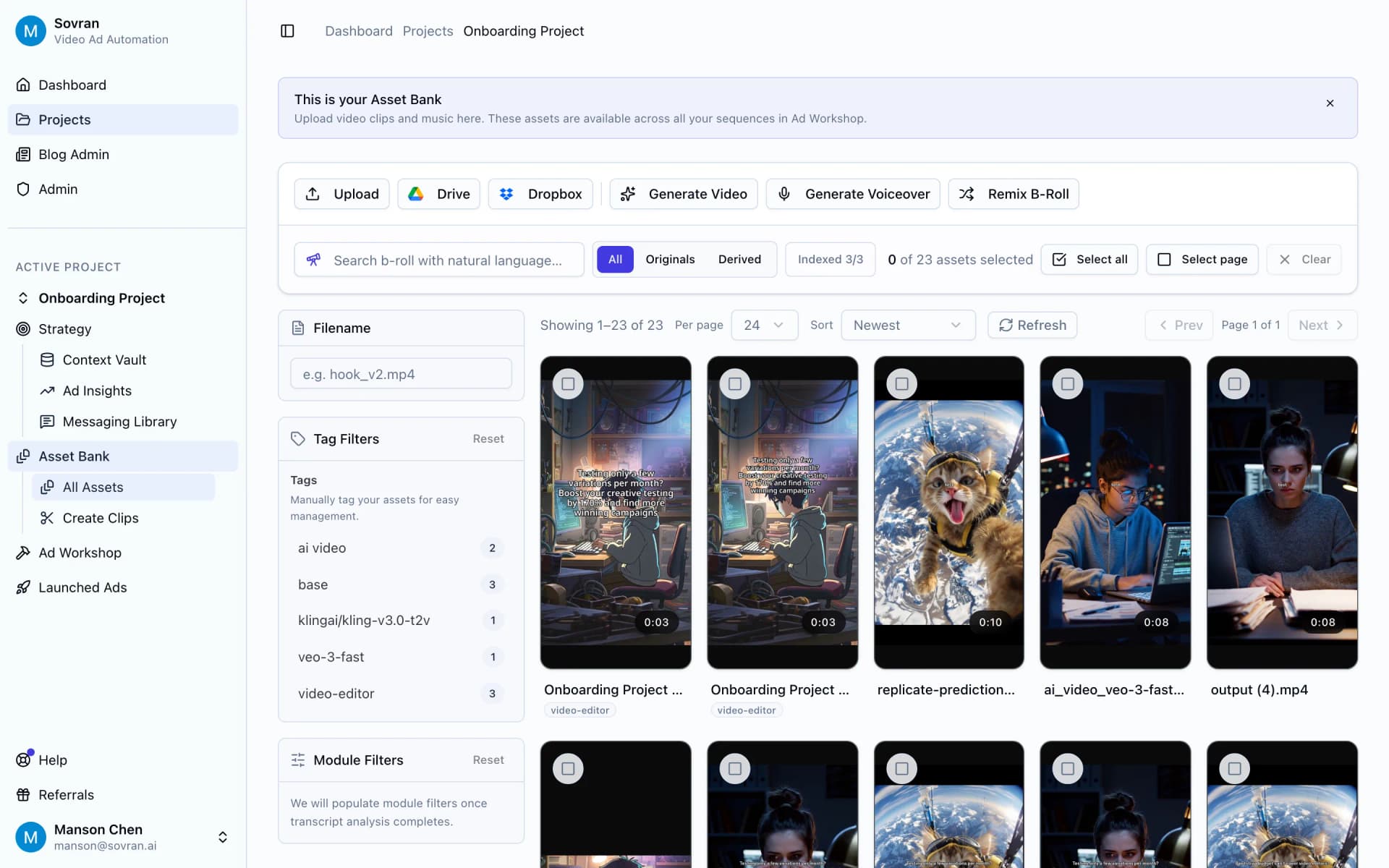
Video Ad Examples That Actually Work on Meta and TikTok
Video ad examples are useful only if they help you decide what to test next. The best video ads are not just clever clips; they make the hook obvious, show proof quickly, and give the viewer one clear next step.
This guide breaks down 10 effective video ads formats you can use for Meta, TikTok, YouTube Shorts, and other paid social placements. For each format, you will see why it works, what to test, and how to turn one good example into a batch of creative video ads instead of a one-off edit.
Quick Answer: The 10 Best Video Ad Examples to Study
If you need digital marketing video ads examples fast, start with these formats. They cover the most common paid social jobs: stopping the scroll, proving the product works, reducing risk, and giving the viewer a reason to act now.
| Example format | Best for | What to test first |
|---|---|---|
| Founder hook | Trust, problem awareness, premium offers | Opening line, problem framing, face-to-camera angle |
| UGC problem-solution | DTC, apps, creator-led offers | First-person pain point, demo order, CTA wording |
| Product demo | Tools, apps, ecommerce, B2B software | Feature sequence, caption text, proof moment |
| Customer proof | High-consideration products and retargeting | Metric, quote, before/after framing |
| Before/after transformation | Beauty, fitness, workflow, productivity | Contrast shot, time period, result language |
| Offer and urgency | Promos, seasonal pushes, retargeting | Discount framing, deadline, visual countdown |
| Comparison ad | Competitive categories and replacement intent | Old way vs. new way, competitor category, switch reason |
| Creator walkthrough | Education, software, higher-trust products | Creator persona, first use case, proof clip |
| Shoppable video | Ecommerce and mobile shopping | Product angle, CTA placement, price/offer overlay |
| Animated explainer | Abstract products and complex offers | Problem visual, metaphor, end-card CTA |
1. Founder Hook Video Ad
A founder hook ad opens with a real person naming a real problem. It works because the face, voice, and conviction make the ad feel less like a brand asset and more like a sharp point of view.
Use it when: your product needs trust before someone believes the claim. Founder hooks are especially strong for supplements, apps, SaaS, education, and any category where the buyer wants to know why the product exists.
Test this: film 10 hooks against the same body video. Try one pain-point hook, one contrarian hook, one result hook, and one "I built this because..." hook. Keep the middle and CTA fixed so the winner is easier to read.
2. UGC Problem-Solution Video Ad
UGC-style ads work because they borrow the texture of a normal social post: handheld footage, plain language, fast captions, and a creator who sounds like the customer. The structure is simple: "I had this problem, I tried this, here is what changed."
Use it when: the product solves a pain people already understand. UGC is one of the safest starting points for creative video ads because the format fits both Meta and TikTok without feeling overproduced.
Test this: keep the creator and product demo the same, then rotate the opening problem. The best video ads often win because the first sentence names the audience more precisely than the competitor.
3. Product Demo Video Ad
A product demo is the cleanest format when the product itself is interesting to watch. For software, show the workflow. For ecommerce, show the product solving the problem. For apps, show the before state, the key tap, and the payoff.
Use it when: the viewer needs to understand what the product does before they can care. A demo is stronger than a claim when the product has a visible result.
Test this: change the order of the demo. Try showing the result first, then the steps. Try showing the annoying old workflow first, then the faster new one. Try one version with captions that name each step.
4. Customer Proof Video Ad
Customer proof ads use a quote, metric, testimonial, or case-study moment as the spine of the creative. They are especially useful when cold audiences need proof and warm audiences need one more reason to act.
For Sovran, proof can be specific. Rewardify boosted creative testing on its largest UA channel by 170% month over month after using Sovran to test more hook and body combinations. Fuelin used Sovran to increase creative output and cut CAC by 40% while scaling spend.
Test this: isolate the proof type. Run one version with the metric in the first second, one with a customer quote first, and one with the product workflow first followed by the result. For more formats, see these testimonial ads examples.
5. Before/After Transformation Video Ad
Before/after ads work because they compress the value prop into a visual contrast. The format is common in fitness and beauty, but it also works for workflows: messy asset folders before, organized clips after; one manual edit before, dozens of variants after.
Use it when: the product has a visible "from this to this" story. The more concrete the contrast, the more effective the ad.
Test this: change the before state. Is the pain slow editing, scattered assets, low creative volume, or unclear learnings? Each version can use the same product demo while speaking to a different buyer pain.
6. Offer and Urgency Video Ad
Offer ads are not subtle, and that is the point. They work when the audience already understands the product and needs a reason to act now: a limited sale, a bonus, a deadline, a launch window, or a seasonal moment.
Use it when: you are retargeting, running a promotion, or pushing a known product to an audience that has already engaged.
Test this: run the same offer three ways: discount first, deadline first, and benefit first. A "40% off" hook can beat a softer benefit hook in retargeting, while cold acquisition may need the benefit before the offer.
7. Comparison Video Ad
Comparison ads help buyers understand why the current way is costing them. The simplest version is old way vs. new way: manual editing vs. modular rendering, static image ads vs. video variants, or one-off creative vs. a repeatable testing system.
Use it when: the buyer is already using another workflow, tool, or habit. Comparison ads are strong for software and performance marketing because the cost of the old workflow is often time, missed tests, or slower learning.
Test this: change the comparison frame. Try "agency vs. in-house," "manual editor vs. modular system," and "one video vs. 50 variants." Keep the proof and CTA consistent.
8. Creator Walkthrough Video Ad
A creator walkthrough is part demo and part endorsement. The creator shows what they did, narrates why it matters, and lets the viewer imagine using the product themselves.
Use it when: your product benefits from explanation. SaaS, apps, production tools, and creator products often perform better when the viewer sees a real workflow instead of a polished brand spot.
Test this: swap the first use case. One walkthrough might show how to remix old video ads. Another might show how to split footage into hooks, bodies, and CTAs. Another might show how to batch render a set of Meta ads.
9. Shoppable Video Ad
Shoppable video ads combine product storytelling with a clear buying path. They work best when the viewer can understand the product, price, and next step without leaving the video context.
Use it when: you sell ecommerce products, creator products, bundles, or any offer where the visual product moment does most of the persuasion.
Test this: move the CTA earlier. Try an end-card CTA, a mid-video CTA overlay, and a product-card-style CTA within the first five seconds.
10. Animated Explainer Video Ad
Animated explainers are useful when the product is abstract, technical, or hard to film. The risk is that they can feel like a generic startup ad, so the hook and proof have to carry more weight.
Use it when: you need to explain a workflow, API, financial product, analytics product, or category that does not produce obvious visual footage.
Test this: use animation for the concept, but ground the ad with a real screenshot, customer quote, or specific metric. Effective video ads usually mix clarity with proof.
What the Best Video Ads Have in Common
The formats are different, but the winners share a pattern. They make the first three seconds clear, show proof before the viewer has to ask for it, and avoid making one ad carry five messages.
Recent video-ad benchmark sources point in the same direction: video keeps pulling attention when the creative is specific. Goldcast's 2026 LinkedIn video ad examples report cites video content generating 3x more engagement than static posts and video ads producing 5x more clicks in its benchmark framing. Zeely's 2026 Instagram ad examples notes that Reels can lead engagement by 22% over static ads. The exact number will vary by account, but the direction is useful: the format works when the creative gives people a reason to keep watching.
For a broader paid video context, IAB's 2025 Digital Video Ad Spend and Strategy report says 86% of digital video buyers are using or planning to use GenAI to build video ad creative. More teams can make more ads now, which means the edge moves from "can we make video?" to "can we test the right examples quickly?"
From Examples to Iteration: Build a Video Ad Workflow
Studying examples is the easy part. The hard part is turning a winning pattern into enough variants to learn something. If you manually rebuild every video ad, the examples stay inspirational. If you turn the examples into reusable hooks, bodies, CTAs, and proof clips, they become a testing system.
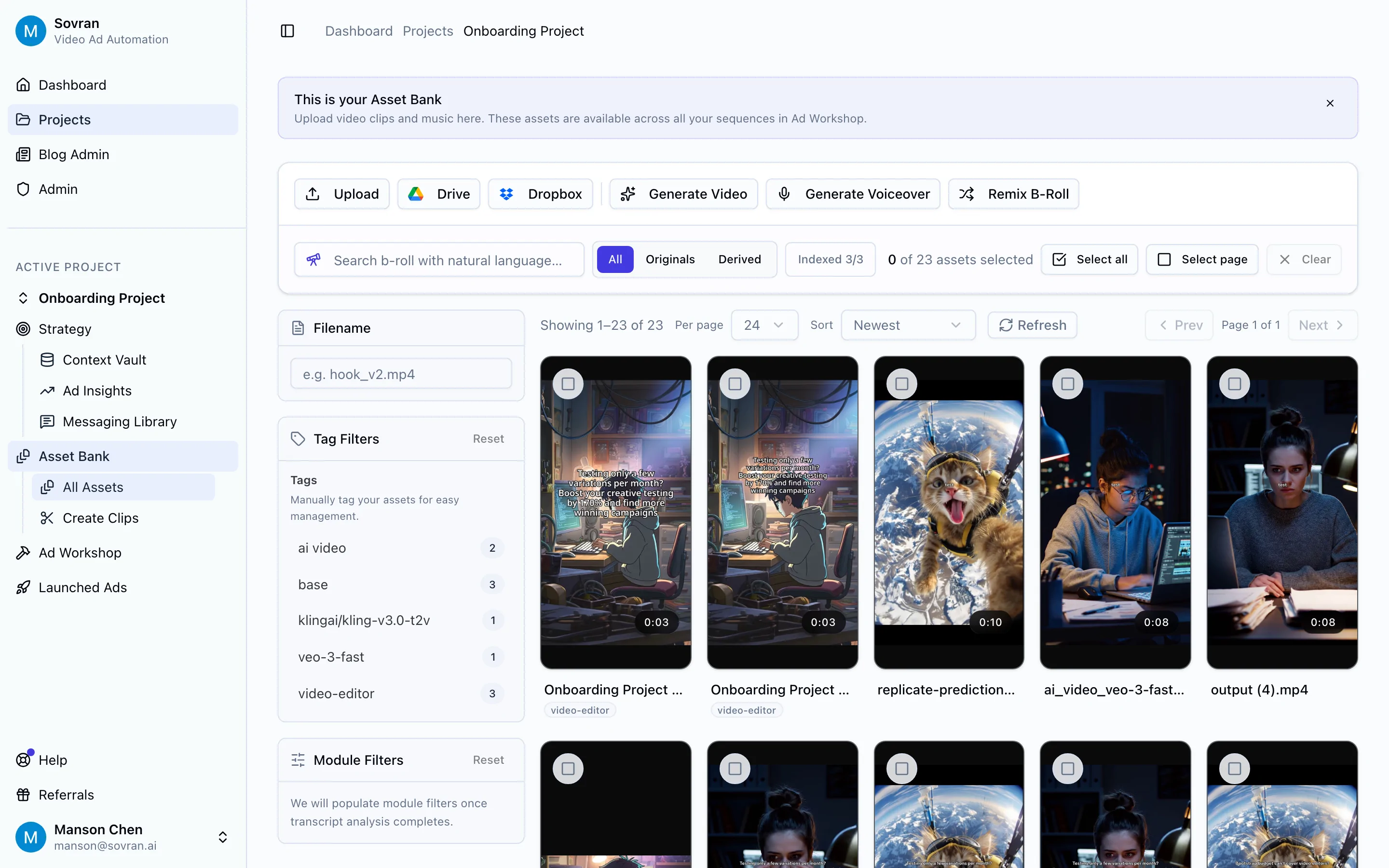
Start by collecting the clips that match the format you want to test. For example, a founder hook test needs multiple opening lines. A UGC problem-solution test needs pain-point clips and product proof. A comparison ad needs old-way footage and new-way footage.
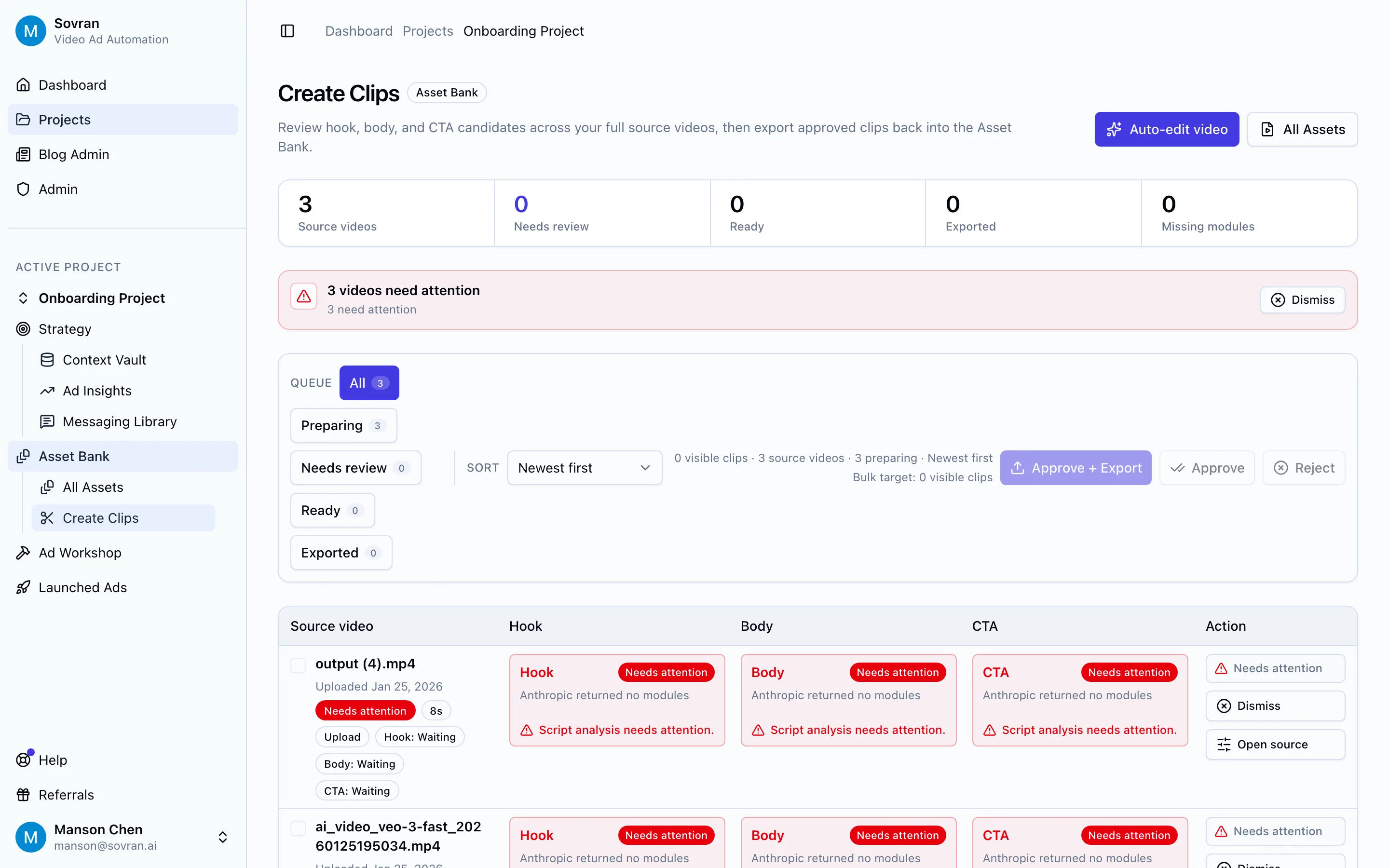
Once the clips are structured, you can recombine them. That is how one founder shoot becomes 20 hooks, five body variations, and several CTA tests instead of one finished ad.
Watch: Testing Video Ads with Modular Hooks
For a practical walkthrough, watch The Lazymaxxer's Guide to Testing Video Ads on Facebook. It breaks down how similar video ads can keep the same body while testing different hooks. For a Sovran-specific workflow, this remix walkthrough shows how to split footage into clips and generate fresh variations faster.
How to Use These Digital Marketing Video Ads Examples
Do not copy the surface of an example. Copy the testable structure. A high-performing founder ad is not "a founder talking." It is a hook type, a proof type, a body sequence, and a CTA. Once you name those parts, you can test them.
- Pick one format. Choose the example that matches your current bottleneck: trust, proof, demo clarity, or urgency.
- Write three hooks. Keep the body and CTA fixed so the test isolates the opening.
- Build two proof versions. Try a metric, a customer quote, a screen recording, or a before/after moment.
- Render variants in batches. Launch enough versions to see a pattern instead of guessing from one ad.
- Feed winners back into the library. Save the winning hook, body, and CTA as reusable modules for the next test.
Proof From Teams Using Sovran
"Sovran allowed us to boost creative testing on our largest UA channel by 170% month-over-month. By exploring new combinations of hooks and body videos, we not only discovered new top-scaling ads but also identified themes that we might not have tested otherwise."
Dan Brosseau, Head of User Acquisition, Rewardify
"We supercharged our creative output with Sovran. That velocity helped us cut CAC by 40% and scale spend efficiently."
Jonathan Lee, CEO, Fuelin
"Perfect timing for us as we've just started a new creative process that tests variants like this super heavily and quickly. Will help us save a good amount of time and speed on our next iteration vs having to edit these all together and export 1 by 1."
Evan Laird, Head of Marketing, Hallow
Related Guides
- Video ad creation software - compare tools for turning examples into finished ads.
- Creative testing software - build a repeatable testing process once ads are live.
- Hook body CTA video ad structure - learn the modular parts behind most paid social ads.
- TikTok video ad specs - make sure your examples fit the platform before launch.
Need a starting structure before choosing software? See our free ad template guide for static, video, display, and modular paid social templates.
Turn video ad examples into tests
Use Sovran to organize footage, create hook/body/CTA clips, and render more paid social ad variations from the assets you already have.
Start with SovranFrequently asked questions

Manson Chen
Founder, Sovran
Related Articles

Customer Journey Mapping for Performance Marketing
Storyboard Development: Scale Video Ad Production in 2026