Bad Ads: 8 Bad Advertising Campaigns and What Marketers Should Learn
A refreshed breakdown of infamous bad ads, the creative and process failures behind them, and the testing workflow performance teams can use to catch weak campaigns earlier.
Jump to a section
- 1. Pepsi's "Jump In" Campaign With Kendall Jenner
- 2. McDonald's All Day Breakfast Removal Announcement
- 3. Twitter Promoted Tweets During Crisis Events
- 4. Dove's Real Beauty Follow-Up Missteps
- 5. Gap's 2010 Logo Redesign
- 6. United Airlines' Crisis Communication Failure
- 7. H&M's "Coolest Monkey In The Jungle" Product Image
- 8. Gillette's "The Best Men Can Be" Backlash
- 8 Bad Advertising Campaigns Compared
- Why Bad Ads Are Getting Easier To Scale
- A Better Workflow For Avoiding Bad Ads
- What Sovran Customers Prove About Creative Testing
- Practical Checklist: Catch Bad Ads Before They Launch
- How To Turn Bad Ad Examples Into A Stronger System
- Frequently Asked Questions
Bad ads are ads that damage trust, waste budget, or miss the audience so badly that the brand becomes the story for the wrong reason. Some bad advertising campaigns are offensive or tone-deaf. Others are quieter: stale creative that keeps spending after fatigue sets in, product claims that overpromise, automated placements that appear next to a tragedy, or a polished video that never answers the buyer's real objection.
The fastest lesson from famous bad advertisements is this: most bad ads are process failures before they are creative failures. The weak spot might be audience research, cultural review, legal review, message testing, media controls, or the production workflow that decides which ads get refreshed before they burn out.
If you need the quick version, here are the common patterns.
| Bad Ad Pattern | What It Looks Like | How To Catch It Earlier |
|---|---|---|
| Tone-deaf cultural tie-in | A brand borrows a social issue without earning the right to speak | Run diverse review and ask what the ad looks like to people outside the approval room |
| Weak timing | A joke, promo, or placement lands during a crisis | Add campaign pause rules and monitor social context before major pushes |
| Stale creative | The ad still spends even though frequency and fatigue are rising | Track creative age, hook rate, hold rate, and conversion trend by asset |
| Bad inputs at scale | AI or automation turns weak product copy into many weak ads | Audit the source messaging before generating variants |
| Brand mismatch | A message chases attention but fights the brand's equity | Pressure-test whether the ad strengthens trust with the core buyer |
| Missing sensitivity check | An obvious issue survives every approval step | Add a real veto path for cultural, legal, and brand-safety concerns |
OUTFRONT's 2026 media trends report is a useful reminder of the stakes: annoying or intrusive ad experiences can reduce brand trust and purchase intent. Dataslayer's analysis of AI ad automation adds the newer version of the same problem: if the source product copy and creative rules are weak, automation can scale bad ads faster than a human team could have produced them.
This guide breaks down eight bad ad examples, why they failed, and what a performance marketing team should change in the creative process so the same mistakes are caught before budget scales.
1. Pepsi's "Jump In" Campaign With Kendall Jenner
Pepsi's 2017 "Jump In" spot showed Kendall Jenner leaving a photoshoot, joining a protest, and handing a Pepsi to a police officer. The intended message was unity. The audience read it differently: a global brand had turned protest imagery and social justice tension into a soft-drink resolution.
The ad was pulled quickly, but the backlash lasted because the issue was not just execution. It exposed a gap between brand ambition and cultural understanding. The campaign wanted emotional relevance without doing the harder work of earning it.
Why it became a bad ad:
- It treated protest as a visual style instead of a real social context.
- It suggested a simple commercial gesture could resolve serious conflict.
- It centered celebrity and brand imagery while borrowing from real activist moments.
- It failed the "who might feel used by this?" test.
What marketers should learn:
- Do not attach a brand to a charged cultural moment unless the brand has a credible role in that conversation.
- Test culturally sensitive ideas with people who are not invested in approving the campaign.
- Ask whether the creative creates empathy or just uses the aesthetics of empathy.
- Build a red-team review process for any ad that touches politics, identity, tragedy, protest, or social conflict.
For performance teams, the practical lesson is not "never take a stand." It is "do not use paid media to discover whether the stand is coherent." Validate the message, language, and visual symbolism before the first major spend wave.
2. McDonald's All Day Breakfast Removal Announcement
McDonald's All Day Breakfast had a strong fan base, so when customers asked whether it was coming back after pandemic-era menu simplification, the brand tried to answer with a playful social post. The tone landed badly. People did not hear a fun brand voice. They heard a large company making light of a comfort item during a stressful period.
This is one of the smaller bad advertising examples compared with global TV campaigns, but it is useful because it shows how little creative is required to trigger backlash when timing and tone are wrong.
Why it became a bad ad:
- The message delivered disappointing news with a joke.
- The social context made casual dismissal feel colder than intended.
- The brand underestimated how emotionally attached customers were to the product.
- The post created frustration instead of clarity.
What marketers should learn:
- Match tone to message. Bad news needs clarity first and cleverness second.
- Check the broader social context before posting humorous brand content.
- Treat beloved products as emotional assets, not just menu items or SKUs.
- Let community managers pause, rewrite, or escalate posts when sentiment shifts.
This matters for paid social too. A hook that works in a normal week can feel wrong during a crisis, a major news event, or a moment when the audience's priorities have changed.
3. Twitter Promoted Tweets During Crisis Events
Twitter, now X, has had recurring issues with promoted posts appearing around crisis conversations. The advertiser may not have intended anything insensitive, but the placement made the message look jarring next to tragic news.
This kind of bad ad is not always a copywriting failure. It is a media-system failure. Automated targeting, keyword matching, and real-time bidding can put otherwise normal creative into contexts where it should not appear.
Why it became bad advertising:
- Automated placement lacked enough crisis and sentiment awareness.
- Brands appeared to be advertising into moments when users wanted information or support.
- The platform and advertisers both looked careless.
- Media controls were treated as background settings instead of brand-safety infrastructure.
What marketers should learn:
- Create a crisis pause protocol for paid media, including who can hit the stop button.
- Maintain negative keyword and exclusion lists for sensitive events and topics.
- Monitor live placements and brand adjacency, especially during high-volatility news cycles.
- Separate always-on campaigns from campaigns that need real-time context review.
The important shift is from "set it and forget it" to "automate with guardrails." Automation is useful, but it does not remove responsibility for where the ad appears.
4. Dove's Real Beauty Follow-Up Missteps
Dove built major brand equity around "Real Beauty," but follow-up campaigns created their own problems. A 2017 body-wash ad was criticized because the sequence appeared to show a Black woman transforming into a white woman. Dove also faced criticism for body-shaped packaging that many people read as reductive.
The lesson is especially sharp because Dove had already earned attention for inclusive positioning. The higher the brand promise, the more damaging it is when the creative contradicts it.
Why it became a bad ad:
- The visual sequence evoked a racist trope, regardless of intent.
- The body-shaped packaging simplified a complex issue into a gimmick.
- The creative did not meet the standard the brand had set for itself.
- Review systems failed to catch how the ad could be interpreted outside the team.
What marketers should learn:
- Audit creative against the brand's stated values, not just campaign objectives.
- Avoid turning identity, body image, or representation into visual shortcuts.
- Include reviewers with the cultural context to spot harmful interpretations.
- Remember that brand trust compounds slowly and can be damaged quickly.
This is where a real sensitivity review is not bureaucracy. It is risk control.
5. Gap's 2010 Logo Redesign
Gap replaced its classic navy blue box logo with a new Helvetica-style wordmark and small blue square. The rollout was abrupt, mostly digital, and poorly explained. The backlash from customers and designers was immediate. Gap reverted within days.
This was not a bad ad in the classic campaign sense, but it was bad advertising because the brand's public presentation changed without a story strong enough to justify the change.
Why it became bad advertising:
- The new identity felt generic and disconnected from Gap's heritage.
- The rollout surprised loyal customers instead of bringing them along.
- The brand underestimated how much equity lived in the old mark.
- The response looked reactive and disorganized.
What marketers should learn:
- Before changing a known brand asset, identify what customers already value.
- Explain the strategic reason for a rebrand before the internet writes its own version.
- Test identity changes with customer segments, not only internal stakeholders.
- Do not mistake "new" for "better."
For performance marketers, the same principle applies to landing pages, product visuals, and paid creative systems. If a familiar brand asset works because it carries trust, do not remove it casually.
6. United Airlines' Crisis Communication Failure
After a passenger was forcibly removed from a United Airlines flight in 2017, the company's initial response made the situation worse. The phrase "re-accommodate" became a symbol of corporate language that sounded detached from obvious human harm.
The failure was not an ad buy. It was public communication. But in a crisis, every statement is marketing because it shapes how people judge the brand.
Why it became bad advertising:
- The first response prioritized procedural language over empathy.
- The company appeared to defend itself before acknowledging harm.
- Public sentiment moved faster than the brand's response.
- The messaging made the company seem less human at the exact moment humanity mattered most.
What marketers should learn:
- Lead crisis messaging with empathy and accountability.
- Avoid jargon when the public is reacting to a human event.
- Align legal, comms, and marketing teams before a crisis happens.
- Monitor sentiment and change course quickly when the first message fails.
The takeaway is simple: if the audience sees harm, do not answer with process language.
7. H&M's "Coolest Monkey In The Jungle" Product Image
H&M published an ecommerce image of a Black child wearing a hoodie that read "Coolest Monkey in the Jungle." The backlash was immediate because the image evoked a racist history that should have been obvious in review.
This is one of the clearest bad ad examples because the problem was not a nuanced interpretation. It was a basic failure of cultural awareness and approval process.
Why it became a bad ad:
- The product text and model choice created a harmful association.
- The issue passed through too many steps without being stopped.
- The brand showed a lack of cultural competency in a global market.
- Public apologies could not undo the signal that the internal process was broken.
What marketers should learn:
- Build diverse review into the workflow, not as a last-minute check.
- Give reviewers authority to stop creative, not just comment on it.
- Train teams on historical and cultural context relevant to the markets they serve.
- Treat ecommerce imagery, product copy, and organic posts as brand advertising.
Bad advertisements are not limited to paid placements. Any brand asset can become an ad once the audience sees it.
8. Gillette's "The Best Men Can Be" Backlash
Gillette's 2019 campaign tried to update its long-running "The Best A Man Can Get" positioning by addressing toxic masculinity, bullying, and the #MeToo era. Some viewers praised the brand for taking a stand. Others felt accused by a brand they had bought from for years.
This campaign is more complicated than the others because it was not universally rejected. The problem was strategic risk: the brand entered a charged cultural debate with a message that many core buyers experienced as a lecture.
Why it became controversial advertising:
- The ad challenged parts of the brand's existing identity without easing loyal buyers into the shift.
- The tone felt accusatory to a meaningful segment of the audience.
- The campaign sparked debate about the brand instead of keeping focus on product or trust.
- Viewers questioned whether the message reflected a durable commitment or a one-off statement.
What marketers should learn:
- Understand the values and self-perception of the core customer before changing brand posture.
- If the campaign asks people to change, invite them into the idea instead of making them defensive.
- Support purpose-led messaging with visible action outside the ad.
- Decide in advance what kind of backlash the brand is willing to accept.
Controversy is not always failure. But if the argument becomes "why is this brand saying this?" instead of "this brand understands me," the campaign has moved into dangerous territory.
8 Bad Advertising Campaigns Compared
| Campaign | Core Failure | Main Risk | Best Prevention Step |
|---|---|---|---|
| Pepsi "Jump In" | Culture-jacking | Public backlash and brand ridicule | Cultural red-team review before launch |
| McDonald's All Day Breakfast post | Tone mismatch | Customer frustration and social backlash | Context check before humorous posts |
| Twitter promoted tweets in crises | Unsafe media adjacency | Brand-safety damage | Crisis pause and placement monitoring |
| Dove Real Beauty follow-ups | Values-execution mismatch | Loss of trust in brand purpose | Diverse review and value alignment audit |
| Gap logo redesign | Brand equity misunderstanding | Rejection of new identity | Customer research and rollout narrative |
| United Airlines response | Empathy failure | Crisis escalation | Human-first crisis communications |
| H&M hoodie image | Cultural negligence | Severe reputational harm | Sensitivity review with veto authority |
| Gillette "Best Men Can Be" | Audience-value conflict | Polarization and boycott calls | Core-audience research and action plan |
The pattern is not that every risky idea is bad. The pattern is that bad ads usually reach the public after too few people asked the uncomfortable questions early enough.
Why Bad Ads Are Getting Easier To Scale
The next wave of bad ads may not come from one big Super Bowl-style campaign. It may come from creative automation without enough review.
Dataslayer's analysis of Meta's AI ad automation plans makes a useful point for marketers: if AI systems build ads from your website, product descriptions, landing pages, and existing creative, then weak inputs can become weak ads at scale. Automation can make good creative operations faster, but it can also make poor positioning, unclear product claims, and stale messaging multiply.
That creates a new rule for performance teams: do not only review the output. Review the inputs.
Before generating dozens or hundreds of variants, check:
- Is the offer clear?
- Is the product claim true and specific?
- Does the hook match the actual buyer pain?
- Could the visual or phrase be interpreted differently by another audience?
- Are old claims, expired offers, or outdated screenshots still in the asset bank?
- Are there enough fresh variants to avoid repeating the same stale idea?
This is why a creative production system matters. Bad ads happen faster when the team cannot see which assets are approved, which hooks are stale, and which variants have already been tested.
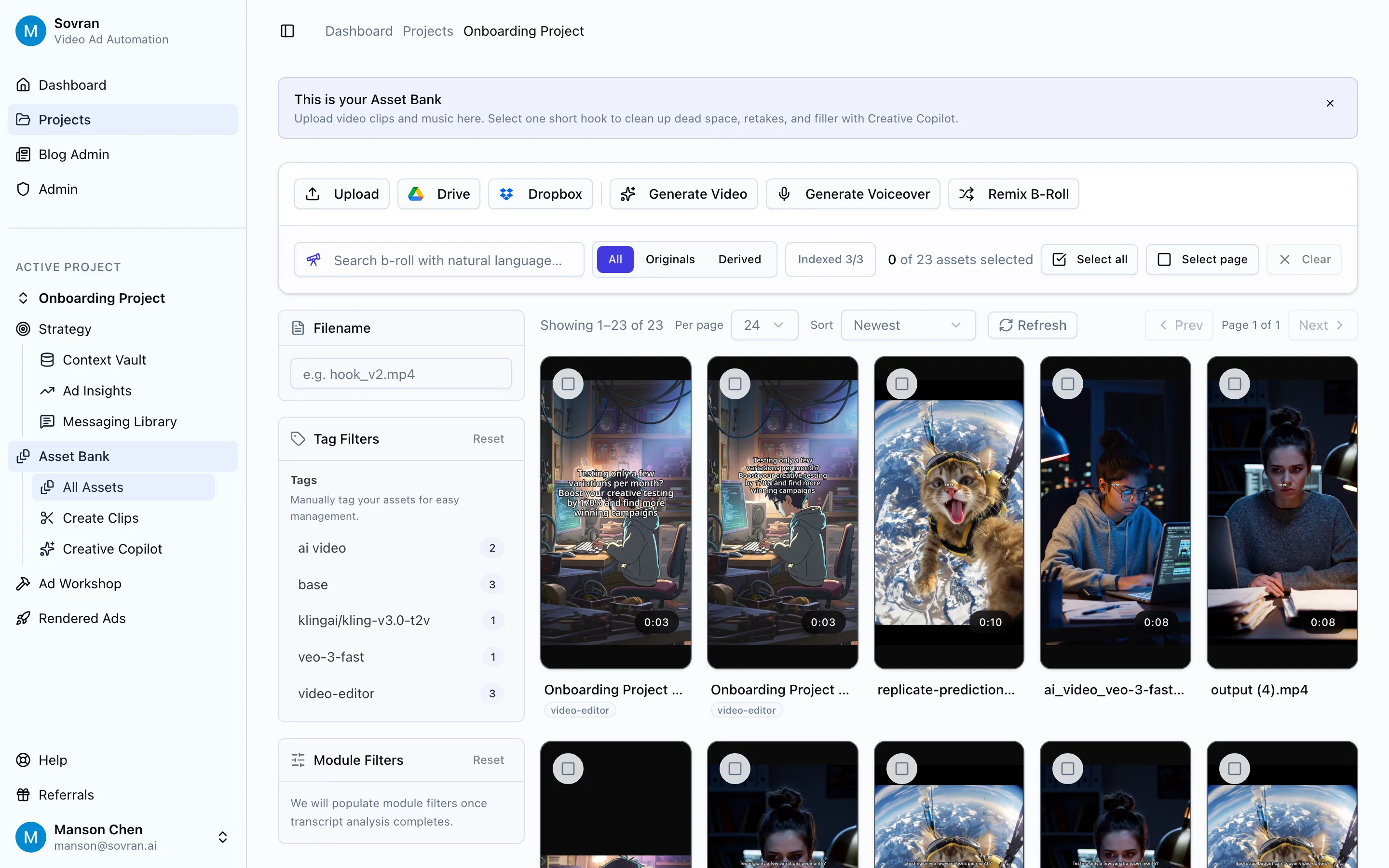
Sovran's Asset Bank gives teams a searchable place to organize reusable hooks, bodies, CTAs, product clips, testimonials, and source videos. For a bad-ad prevention workflow, the value is simple: the team can find approved material, avoid outdated creative, and stop building new ads from scattered folders or old exports.
A Better Workflow For Avoiding Bad Ads
A stronger process does not make creative bland. It gives good ideas a safer path to scale.
Use this workflow before increasing spend:
- Define the job of the ad. Decide whether the ad needs to stop the scroll, explain a product, handle an objection, introduce proof, retarget a buyer, or refresh a fatigued audience.
- Split the creative into modules. For video, separate hook, body, and CTA. For static or carousel ads, separate visual, headline, proof point, and offer.
- Review the riskiest parts first. Hooks and visuals create the fastest interpretation. Check them for cultural, legal, brand, and audience risks before polishing the rest.
- Test small before scaling. Launch controlled tests before committing serious budget. Watch not only conversion metrics but also comments, saves, shares, hides, and negative sentiment.
- Replace weak modules instead of rebuilding everything. If the body works but the hook fails, keep the body and test new hooks. If the proof works but the CTA is weak, replace the CTA.
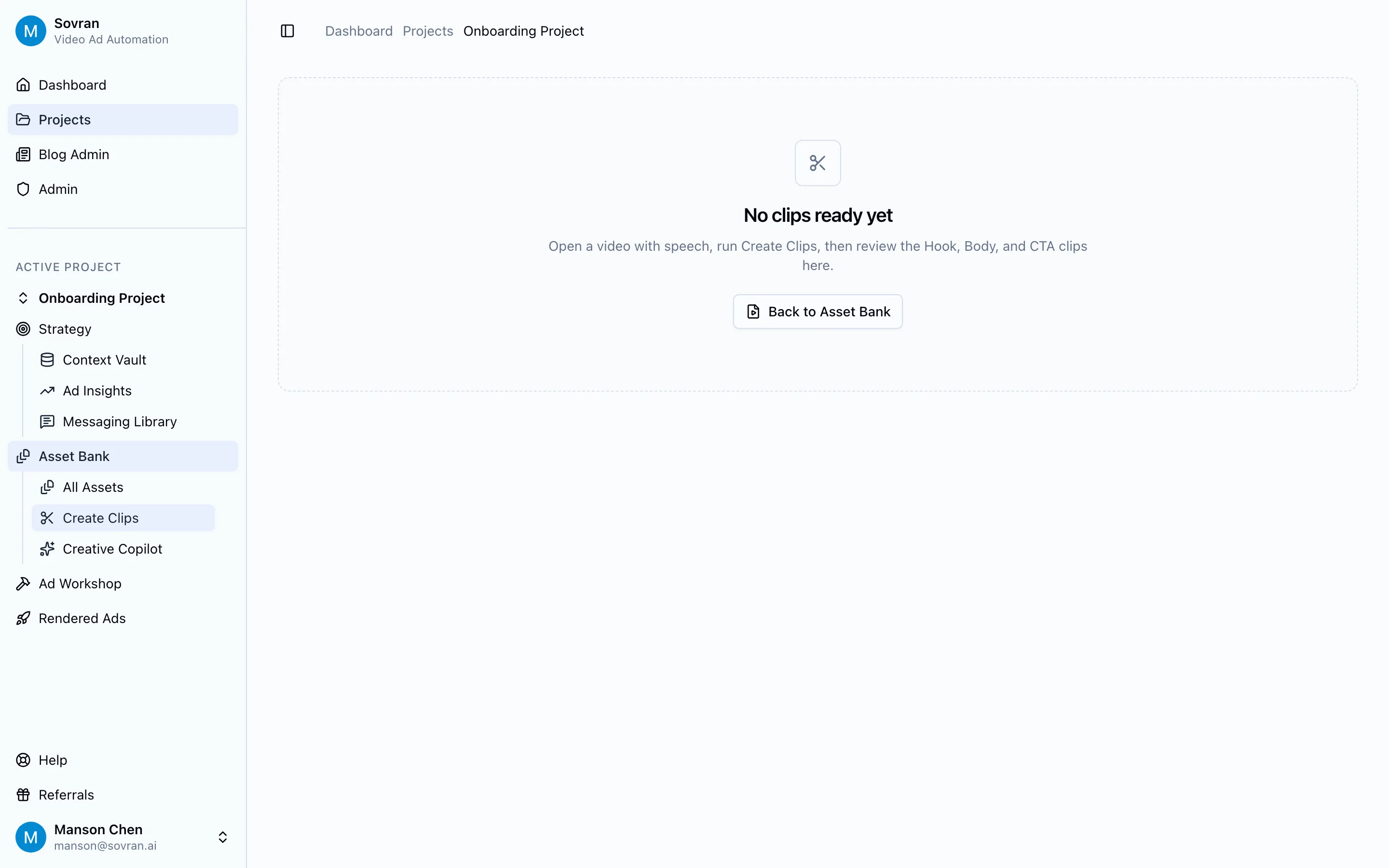
Sovran's Create Clips workflow supports that modular process by turning source videos into reviewed hook, body, and CTA segments. A team can spot weak openings, preserve useful proof, and build more variants without editing every ad from scratch.
Recommended video to include:
How to remix your video ads and get fresh variations in minutes with Sovran.ai
That workflow matters because the best defense against bad ads is not one perfect brainstorm. It is a repeatable system that creates, reviews, tests, and replaces creative before fatigue or backlash has time to compound.
What Sovran Customers Prove About Creative Testing
The most practical alternative to bad ads is more disciplined creative testing.
Dan Brosseau, Head of User Acquisition at Rewardify, said Sovran helped the team boost creative testing on its largest UA channel by 170% month over month. The key was exploring new combinations of hooks and body videos, which helped the team find new top-scaling ads and identify themes they might not have tested otherwise.
Jonathan Lee, CEO of Fuelin, said Sovran helped increase creative output and cut CAC by 40% while scaling spend efficiently.
Those proof points matter for this topic because bad ads often survive when teams do not have enough alternatives. If there are only two ads ready, the weak one keeps running. If the team can produce and review dozens of structured variants, it can replace stale or risky creative sooner.
For a deeper testing framework, read the guide to Facebook ad creative testing, then use the creative testing calculator to estimate how many variations your spend level needs.
Practical Checklist: Catch Bad Ads Before They Launch
Use this checklist before pushing a campaign from test budget to scale budget.
| Check | Question To Ask | Owner |
|---|---|---|
| Audience fit | Would the target buyer feel understood or used? | Growth lead |
| Cultural review | Could this phrase, image, or joke carry another meaning? | Diverse review panel |
| Brand fit | Does the ad strengthen trust in the brand's actual promise? | Brand/creative lead |
| Claim review | Can we prove the claim on the landing page or product page? | Legal/compliance |
| Media context | Are there placements, keywords, or moments we should exclude? | Media buyer |
| Fatigue risk | Are frequency, hook rate, hold rate, CTR, or CPA moving the wrong way? | Performance marketer |
| Replacement plan | Do we have fresh hooks, bodies, CTAs, or formats ready? | Creative producer |
Bad ads rarely appear out of nowhere. There are usually warning signs: a joke that only works in the meeting, a claim no one can prove, a visual that needs too much explanation, a placement that no one checked, or a fatigued asset that is still spending because there is no replacement.
How To Turn Bad Ad Examples Into A Stronger System
Studying bad advertising campaigns is useful only if it changes the workflow.
The goal is not to make every ad safe, generic, and forgettable. The goal is to take bigger creative swings with better controls:
- Better audience research before the concept.
- Better review before production.
- Better testing before scale.
- Better monitoring after launch.
- Better creative volume when an ad starts to fatigue.
That is the difference between learning from bad ads and merely collecting them as cautionary tales.
If your team is still editing variants one by one, digging through old exports, or guessing which hook to test next, start by fixing the production system. A modular workflow makes it easier to test more ideas, retire weak ads faster, and keep the campaign from depending on one risky creative bet.
Related resources:
- Video ad examples
- Video ad creation software
- Hook rate for Meta ads
- Video ad structure benchmarks
- Sovran's modular creative testing platform
Frequently Asked Questions
What are bad ads?
Bad ads are ads that damage trust, waste budget, or fail to move the right audience toward action. Some bad ads are offensive or tone-deaf. Others are simply unclear, stale, over-targeted, poorly timed, or based on weak creative inputs. The common pattern is a gap between what the brand intended and how the audience actually experiences the ad.
What are examples of bad advertising campaigns?
Examples include Pepsi's Kendall Jenner protest ad, Gap's 2010 logo redesign rollout, United Airlines' 2017 crisis response, H&M's "Coolest Monkey in the Jungle" product image, and Dove's body-wash ad backlash. Each failed for a different reason: cultural mismatch, poor timing, weak review processes, or a lack of audience empathy.
Why do bad ads happen?
Bad ads usually happen when teams skip audience research, rely on insulated approval processes, chase attention without brand fit, or scale creative before it has been pressure-tested. In performance marketing, bad ads can also happen when teams keep spending on fatigued creative because they do not have enough tested alternatives ready.
How do you prevent bad ads before launch?
Prevent bad ads with a clear creative review process: test concepts with diverse reviewers, run small creative tests before scaling, monitor sentiment, prepare crisis pause rules, and separate hooks, bodies, and CTAs so weak messages can be replaced quickly. The goal is to catch audience mismatch while the risk is still small.
Can a controversial ad still be effective?
Sometimes controversy can drive awareness, but it is risky when the controversy conflicts with brand trust or alienates the core buyer. A useful test is whether the ad creates productive tension around the product or just makes the brand the story for the wrong reason. If the backlash does not make the offer clearer or more credible, it is usually not worth the cost.
Fix the production system behind bad campaigns
Most campaign failures are process failures: not enough creative volume, weak testing discipline, or no clear benchmark for what good looks like.
Calculate Your Creative Testing Gap
Estimate when your ads will fatigue and how many new creatives you need each month to avoid stale campaigns.
Measure the gap- BenchmarkRead the benchmark
See what winning ad structure looks like
Use first-party benchmark data to compare strong narrative sequences against the patterns that underperform.
- Bottom funnelSee comparisons
Compare better production workflows
Research alternative creative-production tools and what each workflow is actually good at.
- Revenue lensRun the ROAS calc
Quantify the performance impact in dollars
Use your current spend and revenue to understand how much underperforming creative is really costing you.
Frequently asked questions

Manson Chen
Founder, Sovran
Related Articles

Your Video Ad Iteration Strategy: A 2026 Playbook
- video ad iteration strategy
- creative testing
- 3 more
8 Best Hooks for Video Ads That Convert in 2026
- best hooks for video ads
- video ad hooks
- 3 more
Customer Journey Mapping for Performance Marketing
- customer journey mapping
- performance marketing
- 3 more